
A Data-Driven Temporal Framework for Water Consumption Monitoring with Spatial Visualization Using K-Means and STL-LSTM
Journal: International Journal of Image, Graphics and Signal Processing @ijigsp
Article in issue: 2 vol.18, 2026.
Free access
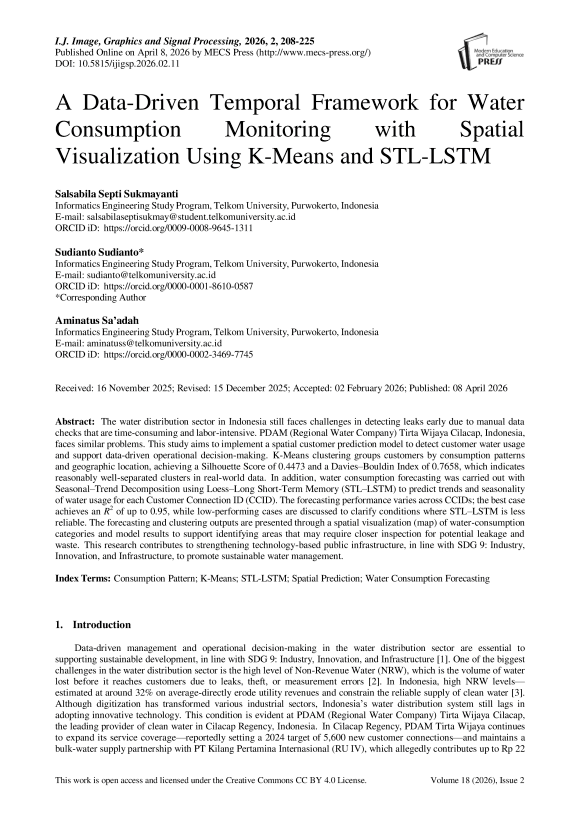
The water distribution sector in Indonesia still faces challenges in detecting leaks early due to manual data checks that are time-consuming and labor-intensive. PDAM (Regional Water Company) Tirta Wijaya Cilacap, Indonesia, faces similar problems. This study aims to implement a spatial customer prediction model to detect customer water usage and support data-driven operational decision-making. K-Means clustering groups customers by consumption patterns and geographic location, achieving a Silhouette Score of 0.4473 and a Davies–Bouldin Index of 0.7658, which indicates reasonably well-separated clusters in real-world data. In addition, water consumption forecasting was carried out with Seasonal–Trend Decomposition using Loess–Long Short-Term Memory (STL–LSTM) to predict trends and seasonality of water usage for each Customer Connection ID (CCID). The forecasting performance varies across CCIDs; the best case achieves an R2 of up to 0.95, while low-performing cases are discussed to clarify conditions where STL–LSTM is less reliable. The forecasting and clustering outputs are presented through a spatial visualization (map) of water-consumption categories and model results to support identifying areas that may require closer inspection for potential leakage and waste. This research contributes to strengthening technology-based public infrastructure, in line with SDG 9: Industry, Innovation, and Infrastructure, to promote sustainable water management.
Similar articles in the section Public health engineering. Water. Sanitation. Illuminating engineering
Short address: https://sciup.org/15020312
IDS: 15020312 | DOI: 10.5815/ijigsp.2026.02.11
