
A Lightweight Framework Using Signcryption Based Key Agreement Scheme with Location Privacy for D2D Communications in 5G VANETs
Journal: International Journal of Computer Network and Information Security @ijcnis
Article in issue: 2 vol.18, 2026.
Free access
Device-to-Device (D2D) communications in 5G enabled vanet Networks offer significant advantages in terms of improved communication efficiency and reduced latency. However, ensuring secure and efficient key agreement among devices remains a critical challenge. In this study, we present a novel lightweight framework for D2D communications that addresses these concerns by employing a Signcryption-based key agreement scheme [1]. The proposed scheme is built on the foundation of Diffie-Hellman Hyper Elliptic Curve Cryptography and leverages two one-way cryptographic hash functions to enhance security. By integrating the signcryption technique, our framework achieves a seamless combination of encryption and signing [2], reducing computational overhead and conserving network resources in resource-constrained 5G-enabled devices. Furthermore, we prioritize user location privacy in our framework by employing advanced techniques, including the Chinese Remainder Theorem. This ensures that location information is protected and not exposed to unauthorized parties during D2D communication sessions. Through extensive simulations and performance evaluations using ns3, we demonstrate the effectiveness and efficiency of our proposed key agreement scheme for D2D communications in 5G enabled vanet Networks. The results show improved communication performance and reduced resource consumption, making our framework a promising solution for secure and efficient D2D interactions in the context of evolving 5G networks.
Similar articles in the section Electrical engineering
Short address: https://sciup.org/15020297
IDS: 15020297 | DOI: 10.5815/ijcnis.2026.02.10
Text of the scientific article A Lightweight Framework Using Signcryption Based Key Agreement Scheme with Location Privacy for D2D Communications in 5G VANETs
Vehicular Ad-Hoc Networks (VANETs) are a type of network that allows vehicles to communicate with each other and with roadside infrastructure. These networks are an essential part of the vision for future intelligent transportation systems (ITS). VANETs use wireless communication technologies such as Dedicated Short-Range Communication (DSRC) or Cellular-Vehicle-to-Everything (C-V2X) to enable vehicles to exchange information in real-time. Vehicles in a VANET communicate to share information about road conditions, traffic congestion, accidents, weather conditions, and other relevant data that helps drivers make informed decisions and improves overall road safety by enabling collision avoidance and warning systems. Vehicular Ad-Hoc Networks (VANETs) can be categorized into different types based on their applications, communication modes, and operational environments. Some most common types of VANETs are Vehicle-to-Vehicle (V2V), Vehicle-to-Network (V2N), Vehicle-to-Pedestrian (V2P), Vehicle-to-Infrastructure (V2I), Vehicle-to-Everything (V2X). The choice of VANET type depends on the application requirements, environmental conditions, and infrastructure availability in a particular deployment scenario. However, VANETs also face challenges such as ensuring robust security and privacy, managing network scalability, and addressing communication reliability in diverse traffic conditions.
Security in Vehicular Ad-Hoc Networks (VANETs) is crucial due to the sensitive nature of the data exchanged and the potential impact of security breaches on road safety and operational efficiency. The key aspects and challenges of security in VANETs include Authentication and Access Control, Data Integrity, Privacy Preservation, Secure Communication, Trust Management, Resilience to Attacks, Secure Vehicle-to-Infrastructure (V2I) Communication, Update and Patch Management, Legal and Regulatory Frameworks. Overall, securing VANETs requires a comprehensive approach that integrates cryptographic techniques, secure protocols, trust management, privacy preservation, and resilience to attacks. Addressing these security challenges is crucial to realizing the full potential of VANETs in enhancing road safety and transportation efficiency.
Device to Device (D2D) Communication is a crucial technology in VANETs that allows the vehicles to communicate directly without any infrastructure like base station or access points in between and is used to enhance communication efficiency, connectivity and reliability. However, D2D can also be in connection with centralized network as is the case of V2X shown in Fig.1.
With the advent of technology and need for faster communication in high mobility networks, D2D in 5G VANETs leverages communication cost and computational cost bypassing the centralized network infrastructure by efficient spectrum utilization through Resource Reuse and localized data processing. D2D in 5G VANETs also support computation offloading and computational workload sharing for V2V interactions. However, the security concerns should be addressed to ensure confidentiality and integrity of data. Signcryption technique helps in ensuring the message authentication and prevents unauthorized modification by third party while maintaining the confidentiality. Secure Signcryption schemes like Ring, blockchain based, certificateless, conditional privacy preserving, multimode and quantum resistant signcryption are a work under research. Based on the existing studies and experimental works available it is suggested to secure the communication with a proper key agreement protocol that can mutually authenticate the vehicles and mitigate the possible attacks.
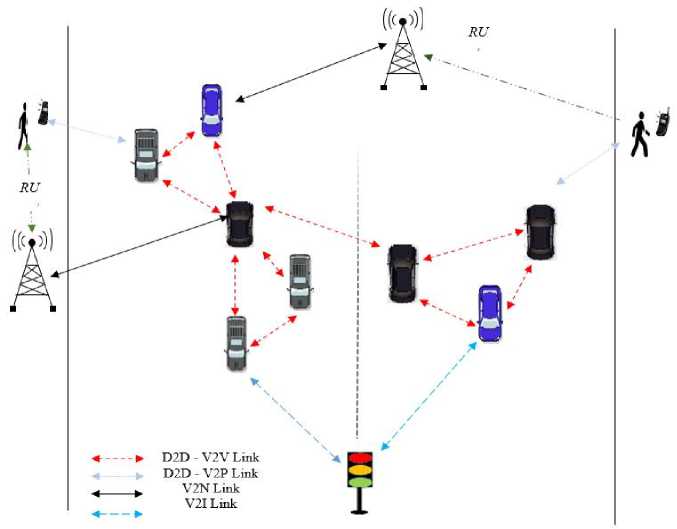
Fig.1. V2X Architecture
2. Research Motivation
The various types of VANETs and the security challenges for ensuring data integrity and confidentiality is discussed in the introduction. Existing works on addressing these challenges incur either high latency or lack forward secrecy or privacy location etc. Earlier works has also not addressed the trade-off between light weight crypto-algorithms and multiattack resilience in a network. Also, it is observed that none of the research is based on D2D communication where information is shared quickly and securely. Signcryption technique addresses these challenges and is a best solution for securing the communication in VANETs. A comprehensive survey of the various existing key agreement schemes based on signcryption technique (mostly with elliptic curves [3]) for security implementation in VANETs is listed in Table 1. These techniques are mostly used with mutual authentication [4]. Majority of the work is done on certificateless Signcryption technique for different type of 5G VANETs. The simulation / Threat model, Random Oracle is proven to be good for evaluating signcryption schemes [5]. The main limitation of certificateless signcryption is when the key generation center that holds the key to decrypt and sign is compromised. Also, this technique is based on ECC which is vulnerable as well as provides larger computational costs and delays due to its large key size. To avoid this, a certificate based signcryption is suggested that can use HECC. It is observed that there is no work currently available on certificate based Signcryption except for [6], where Gomathi et al., has implemented certificate based Signcryption on cluster based VANETs without D2D pairs and with a limited packet size of 512 bytes and limited to smaller network size.
Table 1. Comprehensive literature survey
|
Sch eme |
Year |
Mechanism / Technology / Protocol |
Simulati on / Threat Model / Topolog y |
Sim. Tool / Libra ry |
Network Support |
D2D Supp ort |
Key Agreement Protocol |
Advantage |
Limitation |
|
[5] |
2013 |
Identity based Signcryption |
Random Oracle Model |
- |
No |
No |
Authenticate d Group Key |
Optimal communication complexity, Authentication, Integrity & Confidentiality, Communication Efficiency and Computational Cost |
Support for multiple recipients, Batch verification of signatures, Limited to small groups, Less secure to Collusion attacks |
|
[6] |
2024 |
Authentication & Trust based clustering |
Guindy Kathipara Map OSM |
Netw ork Simul ator with SUM O |
5G enabled VANETs |
Yes |
Diffie Hellman Hyper Elliptic Curve Cryptograph y and Cryptograph ic Hash Functions |
Increased Packet Delivery Ratio, Authentication & Integrity, Cluster based |
System Complexity that increases latency, Scalability Issues, Security Trade-offs in dynamic environments, Less secure to Sybil and bad-mouthing attacks |
|
[7] |
2023 |
Unlinkable Signcryption |
MultiReceiver (USS -MR) |
Netw ork Simul ator with SUM O |
Multireceiver VANETs |
No |
Elliptic Curve Cryptograph y and Chinese Reminder Theorem |
Authentication, Integrity, Confidentiality, Conditional Privacy Preservation, Anonymity, Traceability, Revocability |
Scale multiplication on ECC, Increased Computational & Communication Overhead, Reduced Reliability due to dynamic nature of VANETs, Less secure to Colluding & replay attacks |
|
[8] |
2023 |
Challenge Authentication Handshake |
Random Oracle Model |
MIRA CL Librar y & PBC Librar y |
VANETs |
No |
Key agreement based on Fuzzy Extractor and Schnorr Signature |
Mutual Authentication, Forward Security, Dynamic Management |
Vulnerability to insider attacks, Balance between Anonymity & Traceability, Less secure to Collusion and Sybil attacks |
|
[9] |
2020 |
Certificateless Key -Encapsulated Signcryption |
Dolev-Yao |
AVIS PA |
FANETs |
Yes |
Hyper Elliptic Curve Cryptograph y |
Confidentiality, Unforgeability, Integrity, Computational Cost, Communication Efficiency |
Resourced Constrained, Applicable only for FANETs, Less Secure to Forward Secrecy & Replay Attacks |
|
[10] |
2020 |
Group Signature |
5G enabled VANET |
MIRA CL Librar y & PBC Librar y |
5G enabled VANETs |
Yes |
Group Signature with a Pre Computed Lookup Table for modular exponentiati on operation |
Privacy Preservation, Reduced authentication overhead, Higher Service Capabilities, Anonymity, Robustness to network failures |
Storage, Possible redundancy in local group signature, Increased dependency on infrastructure, Less secure to Man-In-The-Middle attacks |
|
[11] |
2021 |
Group Authentication |
Chaotic Mapping in 5G |
Scyth er |
5G VANETs |
No |
Chinese Reminder Theorem |
Anonymity, Unlinkability, Reduced Computational & Communication overhead, Faster Authentication, Enhanced Privacy |
Possible Single point of failure in group authentication, Vulnerable to Quantum Computing and Side-Channel Attacks, Privacy issues, Vulnerable to Insider attacks |
|
[12] |
2022 |
Provable security with single and batch signature verification |
Random Oracle Model |
Netw ork Simul ator with SUM O |
5G VANET s |
Yes |
Elliptic Curve Cryptograph y and Chinese Reminder Theorem |
No dependency on Infrastructure, Integrity, Confidentiality, Optimized bandwidth and faster Communication, Anonymity |
Resource intensive mathematical operations, Decentralized communication, Key Revocation delays, Trust Issues between vehicles, Vulnerable to sybil attacks |
|
[13] |
2022 |
Certificateless Signcryption based on Elliptic Curve Digital Signature |
Random Oracle Model |
MIRA CL Librar y |
Internet of Vehicles in 5G |
Yes |
Elliptic Curve Digital Signature Cryptograph y |
Confidentiality, Unforgeability, Forward Security, Anonymity |
Pseudonym Management, Key Management overhead, Limited to single cipher text examination, Security assumptions |
|
[14] |
2021 |
Anonymous Certificateless Signcryption |
Random Oracle Model |
MIRA CL Librar y |
Internet of Vehicles in VANET s using 5G Cellular |
No |
Hyper Elliptic Curve Cryptograph y |
Confidentiality, Unforgeability, Receiver Anonymity, Reduced Computational & Communication Costs |
Need for Secure channel to share partial private keys, Need for Key Generation Centre, Vulnerable to MITM, DOS & Replay attacks |
|
[15] |
2023 |
Certificateless Authentication |
Dolev-Yao |
AVIS PA |
5G assisted vehicula r N/W |
Yes |
Elliptic Curve Cryptograph y |
Authenticity & Integrity, Confidentiality, Pseudonym Identity, Privacy |
Computational Complexity, Key Revocation / update challenges, Trust issues, Latency in signcryption & key verification |
|
[16] |
2021 |
Light Weight D2D Authentication |
3GPP 5G Network Scyther Tool with Burrows-Abadi-Needham Logic |
Bounc t Castle v1.64 with Java SDK 13.0.1 |
5G Cellular |
Yes |
HMAC (Hash based Message Authenticati on Code) with Elliptic Curve Diffie-Hellman |
Mutual Authentication, Traceability, Anonymity, Low Transmission Overhead & Computation Cost |
Single Point of Failure of network, Trade-Off between Traceability & Privacy, Increased Computational overhead, Interoperability issues |
|
[17] |
2022 |
Trusted Blockchain based Signcryption |
TB-SCDM using CRUD interface supplied by FISCO BCOS 2.0 |
FISC O BCOS 2.0 |
VANET s |
No |
Block Hash & Signcryptio n based on Schnorr (Provable Security) |
Identity Authentication, Confidentiality, Unforgeability |
High Computational & Storage requirements, Scalability issues, Latency, Blockchain forking and Consensus issues, Increased communication overhead |
|
[18] |
2016 |
ID-based Signcryption using bilinear pairing |
Standard Model without Random Oracle Model |
No |
No |
Computatio nal Diffie-Hellman |
Reduced Computational Cost, Confidentiality & Integrity, Unforgeability |
Not effective when Confidentiality and authenticity are required together, Lack of forward secrecy, OverReliability on Trusted Authority |
|
|
[19] |
2022 |
HECC based IIOT Certificateless Signcryption |
Real or Random Model with Dolev-Yao |
AVIS PA |
IIOT (Low Speed VANET ) |
No |
Hyper Elliptic Curve Cryptograph y |
Mutual Authentication, Confidentiality, Integrity & NonRepudiation, Reduced Communication Overhead |
Key distribution and initial setup, Vulnerability to DOS attacks, Key Revocation and Management, Complex key management |
It is observed that in certificateless Signcryption key computation time and authentication delay is high for most times with limited privacy. Also, existing protocols address only a subset of these problems but fails to have a comprehensive solution tailored for real-time 5G D2D VANET scenarios. This work SPARK, is a light weight framework based on certificate based signcryption with an enhanced key agreement that addresses the above problem and ensures mutual authentication, multi-attack resilience and location privacy and is optimized for real-time D2D communication in 5G D2D VANETs.
3. Proposed Work
Major efforts were put by the researchers to tackle the security and data processing issues in the 5G enabled D2D VANETs for secure communications. It was observed that majority of the flaws are because of the methodology adopted which resulted in high communication and processing costs due to modular exponentiation. As a result, these designs were not able to resist privileged insider attacks, impersonation and TA spoofing attacks thereby compromising privacy and anonymity. This in turn has resulted in security and performance imbalance. The main objective of this work is to create an efficient key agreement scheme based on signcryption and employs HECC and two one way cryptographic hash functions. HECC uses shorter key size compared to ECC (Elliptic Curve Cryptography) and results in lower computational head in a highly mobile and bandwidth constrained VANET environment (Eg. 160 bit ECC Key ≈ 80 bit HECC Key). Chinese Reminder Theorem is used to optimize the modular arithmetic operations involved in signature verification (reduced by ~40%) and hence reduces the computational cost and complexity. In this process, Chinese reminder theorem is used to secure the location privacy of the vehicle. The main contributions of this paper are as follows.
-
• We bring optimal scheme which is certificate based signcryption scheme for authentication and key agreement between and vehicle and RSU / TA. Here each vehicle is equipped with the signcryption module. The process includes
-
(a) Certificate Issuance – by the TA
-
(b) Signcryption Process – with message sent over the 5G network
-
(c) Decryption and Verification - by the recipient
• We implement our proposed system using ns3 simulation tool and provide the performance analysis of our system with existing systems to show that the communication and computational costs are reduced.
4. Implementation Methodology
The use of Certificate based Signcryption scheme guarantees data confidentiality, integrity and authenticity and the certificates generated are useful in preventing Man-in-the-Middle (MITM) and Replay attacks.
The work is compared with [11] and [16,17] that provide state of the art light weight and privacy aware key agreement mechanisms for VANET with 5G support and mostly addresses the critical security dimensions like mutual authentication, Forward Secrecy, resistance to DOS attacks etc. Other schemes fall outside the scope of this work and do not address location privacy, signcryption, light weight structure simultaneously which are core of this work and lack direct applicability to D2D based 5G VANETs. The basic notation and terminology used is given in Table 2.
Table 2. Notations/Terminology
|
Notation |
Meaning |
|
TA |
Trusted Authority |
|
RU |
Road Side Unit |
|
D |
Vehicle |
|
HEC |
Hyper Elliptic Curve |
|
D V k & D psk |
Private and Public Keys of Vehicle |
|
H a & H b |
Hash Functions |
|
Y pk |
Public Key of the TA |
|
RU t |
Road Side Unit Identification |
|
Cert RU . |
Certificate for RU t |
|
D n |
Vehicle ID |
|
Ω |
Key received from RU t |
|
J |
Divisor in HEC |
|
ф & о i |
Random number chosen from a set |
|
SG t |
Signature generated |
|
once |
Time Stamp generated as Random or Pseudo Random number and used once |
|
^ ds |
Session Key |
|
^ u |
Registration Phase Secret Key |
The proposed architecture is comprised of three components: TA, D and RU. Each participant must first register with TA before being assigned to a practical activity. We assume that the TA is a fully trusted participant which may be a potential vulnerability as it introduces single point failure caused by DOS attacks and other potential risks of impersonation, internal threats and location privacy. To address these, we used forward security where we refresh the session keys periodically and zero knowledge proof where the TA can issue the keys without the knowledge of its actual content enhancing privacy. Also, it was assured that TA doesn’t generate all the keys but allows D/RU to generate their own private keys. D and RU are considered partially trusted. D is the most important component of the entire structure. When necessary, RU can access a specified D from anywhere, for example, to check on a large city's infrastructure, such as traffic surveillance and sidewalk monitoring, etc. TA has complete control over the transmission zone, vehicle validity, and external user data access. Similarly, the TA can be in charge of "Who has access to whom," and the entry of an unauthorized vehicle or user at any moment, as well as trajectory, waypoint, and data communication, is the exclusive responsibility of the TA related occurrence. Our proposed work consists of five steps
-
• Setup phase
-
• Registration Phase – RU & D
-
• Key Agreement Phase - Between RU , D & TA
-
• Update Phase – New Joining and Cancellation of Failed vehicles
-
• Location Privacy
-
• Setup phase: This Phase is initialized by the TA that creates Public and Private Keys. The Private Key, Dpk is selected by using HEC that considers a finite field Fg with g > 1 (we considered a genus 2) [20]. The divisor J of hyper elliptic curve (also called Jacobian of HEC) is the finite points sum that is given as FplEHECm i P i , here m , E Fg and(p, ai E [1,2,3, ..(c — 1)] [10]. The Public Key of TA (Ypk) given as (p.J is generated. Two hash functions Ha and Hb are chosen for signature generation and encryption key derivation respectively. To complete signcryption process using HEC, the public parameters are published for use by all the parties involved and is given as
K=[Fg,HEC,J,Ypk,Ha,Hb](1)
-
• Registration Phase – RU and D : The registration of RU and D are handled by TA themselves. In the process of registering the RSU , the TA first allocates an ID for the RU , RU , and computes its Private Key and Public Key as shown in equations (2) and (3) respectively.
RUpsk = RUpk.J(3)
The certificate for RU [ is calculated as (4)
certRm = Ypk +(RUpk)Ha(RUt\\RUpSk)(4)
To track the exact location of the vehicles IDn, TA provides a secret key wu E [1,2,3,... (c — 1)] to the RU , . Finally, TA will update memory of RU , as(RU , , cert , , RUpk, RUpsk). Once the registration of RU is completed, the TA will initiate the registration of vehicle asDn . The Public and Private keys are computed in the similar way as for RU and in shown in equations (5) and (6).
Dpk = P. Ha(Dn)mod c(5)
DpSk = Dpk.J(6)
The certificate for Dn is calculated as (7)
certDi = DpSk + (Dpk)Ha(Dn\\DpSk)(7)
Finally, TA will update memory of Dn as(Dn, certDi, Dpk, Dpsk).
-
• Key Agreement Phase - Between RU, D & TA : When two vehicles, say, Dns and Dnr wants to communicate, a key agreement should be available. For this purpose, we used a key agreement phase among RU, D & TA . Initially we generated a certificate for signature and transmitted the key from RU , to Dns . First a Public Key £i = a^J is generated and the corresponding Private key («0 is generated as sb RUt.Dpsk . Then we encrypted the message from RU , with a timestamp produced as Nonce (Д , ) as RUai(RU i \\Nonce i ). The certificate and corresponding signature are then generated as
CertRUi2D = certDl + Hb(message\\RUl\\Noncel)(8)
SGt = (-----^-----RUt} mod c(9)
-
1 CertRui2D+RUpk
The Signcrypted key from RU1 is sent to Dnr as
^1 = (SGi, CertRui2D, Ai, £1, «1)(10)
Once Dnr receives ^ 1 from the RU1 , its validity is checked by verifying the Time Stamp Noncel after decryption and CertRUl2D and signature are verified using the following conditions
Ypk + (RUpsk)Ha(Dns\\Dpsk) = certDi.J(11)
SGi(Dpsk + CertRU12D. Vi-j)=Dns.£i.Dpk(12)
If signature is valid, £l and SG1 are recalculated using equation (9) with RU1 replaced by Dns and the later part multiplied by o1 . The session key (^l) will updated as olsl in Dns . The relation of Nonce with session key is obtained from
Ai= RUads(Noncens\\Noncens)(13)
The session shared with Dns is
$ns = Hb(message\\Dns\\Noncens\\dl)(14)
and can be verified as
Hdns = Hb(N^ncel\\dl)(15)
This key is sent as
^2 = (HdnS,NoncenS,£i,DnS,RUpk,CertRui2D^(16)
to the TA through RUl through Unsigncryption. The TA decrypts the key and verifies freshness of the Noncens . The certificate of Dns is verified using equation (11) and signature validation is done using (12). The certificate is computed as
SGta= CertTA + Hb(message\\Dnr\\NonceTA\\TA)(17)
The session key for TA is updated in the similar way as for RUl and sends the key as
^3 = (H^TA,N^nceTA,£l,Dnr,RUpk,SGTA)(18)
to Dnr . The Dnr then decrypts the key and checks the freshness of NonceTA to send the data to RU i . It then verifies the Dns (source vehicle) certificate and signature through
Y pk + Ynrpk. Ha (TA\\Y nrpk ) = cer tnr.J
SGnr(Ynr + CertD2RUl.J) Dnr.£nr. Dnrpk
Once verified, the session key needs to be updated in a similar process as for TA and RU l . The relation used is
$
*
and verified as
Н^агтл = Hb (NoncenrTA 11 d^A)(22)
The session key is sent as
^4 = (ЛагтА,Н^агтА)(23)
to RUt . Finally, when the RU i receives Щ and decrypted for checking the freshness of the Nonce using
(messa5e||Bns||SUi||Woncejyi2D) = Da(^RUl2D)(24)
It is observed that the freshness Nonce is new and calculates
H^RUt2D = ^b(^onceRUl2Dll^RUl2D)
Then it checks the relation ^ R* Ui2D is true or false (H-d R* Ui2D = Hd R UtD). The following equivalence can be verified as well (H^R U12D = H$ RU12D ).
-
• Update Phase – New Joining and Cancellation of Failed vehicles: In Vanet scenario, vehicles have a high mobility and will be either entering or leaving the network area. The procedure for adding or removing a vehicle is handled by the TA . Once a new vehicle enters into the network the TA identifies it as Dnew and computes its private and public keys in the same way as registration and generation of certificates of vehicles as shown in equations (5) to (7) and are shown as below
Dnewpk ^. Ha(Dn)mod C (26)
The certificate for Dnew is calculated just as for equation (7) and given as
CertDnewi
^ pk + ( Dnewpk)Ha(Dnew
| IDnewpsk )
Finally, TA will update memory of Dnew as (Dnew,certDnewi,Dnewpk,Dnewpsk) . Similarly, when some of the vehicles are leaving the network, their information has to be removed from the memory.
Ddelete
Ha (Ddelete | |D pskdelete | |^^)
The same remedy will be consider when a vehicle is compromised due to the attack by hackers or when the data has to be safeguarded in the RU .
-
• Location Privacy: In case of failure of a vehicle, Dns or Dnr due to loss of energy or external issues, it will be replaced by RUi . Prior to that the real location GCD of Dns ^ atlor Dnr f ail will be by RUi . To provide privacy of the location, we need to know Latitude Q u ), longitude (d), and altitude ( t ). For providing privacy to GCst the following steps of Chinese Remainder Theorem [21] is used.
Calculate Ri for each wt using Kt = wu/ut(30)
Define Congruence with ^iMi = 1 mod ш1(31)
Vt = Kt^(32)
h = XUi(33)
F = h*^(34)
Here ^ indicates Fnc(^||0||r) that suggests it is an encrypted value.
After the above process, final value of F will be shared to the RUt . In the registration phase, secret key ши is given to RUt , that will calculate ^ using equationF mod at . While decrypting ^ with the help of TA public key,RUt can retrieve the coordinates of the vehicles.
5. Simulation Results
The Proposed design is implemented with NS 3.26. Here we have chosen 5G enabled LTE package in NS3 to create the 5G network and enabled D2D communication features over the LTE package. The simulation parameters and the various libraries used in the design are mentioned in Table 3. To bring security into NS3 we linked Open SSL and libHEC packages. For realistic vehicular mobility simulation with utmost accuracy SUMO is the best choice when integrated with network simulator to generate the required topology. SUMO allows for Online and Offline Communication for real-time road traffic scenarios [22]. The system is implemented on Intel ® Core ™ i7-7700 @ 3.6GHz with 32 GB RAM.
To validate SPARK’s practical feasibility, key performance metrics of authentication delay, communication overhead and computational cost are benchmarked using NS3 simulation and observed that SPARK outperforms [11], [16,17] in terms of speed while maintaining robust security.
Table 3. Simulation parameters
|
Parameter |
Value |
|
Simulation Area (Sq.m) |
5000 x 5000 |
|
Simulation Time (Sec) |
600 |
|
Topology |
Highway |
|
Number of D2D Pairs |
50, 100, 150, 200 |
|
Speed of vehicles (Km/h) |
30 |
|
Packet Size |
1024 |
|
Propagation Model |
Long Distance Propagation loss |
|
Routing Protocol |
AODV |
|
Frequency and Bandwidth |
28GHz and 100 MHz |
|
Traffic Type |
CBR & UDP |
|
Hash Algorithm |
SHA-256 |
|
Modules used |
Antenna, Config store, Mobility, Flow Monitor, LTE and Internet |
|
External libraries used |
NFL library, OpenSSL and Crypto++ |
|
SUMO version |
1.19.0 |
The graphs Fig.2. to Fig.4. display the authentication delay, communication overhead and computational cost parameters that are evaluated using the proposed algorithm – SPARK and compared with results of HDMA [11], ECA-VFOG [16] and LT – AKA [17] that are certificate less based methods. The performance is analyzed over the number of D2D pairs used in the environment. Under practical conditions, those maximum numbers of D2D pairs that can be sustained while using each of these algorithms are 150, 120 and 180 for [11], [16] and [17] respectively. However, SPARK can sustain up to 200 pairs. The authentication delay refers to the total delay experienced when Dnr verifies the identity and authenticity of Dns & RU . From Fig.2., it is observed that as the number of D2D pairs is 50, SPARK faster compared to ECA – VFOG by 2.01 times, 1.67 times compared to HDMA and 3.48 times compared to LT – AKA. The number of nodes are taken as multiples of 50 and up to a maximum of 200 pairs. It is observed that SPARK performs 3.47, 3.78 and 2.74 times faster compared with ECA – VFOG and 1.95, 2.12 and 1.96 times faster compared to HDMA and 4.53, 4.13 and 3.15 times faster compared to LT – AKA. The Communication overhead refers to the additional bits along with the original message communicated from Dns to Dnr and includes certificates, keys and signcryption headers . A minimal communication overhead is very critical in ensuring effective bandwidth utilization and reduced latency for ensuring safety in high mobility environments. From Fig.3., it can be observed that the communication overhead is decreased for SPARK by 1.63, 1.42 and 2.08 times of ECA – VFOG, HDMA and LT – AKA for 50 D2D pairs. When the number of D2D pairs are increased to 100, the same is improved for SPARK by 1.83, 1.67 and 2.73 times, for 150 D2D Pairs it is improved by 1.58, 1.46 and 2.68 times and for 200 D2D pairs it is improved by 1.73, 1.28 and 2.66 times compared with ECA - VFOG, HDMA and LT – AKA. The computational cost is the total time taken for Key management, Certificate verification, Signcryption and Unsigncryption with cryptographic operations for encryption and decryption. From Fig.4., it is observed that the Computational cost of SPARK is only 13.25, 17.99, 10.51 % of the time taken in milli-seconds by ECA - VFOG, HDMA and LT – AKA respectively for 50 D2D pairs. Similarly, the computational cost of SPARK consumes 13.23, 20.64 and 10.59 % of the time for 100 D2D Pairs, 20.56, 27.22 and 17.87% of the time for 150 D2D Pairs and 25.86, 32.69 and 22.93% of the time for 200 D2D Pairs of ECA - VFOG, HDMA and LT – AKA. There is a huge improvement in the computational cost compared to other algorithms. The SPARK algorithm is compared with [11] and [16,17] in terms of authentication delay, communication overhead and computational cost and tabulated in Table 4., Table 5. and Table 6. respectively. It can be observed that SPARK has a clear edge over the other algorithms with respect to the above mentioned parameters.
Fig.2. Authentication delay analysis
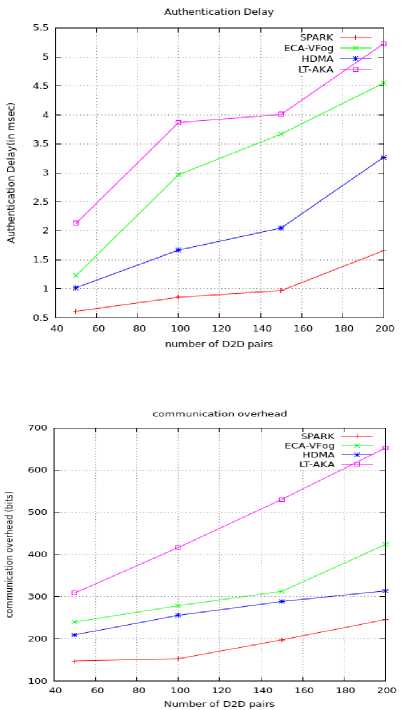
Fig.3. Performance analysis of communication overhead
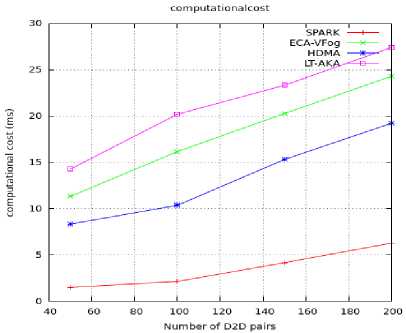
Fig.4. Computational cost analysis
Table 4. Comparison of authentication delay (in ms) for various D2D Pairs with specific quantitative benchmarks
|
No. of D2D Pairs |
LT-AKA [11] |
ECA-VFOG [16] |
HDMA [17] |
SPARK (Proposed) |
|
50 |
2.13 |
1.23 |
1.02 |
0.612 |
|
100 |
3.87 |
2.97 |
4.29 |
0.856 |
|
150 |
4.01 |
3.67 |
5.81 |
0.97 |
|
200 |
5.23 |
4.55 |
6.14 |
1.66 |
Table 5. Comparison of communication overhead (in bits) for various D2D Pairs with specific quantitative benchmarks
|
No. of D2D Pairs |
LT-AKA [11] |
ECA-VFOG [16] |
HDMA [17] |
SPARK (Proposed) |
|
50 |
309 |
240 |
210 |
148 |
|
100 |
417 |
279 |
256 |
153 |
|
150 |
531 |
313 |
289 |
198 |
|
200 |
653 |
424 |
314 |
246 |
Table 6. Comparison of computational cost (in ms) for various D2D Pairs with specific quantitative benchmarks
|
No. of D2D Pairs |
LT-AKA [11] |
ECA-VFOG [16] |
HDMA [17] |
SPARK (Proposed) |
|
50 |
14.28 |
11.32 |
8.34 |
1.5 |
|
100 |
20.21 |
16.18 |
10.37 |
2.14 |
|
150 |
23.34 |
20.28 |
15.32 |
4.17 |
|
200 |
27.43 |
24.32 |
19.24 |
6.29 |
6. Security Analysis
Forward Secrecy : In SPARK, the session key is updated in the private keys of Dns , RUt and Dns and is difficult for the malicious vehicles to find this value because of HECDH. As all the session keys are locally generated, unauthorized vehicles will not be able to read or use the messages and hence this scheme ensures forward secrecy.
Man-in-the-Middle Attack : SPARK strengthens MITM attacks by ensuring mutual authentication, encrypting communications, establishing secure session keys, and integrating with 5G’s network slicing capabilities. HECDH assures mutual authentication using valid certificates issued by TA . Signcryption ensures that the data remains private while verifying the source. Also, since every message is to be signed and verified, any changes to this would invalidate the signature. Dynamic session key generation helps in the cause.
We considered ‘I’ that aims to modify message ‘^1’ that is forwarded between vehicles ‘Da ’ and ‘Db ’. ‘^1’ includes several factors of message! = (Noncea,^a,^a,3a,£a,Certa)(35)
To be effective in the malevolent effort, ‘I’ should determine ‘Aa ’ and ‘Noncea ’:
△a = (Certa + h(Da\\Certa\\6a\\RUpk)(Ea + Pa)(36)
Noncea = ESb(Na)(37)
‘I’ must have the values of ‘ea’, ‘pa’ and ‘pb’ that can only be got from ensuing relations below
Па = sa.D,3a = pa.D and3b = pb.D(38)
Performing such calculation is unfeasible as it is comparable to solving HECDLP thrice. Hence, the scheme proves to be robust in resisting Man-In-The-Middle Attacks.
Impersonation Attack : When a malicious vehicle tries to forge a message as {message, mDns, Nonce^ Ypk, Dpsk,SGt} such that it satisfies equation (9) then only the message might be compromised. However, it is almost impossible to implement. So, this technique is highly secure against such type of attacks.
Resistance to Denial of Service (DOS) and Replay Attacks : A malicious vehicle tries to reuse the previous message but fails due to continuous verification of freshness of Time Stamp using Noncet . Since the time stamp doesn’t match SPARK is secure against these attacks. Based on Noncet and when complemented with signature checks the incorrect messages can be identified and rejected. SPARK technique secures the messages from DOS attacks by terminating the session.
The proposed mechanism offers security against DoS attack. If ‘Db’ sends message2 = (Nonceb,nb,3b,3b,dXb,Certb,CertRUi2D,Db) (39)
to ‘Da’, by calling Nonceab = ESa(Na, Nb). on receiving ‘ф ’, ‘Da’ computes the following. It decrypts,
(Na,Nb) = DPb(Noncea)(40)
and ensures newness of ‘Nb ’ along with certificate of source correspondingly to ascertain
(^RU + RUpkb. h(DbWRU^b)') = Certb.D(41)
It lastly confirms the signature by ensuring the application of ensuing condition:
(Cert^D + (Qb + Sb). h (RUpkb ^QbWCertbWSbWNonceab)) =^.D(42)
Nevertheless, the aforesaid calculation is complex for ‘I’ to determine information which ensures that the system is secured to DOS attacks.
Location Privacy : SPARK secures the privacy of the location by using Chinese remainder theorem. Only the RUt can retrieve the location of the vehicle. It is not possible to impersonate the RU t as it needs the Public Key from TA .
So, practically it is not possible to retrieve key from both.
Secure Data Transmission : In SPARK, actual session key is never transmitted individually. The session key is generated by the HECDH and even when a malicious vehicle tries to get information about all the keys, it cannot find the exact public and private keys used in the certificates during signcryption.
Table 7. Comparison of Resistance to security attacks against various Algorithms
|
LT-AKA [11] |
ECA-VFOG [16] |
HDMA [17] |
SPARK (Proposed) |
|
|
Location Privacy |
√ |
ⅹ |
√ |
√ |
|
Forward Secrecy |
√ |
√ |
ⅹ |
√ |
|
Impersonation |
√ |
√ |
√ |
√ |
|
Mutual Authentication |
√ |
√ |
√ |
√ |
|
Replay Attack |
√ |
ⅹ |
√ |
√ |
|
DOS Attacks |
√ |
ⅹ |
ⅹ |
√ |
|
Man-in-the-Middle |
ⅹ |
ⅹ |
ⅹ |
√ |
|
Sybil Attack |
ⅹ |
ⅹ |
ⅹ |
√ |
Along with resistance to above mentioned attacks, SPARK also offers resistance against Sybil attacks by linking a valid certificate issued by TA to each vehicle pseudonym thereby avoiding false identities. In the process, only one pseudonym is allowed in a session. Signcryption ensures the messages authenticated using valid keys only. This is possible because only valid nodes are allowed to participate as D2D pairs. TA can revoke cloned and unwanted nodes using certificate revocation list. [11] and [16,17] does not resist Sybil attacks.
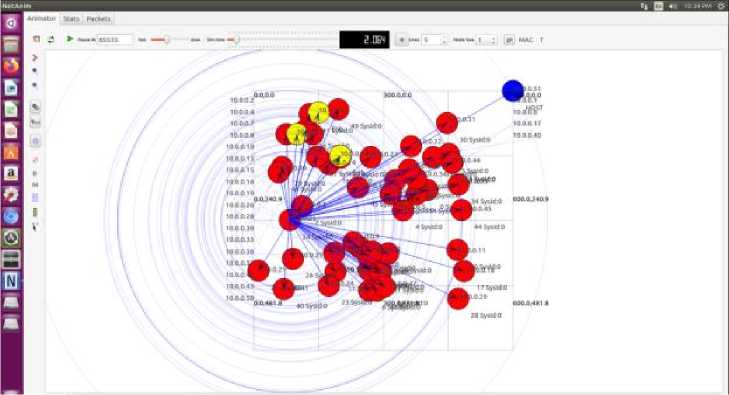
Fig.5. Simulation Scenario with malicious nodes using NS3.26
7. Conclusions
In this paper, a Certificate based Signcryption authentication and key management framework is presented for D2D communication in 5G enabled VANETs by using HECDH. From the results, it is observed that vehicles communicate securely among themselves and Road Side Units and Trusted Authorities as a D2D pair maintaining privacy with reduced latency, Communication overhead and Computational Cost. This scheme ensures confidentiality, authenticity, integrity and non-repudiation for large density of vehicles. The privacy of the location is increased with the use of Chinese reminder algorithm. To our knowledge, it is the second signcryption system in the certificate-based cryptographic scenario that achieves security and privacy in 5G enabled VANETs. Proper research on integrating AI with our technique can help to predict possible threats and integration of edge computing technology can and enhance real-time decision making.
Author Contributions Statement
Chinnam S. V. Maruthi Rao – Corresponding Author - Conceptualization, Methodology, Software Implementation, Formal Analysis, Visualization, and Statistical Analysis, Drafted the initial manuscript, contributed to the literature survey, and documented the technical background of the study.
Rama Krishna Akella – Supervised project execution, Review and edited the manuscript, ensured clarity and coherence, and helped coordinate project milestones and deadlines and validated results using standard metrics
All authors have read and agreed to the published version of the manuscript.
Conflict of Interest Statement
The authors declare no conflicts of interest.
Funding Declaration
This research has not received any grant from any Public / Private funding agency.
Data Availability Statement
Not Applicable as no public data set is used
Ethical Declarations
Not Applicable as the study does not involve human subjects and/or animals.
Acknowledgments
We sincerely thank the experts for their professional evaluation and valuable recommendations, which have contributed to improving the quality of the experiment and the reliability of its results.
Declaration of Generative AI in Scholarly Writing
