
Adaptive regional differentiation as the basis for the monitoring of territorial tourism systems
Journal: Modern Problems of Service and Tourism @spst
Section: Пространственная организация туризма и гостеприимства
Article in issue: 4 т.19, 2025.
Free access
The study examines the critical task of improving the monitoring of territorial systems of tourism regarding regional specifics. Existing monitoring systems, based primarily on static and fragmented statistical data, demonstrate significant limitations in capturing the dynamics and qualitative changes in regional tourism development. The study proposes a monitoring approach based on the principles of adaptive regional differentiation. A key element of the concept is the mechanism for adapting the system of tourism development indicators to the regional specifics of tourism systems in a changing environment. The scientific novelty lies in the combined approach to developing indicator weighting coefficients, which combines retrospective statistical analysis with expert assessments for various types of tourism development, differentiated based on a strategic positioning matrix, taking into account unique combinations of economic, social, environmental, infrastructural, and institutional parameters. Monitoring is implemented through a measurement system integrating traditional data sources and the digital footprint of tourism activity, and a calculation system evaluating integrated indicators for key aspects of tourism development. The concept envisages the identification of indicators with anomalous dynamics, signaling potential risks to tourism development. The practical significance lies in defining the principles for constructing a toolkit for making management decisions based on the results of tourism development monitoring.
Similar articles in the section Production and services according to economic sectors

Short address: https://sciup.org/140313886
IDS: 140313886 | UDC: 338.48 | DOI: 10.5281/zenodo.18015981
Динамическая региональная дифференциация как основа мониторинга территориальных туристских систем
В исследовании рассматривается задача совершенствования мониторинга территориальных систем туризма (ТСТ) с учетом региональной специфики. Существующие подходы к мониторингу ТСТ, основанные преимущественно на статических и фрагментарных статистических данных, демонстрируют существенные ограничения в отражении динамики и качественных изменений в развитии регионального туризма. В исследовании предлагается подход к мониторингу, основанный на принципах адаптивной региональной дифференциации. Ключевым элементом концепции выступает механизм адаптации системы показателей развития ТСТ к региональной специфике функционирования туристских систем в условиях изменяющейся среды. Научная новизна заключается в комбинированном подходе к формированию весовых коэффициентов индикаторов, который сочетает ретроспективный статистический анализ с экспертными оценками для различных типов ТСТ, дифференцированных на основе матрицы стратегического позиционирования с учетом уникальных комбинаций экономических, социальных, экологических, инфраструктурных и институциональных параметров. Мониторинг реализуется через измерительный комплекс, интегрирующий традиционные источники данных и цифровой след туристской активности, и расчетный комплекс, оценивающий интегральные индикаторы по ключевым аспектам развития ТСТ. Концепция предусматривает выявление показателей с аномальной динамикой, сигнализирующих о потенциальных рисках для развития ТСТ. Практическая значимость заключается в определении принципов построения инструментария для принятия управленческих решений на основе результатов мониторинга ТСТ.
Text of the scientific article Adaptive regional differentiation as the basis for the monitoring of territorial tourism systems
Acknowledgements: The study was funded by the state assignment research of FRC SSC RAS FGRW-2025–0003, project No 125021202045–8
Citation: Gorbatova, A. A., Poruchaeva, T. M., Khersonskiy, A. A. (2025). Adaptive regional differentiation as the basis for the monitoring of territorial tourism systems. Sovremennye
ПРОСТРАНСТВЕННАЯ ОРГАНИЗАЦИЯ ТУРИЗМА И ГОСТЕПРИИМСТВА
Article History
Received 10 November 2025
Accepted 23 December 2025
Disclosure statement
No potential conflict of interest was reported by the author(s).
This work is licensed under the Creative Commons Attribution 4.0 International (CC BY-SA 4.0).
To view a copy of this license, visit
ГОРБАТОВА Алена Алексеевна,
Федеральный исследовательский центр «Субтропический научный центр Российской академии наук» (Сочи, РФ);
Кандидат экономических наук, научный сотрудник лаборатории экономики и управления туризмом Института пространственного развития регионов; e-mail:
ПОРУЧАЕВА Татьяна Михайловна,
Федеральный исследовательский центр «Субтропический научный центр Российской академии наук» (Сочи, РФ);
Младший научный сотрудник лаборатории экономики и управления туризмом
ХЕРСОНСКИЙ Артем Александрович,
Федеральный исследовательский центр «Субтропический научный центр Российской академии наук» (Сочи, РФ);
Дата поступления в редакцию: 10 ноября 2025 г.
Дата утверждения в печать: 23 декабря 2025 г.
Tourism, as one of the most dynamic and multifaceted sectors of the global economy, plays a key role in the socioeconomic development of territories. Its sustainable functioning and ability to generate positive economic and social impacts directly depend on effective management based on accurate and timely assessments of territorial tourism systems (TST).
In the face of increasing volatility in global markets, transforming consumer behavior, and intensifying inter-territorial compe-ttion, traditional approaches to monitoring and assessing TST development are demonstrating their limitations. Existing monitoring systems, relying primarily on retrospective official statistics, capture the state of the system at a specific point in time but often overlook its dynamic nature. This leads to static, often belated management measures that are inadequate to address contemporary challenges.
During the preparatory stages of the study, we conducted a comprehensive analysis of existing TST monitoring systems used at the federal and regional levels. The analysis revealed a number of systemic methodological limitations that contribute to their ineffectiveness in the face of increased economic instability and transformation.
The key problems of existing monitoring systems can be summarized as follows:
-
1. Staticity and retrospectiveness. Prevailing approaches rely on official statistical data, which are received with a delay and reflect the state of the system at a specific point in time. This complicates tracking current trends in near real time and promptly responding to rapidly changing market conditions.
-
2. Fragmentation and lack of comprehensiveness. Many methodologies focus on individual aspects of TST development (e.g., economic or infrastructural indicators), ignoring the social, environmental, and institutional components of the system. Existing systems often mechanically aggregate disparate departmental data, failing to provide a holistic picture.
-
3. Inability to adequately reflect qualitative changes. Traditional monitoring systems
-
4. Unification and ignoring regional differentiation. The existing methodological framework typically uses a single set of indicators for all types of regions, ignoring their significant differences in tourism specialization, resource potential, and level of socioeconomic development. This leads to a loss of specificity and a reduction in the practical value of assessments.
-
5. Limited use of the potential of non-tra-ditional data sources. Monitoring relies heavily on government statistics and official reporting, while sources such as digital footprints (data from online platforms, social media), banking transaction information, and other indirect monitoring tools are used sporadically and are not systematically integrated into the system.
built on quantitative indicators are unable to capture and measure such important qualitative transformations as changes in consumer behavior, redistribution of tourist flows, or changes in a region’s image.
The key problem lies in the methodological gap between static measurement tools and the dynamic, nonlinear reality of destination development. Overcoming this gap requires a shift from acknowledging existing differences between regions to analyzing dynamic and adaptive regional differentiation -a process that identifies not only spatial differences but also their dynamics over time, development trajectories, growth points, and stagnation zones.
The aim of this study is to develop an approach to monitoring territorial tourism systems based on the principles of adaptive regional differentiation.
Adaptive regional differentiation is a complex and multifaceted process reflecting the uneven socioeconomic development of territories across time and space. In recent years, both Russian and international research has focused on analyzing the causes and consequences of these differences and mechanisms for managing them. To assess the dynamics of regional differentiation, principal component analysis, cluster analysis [1], Gini coefficient [9], Theil index [4], integral indices of structural changes, and spatiotemporal modeling are used [10, 18, 19]. Particular attention is paid to the development of algorithms for monitoring and predicting changes, which allows for assessing the effectiveness of public policy and identifying new risks [17]. To reduce regional disparities, it is proposed to develop infrastructure, support investment, implement digital technologies, and take into account the specifics of the region when formulating a development strategy [6, 16]. Of particular importance is the integration of efforts of federal, regional and municipal authorities, as well as the participation of businesses and public organizations [7].
Regional differentiation is a key factor that must be considered when formulating effective tourism development strategies or conducting comprehensive monitoring of TST. Scientific research emphasizes that ignoring the unique characteristics of regions leads to inefficiency, while taking into account these differences allows for the creation of competitive advantages and sustainable development. Using factor analysis clustering allows us to identify groups of regions with similar characteristics and develop tailored strategic approaches for them. This helps optimize resource allocation and create balanced tourism products [8, 11, 15]. In addition, tourism can contribute to the reduction of regional economic disparities if its development is integrated with the overall strategy of socioeconomic development and takes into account the characteristics of the territories [5, 12, 13].
The use of regional indicators in tourism monitoring systems occupies a special place in the scientific community’s discourse. This allows for the consideration of local characteristics and the comparison of the sustainability and competitiveness of tourism destinations at the regional and federal levels. This approach provides a more accurate assessment of the state of tourism and identifies vulnerable or, conversely, promising regions for targeted management and investment [2]. Research shows that significant regional differences in tourism performance and potential require an individual approach to monitoring and management, especially in times of crisis [3, 14].
The methodological framework of this study is based on a systems approach, allowing for the consideration of the territorial tourism system as a complex, multifaceted entity. The study utilizes a composite indicator methodology, which overcomes the limitations of static and fragmented assessment systems. This involves constructing an integrated indicator of tourism system development, synthesized from a system of normalized individual indicators. A distinctive feature of the proposed methodology is the use of adaptive weighting coefficients. These coefficients are not fixed but calculated dynamically, taking into account both the relative influence of each indicator on the overall state of the system and its sensitivity to changes in the external and internal environment. This ensures the adaptation of the assessment tool to the dynamics and structural characteristics of different regions.
The selection of socioeconomic indicators for monitoring territorial tourism systems must take into account the profound regional differences characteristic of the national economic landscape. A single set of indicators applied indiscriminately to different territories fails to capture the unique development paths, resource endowments, and structural constraints of individual regions. Therefore, the proposed system prioritizes a flexible system of indicators that can be adapted to the context, where the significance of each metric is calibrated against the specific socioeconomic baselines and strategic priorities of the analyzed region. This approach goes beyond a simplified comparison of absolute values and allows for the assessment of development dynamics and relative effectiveness.
The foundation of this adaptive system lies in the integration of both standard statistical indicators and more detailed, regionspecific metrics. While traditional indicators such as tourism’s contribution to GRP and employment in the sector provide basic insights, they are complemented by indicators reflecting regional purchasing power, the structure of investment in tourism infrastructure, and the quality of human capital. Furthermore, incorporating data on the diversification of tourism offerings and the accessibility of services for different population groups allows for a more detailed analysis of a region’s sustainability and inclusiveness. This multi-layered approach ensures that the monitoring process considers not only economic performance but also the broader social embeddedness and resilience of the tourism system (fig. 1).
Ultimately, the dynamic interpretation of these indicators is paramount. By tracking their dynamics over time, the monitoring system can identify trajectories of regional development, defining areas of accelerated growth, stabilization, or decline. This temporal analysis transforms a static snapshot into a dynamic picture, revealing how regional differences either converge or diverge under the influence of policy measures and external shocks. The resulting typology of regions, based on the unique socioeconomic profiles and development dynamics, provides a robust evidence base for developing differentiated and effective strategic management decisions.
To bridge the methodological gap inherent in static monitoring systems, an assessment complex was developed based on an integrated indicator of the development level of a territorial tourism system. This indicator is a composite metric synthesizing multiple normalized parameters reflecting the economic, social and infrastructural aspects of the system. The innovation of this approach lies in its rejection of fixed waiting coefficients, utilizing adaptive waiting coefficients instead. These coefficients dynamically adjust the contribution of each individual parameter to the final assessment based on its current contextual significance and sensitivity to fluctuations in the internal and external environment
This mechanism ensures the model’s inherent flexibility and ongoing relevance, and its basic structure is formally expressed by the following formula:
1 = ZO; * xd , где (1)
I – the integral indicator of TST development wi - the adaptive weighting coefficient of the i-th indicator xi – the normalized value of the i-th indicator
The adaptive weighting coefficients that form the dynamic core of the integrated assessment model are calculated using a special formula designed to objectively quantify the
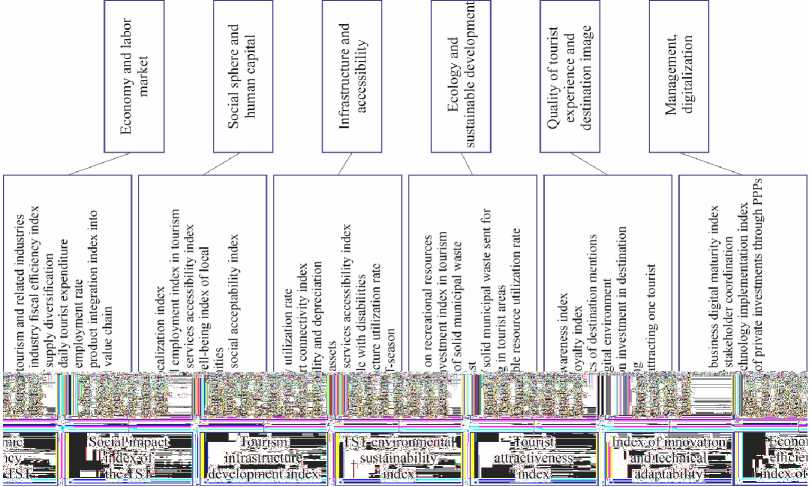
Fig. 1. The system of indicators for calculating the integrated indicator of the development of territorial tourism systems
relative importance of each indicator. These coefficients are not assigned arbitrarily, but are derived from the interaction of two fundamental parameters: the influence coefficient, representing the predetermined strategic weight of the indicator in the overall system, and the sensitivity coefficient, measuring its statistical volatility and susceptibility to change over time. This multiplicative relationship ensures that the resulting weight reflects both the normative significance of the indicator and its empirical behavior, thereby preventing disproportionate distortion of the model by highly volatile but less important metrics. The normalization coefficient in the denominator serves to standardize the results, ensuring that the sum of all weights equals one and maintaining the consistency of the composite indicator, defined by the following expression:
Wi = , где (2)
wi - the adaptive weighting coefficient of the i-th indicator ei — the influence coefficient of the i-th indicator
Sj - the sensitivity coefficient of the i-th indicator
'£Sfij*sj) — the normalization factor
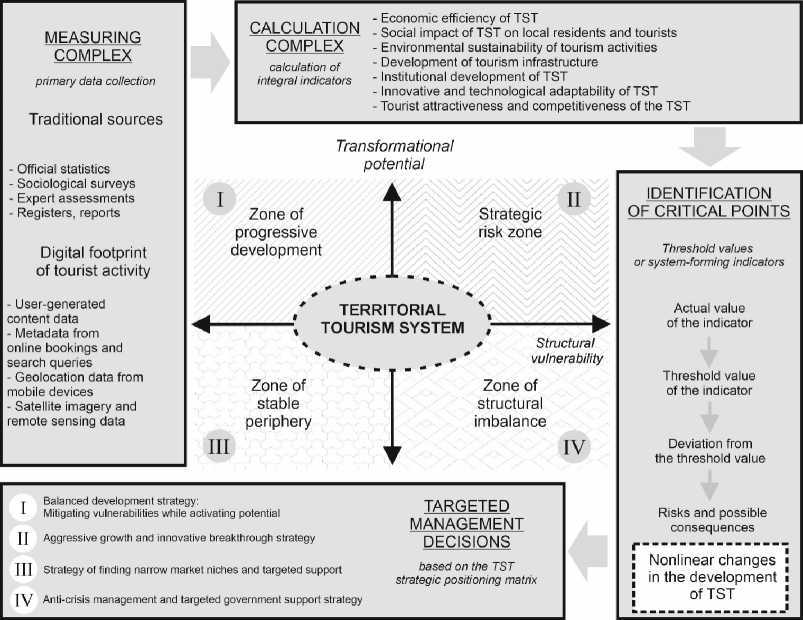
Fig. 2 represents the algorithm, describing a systematic sequence of steps, beginning with the integration of heterogeneous data from primary operational systems, government statistics and indirect sources. The process then moves on to the normalization of indicators and the dynamic calculation of adaptive weighting coefficients, taking into account both the impact and sensitivity of each parameter. The algorithm then guides the calculation of an integrated indicator for each region and time period, culminating in a spatiotemporal analysis and cluster classification of territories based on the development trajectories.
The proposed conceptual model for monitoring territorial tourism systems represents a paradigm shift from fragmented data collection to an integrated analytical framework. It
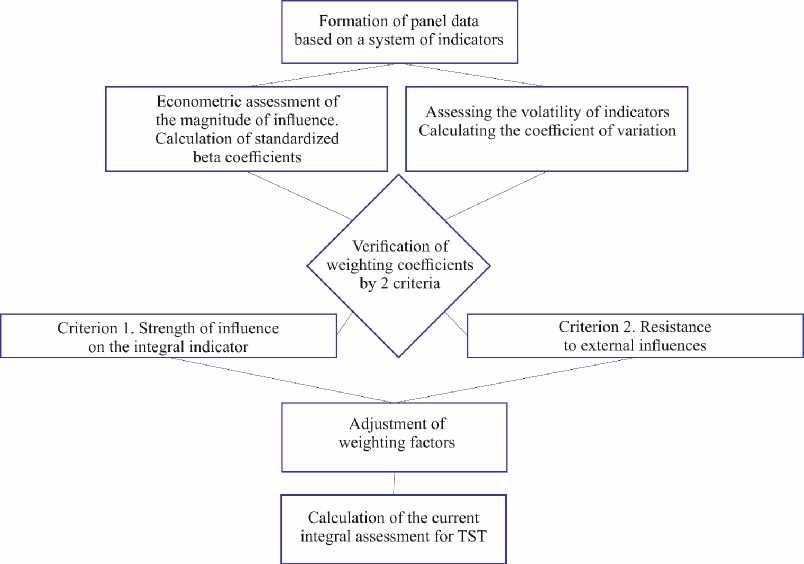
Fig. 2. The algorithm for adapting the weighting coefficients of indicators in the overall integrated assessment of the TST development
synthesizes the core principles of adaptive regional differentiation into a coherent framework illustrating the synergistic interaction between various data sources, methodological approaches, and end-use management applications. This model positions an integrated indicator, calculated using an adaptive weighting coefficient, as the central link transforming raw data from multiple sources into a coherent assessment of a territorial development trajectory.
Contemporary tourism development management challenges require a shift from fragmented data collection to a holistic analytical paradigm. This approach must be capable of synthesizing information from disparate sources (from traditional government statistics to dynamic digital footprints) into a unified assessment system. The central element of this system is an integrated indicator, calculated using adaptive weighting factors, which serves as a link, transforming the raw data into a coherent assessment of a territory’s development trajectory and its position within the broader regional context.
Fig. 3 represents the structural and logical scheme for monitoring territorial tourism systems based on regional differentiation indicators.
The system enables not only point-intime assessments but also continuous tracking of a territory’s evolution, identifying its movement along specific development trajectories, such as sustainable growth, volatility or stagnation. Stratifying regions, differentiated based on a strategic positioning matrix, taking into account unique combinations of economic, social, environmental, infrastructural, and institutional parameters, enables a decisive shift from uniform, one-size-fits-all policies to precisely calibrated strategic interventions. This ensures that management measures and resource allocation are tailored to the specific needs, constraints and potential of each identified territorial type, thereby maximizing the
Zone of progressive development
Transformational potential
II
Strategic risk zone
- User-generated content data - Metadata from online bookings and search queries
- Geolocation data from mobile devices
- Satellite imagery and remote sensing data
I
II
III
IV
Balanced development strategy:
Mitigating vulnerabilities while activating potential
Aggressive growth and innovative breakthrough strategy
Strategy of finding narrow market niches and targeted support
Anti-crisis management and targeted government support strategy
- Official statistics
- Sociological surveys
- Expert assessments
- Registers, reports
Digital footprint of tourist activity
TARGETED
MANAGEMENT
DECISIONS based on the TST strategic positioning matrix
MEASURING
COMPLEX primary data collection
Traditional sources
Zone of structural imbalance
/ TERRITORIAL
\ TOURISM SYSTEM
III
Structural vulnerability
Zone of stable periphery
IDENTIFICATION OF CRITICAL POINTS
Threshold values or system-forming indicators
Actual value of the indicator
Threshold value of the indicator
Deviation from the threshold value
Risks and possible consequences
Nonlinear changes in the development of TST oAiniii - Economic efficiency of TST
GALOULAI ION _ Social impact of TST on local residents and tourists
COMPLEX - Environmental sustainability of tourism activities calculation of ’ Development of tourism infrastructure integral indicators - Institutional development of TST
- Innovative and technological adaptability of TST
-Tourist attractiveness and competitiveness of the TST
Fig. 3. The structural scheme for monitoring territorial tourism systems
effectiveness and sustainability of regional tourism development.
The study confirms the significant limitations of existing monitoring systems for territorial tourism systems, which are characterized by the static nature, fragmentation and inability to reflect rapid qualitative transformations. In response to these shortcomings, this research has developed a monitoring approach based on the principles of adaptive regional differentiation. The proposed methodology, centered around an integral indicator with adaptive weighting coefficients, enables a transition from a unified assessment to a differentiated analysis of regional development trajectories. This allows for the identification of not only current disparities but also the dynamics of their change, forming a robust information base for strategic management.
Despite its theoretical contributions the study has certain limitations. The proposed model’s effectiveness is contingent on the availability and quality of diverse data sources, which can be uneven across regions, potentially affecting the comparability of results. Furthermore, the calculation of adaptive weights relies on expert judgment to determine influence coefficients, introducing a degree of subjectivity. The concept is yet to undergo empirical testing, which is necessary to validate its practical utility in diverse regional contexts. The approbation will require its application to a selected group of Russian regions with contrasting tourism specialization.
