
Aggregation of results of automatic classification of remote sensing data of natural objects
Журнал: Siberian Aerospace Journal @vestnik-sibsau-en
Рубрика: Informatics, computer technology and management
Статья в выпуске: 3 vol.27, 2026 года.
Бесплатный доступ
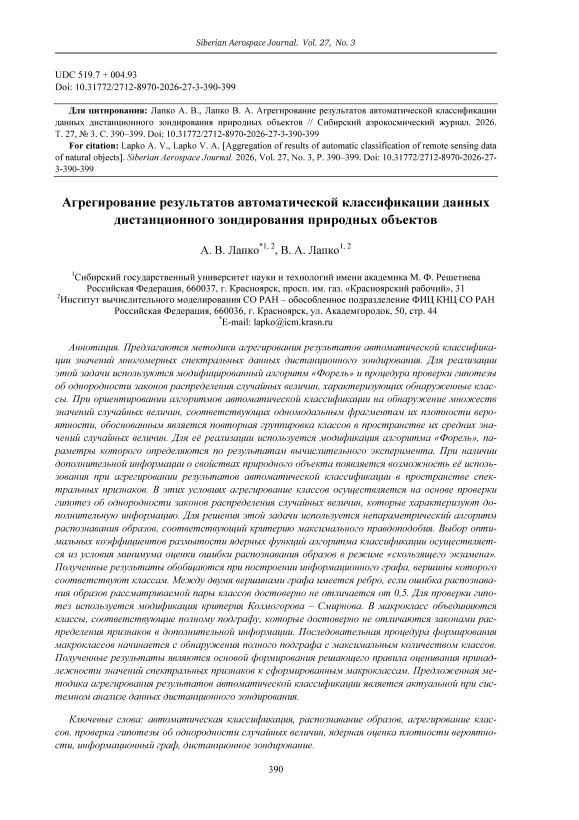
Methods for aggregating the results of automatic classification of multidimensional spectral remote sensing data are proposed. This task is accomplished using a modified «Forel» algorithm and a procedure for testing the hypothesis of the homogeneity of the distribution laws of random variables characterizing the detected classes. When automatic classification algorithms are designed to detect sets of random variable values corresponding to unimodal fragments of their probability density, it is reasonable to regroup classes within the space of their mean random variable values. This is implemented using a modification of the “Forel” algorithm, the parameters of which are determined based on the results of a computational experiment. If additional information about the properties of a natural object is available, it can be used to aggregate the results of automatic classification in the spectral feature space. Under these conditions, class aggregation is based on testing the hypothesis of the homogeneity of the distribution laws of the random variables that characterize the additional information. To solve this problem, a nonparametric pattern recognition algorithm that follows the maximum likelihood criterion is used. The optimal blur coefficients of the classification algorithm's kernel functions are selected based on the requirement to minimize the pattern recognition error estimate in the “sliding exam” mode. The obtained results are summarized in the construction of an information graph, the nodes of which correspond to classes. An edge is formed between two graph nodes if the pattern recognition error for a given pair of classes does not differ significantly from 0,5. A modification of the Kolmogorov–Smirnov test is used to test the hypotheses. A macroclass is formed by classes corresponding to a complete subgraph that do not reliably differ in the distribution patterns of features in the additional information. The sequential procedure for forming macroclasses begins with finding the complete subgraph with the maximum number of classes. The results obtained form the basis for developing a decision rule for assessing the membership of spectral feature values in the resulting macroclasses. The proposed method for aggregating the results of automatic classification is relevant for the system analysis of remote sensing data.
Короткий адрес: https://sciup.org/148334518
IDS: 148334518 | УДК: 519.7+004.93 | DOI: 10.31772/2712-8970-2026-27-3-390-399
