
Ameliorative role of ethanolic extract of Allium sativum (garlic) on chromium-induced membrane damage in male albino rats
Journal: Journal of Stress Physiology and Biochemistry @jspb
Article in issue: 2 т.21, 2025.
Free access
Membrane damage is one of the most important consequences of chromium (Cr) induced cytotoxicity. Allium sativum (Garlic) possesses antioxidant property to scavenge the toxic radicals and cytoprotective activity. The aim of the present investigation is to evaluate the protective effects of ethanolic extract of garlic (EEG) on Cr-induced membrane damage of liver and kidneys in male albino rats. For this study male albino rats of Wistar strain (80-100 g) were used. Rats were divided into three groups of almost equal average body weight. The animals of two groups were injected K2Cr2O7 at a dose of 0.8 mg per 100 g body weight per day for 28 days. The animals of one of the Cr-treated groups served as the supplemented group supplied ethanolic extract of garlic (EEG) (400 mg per kg body weight) daily at an interval of 6 h after injection of Cr for a period of 28 days. The animals of the remaining group received only the vehicle (0.9% NaCl), served as control. The body weights were taken in each day of the treatment schedule. The results indicated that significant increases in membrane cholesterol as well as significant decreases in membrane phospholipid in Cr exposed animals suggest structural alterations in both liver and kidneys plasma membrane. Alkaline phosphatase (ALP), total ATPase, and Na+-K+- ATPase activities were significantly decreased in both liver and kidneys plasma membrane. On the other hand, EEG supplementation restores such alterations induced by Cr in plasma membrane of both liver and kidney. These findings indicate that Cr treatment at the present dose and duration induces structural and functional alterations in the plasma membrane in both liver and kidney. However, EEG supplementation restored such alterations induced by Cr in plasma membrane of both liver and kidneys but was not able to eliminate the deposited Cr from liver and kidney.
Similar articles in the section Material bases of life. Biochemistry. Molecular biology. Biophysics
Short address: https://sciup.org/143184717
IDS: 143184717
Text of the scientific article Ameliorative role of ethanolic extract of Allium sativum (garlic) on chromium-induced membrane damage in male albino rats
Chromium (Cr) is a naturally occurring heavy metal found commonly in the environment in two valence states: trivalent [Cr (III)] and hexavalent [Cr (VI)]. Cr (VI) is widely used in steel, alloy cast iron, chrome plating, leather tanning, paints, metal finishes and wood treatment. Cr plays a dual role in nature with Cr (III) essential for glucose and lipid metabolism (Chorvatovicova et al., 1993). However, excessive intakes of Cr (VI) compounds are potent toxicants and carcinogens (De Flora et al., 1990). Hepatic and renal toxicity is the most common toxicity found in Cr (VI)-exposed workers or animals (Hojo and Satomi 1991) This functional differentiation of Cr (III) and Cr (VI) is largely decided by the ionic permeability of the plasma membrane (De Flora and Watterhahn 1989). Thus, membrane damage is one of the crucial factors observed with Cr (VI) toxicity (Dey and Roy 2010).
Allium sativum (Garlic) is a potential herb that belongs to the amaryllidaceae plant family. It is one of the most multipurpose medicinal plants used as a traditional herbal medicine to prevent and treat the variety of diseases (Prasad et al., 1996). The anti-carcinogenic and anti-inflammatory properties of garlic extract and its derivatives also have recently been reported by several investigators (Kalayarasan et al., 2008). Allium sativum compounds are having tremendous antioxidant property which exerts action by scavenging ROS, enhancing cellular antioxidant enzymes and increasing glutathione in the cells (Borek 2001). Our previous studies showed that aqueous extract of garlic and some antioxidants like Vitamins and GSH were able to ameliorate Cr (VI)-induced membrane damage in the liver and kidneys (Dey and Dey, 2021; Dey et al., 2001; Dey et al., 2003; Dey and Roy 2010).
Therefore, the aim of this present investigation was an attempt to reduce the effects of Cr-induced cytotoxicity using methanolic extracts of Allium sativum (Garlic) in vivo in terms of certain structural and functional components like cholesterol and phospholipids levels as well as alkaline phosphatase (ALP), total ATPase, and Na+-K+- ATPase activities of the liver and kidneys plasma membrane.
MATERIALS AND METHODS
Collection of plant materials
Plant parts i.e. the fresh bulb of garlic were collected from the market. Each specimen was labelled with date of collection. Plant parts were cleaned and peeled off Then plant parts were dried in incubator less than 40ºC.
Preparation of ethanolic extract of Allium sativum (garlic)
The pulverized sample (exactly 500g) was soaked in 2 litres of 70% ethanol (by maceration) for 48 hours with constant stirring at an interval of two hours. At the lapse of 48 hrs, the solution was filtered using muslin cloth and then with whatmann No 1 filter paper and the filtrate gotten was concentrated using water bath at 50oC to obtain the crude extract which was thereafter stored in an airtight container and kept in a refrigerator until it was needed.
Maintenance and treatment of animals
Male albino rats of the Wister strain (80–100 g) were fed with a lab-prepared diet, as described elsewhere (Dey et al., 2003b), with water ad libitum . They were maintained in accordance with the guidelines of the rule of Institutional Animal Ethics Committee. Laboratory acclimatized rats were divided into three groups of almost equal average body weight. The animals of two groups were injected intraperitoneally (i.p.) with Cr as K 2 Cr 2 O 7 at a dose of 0.8 mg per 100 g body weight per day (20% LD 50 ) for 28 days, as described earlier (Dey et al., 2003b). The animals of one of the Cr-treated groups served as the supplemented group injected ethalonic extract of garlic (EEG) orally at a dose of 400 mg per kg body weight daily at an interval of 6 h after injection of Cr for a period of 28 days. The animals of the remaining group received only the vehicle (0.9% NaCl), served as control.
Tissue collection
After the experimental period, overnight fasting rats were sacrificed by cervical dislocation. The liver and kidneys were immediately dissected out of the body and weighed. The tissues were then quickly stored at -200C The concentration of Cr was measured in the liver and kidneys by atomic absorption spectrometry.
Isolation of crude membrane fraction
Membrane fractions of the liver and kidneys were isolated according to the method described by Ghosh Chowdhuri et al., (1995). Tissues were homogenized with a glass homogenizer in 0.25 mol L-1 cold sucrose solutions. The homogenates were then centrifuged at 15,000×g for 15 min at 40C. The supernatants were collected and centrifuged again at 22,650×g for 20 min at 40C. The supernatants, thus obtained, were discarded and the pellets were suspended in 1mL chilled Tris buffer (pH 7) after three washings with the same buffer.
Assay of membrane protein
Membrane protein was estimated using Folin– Ciocalteau reagent according to the method of Lowry et al. , (1951) using bovine serum albumin as the standard.
Estimation of membrane cholesterol and phospholipid
Cholesterol and phospholipid levels of the isolated membrane fractions were estimated by the methods of Zlatkis et al., (1953) and Christopher and Ralph (1972), respectively.
Measurement of alkaline phosphatase activity
Alkaline phosphatase (ALP) activity of the isolated membrane fractions were assayed using p-nitrophenyl phosphate (PNPP) as substrate according to the method of Linhardt and Walter (1963).
Determination of total ATPase and Na+-K+-ATPase activities
Total ATPase and Na+-K+- ATPase activities were measured by the method of Sen et al., (1981).
Statistical analysis
Results were expressed in terms of mean and standard error of different groups. The differences between the mean values were evaluated by ANOVA followed by multiple Students’t-tests. The values for p < 0.05 were considered significant.
RESULTS AND DISCUSSION
Based on a comparison of body weight gain on Cr exposed rat with that of control (Figure 1), it appears that weight gain was decreased in Cr treated rats. The impact on body weight due to the direct effect of Cr and not due to reduce food intake as control rats were pair- fed with the Cr treated rat. EEG partially reversed the body weight fall to control levels when it was supplemented with Cr treated animals.
The lowered body weight was not reflected in organ weight, as noted just after sacrifice (Table 1). Only the liver showed a significant increase in weight. Similar results were reported in our laboratory (Dey et al. , 2003b) suggesting that Cr treatment at the given dose and duration increased the liver weight but the kidneys remain unaltered. Thus, Cr appears to have a differential impact on organ size but after supplementation with EEG restored the changes in organ weights following metal exposure.
The Cr content of the liver and kidney tissues were increased significantly after Cr treatment (Table 1). The increased levels of Cr in all tested organs studied following Cr treatment were found to be unaffected by supplementing Cr-treated rats with EEG. This shows that supplementation with EEG was not able to reduce the load of accumulated metal in the tissues. It was reported that protection with deferoxamine (DFO) against Cr was not attributed to either a reduced Cr uptake by the cells or alterations in Cr distribution within cells (Susa et al., 1997a). It was also reported that pretreatment with vitamin E and melatonin did not affect Cr uptake or distribution in cells after metal treatment (Susa et al., 1996; Susa et al. , 1997b). Sugiyama (1989) also demonstrated that the uptake of Na 2 CrO 4 was not affected by pre-treatment with vitamin E. From the present study, it may be suggested that EEG exerted no effect on Cr uptake or distribution in different organs after metal treatment. Whether such supplementation has any impact on the distribution of different forms of Cr within the cells remains to be ascertained by further studies.
Various studies indicated that both Cr (VI) and Cr (III) are biologically active oxidation states (Susa et al., 1997a). It was suggested that an oxidative impact of Cr (VI) on membrane phospholipids indicates a probable structural alteration of the membrane (Ginter et al., 1989). On the other hand, activation of the membrane bound enzyme indicates a functional alteration of the membrane (Bagchi et al., 1997).
In the present study, the Cr induced membrane damaged was clearly indicated by significantly increases of the membrane cholesterol content in the both liver and kidneys (Figure 2). These results may be due to imbalance in cholesterol incorporation into the membrane. Thus Cr impaired the function of lecithin cholesterol acetyl transferase. On the other hand, decreased membrane phospholipids levels (Figure 3) indicated that the damage of membrane structure of the cell. The probable impact of Cr on the lipid catabolizing enzymes cannot be ruled out as evidenced by increased excretion of urinary lipid metabolites (Bagchi et al. , 1995). This enhanced catabolism of lipid may result in accumulation of acetyl Co-A, which in term may lead to increased synthesis of cholesterol in the tissues particularly in nonsteroid producing tissues. Thus, Cr by altering the relative proportion of cholesterol and phospholipids may produce cellular damaged to membrane structure. The impact of Cr on membrane cholesterol and phospholipids contents was found to disappear when Cr was accompanied by EEG. It was reported that serum cholesterol level is increased in response to Cr but simultaneous treatment of garlic extract relatively improved serum cholesterol level (Chi et al., 1982). Evidence indicates that this structural change of both liver and kidneys plasma membrane is attenuated by the EEG supplementation.
This report of impact of Cr on ALP activity of tissue membrane is contradictory (Kumar and Rana 1984;
Chorvatovicova et al., 1993; Susa et al., 1997a). After Cr treatment, the activity of ALP in plasma membrane of both liver and kidney was found to be decreased (Figure 4) as observed in our earlier studies (Dey et al., 2001; Dey et al., 2003; Dey and Roy 2010; Dey and Dey 2021). This inhibition of ALP activity reflects selective damage of the plasma membrane (Kumar and Rana 1984), which is also supported by the alterations in cholesterol and phospholipid contents (Figures 2 and Figure 3). In the present investigation, results indicated that the supplementation with EEG completely attenuated Cr-induced inhibition of membrane ALP activity of both liver and kidneys.
Total ATPase activity of membrane was reduced significantly in the Cr treated group but EEG supplementation completely attenuated Cr induced inhibition of liver and kidney membrane total ATPase activity (Figure 5). The inhibition of the energy production by cytotoxic concentration of Cr (Stohs and Bagchi 1995) may play a role in Cr induced changes of the ATPase activity. Na+-K+ -ATPase activity was found to be reduced significantly in Cr treated organs (Figure 6). The observed results are supported by findings on Cr induced reduction of membrane transport (Standeven and Wetterhahn 1991a; Standeven and Wetterhahn 1991b). When the Cr-treated group was supplemented with EEG, the Na+-K+-ATPase activity was found to restore in liver and kidney plasma membrane.
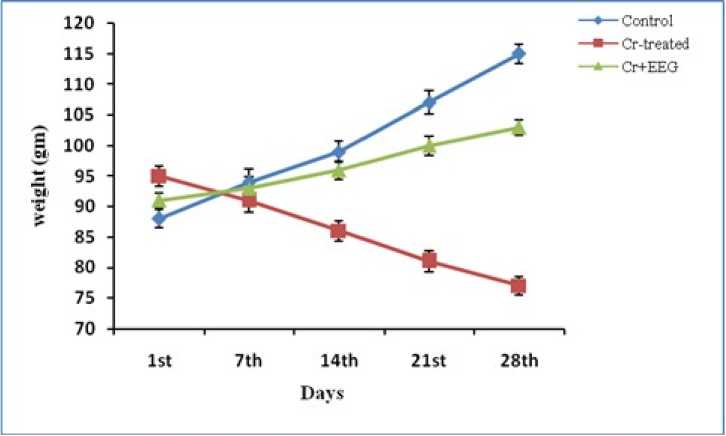
Figure 1: Changes in body weight after co-administration of EEG to Cr-treated rats
Table 1: Tissue weight and Cr content of organs after co-administration of EEG in Cr-treated rats
|
Tissues |
Groups of animals |
Organ weight (g per 100 g bw) |
Cr content (µg per g tissue) |
|
Liver |
Control |
2.95 ± 0.12a |
0.36 ± 0.04a |
|
Cr-treated |
4.20 ± 0.19b |
2.94 ± 0.16b |
|
|
Cr+EEG |
3.12 ± 0.25a |
2.81 ± 0.11b |
|
|
Kidney |
Control |
0.79 ± 0.05a |
1.15 ± 0.09a |
|
Cr-treated |
0.76 ± 0.04a |
6.30 ± 0.42b |
|
|
Cr+EEG |
0.78 ± 0.04a |
6.18 ± 0.31b |
Data represents mean ± SE, p < 0.05 and ANOVA followed by multiple comparisons
Student’s t-test. Same superscript in each vertical column did not differ from each other significantly
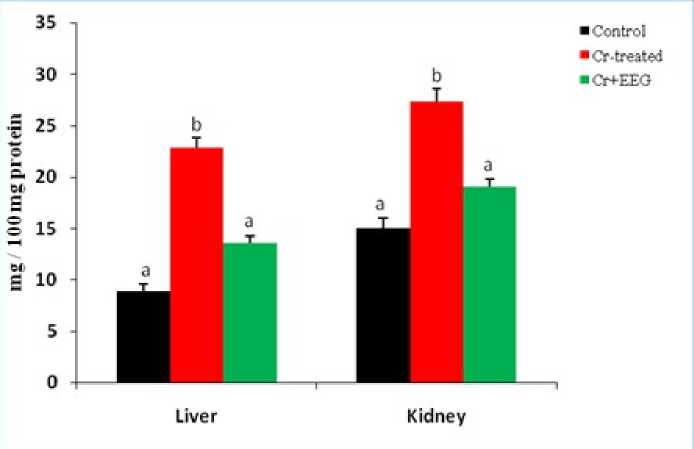
Figure 2: Changes in membrane cholesterol level after co-administration of EEG in Cr-treated rats. Data represents mean ± SE, p < 0.05 and ANOVA followed by multiple comparisons Student’s t-test. Same superscript in each vertical column did not differ from each other significantly.
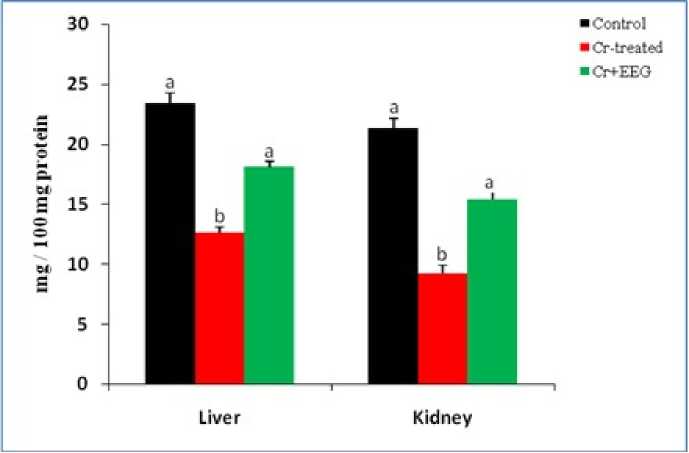
Figure 3: Changes in membrane phospholipid level after co-administration of EEG in Cr-treated rats. Data represents mean ± SE, p < 0.05 and ANOVA followed by multiple comparisons Student’s t-test. Same superscript in each vertical column did not differ from each other significantly.
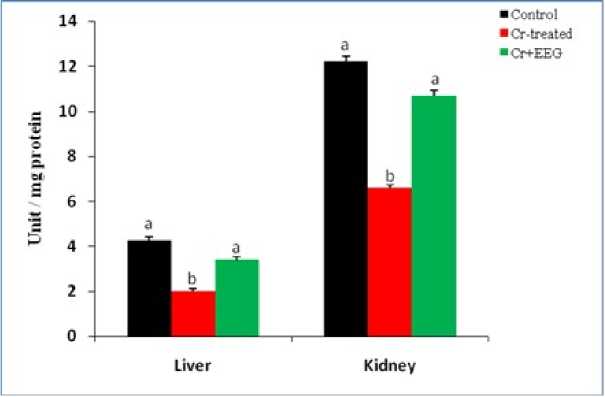
Figure 4: Changes in membrane ALP activity after co-administration of EEG in Cr-treated rats. Data represents mean ± SE, p < 0.05 and ANOVA followed by multiple comparisons Student’s t-test. Same superscript in each vertical column did not differ from each other significantly.
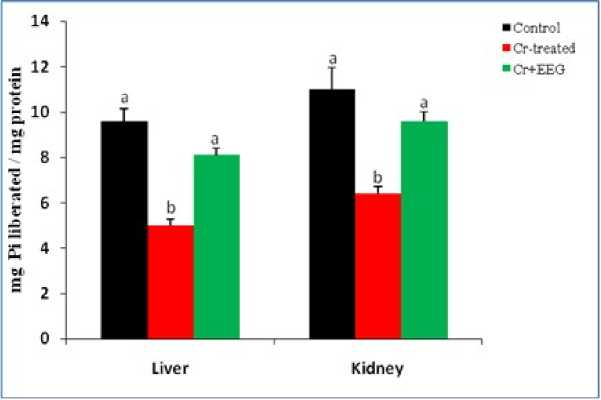
Figure 5: Changes in membrane ATPase activity after co-administration of EEG in Cr-treated rats. Data represents mean ± SE, p < 0.05 and ANOVA followed by multiple comparisons Student’s t-test. Same superscript in each vertical column did not differ from each other significantly.
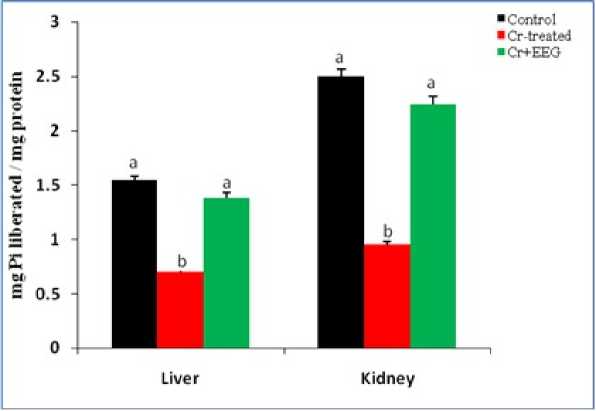
Figure 6: Changes in membrane Na+-K+-ATPase activity after co-administration of EEG in Cr-treated rats. Data represents mean ± SE, p < 0.05 and ANOVA followed by multiple comparisons Student’s t-test. Same superscript in each vertical column did not differ from each other significantly.
CONCLUSIONS
Allium sativum is commonly used as a food additive and traditional medicine since ancient times. Our findings indicate that Cr treatment at the present dose and duration induces structural and functional alteration in liver and kidney plasma membrane. The structural and functional changes may be attenuated by EEG supplementation. The protective action of EEG might be due to presence of one or more principal component in garlic. However more details studies are needed to elucidated the exact mechanism underlying Cr induced membrane damage.
CONFLICTS OF INTEREST
The authors declare that they have no potential conflicts of interest.
ACKNOWLEDGEMENT
The author is thankful to Vidyasagar University, Midnapore for providing the facilities to execute these studies.
