
Анализ изменений политических ценностей монгольской молодёжи с позиции теории поведения

Журнал: Восточный вектор: история, общество, государство @eurasia-world
Рубрика: Социология
Статья в выпуске: 1, 2026 года.
Бесплатный доступ
За последние 30 лет стремительный технологический прогресс и переход демократии в Монголии привели к значительным изменениям во всех сферах общества, в частности в политических ценностях, установках и формах участия молодёжи. Такие факторы, как цифровое расширение, улучшение доступа к информации и снижение доверия к политическим институтам, сделали участие молодёжи в политике более сложным и разнообразным. Традиционные формы участия (такие как голосование) остаются важными, однако «экспрессивные» и цифровые формы участия становятся всё более доминирующими среди молодого поколения. В статье рассматриваются изменения политических ценностей монгольской молодёжи с точки зрения теории поведения с акцентом на взаимосвязь индивидуального политического поведения, психологических факторов и внешней среды. Анализируется восприятие политических процессов современной молодёжью, а также факторы, влияющие на принимаемые ею решения. Целью исследования является определения текущего состояния и перспектив развития политического участия молодёжи в Монголии.
Похожие статьи в разделе Основные элементы и подсистемы общества
Короткий адрес: https://sciup.org/148333454
IDS: 148333454 | УДК: 316.334.3 | DOI: 10.18101/2949-1657-2026-1-13-32
Analyzing changes in the political value of Mongolian youth from the perspective of the theory of behaviour
In the past 30 years, rapid technological progress and the transition to democracy in Mongolia have brought about significant changes in all social sectors, in particular in the political values, attitudes and forms of youth participation. Factors such as digital expansion, improved access to information and a decrease in trust in political institutions have made youth's participation in politics more complex and varied. Traditional forms of participation (such as voting) remain important, but “expressive” and digital forms of participation are increasingly dominant among younger generations. This paper examines changes in Mongolian youth's political values from the point of view of behavior theory, focusing on the relationship between individual political behavior, psychological factors and the external environment. The study analyzes the perception of political processes by modern youth and the factors that affect their decisions and aims to define the current situation and future trends in Mongolia's youth's political participation.
Текст научной статьи Анализ изменений политических ценностей монгольской молодёжи с позиции теории поведения
The rapid development of technology has brought about significant changes in political, economic, cultural, educational, value-added and social life in the last thirty years. In short, digital expansion, increased access to information, and declining confidence in political institutions are creating a variety of youth's attitudes and forms of participation in politics.
In 1990, the transition from socialist to democratic society brought about important changes in the fields of social, political, legal, economic and foreign relations. This social change also brought about a change in Mongolian political values, and researchers often believed that the transition period was not yet over. This is due to the fact that political values in democratic societies are often explained in terms of ideas, declarations, and norms, making it difficult to fully explain the dynamics of young people's actual political behavior. It is therefore undeniable that the need to examine political views and values in relation to actual participation and action is increasing.
In fact, we are trying to study the change in Mongolian youth's political values from the perspective of the theory of political behaviour. This is due to the fact that young people claim to support democracy and freedom, but they face low turnout, poor confidence in institutions, rejection of traditional political participation, and the trend towards digital political activism. However, to explain these changes, researchers often rely on the standard concepts of democratic values, civic consciousness, and political culture, which are not sufficient to fully explain the changes taking place at the level of actual behavior.In this case, it was assumed that political values were not only subject to consciousness and ideology, but also to the result of observed behavior, and that differences between values and behaviors could be explained using behavioural theory. This study aims to explain changes in Mongolian youth's political values using basic concepts from behavioural politics and provide a theoretical conceptual map.
Methodology
This paper uses a methodology to analyze changes in Mongolian youth's political values within the framework of behavioural theory based on the views of the main representatives of the theory. The aim is to explain the dynamics of youth political behavior objectively, which is difficult to explain in traditional methods. The paper begins by explaining the basis of behavioral political theory. In the mid-20th century (1950s-1960s), it dominated the study of political science and emphasized the study of politics based on people's actions, choices and participation rather than institutional or legal structures. The basic principle used was that the research objective should be limited to phenomena that can be observed and measured independently. Objective and quantitative methods have been used to explain and predict political behaviour.
The theoretical framework: The behaviouralism of political analysis
Political behavior theory has been a dominant approach to political science since the mid-20th century, in the 1950s and 1960s, and emphasizes the study of politics based on real behavior, choices, and people's participation, not on institutions and legal structures. It is one of the most important approaches in modern political science and shows that political science research should be limited to phenomena that can be observed independently and measured. Behaviorism is a political science approach that uses objective and quantitative methods to explain and predict political behavior. However, the focus is on individuals, their behaviour, actions and activities and is not intended to study the characteristics of institutions such as the legislative, executive and judicial branches.Because the logic of this theory is that using scientific methods, techniques and tools, understanding, explaining, defining, and predicting political phenomena, events, and actions, interdisciplinary approaches must be used. Behavioral approaches have changed the focus of political science to observe human behavior. Scholars such as David Easton and Robert Dahl argued that political phenomena must be analysed through empirical data and psychological variables.
Modern political theorists such as Gabriel Almond, Sandy Bena, and L. Pax suggested that politics ultimately is cultural and associated with a specific model of political culture, the whole system of values and beliefs. They believed that “when we talk about the political culture of society, we take into account the entire political system, which is transformed into the knowledge, feelings, and values of its members” (Almond G.A, Verba S, 1989)and that “political culture is a series of fundamental 14
values, feelings, and knowledge that determine the content and shape of the political system” (Smorgunov L.V, 1997).
After World War II, this behavioural approach to politics intensified and led political science to a more scientific, empirical orientation. For example, they began to develop and disseminate methods based on detailed data and quantitative measurements that differ from traditional methods of studying social and political change in countries and to explain them by non-quantitative explanations, examples, historical analogies, and ideologies and philosophical motives. In short, the origin of political behaviorism is often attributed to the work of political scientists Graham Wallace, Arthur Bentley and Charles Merriam.These theorists are important in explaining the dynamic change in political values between young generations by explaining the influence of human behavior, psychology, and groups, rather than legislative institutions or systems. For example, behavioral theory is based on the research of English political theorist Graham Wallace in Human Nature in Politics (2020) and Arthur Bentley in The Process of Government (1908). In addition, political behavior approaches define political values by psychological behavior (Wallas), interest group and pressure theory (Bentley, Truman) and behavioral pragmatism (Merriam, Dahl). Specifically,
From the point of view of psychological characteristics and emotional influences, Graham Wallace believes that “human nature should be considered the centre of political behaviour rather than an isolated study of political institutions. This is a statement that political action and value cannot be explained only by rational calculations and profit and loss logic(Wallas, 1908). He believed that political decision-making was not based on logical processes, but on emotions, customs, beliefs, fears and desires. However, it is explained that voting, supporting parties and accepting political ideologies are directly related to individual psychological characteristics and social psychology. He believed that political values were formed and formed by the psychological environment, not by the level of education and knowledge. For young people, political values are in the stage of development, changing rapidly, becoming radical and manifesting themselves in idealistic forms. At the moment, there is a tendency to weaken critical thinking, overcome emotions, and follow dominant ideas.Therefore, political participation is the question of “what is right”. Therefore, political participation depends on the question of "What causes emotion?" and "What atmosphere was created". Instead of "what is right?", However, the reason for the decline in youth participation is: First, because young people are sensitive to emotions, their involvement may increase in the short term, but if emotions fall, they are rapidly decreasing; second, because they have not yet reached political participation levels, they are easily influenced by social climate; and third, because of the strong influence of collective beliefs, if they follow the dominant ideas, imitations, emotions, and when the real results are slow to manifest.
According to Wallace, the political values of young people are not fully established beliefs, but based on emotions, symbols, and moral emotions. In fact, youth political behaviour is unstable and temporary because it is based on psychological impulses and temporary emotions. It can also be said that, although they have a high moral and strong sense of the boundary between justice and injustice, they view social injustice in a bipolar way as wrong and right, thereby being driven by corruption, inequality and political irresponsibility that distorts values.
Modern youth political values are shaped by the flood of information expressed by emotional narratives, images and symbols, rather than by substantive policy analysis. Social media, digital algorithms, influencers have had a strong impact on the spread of injustice, corruption, slogans, and images, creating powerful emotions and stimulating them within a short time. Wallace believed that the foundation of successful democracy was not simply to transmit knowledge, but to develop the ability to understand values by studying psychological influences, filtering emotional messages, reducing polarization, and increasing rational understanding.
However, Arthur Bentley (Bentley, 1908) argued that "laws, government institutions and policies are not political sources, but temporary results of mutual influence between groups". This emphasises the need to pay attention to the behavioral approach of “how groups act and what pressure is exerted to produce a particular law.” To understand politics. He also believes that in real life politics people act not alone, but as members of a group, which is fully in line with the principles of behavioral theory based on “observable behaviour”. This is because political behaviour is determined by the social group belonging to the individual, rather than by the beliefs of the individual.
His view is that political values are not abstract moral concepts, but real interests under social pressure. In this sense, it is clear from the explanation that values such as justice, equal opportunities, participation, corruption and social protection that young people often observe are directly related to the expression of interests resulting from the effects of the digital environment, education, employment and income inequality that directly affect their lives. Arthur Bentley's theory suggests that modern youth would have fewer chances of putting national interests, official political slogans, and institutional explanations at the centre of attention, while focusing more on focusing on what group interests would actually be protected.
Therefore, it is not sufficient to measure the political values of young people only through electoral participation, and it is important to consider how social movements and collective activism are more effective in the digital environment. Furthermore, political change begins with groups exerting public pressure rather than individual pressure. However, political stability does not depend on one group's dominance, but on balancing pressures from several groups. If the pressure of a group is excessively dominant, the stability of the system is interrupted and new resistance and new groups develop. This means that values are not radical in isolation, but when others share them and affirm them, and that individual frustrations can transform into group values depending on social networks, protest spaces, and repeated messages. It should not be forgotten that this is a public feeling, and can form the basis of groups and movements and ultimately demand political changes.
American political scientist C.E. Merriam (Merriam, New aspects of politics, 1925)interprets political values as combinations of psychological attitudes and participatory behaviours in terms of changes in participation form. He believed that rather than explaining politics in terms of law, institutions, and systems, it was more important to study how people actually participate in the political environment, their behaviors, and reactions.Therefore, political values are defined as "fluctuating phenomena" characterized by psychological attitudes and participation behavior despite change in stable beliefs and tendencies in response to stimuli in social and political environments. Therefore, on the theoretical level, it is not only an expression of ideas, but also an objective measure of actual action (C.E Merriam, 1934). People who engage in politics choose the form they believe will yield tangible results, rather than complying with institutional rules. The study of who influences, follows and under what conditions reveals the true nature of political power is an important subject of behavioral analysis(C.E Merriam, 1934).
When trust in the functioning of the institution deteriorates, particularly young people tend to abandon formal forms of political participation and adopt non-institutional channels such as movements, protests and digital participation. This shows that the expression of political values shifted from institutional systems to other forms of behaviour (Merriam 1925, 1945).Furthermore, one of the most important contributions of behavioural approaches to politics is the 1955 election research of the American political scientist W.O. Key Jr.(Key, 1966) described several elections in American history as “important” or “rebalancing”, in which voters, many of whom have long held political affiliations, have made fundamental changes to the political party system.The SRC, founded in the 1940s at the University of Michigan, conducted the first statistical analysis of this kind of election behavior.
From the point of view of the above-mentioned political theorists, taking into account political values from a theoretical behavioural point of view, one hopes to find the links and differences between the values expressed by citizens and the actual political behavior. The aim of this paper, on the other hand, is to analyze Mongolia's young people's political values in light of current social development processes and whether people choose to participate in politics in a way that gives more tangible results than according to institutional standards.
The analysis of changes in the political values of Mongolian youth from the point of view of behavioral theory
By presenting changes in Mongolian youth's political values from the theoretical perspective of behaviour, they can be deeply and realistically understood as to the complexity of their political participation and attitudes, given the limitations of traditional normative understandings, psychological characteristics and emotional influences, influence of digital environments, influence of group interests and pressures, and changes in behaviors and behavior manifestations.
The limitations of traditional normative understanding: Since the transition to democracy in Mongolia, political values have often been expressed from the point of view of ideas, declarations, normative understandings. This approach is based on idealistic expectations that define the roles and participation of citizens and the importance of state institutions. This method does not yet fully explain the dynamics of Mongolia's young people's actual political behavior.
In short, while young people may claim to support democracy and freedom, they tend to ignore traditional political participation and voter turnout, low trust in institutions. For example, in a 2016 Youth Political Participation Survey (NAOG, 2016), 7 percent of respondents said they participated regularly or regularly, 58% sometimes participated, 35 percent did not participate because they did not have a trusted party or politician, did not believe in politics, or did not have interest in politics.
However, 98 percent of young people correctly believe that “free and fair elections and real choices are essential to the establishment of democracy in any country” (USA Republican Institute, IRIM, 2020). It is not sufficient to explain these differences in 17
normative terms, and it is possible to misinterpret them as “permanent” or “politically indifferent”.
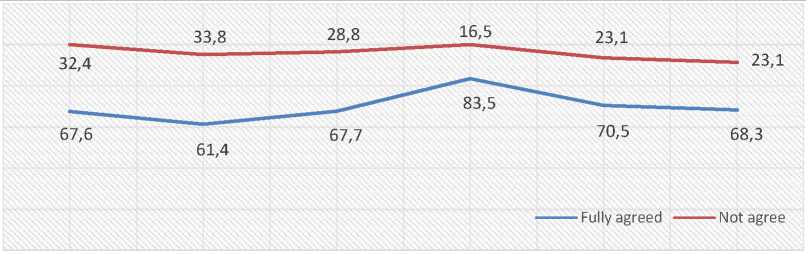
Specifically, since the late 1980s, the development of democracy, human rights and freedom has become a key factor in the formation of new subcultures in young people. However, the change in the 1990 political system provided conditions for learning about political freedom, economic needs, freedom and democratic practice. This means that the values and standards of socialist societies are no longer the pillars on which to sit, and that Communist ideology and spiritual life no longer play an important role in unifying power. Since 1990, democratic and free social values such as democracy, human rights, freedom, private property, market and free competition have become increasingly part of society and are maturing (Figure 1).
Figure 1
2002 2006 2010 2014 2018 2022
Democracy may have own problems but it is still the best form
Source: (Ganbat D, 2023)
Since 2000, a new democratic political structure has been established by accepting and disseminating the concept of democracy and creating favourable economic conditions to accelerate democratic development. In order to build a peaceful and democratic society, it is now necessary that “democratic” reformers and young people who make democracy a priority carry out comprehensive activities to ensure the proper development of civil society, to increase citizen participation, and, above all, to promote the political education and culture of citizens in a step-by-step and in accordance with solid principles.The influence of the above-mentioned values and attitudes of young people has been apparent since 2010. For example, political opinions and beliefs are an important part of modern young people's worldview, helping to understand the meaning of the time they live, thinking about social institutions, their characteristics and future prospects, and creating conditions for effective social service. It is said that it is manifested by attitudes towards political ideologies, evaluations, and contents of policies and concepts guiding political activity. From 2020, we will create peaceful and friendly cooperation for green development, increasing the equal, equitable and responsible creative participation of all people in the strengthening of good governance, ensuring sustainable development. In this respect, recent global events and specific events have highlighted the crucial importance of cultivating new cultures that foster meaningful relations between government and private and civil society and those that promote partnerships for a principled development(Khatanbold O, Urtnasan D, 2024, p. 536). It should be stressed that these objectives aim to eliminate social inequality and create social wealth that offers a comfortable, healthy, safe and sustainable environment for life and ensures the participation of all parties.The above-mentioned changes created conditions for Mongolians to develop new political values and, on the other hand, to learn democratic values. For example, o Democracy itself has played an essential role in influencing others to listen to voices that express the importance of political and social participation to the lives and well-being of the population, and political expression deserves attention.
o People seek reforms to spread democratic ideals and cultivate democratic Mongolians.
o The freedom of expression and publication has been opened up, people can freely talk and write about previously closed topics, causing a revolution in the explosion of information in society's minds and laying the foundations for a new subculture of young people focused on technology.
o A subculture of creative freedom, which seeks a new stream of knowledge, has begun to develop. The revival of national consciousness and the emergence of modern patriotic attitudes aimed at revitalizing national ideals, consciousness, culture and traditions has therefore contributed significantly to the rapid development of this subculture.
o In the search for a new path of development, liberated from ideological illusions and accepting diversity as a major source of social change.
o The third neighbouring policy, which began with the desire to maintain Western civilization's foreign relations, is likely to be due to the influence of education, which has changed values and grew the appreciation of freedom.
Firstly, by defining political values through civic citizenship and political knowledge, it is an indicator that takes into account both the rights and obligations of our country and can be a unique indicator.
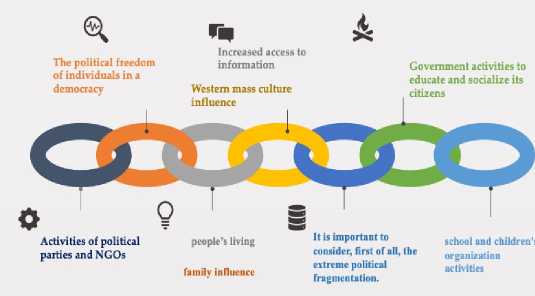
Secondly, when making major political changes and making policy-related decisions, it is important to emphasise that important parties must create groups to exchange, disseminate, debate and discuss information, and that there is sufficient space and time to reach consensus. Thus, analysis can show that this focus can include the following characteristics:
Thirdly, it is important to investigate changes in Mongolia's political traditions, culture and values in several social groups, identify and study public attitudes, orientations and values to political realities and processes. The researchers analyzed data from previous theoretical and empirical research to explore these concepts and related questions in three periods of time: past, present and future, to determine public attitudes, orientations and values about political realities and processes, and revealed the following common characteristics.
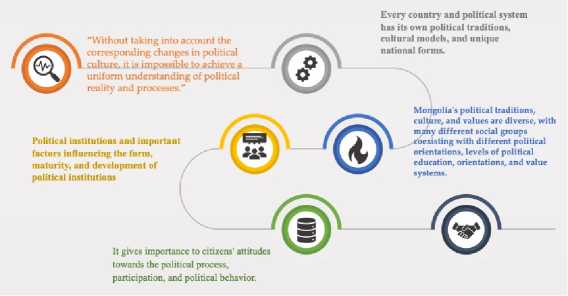
According to this statement, Mongolian traditional political culture is closely related to the historical process of nomadic pastorism and the establishment of a steppe state, and differs from Western established cultures and civilizations (NUM,
De pa r t ment of P o li tic al Science & Legal Studies from the Institute o f Phi l os ophy , MAS, Otgontenger U n iv ersi ty , MS U E, 20 24), including national traditions, c i vi li z a t io ns , c ust om s, e t hic s, and t he conc e p t o f r e sp e c t for t h e s t a te .
I n t his reg a r d, po liti cal culture is generally understood as a set of social , na t i on al , or popul a t i on per ce pt i o ns and attitudes to political systems, phenomena, and processes. Pol i t ic al c ult ur e ref e r s t o “the perception, position and attitude of a s oci e ty and i ts pe opl e s t ow a rds po l i t i ca l va l ue s , v a l ues a n d polit ic a l inst i t u ti o ns”(Archie Brown, Jack Gray, 1977, p. 56) . Th erefore, knowledge, education, ideology, attitudes , a nd th e s u m of k now l e dg e , at t it ud es, attitudes and attitudes can be understood a s a s e t of e xpe r i e n c es pas s ed d own to generations of politicians. For examp l e, e m oti on a l sens i t i vi t y , moral sens iti v ity and the influence of the digital environment a re pa rt of a be ha v i our a l app r oa c h t o the political values of youth, as indicated in t he fo l lowing words:
Emotional s ens i t i v ity:Mongolian youth, due to their emotional sensitivity, tend to a c t i v el y pa rti c ip ate i n political processes for a short period of time, and t he n t he ir a c t i v i t y quic kl y de cl i ne s when emotions subside. This reflects a ten denc y t owa r d t e mpora r y , emot i onal l y dr i v e n ac t ions ov e r long-term, sustainable engagement.One of t he re s e a rch g rounds f or this is that a recent study found that the political t r a di t i o ns w e i nhe r ite d a s moder n ci t i z ens are evolving today, as reflected in the follo wi ng commo n s ta n ce s of mode r n Mong ol i ans r e g a rdin g th ei r po l it i ca l t ra dit io n s (F ig ur e 2).
-
Figure 2
P os i t io n of m odern M ong ol i a ns on po l i t i c a l t r a d i t i ons
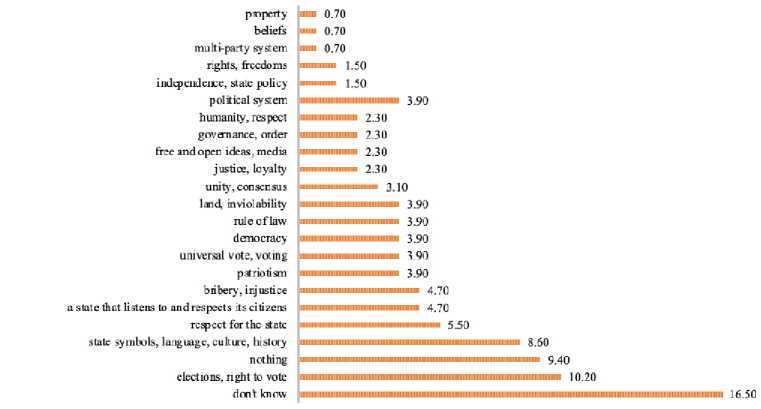
N ot e : The m o st repeated response is classified by content into 23 conc e p t s.
As show n abov e, t he most common reaction to public opinion polls o n M ong ol i a 's pol it ic a l t ra di t i on s is " no knowledge". Of the participants, 57.7% wer e w ome n a nd 42. 3% we re men. A g e was 27.9 per cent between 18 and 25 years, 27. 9 per ce n t between 26 and 35 y ears , 16.2 per cent between 36 and 45 years, 10.8 per ce n t be twe e n 46 and 55 y e ars, 6. 9 pe r c ent between 56 and 65 years and 9.9 per cent abov e 66 y e a r s .
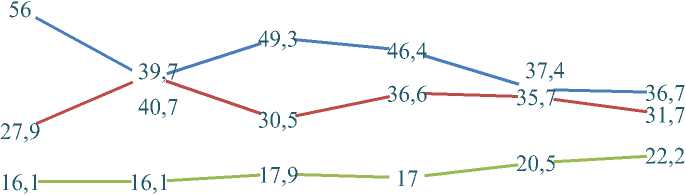
Moral awareness: Young people have a high sense of morality, a strong sense of justice and injustice, and they tend to take a firm stand against negative social phenomena such as corruption, inequality, and political irresponsibility. This depends on how the situation affects the psychology of the person, rather than on the nature or consequences of the problem.In particular, with regard to political traditions and mentalities, it is common not to abandon communist and authoritarian thought and not to understand the meaning of democracy. Factors that affect political values lead to the conclusion that the differences in the political culture between cities and rural areas, the understanding of the basic ideals of their societies, and the lack of development of democratic understandings and values lead to the lack of development of people (Figure 3).
-
Figure 3
Citizens' attitudes towards democracy vs authoritarianism
Democracy Authoritarism
2002 2006 2010 2014 2018 2022
Source:(Ganbat D, 2023)
One of Mongolia's most important political traditions is Mongolia's traditional nomadic culture and unique nature. Today, Mongolia's traditional nomadic culture is strongly influenced by colonial culture, with almost half of the population still living and working in the capital, Ulaanbaatar(Metropolitan Stastical Office, 2022)1. The changes in Mongolia's political attitude and modern Mongolian thought about nationalism indicate that they have entered an interesting period of evolution and have passed some periods (Khatanbold O, 2022, pp. 8-9).
This characteristic is an important basis for creating a unique political culture of Mongolian national identity and characteristics. Historically, Mongolians learned Tibetan Buddhism directly in the 16th and 17th centuries, developed it in accordance with their unique thinking, expanded Mongolian society's Buddhist knowledge, and provided a basis for deep spiritualization.
Influence of the digital environment: Modern social media, digital algorithms and influencers are having a stronger impact on emotional engagement. In other words, injustice, corruption scandals and quickly spreading slogans and images online can create sudden emotional waves and increase activism in a short time. This is completely in line with Wallace's concept that «value comprehension should develop by studying psychological influences, filtering emotions-based messages to reduce biases, and increasing rational understanding».
To clarify, people are a product of society.The closer, more meaningful, more comfortable, the less they will experience anxiety, stress, depression, the higher their self-esteem, the happier they will be, the longer they will live.However, in today's era of information, it is not exaggerated to say that people spend a lot of time in the Internet, especially in social media, away from the real world, being lonely, and losing the real world, which is one of the most frequently discussed social and psychological problems in the world.
For adolescents and young people, acceptance by others is a very important question, which means that they must overcome fear of missing something. In short, being accepted by friends and classmates is a sign that they are accepted and not missing anything. This is a common psychological need of young people, and in modern times, social media influence has made this situation more complicated. For example, children and young people may think that social media are living a happier and more adventurous life than other people. Consequently, self-esteem decreases, and people tend to be frustrated and isolated from society(Khatanbold O, Tsetsenbileg Ts, Enkhchimeg B, & et.all, 2024). Social isolation increases the risk of spending more time in social media. In this respect, some reviewers show that excessive social media time is directly related to fear of missing something, which has a negative impact on the productivity of daily life(Rozgonjuk D, Sindermann C, 2020). Specifically, a study from the University of Pennsylvania found that Facebook, Snapchat, and Instagram increase feelings of loneliness (Credits Michele W. Berger Writer & et al, 2022). On 23
the contrary, cultivating and improving a real relationship with people around you will reduce loneliness and psychological happiness.
Group interests and pressure: According to Arthur Bentley, youth's political values are related to the direct effects of education, employment, income inequality, and digital environment, the expression of real interests directly affecting young people's lives. Since the model of controlling the state apparatus and conquering the country's societies by force, through political forces and powerful dictatorships, has ceased for a long time. Since then, the need to organize local activities with transparent, open and fair systems based on democratic orientation aimed at reversing the bottom-up management method has naturally began to arise. This not only creates the political, economic and social requirements for the creation of a healthy, civicly active or open society, as we know it today, but also allows local citizens to play a major role in the political arena and to open the way for a new form of political participation(Etzioni 24
A.W, 1968). In addition, these changes were linked to technical and political conditions, leading to the tele-democracy (Arterton F.C, 1987) and new initiatives in this field.
For example, by broadcasting public hearings, debates, and citizen conversations on television, or by creating interactive programs, citizens can express opinions via mobile phones, and create new information and communication initiatives (Dutton W, Blumler J.G, Kraemer K.L, 1987), For instance, cable television was launched in many cities around the world (Slaton C.D, 1992)in Minerva, New Jersey, USA, 1977 in Columbus, Ohio, 1977 in Curaçao, Hawaii, 1978 in Televot KaTV, 1970 in Milton Keynes Interactive, etc.) and marked the beginning of a new phase in cable television development.
Although this development is a fundamental right of citizens to information, it also reflects the desire to improve the open and transparent relationship between elected officials and citizens. This is directly related to the government's approach to citizens and focuses on citizens' awareness and voice by approaching the political and decisionmaking levels of the government. In addition, it has triggered a trend towards the pursuit of new developments in information and communication technologies in order to promote and support equal participation in social relations. Specifically, topics of interest-based value and group dynamics were raised among participants. Let us examine them in detail:
The development of group activity and cooperation is fully consistent with the “observable behavior” principle of behaviorist theory, which states that young people act not alone but as members of a group. Their importance and trust in national interests, official political slogans, and institutional explanations is decreasing, but they are increasingly focusing on “which group’s interests are actually being protected,” as explained by A.Bentley.Specifically, Bentley's idea that if the pressure of one group becomes too dominant, instability will occur, creating the conditions for the emergence of new resistance and new groups, is important for understanding Mongolian youth resistance movements.
Changes in participation patterns and behavioral manifestations: According to Merriam's theory, as trust in institutional functioning weakens, Mongolian youth tend to abandon formal forms of political participation and choose non-institutional channels such as movements, protests, and digital participation. This clearly shows that the expression of political values is not in institutional systems, but in other forms of behavior (Merriam, 1925; 1945).
It is necessary to expand the real opportunities for citizens to meet their legitimate needs for all-round participation, strengthen their active and decision-making participation capacity, and thereby improve efficiency by narrowing the organizational forms of participation, innovating methods, and improving efficiency (Khatanbold O, 2022). The following steps should be implemented to narrow down the organizational forms of participation, innovate methods, and improve efficiency.

Second
Step 2

Step 3
• Third

Comprehensively address key objectives such as expanding open sources of information, free flow, creating a basic environment, and equal opportunities
Empowering citizens to own and adopt democratic values

Creating a socio-legal environment that supports and encourages human development.
Establishing a strong civil society oversight mechanism

Establish and practice simple and practical rules of conduct for communication between citizens and


This has an important impact on developing the intelligent needs of citizens to participate in government and public affairs to protect their rights and interests, and thus, their weak participation, poor culture, and lack of motivation to participate, while intelligently developing and enriching the meaning of democracy and creating conditions for its fulfillment (Chuluunbaatar G, 2009).
In light of all this, in recent years, a noticeable trend has been observed in the social and political participation of citizens in real life. This is because it is important to emphasize that small groups of society unite with their views to form micro-units of civil society organizations and have a real impact on government policy by bringing their voices to the government, expressing their opinions, and organizing demonstrations (Enkhbold D, 2010). On the other hand, from a socio-political perspective, the people understand that the common goal is an independent legal system and a common principle for building their lives ойлгодог (Purevsuren Bat, 2023). In other words, it means that the people are making a democratic system their unified goal, opening up opportunities for broad political participation.
This suggests that the shift in participation patterns reflects a shift in Mongolian youth's focus on tangible outcomes, with youth abandoning formal forms of political participation as trust in institutional processes weakens and opting for non-institutional channels such as movements, protests, and digital engagement. For example, young people are expressing their political activism not only through the expression of ideas, but also through concrete actions, aiming to achieve tangible and measurable results.
The youth demonstration “Against Coal Thieves” is a clear example of civic activism.Specifically, in December 2022, a youth-led protest march was held in the capital's central square, calling for more than 20 days of youth struggle to expose corruption cases and the corrupt and unjust actions of high-ranking government officials who prioritized their personal interests over the interests of the country and to hold them accountable. While many people positively supported this action, it is important to note that there are also attitudes that are intended to blacken and negatively influence, 2022). How the youth movement “Against Coal Thieves” , 2022) will continue to develop and how effective it will be will depend largely on the honest actions of the current political party in power, the Prime Minister (L. Oyun-Erdene and his cabinet) elected from the same party and leading the executive branch, and the passion and courage of the civil servants who have sworn an oath to serve their country and people , 2022) in the legislative body. It is worth noting here that time will tell.
To put it simply, the transformations that have taken place since the late 1980s, the drive for democracy, human rights, and freedom have been key factors in the formation of a new subculture among young people. Since the 1990s, political freedom, economic needs, and the need for freedom and democracy have created conditions for learning about the practice of democracy. This means that democracy has become instrumental in making people aware of the impact of political and social participation on their lives and well- being, and in making their voices heard.
Public and expert surveys have found Mongolians' satisfacti on with the development of their political culture to be below average (Figure 4).
Figure 4
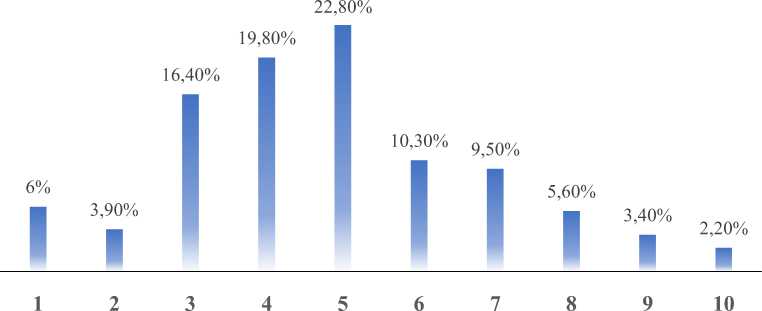
Cultural mat urity assessment (public opinion survey findings )
Source (Khatanbold O, Urtnasan D, 2024)
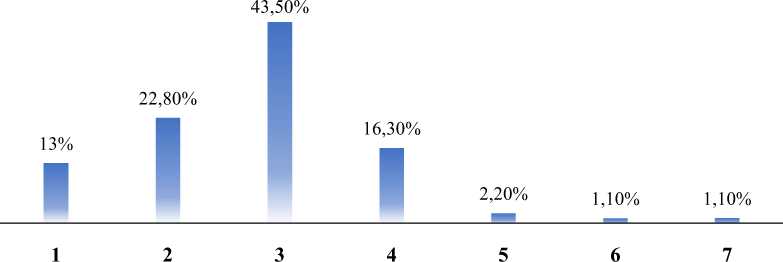
According to a publ ic survey, 69 percent of respondents rated th e maturity of political culture as 5 or below on a 10 -point scale, while 79.3 percent of experts rated it as 3 or below on a 7- point scale (Figure 5).
Cultural maturity assessment (expert survey findings)
Figure 5
Source (Khatanbold O, Urtnasan D, 2024)
This is due to many factors, including the failure of democratic v alues to fully mature, st ate institutions not performing their functions, the absence of democratic traditions, and obstacles to the activities of media organizations.
In terms of youth dev elopment and citizen trust in the civil service, the National Statistical Office (NSO) based on data released by the Civil Service Council on July 26, 2023, states that «A c ivil servant is a person who holds a civil service position and receives a salary from th e state for exercising his rights and duties an d is provided with working conditions a nd guarantees»(NSO, 2024). The number of civil servants increased by 37.1 percent from 1995 to 2022.
In particular, the num ber of administrative employees increased by 65.4 percent, which suggests that "people are flocking to government power." This is because the instability of the civil service (continuous turnover), corruption, and bribery are reducing citizens' trus t and creating conditions for distrust in democratic values (MONTSAME, 2023) ;(General Council of the Judiciary, 2024). Especially for young people, the attitud e against corruption and bribery is directly re lated to their interests.
However, in order to explore public opinion on democracy and order, when asked “Which is most needed in Mongolia in the current situation?”, 45 percent of the survey participants answered “democracy” and 55 percent answered “order”. In terms of age group, 51.8 percent of participants aged 18-35 considered “order” more appropriate in Mongolia under the current circumstances(Khatanbold O, Urtnasan D, 2024). This may be related to the “negative reinforcement” or avoidance of negative consequences in stimulus-response behavior. Citizens judge social issues based on their own values and value systems. This can be explained in the context of the concept of “critical citizens” and can be expressed in three types: “critical trusters” (showing varying levels of trust in institutions), “compliants” (trusting all institutions), and “cynics” (distrusting all institutions).To strengthen democratic values, it is necessary to prioritize education and cultivate “critical trusters” citizens.(Khatanbold O, Urtnasan D, 2024). Education determines people's beliefs and their place in society, and it is important to understand the nature of democracy. People born and raised in families or environments with high democratic values tend to invest more in education, and education, in turn, increases the likelihood that citizens will be “critical trusters”.Therefore, it is clear that in order to strengthen democratic values, we need to improve them, correct mistakes, and have citizens who believe in democracy. However, political parties are the pillars of the democratic system, but according to experts, they have become “groups” that seek profit and pursue personal gain rather than sound management, which is eroding trust.Civil society organizations are weak and disorganized, limiting their ability to control state power. Lack of transparency and citizen participation continues to have a negative impact on democratic mechanisms. All of this suggests that for today's youth, the ideal image of a politician has changed. While a survey conducted 30 years ago found that “the ability to predict the future with vision” and “good education” were important for a politician, today the characteristics of “honesty”, “free from corruption”, “listening to the people”, and “fulfilling their promises” have become more important(Khatanbold O, Urtnasan D, 2024). This indicates that citizens' trust in politics has declined and that issues of ethics and accountability among politicians have become more acute.
Conclusions o Studying the changes in political values of Mongolian youth from the perspective of behavioral theory is important for a more realistic understanding of their political participation and attitudes. The traditional approach to concluding that young people are politically inactive is flawed, but behavioral theory explains that their political values and forms of participation are adapting and changing to new circumstances.
o Psychological characteristics: According to Wallace, the political values of young people are driven by emotions and moral feelings, and are greatly influenced by the flow of information in the digital environment, which can be explained by their short-term activism.
o Group interests: According to A. Bentley's theory, young people act in groups in response to real interests and social pressures, such as education, employment, and income inequality, rather than abstract morality.
o Participation in the digital environment: According to the theory proposed by C.Merriam, when institutional trust weakens, young people reject formal participation and express their political values through movements, protests, and activism in the digital environment, which indicates a change in their behavior.
From these, it can be seen that the political values of young people are not fixed beliefs, but rather dynamic and arise from emotions, feelings, pressures of the situation, and group interests. In particular, the digital environment is becoming a platform for creating rapid and temporary activism based on youth emotions, as well as creating interest groups.Also, the fact that political values appear to be stable at the institutional level and are still preserved at the ideological level, but have not yet been transferred to the level of institutional behavior, indicates the need for an analysis of actual, recurring behavior, rather than declarations.
Therefore, in studying the political values of Mongolian youth, an important area of future research is to delve deeper into the behaviors and forms of participation they express, both quantitatively and qualitatively. This is believed to be important information for policymakers to implement effective measures aimed at increasing the political participation of young people and strengthening their confidence.
