
Antibacterial activity of biosynthesized silver nanoparticles against Pseudomonas aeruginosa
Journal: Saratov Medical Journal @sarmj
Article in issue: 1 Vol.6, 2025.
Free access
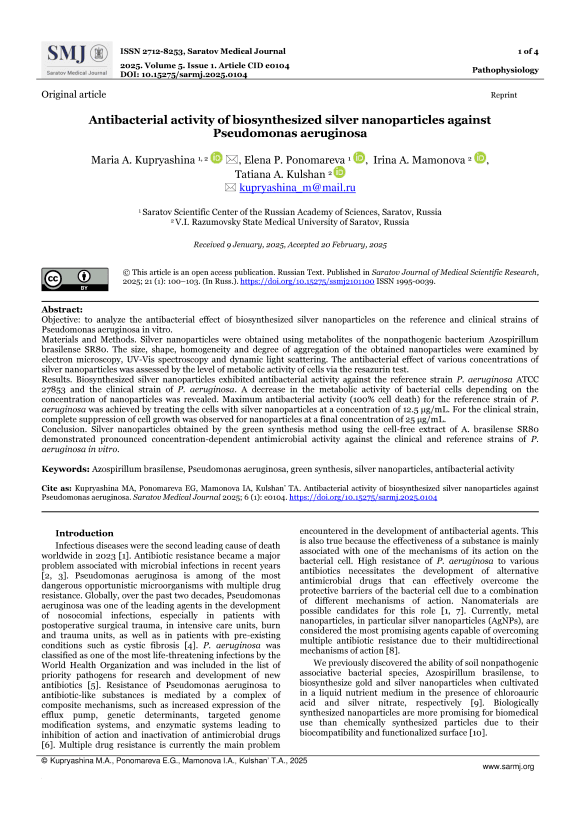
Objective: to analyze the antibacterial effect of biosynthesized silver nanoparticles on the reference and clinical strains of Pseudomonas aeruginosa in vitro. Materials and Methods. Silver nanoparticles were obtained using metabolites of the nonpathogenic bacterium Azospirillum brasilense SR80. The size, shape, homogeneity and degree of aggregation of the obtained nanoparticles were examined by electron microscopy, UV-Vis spectroscopy and dynamic light scattering. The antibacterial effect of various concentrations of silver nanoparticles was assessed by the level of metabolic activity of cells via the resazurin test. Results. Biosynthesized silver nanoparticles exhibited antibacterial activity against the reference strain P. aeruginosa ATCC 27853 and the clinical strain of P. aeruginosa. A decrease in the metabolic activity of bacterial cells depending on the concentration of nanoparticles was revealed. Maximum antibacterial activity (100% cell death) for the reference strain of P. aeruginosa was achieved by treating the cells with silver nanoparticles at a concentration of 12.5 μg/mL. For the clinical strain, complete suppression of cell growth was observed for nanoparticles at a final concentration of 25 μg/mL. Conclusion. Silver nanoparticles obtained by the green synthesis method using the cell-free extract of A. brasilense SR80 demonstrated pronounced concentration-dependent antimicrobial activity against the clinical and reference strains of P. aeruginosa in vitro.
Similar articles in the section Pharmacology. Therapeutics. Toxicology
![Antifungal activity’s study of the of new derivatives of pyrrolo[3,4-c]pyrazol-3-ones and pyrazol-3- carboxamides in the biofilm model of Candida spp.](/file/thumb/149146291.png "Antifungal activity’s study of the of new derivatives of pyrrolo[3,4-c]pyrazol-3-ones and pyrazol-3- carboxamides in the biofilm model of Candida spp.")
Short address: https://sciup.org/149148849
IDS: 149148849 | DOI: 10.15275/sarmj.2025.0104
