
Aquaculture in the North-West of Russia: Statistics, Conditions and Development Prospects
Журнал: Arctic and North @arctic-and-north
Рубрика: Social and economic development
Статья в выпуске: 64, 2026 года.
Бесплатный доступ
The study presents statistical data on the dynamics of aquaculture production volumes in Russia, identifies the main segments in the structure of commercial aquaculture production, and determines the regional specialization of aquaculture production in the North-Western Federal District of Russia. Based on reports of the Federal Agency for Fisheries, the study highlights key performance indicators of the fisheries sector in implementing the country’s Food Security Doctrine, in particular, the self-sufficiency rate for fish and fish products exceeded 138%, an increase in the consumption of fish products by the country’s population was recorded in 2024, reaching 23.5 kg per person per year. A statistical analysis of commercial aquaculture production in the fisheries sector identifies the North-Western Federal District as the traditional leader in aquaculture production and indicates its regional specialization in the farming of salmonid species. Data is presented on past and current unforeseen circumstances affecting commercial aquaculture production, as well as promising areas for development, such as the construction of new aquaculture complexes, the production of feed and fish seed, the expansion of water areas for aquaculture farms, etc. It is noted that the industry is working on new investment projects and additional measures of state support, updating the legislative framework, advancing fisheries science, and paying particular attention to staffing within Russia’s fisheries sector. The research and developments of the All-Russian Research Institute of Fisheries and Oceanography (VNIRO) and its branches to improve the quality of domestic fish feed are presented. Projects for the construction and modernization of commercial aquaculture plants and farms in the regions of the country are examined. The global trend of leading foreign companies in the long-term development of aquaculture production is outlined. The significant contribution of fish farmers of the North-West of Russia to aquaculture production is emphasized.
Короткий адрес: https://sciup.org/148334380
IDS: 148334380 | УДК: [639.2:338.22](470.2)(045)
Текст научной статьи Aquaculture in the North-West of Russia: Statistics, Conditions and Development Prospects
DOI:
The Russian fishing industry is working systematically to ensure the country’s food security in the current political, economic, and financial conditions. Sanctions imposed by unfriendly countries, the introduction of export duties, and the explicit rejection of fish products from Russian suppliers are complicating the productive operations of the fisheries sector (FS) (Ershov, 2022). Nevertheless, the FS’s economic performance indicators for 2024 demonstrate stability in the harvesting and production of fish products, as well as timely adaptation to the impact of sanctions. The catch of fish and seafood amounted to over 4.9 million tons, and the self-sufficiency rate for fish and fish products exceeded 138%, compared to the Food Security Doctrine target of 85% (Va-
∗ © Vopilovskiy S.S., 2026
This work is licensed under a CC BY-SA License silyev, Lisunova, 2022). Rosrybolovstvo notes an increase in fish consumption by the country’s population, which amounted to 23.5 kg per person per year in 2024 (+4.4% compared to 2023 level of 22.5 kg). Fishing industry enterprises have fully supplied the domestic market with fish products and fulfilled all obligations to foreign partners, and a modern fishing fleet ensures efficiency and environmental sustainability (Vopilovskiy, 2025).
The Russian fisheries industry is undergoing a large-scale reorganization: port infrastructure is being developed; new fishing and research vessels, fish processing plants, transport refrigerator vessels, and other facilities are being built. The implementation of investment programs aimed at modernizing the fisheries industry will determine the long-term prospects of the fishing industry.
Russian aquaculture
The development of Russian aquaculture is showing positive trends: since 2016, commercial aquaculture production figures have more than doubled (as shown in Table 1) (Ivashko, Ivash-ko, 2024).
Table 1
Dynamics of aquaculture production volumes in Russia1
|
Year |
Thousand tons |
Deviation % current year / previous year |
|
2014 |
159.9 |
2.8 |
|
2015 |
153.2 |
-4.2 |
|
2016 |
173.6 |
13.3 |
|
2017 |
186.5 |
7.4 |
|
2018 |
204.0 |
9.4 |
|
2019 |
286.8 |
40.6 |
|
2020 |
328.6 |
14.6 |
|
2021 |
356.6 |
8.5 |
|
2022 |
383.5 |
16.7 |
|
2023 |
402.0 |
4.8 |
|
2024 |
380.0 |
-5.8 |
At the end of 2024, commercial aquaculture production, including fish seed, amounted to 380,000 tons, which is 22,000 tons less than in 2023. In 2023, commercial production amounted to 402,000 tons, which is 18,600 tons (4.8%) more than in 2022 (383,500 tons), making it the most productive year in domestic aquaculture (Vasilyev, Lisunova, 2022). In 2024, the first decline in the previous eight years occurred. According to experts, the primary cause was a natural factor. In North-West Russia, particularly in the Murmansk and Leningrad Oblasts, adverse weather conditions and poor-quality salmon seed led to a reduction in commercial aquaculture production. The cold spring and hot summer of 2024 in the North-Western Federal District disrupted the specific temperature conditions that are critical for the production of salmonids — salmon and trout. The summer heat and, as a result, the oxygen deficiency triggered fish diseases. Dependence on im-
-
1 Source: (Ivashko, Ivashko, 2024).
ported seed, vaccines, and feed is the cause of the decline in salmon production. Rising operating costs, increased borrowing costs, and other economic factors negatively impacted commercial aquaculture production (Sergeev, Sergeev, 2024).
According to the updated Strategy for the Development of the Agro-Industrial and Fisheries Complex of Russia until 20302, commercial aquaculture production in 2025 should amount to 420,000 tons in the baseline (optimistic) scenario, 400,000 tons in the conservative (pessimistic) scenario; in 2030, it is expected to reach 618,000 tons and 502,000 tons, depending on the scenario.
Currently, commercial aquaculture enterprises in the North-West have begun work on the construction of new complexes, including feed and fish seed production, and expansion of water areas for their farms (Zhukova, 2024). In 2024, the Ministry of Agriculture of the Russian Federation proposed compensating fish farmers’ capital expenditures on the creation and modernization of hatcheries for the cultivation of salmon and seafood seed. This measure is aimed at accelerating the domestic market’s independence from imported products and stimulating the production of domestic salmon seed and high-quality valuable seafood. In 2025, the Federal Agency for Fisheries was allocated over 40.2 billion rubles (+24.1% compared to 2024 level of 32.4 billion rubles) for the artificial reproduction and conservation of aquatic bioresources, funding for fisheries science, repair of rescue vessels, and other purposes. The Russian government will provide support to entrepreneurs investing in salmon farming, who can expect reimbursement of up to 25% of the direct costs incurred in establishing and modernizing hatcheries. In 2025, the budget reserved 8 billion rubles for these purposes.
In 2024, salmon production ranked second in Russian aquaculture production, compared to the leading position in 2023. The production rate decreased by 5.8% compared to 2023 (Table 1).
Figure 1 shows the structure of aquaculture production in 2023.
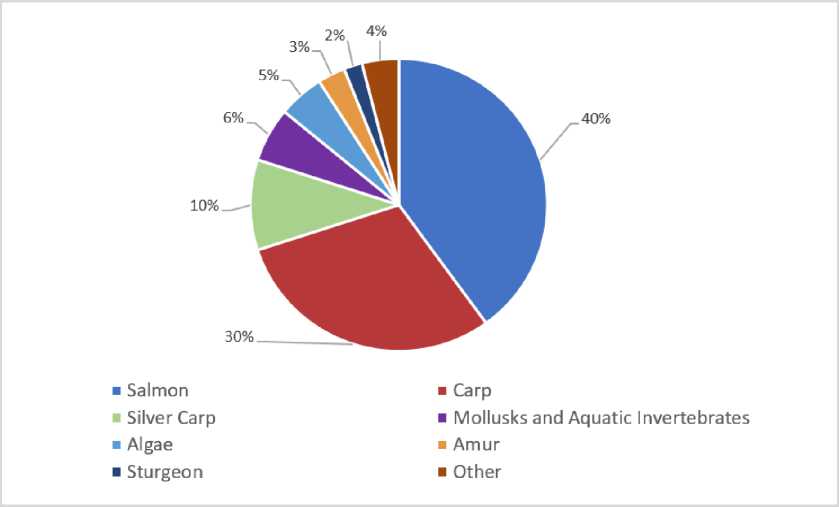
Fig. 1. Structure of aquaculture production in 20233.
Figure 2 shows the main segments of aquaculture production in 2024.
-2 Л
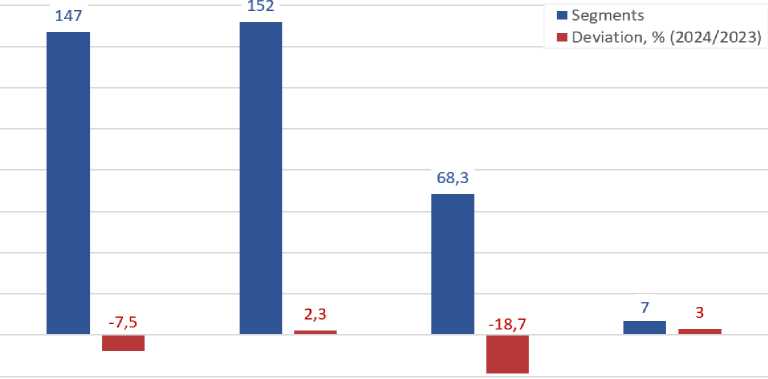
20Imonid fish species (trout, Cyprinids and herbivorous fish Valuable aquatic organisms salmon) species (oysters, mussels, scallops, and other mollusks and echinoderms)
Sturgeon species
Fig. 2. Main segments of aquaculture production in 20244.
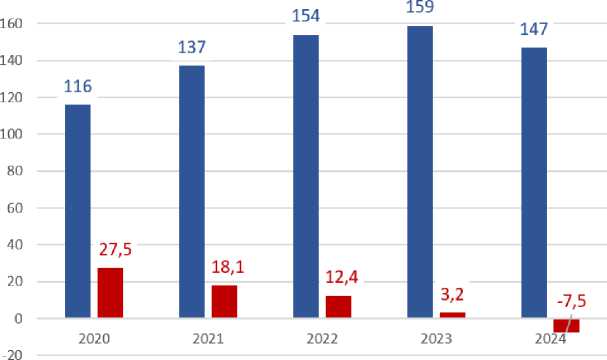
The development of domestic salmon farming is of great importance, as this product is in high demand by the population and this segment has consistently increased in growth, with the exception of 2024 (shown in Fig. 3).
■ Production Volume
■ Deпроизводств
Fig. 3. Dynamics of aquaculture salmonids production in Russia5. Over the forecast period up to 2034, salmon farming in Russia is set to rise to 209,000 tons, with imports reaching 75,000 tons per year, compared to 60,000 and 65,000 tons in 2023 and 2024, respectively. Consumption could reach 450 billion rubles in monetary terms, which is 2.8 times more than in 20246. The current regional specialization of aquaculture production shows that in Russia’s NorthWestern Federal District (NWFD), salmonids constitute the key production volume, accounting for 98%. In the Murmansk Oblast, the main products of commercial fish farming are Atlantic salmon, sea trout, and rainbow trout; in the Leningrad Oblast, rainbow trout accounts for 97%; and in the Republic of Karelia, trout accounts for 99% (Zhukova, 2024). The Republic of Karelia leads the NWFD in terms of the number of operating aquaculture facilities (98 facilities), followed by St. Petersburg — 47 facilities, the Murmansk Oblast — 26, the Vologda Oblast — 15, and the Arkhangelsk Oblast — 10. Table 4 shows salmonid production in the Russian Federation. In 2024, the North-Western Federal District became the traditional leader in aquaculture production, with 103,400 tons, followed by the Southern Federal District with 94,200 tons, and the Far Eastern Federal District with 93,000 tons. A press release from the North-Western Territorial Administration (NWTA) dated February 17, 2025, stated: “In 2024, the North-Western Territorial Administration (NWTA) produced 46,030 tons of commercial aquaculture products: 32,700 tons of commercial fish and 13,300 tons of fish seed. Compared to 2023 (54.68 thousand tons), the volume of commercial aquaculture production amounted to 84.2%. In 2024, the NWTA held 12 auctions for the right to conclude agreements for the use of fish farming sites; as a result, 6 fishing sites with a total area of 184.7 hectares were provided for aquaculture purposes, leading to the transfer of over 52 million rubles to the federal budget. In order to fulfill the state assignment to compensate for damage caused to aquatic bio- logical resources (ABR), the first release of juvenile Atlantic salmon in 2025 by the Nevskiy Fish Hatchery into the Neva River amounted to 80,000 specimens. The Atlantic salmon juveniles were hatchery-reared from broodstock caught in the Neva River. In 2024, 267,119 specimens of Arctic char were released into Lake Ladoga; 678,049 specimens of Atlantic salmon — into the rivers of the Gulf of Finland basin; 761,338 specimens of juvenile pike perch — into the lakes of the Leningrad Oblast.”7 Construction and modernization of fish feed production facilities The importance of domestic fish feed production is highlighted in the Strategy for the Development of the Fisheries Sector, which states that by 2030, 90% of enterprises’ fish feed needs are to be met by domestic production. The Russian salmonid aquaculture market’s dependence on foreign feed in 2022 was approximately 90%, but the situation is changing. In 2024, the volume of fish feed production for aquaculture in Russia amounted to 100,000 tons, which is 108.3% more than in 2023 (48,000 tons)8. This made it possible to meet approximately 25% of the Russian aquaculture market’s needs. In 2024, domestic fish farmers met 15% of the Russian market’s demand for salmon seed. According to estimates by experts at the Centre for Market Economics9, demand for feed could grow to 250,000 tons in the medium term, of which over 139,000 tons will be for salmon feed and over 10,000 tons — for both salmon and sturgeon. The current trend in the development of the Russian fisheries complex identifies aquaculture as a key area for scientific support in the fields of genetics, breeding and the development of new fish feed formulations. The Federal State Budgetary Scientific Institution VNIRO, its branches, and higher education institutions involved in the country’s fisheries industry are conducting research to improve the quality of domestic fish feed. In particular, researchers at the Kaliningrad State Technical University (KSTU) have patented a unique technology that combines the raw material potential of Russia’s marine areas, from Kaliningrad Baltic herring to Kamchatka squid, using amber chelate bonds. The Department of Chemistry at KSTU reports: “...we succeeded in synthesizing amber chelate complexes. The resulting products contain succinate ions, which gives them increased biological and nutritional value, as well as adaptogenic and immunomodulatory properties. Protein hydrolysates obtained in this way can be used in a wide range of industries, from pharmaceutical and food to veterinary and innovative feed products.”10 In the Republic of Karelia, the company “RusFish” has been producing fish feed since 2023. It is planned to invest 1.6 billion rubles in the new facility, located in the Kondopoga District of Karelia, and to create 89 new jobs. The products manufactured there will enable the republic’s fish farmers to completely eliminate their reliance on imported feed. The project is scheduled for completion in 2026. In 2024, production facilities in the Nizhny Novgorod and Kursk Oblasts were commissioned, with a total estimated capacity of 18,500 tons of specialized fish feed per year. In North Ossetia, Ostrov Aquaculture Company completed the first phase of its trout farm development in 2023. As a result, 100 reservoirs were constructed, with annual production reaching 2,500 tons of trout. The second phase of the project is currently at the design stage. The planned completion date for the investment project is 2029. In the Primorskiy Krai, Vozrozhdenie Company plans to commission a plant for the production of high-quality fish feed in 2025. The plant’s annual capacity will be up to 16,000 tons of feed with an original formula for Pacific salmon, trout, carp, catfish, and other aquatic species. The initial stages of the project began with the development of original feed formulas. Scientists, engineers, and technologists from the Advanced Engineering School “Institute of Biotechnology, Bioengineering, and Food Systems” of the Far Eastern Federal University (FEFU) were engaged in the project. As a result, the feed formulations included specialized components such as microalgae, hydrolysates, and others (Tsitskieva, Betlyaeva, Markin, 2024). All feed components are grown, harvested, and produced in Primorye, with the exception of certain vitamin groups. Laboratory testing of feed samples showed that these products are comparable to, and in some respects, superior to, the best Russian and foreign feeds. The company plans to supply salmon hatcheries in the Far East with feed and subsequently to expand into export markets. One of the promising areas of the fishing industry is mariculture — a form of aquaculture involving the farming of aquatic organisms in controlled artificial environments. In Primorsky Krai, which accounts for 95% of mariculture in the Far East, the draft regional budget allocated over 7.6 million rubles for subsidies for this sector in 2025. Salmon farming and mariculture are the key drivers for achieving the strategic indicators of the Russian fisheries sector. According to statistics on the Russian fishing industry from the Russian Federal Research Institute Of Fisheries and Oceanography (VNIRO), commercial fish farming in 2021 and 2022 amounted to: (presented in Table 2) (Kolonchin, 2023). Table 2 Commercial fish farming 11
Farming facilities
Total
2021
Number of facilities, units
1 988
Number of farmed species including:
319 342
Freshwater farming
11 Source: (Kolonchin, 2023).
— number of facilities, units — farmed by species
1 854
190 479
Mariculture
— number of facilities, units — farmed by species
134
128 863
2022
Number of facilities, units
2 283
Number of farmed species including:
348 187
Freshwater farming
— number of facilities, units
— farmed by species
2 132
195 039
Mariculture
— number of facilities, units — farmed by species
151
153 148
The statistical data demonstrate the potential for their application in analysis and recommendations for improving the efficiency of commercial fish farming. Domestic aquaculture production ensures a sustainable supply of high-quality aquatic products to the country’s population. Enterprises in this sector have economic and social respon- sibilities — they create new jobs for local residents, play an active role in social life and contribute to the development of the relevant infrastructure. These activities are particularly important in Russia’s border regions (Khasanova, Skuratova, Musina, 2024). International trends In the long term, aquaculture could become the main driver of global fisheries development — global aquaculture production is growing by approximately 4% per year. According to estimates by the Food and Agriculture Organization of the United Nations (FAO), global fish production increased by 3.3% by the end of 2024, exceeding 100 million tons (The State of Food and Agriculture, 2024). FAO experts regard the high level of fish farming and aquaculture12 as a success, as they believe it allows for increased food production from aquatic resources without placing additional pressure on the marine environment. Farming seafood instead of catching it will provide a respite for overexploited species (Ignaciuk, Ilicic, Asprooth et al., 2021; OECD, 2021). However, global researchers conclude that aquaculture almost never produces more calories or nutrients than it consumes, which contradicts the industry’s claim that large-scale fish farming is essential for feeding the world’s growing population. Research shows that 23.4 million tons of wild-caught small fish are processed into fishmeal and fish oil annually, most of which is intended for use in feed for predatory fish cultivated on farms and in factories, such as salmon, trout, prawns, and others. Farmed salmon consume up to six times their own weight in wild fish, and prawns — up to one and a half times their own weight in wild fish by the time they reach the market (Nikandrov, Shindavina, Zinchenko et al., 2024). Salmon and prawns are the most popular farmed marine species among consumers in developed countries. In 2022, global salmon sales were estimated to be worth over 21 billion US dollars; the prawn market — nearly 74 billion US dollars in 2024. As aquaculture production continues to grow, demand for fishmeal and fish oil is increasing. Cooke (Canada), one of the largest seafood producers, is acquiring Copeinca, a Peruvian producer of fishmeal and fish oil. High-quality fishmeal and fish oil provide safe and nutritious feed for the growth and care of animals across several sectors, including aquaculture. Copeinca holds the largest anchovy quota in Peru — 15.9% of the total — and processes approximately 21% of the country’s catch, enabling the company to produce approximately 200,000 tons of fishmeal and 23,000 tons of fish oil annually. The deal will allow Cooke to diversify its geographic presence and product range, strengthening its vertical integration as a producer of aquaculture salmonids. The Japanese corporation Mitsubishi is investing in Finnish salmon aquaculture producer Finnforel to expand its trout farming facilities. Finnforel’s mission is to save the seas and feed the planet. The Finnish company farms fish using its own concept, which involves advanced biofiltration to control all environmental factors in the trout’s environment. The concept includes processing and packaging fish products in the farming sites, which minimizes the number of participants in the logistics chain and reduces transportation time. This guarantees the freshness of the fish products and lowers their cost. Mitsubishi’s assets in the fishing industry include the British Princes Group, which processes 30–40% of the bluefin tuna imported into Japan, the Norwegian aquaculture company Cermaq, and the Japanese wholesale company Toyo Reizo. Global catches of aquatic biological resources have remained in the range of 90–92 million tons for over 10 years. At the same time, global aquaculture production is growing by almost 4% per year, making investment in this segment of the fishing industry feasible. According to experts, the Russian fishing industry is capable of increasing capacity and producing up to 500,000 tons of feed meal by 2030. According to research by the All-Russian Association of Fishery Enterprises (VARPE), the potential for fishmeal exports by 2030 could reach 1.1 billion US dollars, which is more than four times higher than the figure for 2023. Aquaculture is currently becoming one of the fastest-growing sectors of Russian agriculture. However, despite this progress, a number of recommendations need to be implemented to improve the efficiency of commercial aquaculture production:
• ensure healthy growth and immunity of aquatic organisms;
• develop innovative high-energy feeds that improve the nutritional value and boost the immunity of valuable fish, in collaboration with Russian higher education institutions and institutes of the Russian Academy of Sciences; this will lead to an improvement in the quality of fish products on the market;
• enable domestic enterprises to increase production volumes in key aquaculture segments using Russian scientific achievements in breeding. For example, in the Republic of Karelia (North-Western Federal District), salmonid production volumes increased in the first three months of 2025 (7.5 thousand tons were farmed, which is 37.2% higher than the result for the same period in 2024), sturgeon production figures in the first quarter increased by 17.5% (4.3 thousand tons of commercial fish were farmed), and in the Sakhalin Oblast, from January to March 2025, there was an increase in the production of seafood — mussels, oysters, scallops and other mollusks and echinoderms, as well as seaweed (more than 14.4 times higher than the figures for the first quarter of 2024).
Conclusion Aquatic biological resource production in Russia has remained stable for over five years, amounting to approximately 5 million tons. Since 2021, the total allowable catch (TAC) set by the Joint Russian-Norwegian Fisheries Commission (JRNFC) for northern cod in the Barents Sea has been decreasing: 2021 — 378,635 tons; 2022 — 302,605 tons; 2023 — 241,782 tons; 2024 — 193,124 tons; 2025 — 151,436 tons. There are plans to introduce restrictions on cod fishing in two areas of the Far East (specifically during the spring fishing season) (Lisienko, 2024). The reduction in the TAC will affect cod catch volumes and supplies to the domestic and export markets; cod prices are already rising sharply (Vopilovskiy, 2024). Growing demand is noted, and cod remains one of the most popular whitefish species on the global market. Consequently, it would be beneficial to draw on the expertise of Norway, which borders the Murmansk and Arkhangelsk Oblasts (NWFD) and has similar climatic conditions, in the production of farmed cod. Norwegian farmers are actively developing this sector: in 2024, total aquaculture cod production reached 20,000 tons, and by 2026, it could reach 32,000 tons (+60%). Norwegian aquaculture will account for around a third of all exported cod. In the past, cod farming was not economically viable due to high production costs and relatively low market prices for this species. Currently, the situation is changing rapidly: the TAC is being reduced, the supply of cod on the global market is steadily declining, and prices are rising. Russian cod aquaculture is not yet well developed, but there is a good example set by Norwegian farmers that aquaculture farms in the Northern Basin can follow. The People’s Republic of China is intensifying its efforts to develop commercial aquaculture of Pacific cod (Gadus macrocephalus) aquaculture, viewing this sector as promising. The technology developed by Chinese scientists for the full biological cycle of Pacific cod farming in artificial conditions has been recognized as ready for commercialization. Commercial aquaculture production in Russia showed steady growth from 2016 to 2023 (Table 1), which is related to systematic research into the development of this sector. Further joint work between representatives of fisheries science and fish-farming community reveals strategic prospects for the development of the country’s aquaculture sector: increasing export potential, reducing dependence on imports, relieving pressure on wild stocks, and diversifying aquaculture.
