
Automation of Food and Beverage Processes using Integrated Software Solutions
Журнал: Бюллетень науки и практики @bulletennauki
Рубрика: Технические науки
Статья в выпуске: 10 т.12, 2026 года.
Бесплатный доступ
The rapid digital transformation of the hospitality industry has increased the importance of software-based automation in food and beverage (F&B) operations. Restaurants, cafés, catering companies, hotels, and other food-service businesses increasingly rely on integrated digital systems to manage ordering, inventory, kitchen operations, procurement, workforce scheduling, customer relationships, payments, and managerial analytics. This study examines the role of software solutions in automating F&B processes and evaluates their potential contribution to operational efficiency, cost control, service quality, and data-driven decision-making. The research applies a qualitative analytical approach based on a structured review and synthesis of contemporary studies concerning restaurant technologies, self-service systems, artificial intelligence, digital inventory management, demand forecasting, and service automation. The analysis identifies five major areas of F&B automation: order and payment management, kitchen operations, inventory and procurement, workforce management, and business intelligence. The findings indicate that the greatest value is generated when individual digital applications are integrated into a unified information environment in which operational data are automatically exchanged between point-of-sale systems, kitchen displays, inventory modules, customer interfaces, and analytical platforms. At the same time, technological fragmentation, implementation costs, employee resistance, cybersecurity concerns, data quality, and dependence on reliable digital infrastructure remain significant barriers. The study proposes an integrated model of F&B process automation and argues that software automation should be considered not simply as a mechanism for replacing manual tasks but as an organizational capability supporting scalability, operational transparency, resource optimization, and improved customer experience.
Короткий адрес: https://sciup.org/14139245
IDS: 14139245 | УДК: 658.512.011.56 | DOI: 10.33619/2414-2948/131/14
Автоматизация процессов производства продуктов питания и напитков с использованием интегрированных программных решений
Стремительная цифровая трансформация индустрии гостеприимства повысила важность автоматизации процессов в сфере общественного питания (F&B) на основе программного обеспечения. Рестораны, кафе, кейтеринговые компании, отели и другие предприятия общественного питания все чаще полагаются на интегрированные цифровые системы для управления заказами, запасами, работой кухни, закупками, расписанием работы персонала, взаимоотношениями с клиентами, платежами и управленческой аналитикой. В этом исследовании рассматривается роль программных решений в автоматизации бизнес-процессов и оценивается их потенциальный вклад в повышение операционной эффективности, контроль затрат, качество обслуживания и принятие решений на основе данных. В работе используется качественный аналитический подход, основанный на структурированном обзоре и обобщении современных исследований, касающихся ресторанных технологий, систем самообслуживания, искусственного интеллекта, цифрового управления запасами, прогнозирования спроса и автоматизации обслуживания. Анализ выявил пять основных областей автоматизации предприятий общественного питания: управление заказами и платежами, кухонные операции, инвентаризация и закупки, управление персоналом и бизнес-аналитика. Полученные результаты свидетельствуют о том, что наибольшая ценность достигается при интеграции отдельных цифровых приложений в единую информационную среду, в которой происходит автоматический обмен оперативными данными между системами торговых точек, кухонными дисплеями, модулями инвентаризации, клиентскими интерфейсами и аналитическими платформами. В то же время технологическая фрагментация, затраты на внедрение, сопротивление сотрудников, проблемы кибербезопасности, качество данных и зависимость от надежной цифровой инфраструктуры остаются существенными препятствиями. В исследовании предлагается интегрированная модель автоматизации бизнес-процессов и утверждается, что внедрение программного обеспечения следует рассматривать не просто как механизм для замены ручных задач, но и как организационную возможность, поддерживающую масштабируемость, прозрачность работы, оптимизацию ресурсов и улучшение качества обслуживания клиентов.
Текст научной статьи Automation of Food and Beverage Processes using Integrated Software Solutions
Бюллетень науки и практики / Bulletin of Science and Practice
UDC 658.512.011.56
Software automation provides an alternative operational model. Instead of treating individual restaurant activities as isolated processes, contemporary information systems can connect front-of-house, back-of-house, administrative, and analytical functions through common digital workflows.
The expansion of self-service technologies illustrates this transformation. Recent restaurant research shows that ordering interfaces, kiosks, tablets, and related technologies are increasingly changing the traditional interaction between employees and customers. Perceived usefulness, ease of use, service speed, system functionality, and interface design are among the factors associated with customer acceptance of, and satisfaction with, restaurant self-service technologies [1–3].
Automation is simultaneously expanding beyond customer-facing operations. Contemporary restaurants increasingly employ software for inventory monitoring, demand forecasting, workforce planning, recipe management, procurement, waste tracking, and managerial analytics. Artificial intelligence further expands these capabilities through predictive models, computer vision, intelligent recommendations, and service robotics [4–6].
RQ2: How can integrated software systems improve operational efficiency and managerial decision-making?
Materials and Methods
The analysis focused on research and applied evidence addressing the following technological categories: point-of-sale (POS) systems, digital and self-service ordering, kitchen display systems, inventory management software, procurement systems, workforce-management applications, customer relationship management (CRM), demand forecasting, artificial intelligence, service robotics, food-waste monitoring, and managerial analytics and business intelligence.
Particular attention was paid to the interaction between technologies rather than to individual applications in isolation.
For each functional area, four analytical dimensions were considered: degree of automation, data generated by the process, integration potential, and expected operational outcome.
Table 1
|
Functional area |
Typical manual process |
Software-based process |
Expected outcome |
|
Customer service |
Waiter manually records orders |
POS, QR ordering, kiosk, mobile ordering |
Faster order processing |
|
Kitchen |
Printed/handwritten tickets |
Kitchen Display System (KDS) |
Improved order coordination |
|
Inventory |
Manual stock counting |
Real-time inventory software |
Better stock visibility |
|
Procurement |
Manual supplier ordering |
Automated purchasing module |
More accurate replenishment |
|
Workforce |
Manual shift preparation |
Scheduling and forecasting software |
Improved labor allocation |
|
Customer management |
Informal customer records |
CRM and loyalty platforms |
Personalization and retention |
|
Reporting |
Spreadsheet-based reporting |
Real-time dashboards |
Faster managerial decisions |

The study assumes that automation produces maximum operational value when information flows continuously between operational systems.

CUSTOMER
Digital Ordering
S □ 5 ®
QR Code Mobile App Kiosk Online Ordering
POS System
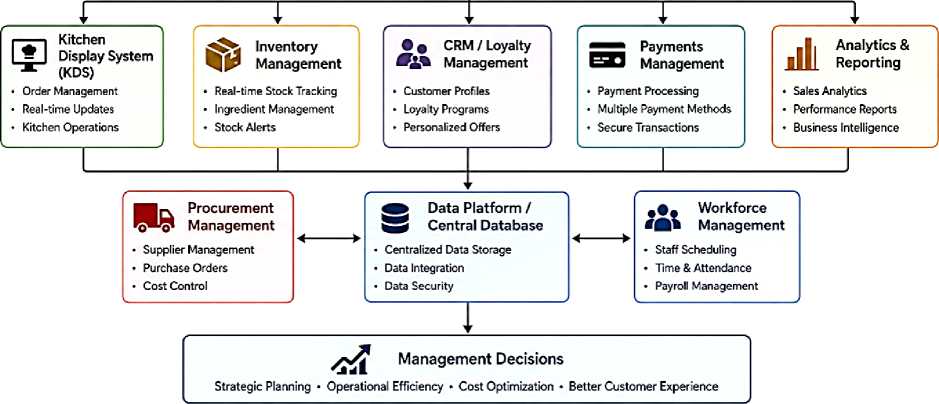
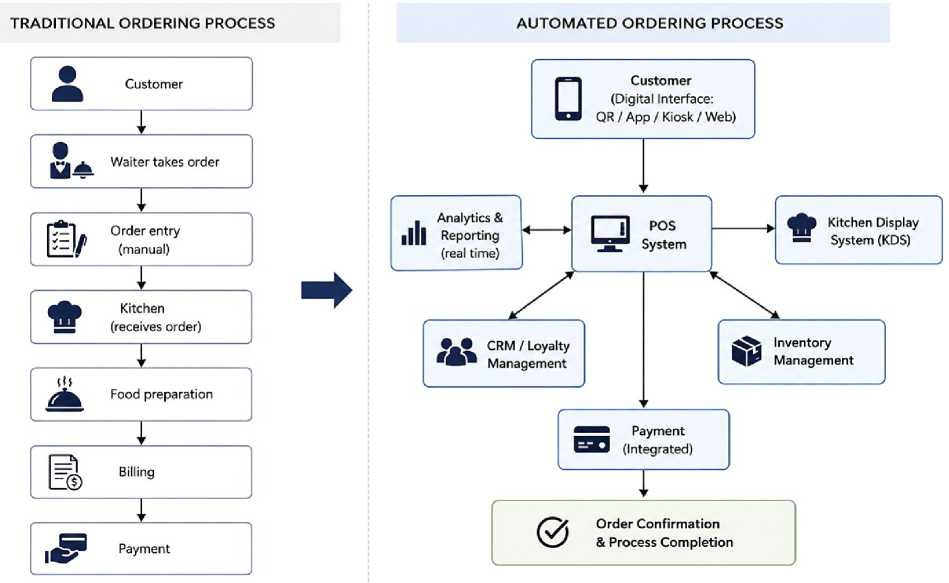
The conceptual architecture demonstrates that the POS system can operate as a central transactional component. A customer order generates data that can simultaneously trigger kitchen production, update sales information, reduce theoretical inventory, update customer profiles, and contribute to managerial analytics.
Results
Therefore, automation should not be interpreted simply as replacing employee interaction. The quality of the technological interface becomes part of service quality. The automated process can be represented as follows: the primary advantage is not merely faster ordering. Digital order capture creates structured data that can be reused by other operational systems. The kitchen represents another critical point for software integration. Kitchen Display Systems replace or complement printed tickets and allow incoming orders to be displayed according to preparation station, priority, order type, or preparation time. A digitally connected kitchen can receive orders directly from the POS or online ordering platform. This reduces unnecessary information transfer and enables management to monitor operational indicators such as preparation time and order completion. Kitchen automation can also provide the technological foundation for more advanced solutions. Research concerning artificial intelligence and service robotics demonstrates the increasing interest in AI-enabled restaurant operations [4].
However, kitchen automation does not necessarily mean replacing chefs or service personnel. In most practical applications, software primarily coordinates information, prioritizes tasks, and eliminates repetitive administrative activities.
An integrated system can create a continuous relationship between sales and theoretical inventory: Sale → Recipe → Ingredient Consumption → Inventory Update → Reorder Decision.
For example, when one menu item is sold, the software may automatically calculate the theoretical consumption of all ingredients associated with its standardized recipe. Evidence from restaurant inventory research indicates that reliance on manual, experience-based inventory practices can contribute to inefficiency, while structured inventory control, forecasting, FIFO procedures, and digital monitoring can improve operational effectiveness and support food-waste reduction [7].
The potential of artificial intelligence is particularly relevant here. Demand forecasting models can process historical orders and other variables to estimate future demand. Recent research applying deep-learning forecasting to online food-delivery supply chains has demonstrated the potential of predictive approaches to improve inventory decisions and reduce supply-chain instability [8].
Table 2
|
Criterion |
Manual approach |
Software-automated approach |
|
Inventory visibility |
Periodic |
Near real-time |
|
Ingredient consumption |
Estimated manually |
Calculated from recipes and sales |
|
Reordering |
Manager judgment |
Threshold/forecast-based |
|
Waste identification |
Limited |
Digitally recorded and categorized |
|
Cost updates |
Manual |
Can be linked to purchasing data |
|
Variance detection |
Delayed |
Continuous or periodic automated comparison |
|
Forecasting |
Experience-based |
Data-driven |
COMPARISON OF MANUAL AND AUTOMATED INVENTORY MANAGEMENT
1. SALES DATA
• POS transactions
• Menu performance
8. FORECAST UPDATE
* Model recalibration
-
• Process adjustments
-
• Policy refinement
-
• Continuous learning
2. DEMAND FORECAST
-
• Predictive analytics
-
• Al / ML models
-
• External factors (weather, events, etc.)
7. DATA ANALYSIS
Data-Driven
-
• Waste pattern analysis
-
• Variance identification
-
• Root cause analysis
-
• KPI monitoring
Food-Waste
-
3. PURCHASING PLAN
Reduction Cycle
» Optimal order quantities
• Supplier & lead time
-
• Cost considerations
6. WASTE MONITORING
4. INVENTORY MANAGEMENT
-
-
• Plate waste measurement
-
• Real-time stock tracki
-
• FIFO/FEFO
-
• Expiry & usage alerts

-
-
• Ingredient waste tracking
-
• Reason categorization

5. FOOD PREPARATION & SERVICE
-
• Standardized recipes
-
• Portion control
-
• Operational efficiency
Figure 3. Data-Driven Food-Waste Reduction Cycle
An automated waste-management cycle can therefore be represented as follows, where waste information becomes a feedback mechanism rather than merely a record of losses. Labor represents another critical operational resource in restaurants and hospitality establishments. Demand fluctuates based on the hour, weekday, season, weather, events, promotions, and other factors; consequently, static schedules may result in understaffing or excessive labor allocation. Workforce-management software can combine historical sales data with scheduling information and predicted demand.
Transaction Data
↓
Customer Profile
↓
Segmentation
↓
Personalized Offer
↓
Customer Response
↓
Updated Customer Data
Table 3
|
Area |
KPI |
Managerial application |
|
Sales |
Revenue by hour/day |
Demand planning |
|
Menu |
Contribution margin |
Menu optimization |
|
Inventory |
Stock variance |
Loss control |
|
Kitchen |
Preparation time |
Workflow improvement |
|
Labor |
Labor cost/sales |
Staffing optimization |
|
Customer |
Repeat purchase rate |
Retention management |
|
Waste |
Waste per sales unit |
Sustainability/cost control |
|
Procurement |
Purchase price variance |
Supplier management |
Бюллетень науки и практики / Bulletin of Science and Practice Т. 12. №10 2026
|
Table 4 LEVELS OF F&B AUTOMATION MATURITY |
|
|
Level |
Characteristics Example |
|
Level 1: Digitalization |
Individual manual activities become Electronic POS digital |
|
Level 2: Automation |
Software automatically performs Automatic inventory deduction predefined tasks |
|
Level 3: Integration and Intelligence |
Multiple systems exchange data and POS + inventory + forecasting + generate recommendations procurement + BI |
The relationship can be conceptualized as: Digital Data → Integration → Automation → Analytics → Prediction → Decision → Operational Outcome.
Nevertheless, the results also suggest that automation should not be treated as an inherently beneficial technological intervention.
Table 5
|
Potential benefits |
Potential risks/barriers |
|
Faster order processing |
High implementation costs |
|
Reduced manual data entry |
Integration problems |
|
Improved inventory visibility |
Poor data quality |
|
Better demand forecasting |
Employee resistance |
|
Lower probability of human error |
Training requirements |
|
Improved managerial analytics |
Cybersecurity risks |
|
Scalable operations |
Vendor dependence |
|
Better waste monitoring |
System downtime |
|
Personalized service |
Privacy concerns |
Similarly, service-robot research shows that restaurant AI adoption involves complex relationships among technology, service experience, and consumer responses [4].
Conclusion
