
Big Data и предиктивная аналитика в управлении рекламными бюджетами на маркетплейсах: анализ эффективности рекламных инвестиций Ozon и Wildberries
Журнал: Экономика и бизнес: теория и практика @economyandbusiness
Статья в выпуске: 5 (135), 2026 года.
Бесплатный доступ
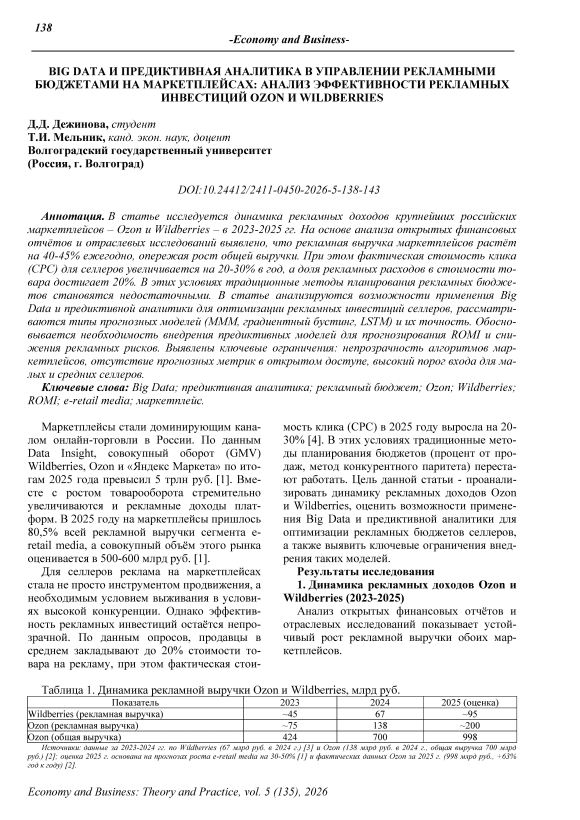
В статье исследуется динамика рекламных доходов крупнейших российских маркетплейсов – Ozon и Wildberries – в 2023-2025 гг. На основе анализа открытых финансовых отчётов и отраслевых исследований выявлено, что рекламная выручка маркетплейсов растёт на 40-45% ежегодно, опережая рост общей выручки. При этом фактическая стоимость клика (CPC) для селлеров увеличивается на 20-30% в год, а доля рекламных расходов в стоимости товара достигает 20%. В этих условиях традиционные методы планирования рекламных бюджетов становятся недостаточными. В статье анализируются возможности применения Big Data и предиктивной аналитики для оптимизации рекламных инвестиций селлеров, рассматриваются типы прогнозных моделей (MMM, градиентный бустинг, LSTM) и их точность. Обосновывается необходимость внедрения предиктивных моделей для прогнозирования ROMI и снижения рекламных рисков. Выявлены ключевые ограничения: непрозрачность алгоритмов маркетплейсов, отсутствие прогнозных метрик в открытом доступе, высокий порог входа для малых и средних селлеров.
Короткий адрес: https://sciup.org/170214082
IDS: 170214082 | DOI: 10.24412/2411-0450-2026-5-138-143
Big data and predictive analytics in advertising budget management on marketplaces: analysis of advertising investment efficiency of Ozon and Wildberries
The article examines the dynamics of advertising revenue of the largest Russian marketplaces – Ozon and Wildberries – in 2023-2025. Based on the analysis of open financial statements and industry studies, it was revealed that the advertising revenue of marketplaces is growing by 40-45% annually, outpacing the growth of total revenue. At the same time, the actual cost per click (CPC) for sellers increases by 20-30% per year, and the share of advertising expenses in the cost of goods reaches 20%. In these conditions, traditional methods of advertising budget planning become insufficient. The article analyzes the possibilities of using Big Data and predictive analytics to optimize sellers' advertising investments, considers the types of predictive models (MMM, gradient boosting, LSTM) and their accuracy. The necessity of implementing predictive models for forecasting ROMI and reducing advertising risks is substantiated. Key limitations are identified: opacity of marketplace algorithms, lack of predictive metrics in open access, high entry threshold for small and medium sellers.
