
Bio-Economy as a Key Lever for Improving the Performance of the Agro-Food Complex in the Northern Arctic Regions (On the Example of the Republic of Sakha (Yakutia))
Journal: Arctic and North @arctic-and-north
Section: Social and economic development
Article in issue: 62, 2026.
Free access
Bio-production and waste-free technologies in Russia are becoming an integral part of the modern economy. These processes are facilitated by political sanctions and the need to ensure food security and food independence for the country. The growth in the number of processing enterprises and other forms of business with a complete closed production cycle is also of considerable importance to this process. This is particularly true for large enterprises that can develop and implement innovative waste-free biotechnologies in production. All this helps to overcome import dependence and, most importantly, ensures environmental protection and ecological measures. Population growth and rising consumption levels, as well as the demand for environmentally friendly food, require the rational and economical use of resources. In turn, in order to increase the efficiency of the use of biological resources, especially in regions with difficult natural and climatic conditions, such as the Northern Arctic regions, with insignificant volumes of agricultural raw material production, their careful and efficient use is particularly important. This requires waste-free and closed-loop technologies that ensure maximum use of valuable raw materials and prevent damage to the environment from production waste. The subject of the study is to identify factors that directly influence the level and efficiency of bio-resource use for food production and ensuring food security and food independence of the country and regions, especially those with complex natural and climatic conditions for agro-industrial production. The aim is to identify the characteristics and assess the impact of food technologies used in the agro-industrial complex on the level of food self-sufficiency. Studies confirm the insufficiency of the measures taken to transition to deep processing of agricultural raw materials and bio-resources and the need to develop new standards for their industrial processing. The research results were based on a systematic analysis and an economic and statistical method of processing information obtained from the State Statistics Service and executive authorities on the state and problems of the agro-industrial complex.
Similar articles in the section Regional economics. Territorial economics
Short address: https://sciup.org/148333283
IDS: 148333283 | UDC: [332.14:338.439](571.56)(045) | DOI: 10.37482/issn2221-2698.2026.62.69
Text of the scientific article Bio-Economy as a Key Lever for Improving the Performance of the Agro-Food Complex in the Northern Arctic Regions (On the Example of the Republic of Sakha (Yakutia))
DOI:
In recent years, Russia’s agro-industrial complex has been characterized by a shift toward organic farming in order to produce environmentally safe raw materials and food products, as well as using by-products from all agricultural sectors [1, Antonova I.A.].
-
∗ © Rodnina N.V., 2026
This work is licensed under a CC BY-SA License
Biological and food security requires a systematic approach to organization, which implies a whole range of measures, including legislative ones at the international level [2, Kartskhia A.A., pp. 13–35].
The bio-economy covers all sectors of the economy that utilize biological resources. Agriculture is one of such sectors. Taking into account the specific features of agriculture, namely, the inefficient use of natural resource potential in most cases, the bio-economy is an extremely promising direction for achieving the goals of the Sustainable Development Strategy for agriculture and the country’s Food Security Doctrine [3, Gordeeva I.V., pp. 16–21].
April 2025 has been designated as the initial stage for the launch of the national project for the development of the bio-economy in the Russian Federation. The project should not only ensure the transition to waste-free production and new technologies, but also make up for lost time and minimize dependence on imported technologies, which currently accounts for 26% of the total market in the agro-industrial complex [4, Kartskhia A.A., pp. 216–224]. Therefore, the transition to a bio-economy, i.e. the efficient use of raw materials and waste-free production, can lead to the development and, accordingly, sustainability of agriculture and rational use of natural resources. This is especially important for Russia’s regions, as the development of the agricultural sector based on bio-economy will contribute to the increase of one of the key indicators of regional development — gross agricultural production, and will ensure increased food self-sufficiency, environmental preservation, employment, and, consequently, improved quality of life.
Agriculture and bio-economy in Yakutia: key indicators, problems, solutions
The current state of the agro-industrial complex of the Republic of Sakha (Yakutia) is characterized by instability and a lack of dynamic development. Over the past four years, the agricultural production index has fluctuated between 99% and 101.4% (Fig. 1).
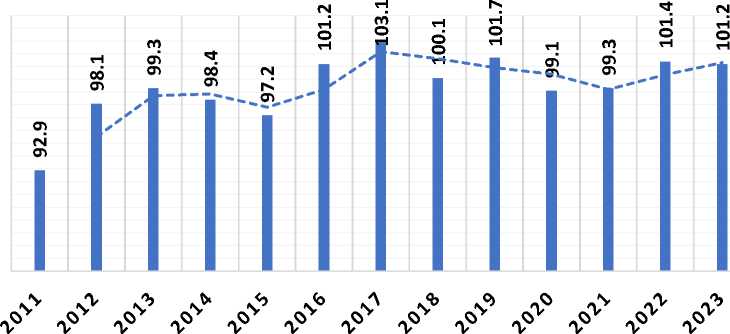
Fig. 1. Agricultural production indices in the Republic of Sakha (Yakutia).
The main agricultural producers in the Republic of Sakha (Yakutia) are private household farms, which account for up to 49% of all agricultural output. This is the only category in which the production index (2023 to 2010) exceeded 100%, reaching 100.5%. Agricultural organizations, peasant (farmer) households, and individual entrepreneurs experienced a continued decline (80.8% and 88.7%, respectively) 1.
Despite high depreciation and the lack of high-performance equipment, farmers managed to slightly increase agricultural production per hectare of farmland. Thus, according to data from the Office of Rosreestr in the Republic of Sakha (Yakutia), agricultural output per hectare increased by 85.6% from 2012 to the end of 2023, while crop and livestock output per hectare of arable land and hayfield increased twofold and by 75.7%, respectively (Table 1).
Table 1 Agricultural output per hectare of agricultural land in the Republic of Sakha (Yakutia) in 2023 according to data from the Office of Rosreestr in the Republic of Sakha (Yakutia), thousand rubles
|
Agricultural output per hectare of agricultural land |
Crop output per hectare of arable land |
Livestock output per hectare of hayfields |
||||||
|
2012 |
2018 |
2023 |
2012 |
2018 |
2023 |
2012 |
2018 |
2023 |
|
11.1 |
15.7 |
20.6 |
52.8 |
75.9 |
109.1 |
17.7 |
24.7 |
31.1 |
Agriculture in the Republic of Sakha (Yakutia) is focused on livestock farming, primarily dairy farming. However, in most regions of the republic, due to the outflow of the working-age population from rural areas, there has been a significant decline in the number of certain livestock species. For example, since 1990, the number of horses in the republic has decreased by 11%, while the number of domesticated reindeer has decreased by 53%. The number of cattle in the region has declined particularly significantly (by 2.5 times) (Fig. 2). As a result, according to data as of 1 January 2024, the dairy herd has decreased from 145.4 to 67.6 thousand head, or by 2.2 times, and the number of cows per 1,000 people has decreased by 1.9 times (Table 2).
150000 I ♦
|
0 |
1990 2000 2010 2015 2018 2023 |
|
— ♦ — Reindeer |
361556 156237 200280 156011 146585 171595 |
|
— ■ — Horses |
199537 129496 163557 176649 178184 178938 |
|
-*- Cattle |
409201 289716 233695 187207 183468 158953 |
Fig. 2. Number of traditional livestock species in the Republic of Sakha (Yakutia).
Table 2
Cow population in the Republic of Sakha (Yakutia) at the end of the year
|
1990 |
2000 |
2010 |
2015 |
2018 |
2023 |
|
|
Cows, heads |
145367 |
109020 |
87805 |
75302 |
70255 |
67557 |
|
Number of cows per 1,000 population, heads |
130 |
114 |
92 |
79 |
73 |
68 |
|
Gross milk yield, tons |
267400 |
164599 |
191606 |
164572 |
166055 |
153170 |
|
Milk production per capita, kg (standard: 322 kg/year) |
239.8 |
171.5 |
199.9 |
172.2 |
172.3 |
153.2 |
The volume of agricultural production in the livestock sector depends primarily on such factors as the average annual livestock population and productivity. In the harsh conditions of livestock farming in the republic, it is very difficult to increase milk yield per cow. Therefore, agricultural producers are faced with the challenge of adopting biotechnology to effectively manage available resources, particularly by influencing processes that maximize production per ton of raw materials, such as milk.
Dairy products are a source of vitamins and minerals without preservatives or artificial additives, which makes them much more expensive to produce than dairy products containing artificial and plant-based additives. This situation can be improved by developing and implementing technologies that ensure more thorough milk processing and the efficient use of secondary raw materials — essentially, production wastes, which is comparable to whole milk in terms of its biological characteristics.
At the same time, one of the important problems in the formation of effective dairy production remains the low level of use of secondary raw materials. The issue of full and rational use of milk is relevant for almost all countries. This production is particularly challenging for countries and regions where the main agricultural producers are farms and the population. The problem stems from traditional dairy production technologies and its inefficiency, and in some cases, the complete absence of innovative waste-free technologies. In the Republic of Sakha (Yakutia), this problem also remains unresolved. Moreover, the problem concerns not only cow’s milk, but also mare’s and deer’s milk. Despite the fact that industrial technologies have been developed for the production of certain types of products from secondary milk raw materials, including mare’s and deer’s milk, the wear and tear of equipment at most producers, as well as the remoteness and inaccessibility of certain areas where these herds are located, prevent their full utilization. At the same time, the state has set a strategic goal for the agro-industrial complex to ensure a sustainable and guaranteed supply of high-quality, safe and sufficient food products to the population.
Raw milk is one of the most expensive commodities. In market conditions, as well as in conditions of insufficient supply, all efforts should be directed towards preserving the raw milk that has already been produced through its full and rational use, applying waste-free technologies and preserving all useful components. For example, whole and skimmed milk (including buttermilk) contain 3.2% protein, 4.7% lactose, and 0.7% minerals, while milk whey contains 0.8%, 4.8%, and 0.5%, respectively. All these secondary raw materials, including milk fat, carbohydrates, vita-
SOCIAL AND ECONOMIC DEVELOPMENT
Natalia V. Rodnina. Bio-Economy as a Key Lever for Improving the Performance … mins, enzymes and organic acids, are part of a set of vital compounds and are contained in whole milk. In turn, all of these components — enzymes, phospholipids, and vitamins — are biologically active substances found in skimmed milk, buttermilk, and whey, which play an important role in human health. Although they are inferior to milk in terms of energy value (buttermilk — by almost 2 times, and whey — by almost 3.5 times), they have practically the same biological value [5, Makarenko V.V., Drannikov D.D., pp. 112–115].
The use of secondary raw materials is possible by including them in the recipes of manufactured products, which will not only expand the range, but also improve the taste properties due to buttermilk and whey. This is especially true for whey, which usually accounts for up to 70% of the total volume of processed milk [6, Kremyanskaya E.V.]. As for the Republic of Sakha (Yakutia) specifically, dairy plants process an average of up to 3 tons of milk per day. The production of cream, butter (traditional technology), curd products and sour cream results in secondary raw materials. Thus, the production of 1 ton of butter yields up to 20 tons of skimmed milk and up to 1.5 tons of buttermilk, while the production of 1 ton of cheese and 1 ton of curd cheese yields up to 10 tons and 8 tons of whey, respectively [7, Stepanov K.M., Darmaeva G.G., Khankhaldaeva S.G.-D. et al., pp. 43–45].
In Yakutia, whey is used for food purposes in insignificant volumes. In most cases, it is poured out or fed to calves [8, Darmaeva G.G., 256]. However, whey-based beverages are costeffective and can be produced in a wide variety of forms, including through the addition of various components, such as fruits or, for example, flower honey [9, pp. 241–246].
Another problem specific to Yakutia is the need to improve the efficiency of raw material use in traditional agricultural sectors, such as herd horse breeding and northern domestic reindeer husbandry.
Thus, advanced processing is required in the production of reindeer products. This will improve the efficiency of reindeer herding. Therefore, it is necessary to address the issue of the most complete and waste-free use of all reindeer products, not just meat, but also antlers, blood, endocrine-enzyme, and other raw materials. Currently, secondary products from reindeer herding are largely wastes, negatively impacting the environment. However, the biologically active substances in reindeer blood, when thoroughly processed, can be used as food supplements and human pharmaceuticals, while endocrine-enzyme and other raw materials are very useful for the pharmaceutical industry in the production of hormonal, enzymatic, and biologically active drugs, numbering already more than 30 [10, Maksimov A.A., pp. 110–118].
In general, deep processing of secondary raw materials increases the profitability of production, as it expands the range of products beneficial to human health and reduces the level of environmental pollution. At the same time, the biotechnological processing of secondary raw materials and waste from traditional northern industries, such as reindeer herding, horse breeding, and hunting, makes it possible to increase the profitability of these industries by 25–40%. The cre- ation of high-tech jobs, in turn, will increase the profitability of production and improve the quality of life of the rural population 2.
Bio-economy: focus on efficiency of the agro-industrial complex
Back in 2012, the European Commission’s strategy and action plan defined the creation of an innovative economy based on a balanced agriculture and its sectors while simultaneously preserving the environment and its biodiversity as its main goal. The plan included provisions such as development of technological bio-economic processes, development of market and competitive relations in economic sectors, and ensuring cooperation between all participants in bio-economic processes [11, Eugeniusz K.Kh., Ostrowski J., pp. 2–7].
Russia has been addressing issues related to the development of the bio-economy and bioenergy for a long time. However, to date, the Russian Federation has not adopted a unified bio-economic strategy for transforming the linear economy into a bio-economy. Despite the fact that the Russian President identified Russia’s transition to an environmentally sustainable development model as one of its key goals back in 2017, and the Government was instructed to pay special attention and establish indicators characterizing the maximum use of renewable energy sources, a fragmented approach to the closed-loop economy persists, and the transition to an environmentally sustainable development model has not yet taken place.
Current agricultural activity in the country and regions is influenced by internal and external factors, as well as other barriers that negatively affect the development of bio-economic processes (Fig. 3).
|
Disadvantages |
Barriers |
|
Lack of sufficient competencies for professional supervision and research |
Slow transformation of bio-economic regulatory systems (organizational and legal, financial and fiscal, economic and administrative) |
|
Lack of initiative in training professionals for work in the relevant field |
Difficulties in identifying priority bio-economic research projects taking into account the economic and production needs of businesses |
|
Lack of funding for research and implementation |
Insufficient interest in new bio-economic approaches and other environmentally friendly technological innovations and solutions |
|
Lack of a unified approach to implementing biotechnology innovations across various industries and sectors of the economy |
Slow implementation of existing innovative developments and solutions in the field of waste-free technologies |
|
Lack of financial resources for bio-economic activities, especially those associated with risk |
Weak and underpowered scientific and technological base, lack of programs to create infrastructure for the development of the bioeconomy |
|
Lack of industrial facilities and infrastructure |
Lack of technological leadership |
Fig. 3. Factors and barriers hindering the transition to bio-economy.
Business plays a major role in the development of a closed-loop economy. However, the bio-economy requires significant investments in innovation and other areas. Environmental design and research aimed at developing technologies for the rational use of resources with waste minimization are costly, and mandatory synchronization across all production sectors is also required.
In turn, the bio-economy model can be considered effective when the natural resources extracted are largely replenished by the wealth created in the process of their development 3.
There are two main tasks in this regard. Firstly, it is the training of qualified personnel with multidisciplinary knowledge and skills, especially in the use of applied ICT. Secondly, it is the reduction of dependence on external supplies of components and know-how. Investments in production will ensure increased productivity and quality of manufactured products, while investments in environmental protection measures will have a positive impact on nature by reducing anthropogenic pressure [12, Samarina V.P., pp. 72–96].
In turn, the low investment attractiveness of the agro-industrial complex leads not only to a decline in the level of technical modernization across all its sectors, but also to a decline in the effective use of its full potential and resources. At the same time, it is necessary to take into account the role of the agro-food complex in import substitution to provide the population with food [13, pp. 5–9] and achieve food independence for the country.
Meanwhile, the bio-economy goes far beyond the boundaries of the agro-industrial complex and agribusiness and adheres to new views on innovation processes, taking into account changes in both production and the environment.
The basic concept of bio-economy can be summarized in three parts. Firstly, it involves the use of advanced genetic and cellular knowledge, which is necessary for the development of products and processes. Secondly, it includes biological processes aimed at renewing resources and creating conditions for sustainable production. Thirdly, it involves conducting biotechnological research, developing and implementing innovative technologies in economic sectors [14, Wang T., Ahmad R., Riaz S., et al.].
All of the above will create conditions for the transition from a production-based economy to an economy based on renewable resources and care for the environment. A closed-loop economy will ensure the reuse of resources, taking into account their renewability and waste-free nature. As a result, a new technological paradigm is inevitable. These issues should be addressed in the near future. Otherwise, there will be even greater depletion of biosphere resources, causing irreparable damage to humanity [15, Akkanina N.V.]. Thus, the bio-economy can be represented as a bridge between the economy, technological processes, and ecology [16, Zhemkov A.I., pp. 48–50].
As applied to agriculture and the agro-industrial complex, innovations should concern changes in both production and product sales processes, especially in the context of current sanctions pressure. Food security is a key focus of state policy and requires the intensification of innovation processes in agriculture and the processing industry, playing a significant socio-economic role [6, E.V. Kremyanskaya, pp. 361–366].
When developing a closed-loop economy, it is rational to act cohesively, maintaining ties with developed countries without creating technological dependence. The crisis state of national economies requires modeling the sustainability of global systems. In turn, the bio-economy should become the foundation for this and shape mechanisms aimed at development.
Understanding the enormous importance of implementing a closed-loop economy has necessitated the development and implementation of another National Project in the country. It is currently known that the project will include five federal projects based on scientific and technical support for the development of biotechnologies, the creation of infrastructure, the training of highly qualified personnel in this field, the development and implementation of biotechnological equipment, and the creation of microbiological production facilities. Five biotechnology product groups will be formed, including:
-
• for agriculture and food production (starch products and sugars, starter cultures and ferments, animal and plant proteins);
-
• for human health (raw materials for vaccines, hormones, and antibiotics);
-
• for the production of component bases (amino acids, vitamins, enzymes);
-
• for the energy sector (liquid, solid and gaseous biofuels);
-
• for waste disposal and recycling (composting, wastewater treatment, bioremediation of contaminated land) 4.
As for agriculture and rural areas, the bio-economy can solve such problems as reducing energy costs, increasing production efficiency and ensuring the restoration of land resources. Another important factor is the possibility of creating additional jobs and ensuring employment for the rural population, which will lead to an improvement in their standard of living and quality of life. Furthermore, it is important to understand that the socio-economic and cultural growth of the region’s districts is entirely dependent on the state of agriculture and the agro-industrial complex.
Conclusion
The transition to a closed-cycle economy requires the creation of new policy documents for the development of the bio-economy at both the national and regional levels. Program activities should take into account all the specific characteristics of production sectors: from their organization to the types of enterprises, as well as opportunities for international cooperation.
The transition from a linear economy to a bio-economy will solve many problems, especially in the agricultural sector of Russia’s northern Arctic regions, and a closed-loop economy will become a key component of the future agro-food industry.
At the same time, the implementation of waste-free and closed-loop technologies requires not only significant financial investment, but also the development of new educational standards and programs to promote biotechnologies and train not only agricultural producers, but also scientific staff in innovative technologies, so that more advanced developments and technologies could be implemented in the future.
There should be an understanding — both among agribusiness and among leaders at all levels of government — of the need to take into account the barriers they face and their impact on the development of an effective bio-economy.
