
Colchicine-induced polyploidy in sunnhemp (Crotalaria juncea L.) and dhaincha (Sesbania bispinosa Jacq.) W. Wight
Journal: Journal of Stress Physiology and Biochemistry @jspb
Article in issue: 2 т.21, 2025.
Free access
A mutation technique provides good exciting opportunities for modern plant breeding. Induced autotetraploidy has potential for genetic improvement of various crops species. The crops like Sunnhemp (2n=16) and Dhaincha (2n=24) are to diploid species, which are included in family legumunaceae and commonly cultivated as green manure in all over the India. The M1 generation in the Sunnhemp and Dhaincha shows mitotic chimera changes due to colchicines treatment. Colchicines induced chimeric mutant showed variation in thickness and colour of leaves due to partitioning of diploid and tetraploid cells into different patches in early growth of plants but later on some days gradually normal conditions were restored in these plants. Mitosis in the chimeric mutants of both plants was highly irregular and resulting a mixoploid composition. The experimental study was done by using the root tips of M1 generation seeds as well as pollen sterility and stomatal Index of both the plants.
Similar articles in the section General genetics. General cytogenetics
Short address: https://sciup.org/143184722
IDS: 143184722
Text of the scientific article Colchicine-induced polyploidy in sunnhemp (Crotalaria juncea L.) and dhaincha (Sesbania bispinosa Jacq.) W. Wight
Sunnhemp ( Crotalaria juncea L.) and Dhaincha [ Sesbania bispinosa (Jaque. W. Wight)] both are tropical Asian plants included in Legume family. In India, cultivation of these plants for green manure purpose in kharif as well as rabbi seasons for improvement of soil fertility. The plants show fast growth which increases nitrogen and high biomass in soil within short a time (Kumar and Saumil Dwivedi, 2014).
The plant mutation by induction of chromosome doubling forms polyploids by treatment of colchicines which inhibits the formation of microtubules during cell division (Dhooghe et al ., 2011). Colchicine halts the cell division at the early anaphase stage and chromosomes are duplicated without mitosis and cell wall formation and results in the polyploidy. In the tetraploids, the immediate effects observed, were thick, dark green and deformed leaves and the apices of the leaf-lets were acute instead of acuminate as in the control diploids. The slower of growth and development just after the treatment has been attributed to some physiological disturbances and slower rates of cell division (Gunckel, 1957).
The colchicine induced periclinal chimeric plant showed variation in thickness and colour of leaves due to partitioning of diploid and tetraploid cells into different patches (Sikdar and Jolly, 1994). Such patches were observed in the both Sunnhemp and Dhaincha plants mutant. On the other hand, the increase in thickness and greenness of the lamina was uniform, thereby, the existence of sectorial chimera is ruled out in this mutant. Polyploidy or whole genome duplication (WGD) may be used to refer to new lineages and experimental hybrid products (Mattingly and Hovick, 2023).
In the tetraploids, the immediate effects observed, were thick, dark green and deformed leaves and the apices of the leaf-lets were acute instead of acuminate as in the control diploids. Stomatal density, stomatal size, and chloroplast number were useful tools for rapid pre-screening of plant polyploidy. These results of stomatal length and frequency agreed with those obtained by Evan (1955) and Speckman et al. (1965), who reported that increase in size of stomata was the accurate indicator of the polyploidy level in many plants.
MATERIALS AND METHODS
The present study was carried out during 2021-22 at the Department of Botany and research centre of Padmashree Vikhe Patil College of Arts, Science and Commerce Pravaranagar Taluka Rahata District Ahmednagar Maharashtra. The experimental material was used seeds of Sunnhemp and Dhaincha of Mahabeej Seed Industries Ltd that purchased from local market. The seeds of Sunnhemp and Dhaincha were treated with different concentration of colchicine (0.0%, 0.1%, 0.2%, 0.3%, 0.4%, 0.5%, 0.6%, and 0.7%) with seed soaking method (Dhamayanti and Gotmare, 2010) for induction of polyploidy. Further, cytological and ploidy analysis of treated material was carried out and then cells were examined under a microscope.
Colchicine treatment:
Dried seeds of uniform size were selected for each treatment. The seeds were then sterilized with 70% ethanol for 1minute and washed 2 to 3 times in distilled water to remove ethanol. The seeds were soaked in distilled water for 6hrs then well soaked 100 seeds for each treatment treated with (Control) 0.0%, 0.1%, 0.2%, 0.3%, 0.4%, 0.5%, 0.6%, and 0.7% concentration of colchicine. After 3hrs treatment seeds were rinsed with distilled water and the seeds were sown in well prepared field in 3cm ×4cm distance in plot size 4.5m ×5m size, with regular watering in 15 to 20 days interval for 90 days. The seeds were harvested after 140 days when pods were completely dried. These Seeds were used for mitotic study by seed germination techniques in Petri plates.
Cytological study:
The root tips of control and colchicine treated plants were pre-fixed at 7.00 AM to 8.00 AM in 1,3dichlorobenzene for 2 hrs at 250C. The tips were washed 2-3 times with distilled water and then used for temporary slide preparation immediately. The root tips were taken into small Petri plate with 3ml 1N HCl and heated up to 600C for hydrolysis. Then root tips were transferred into distilled water for to remove excess HCl. The whitish root tip squash taken on slide with 1 to 2 drop of 2% aceto-orcein stain, cover the coverslip and then spread the squash with the help of needle. Then cover the filter paper and press the thumb on it and the slide was observed under Leica DM 1000 microscope with 100% magnification of 100X oil immersion (Levan et al., 1964).
RESULTS AND DISCUSSION
The ploidy levels of Sunnhemp and Dhaincha were identified by chromosome number counting. These observations showed that colchicine treatment increased the number of chromosomes, but the multiple rates of chromosome set number were different (aneuploid). Aneuploidy is defined as a chromosome number that is not an exact multiple of the usually haploid number, reflects both gains or losses of whole chromosomes, as well as non-balanced rearrangements of chromosomes.
Here we reported a colchicine induced cytochimeral plant in M2 generation of Crotalaria juncea and Sesbania bispinosa (Jacq.) Wight. Which showed two chromosome number (2x and 4x). The cytochimeral mutant was characterized by the presence of both 2x and 4x chromosome numbers in the same plant. This abnormality led to considerable sterility. Mitotic study in the normal diploids revealed 2n= 16 bivalents in Sunnhemp and 2n = 24 in Dhaincha.
In the tetraploids, 4n= 32 bivalents in Sunnhemp and 4n= 48 in Dhaincha have been observed. The exact 32 and 48 bivalents have been noticed in rare cases but various combinations of uni, bi, tri and tetravalents have been observed in Sunnhemp and Dhaincha respectively. As many as 4 quadrivalent have been observed while the previous report of Monge et al . (1963) shows 5-10 quadrivalents in autotetraploid of this species. Occurrence of high frequency of bivalents has been attributed to the short size of chromosomes (Riley and Chapman 1958). We found that the chromosome number of the diploid control plants were 2n=2x=16 and 2n=2x=24 and the chromosome number of colchiploid plants were varied from 16 to 32 and 24 to 48 respectively (Fig. 1 - 2).
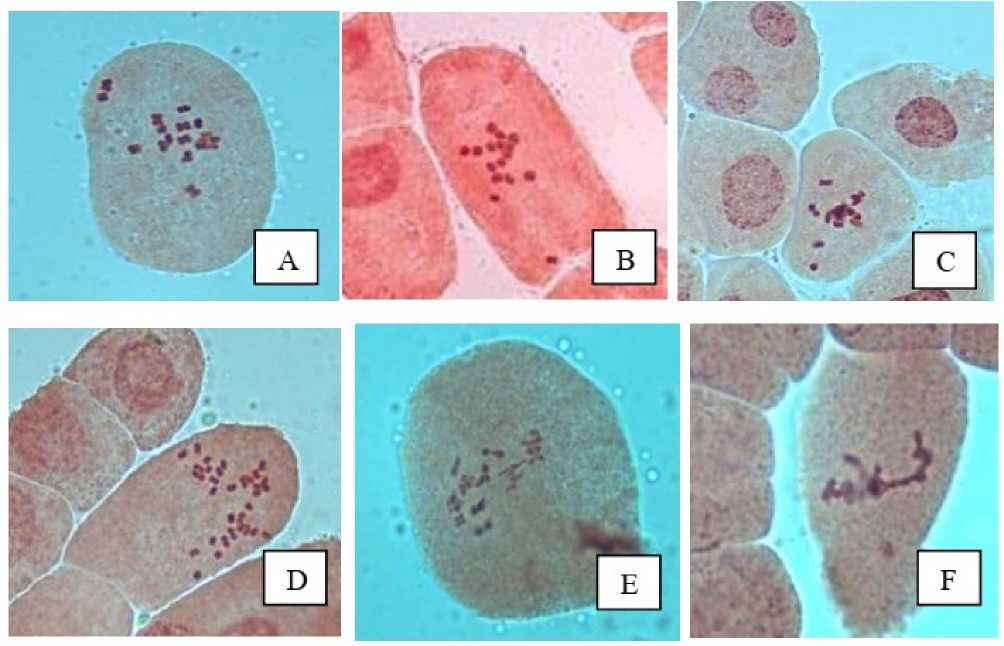
Figure 1: Mitotic patterns in the cytochimeral mutant of C. juncea L. Mitotic metaphases: A ) Control 2n = 16 (8I+2II+1IV); B ) Mutant 2n=2X=16 (4I+3IV) C ) Mutant 2X=16 (4I+2II+2IV); D ) Tetraploid Mutant 2n=4X=32 (8I+6II+3IV); E ) Mutant 2X=16 (2I+1II+1IV at each pole but dissimilar); F ) Mutant 2n=2X=16 equatorial distribution and laggard
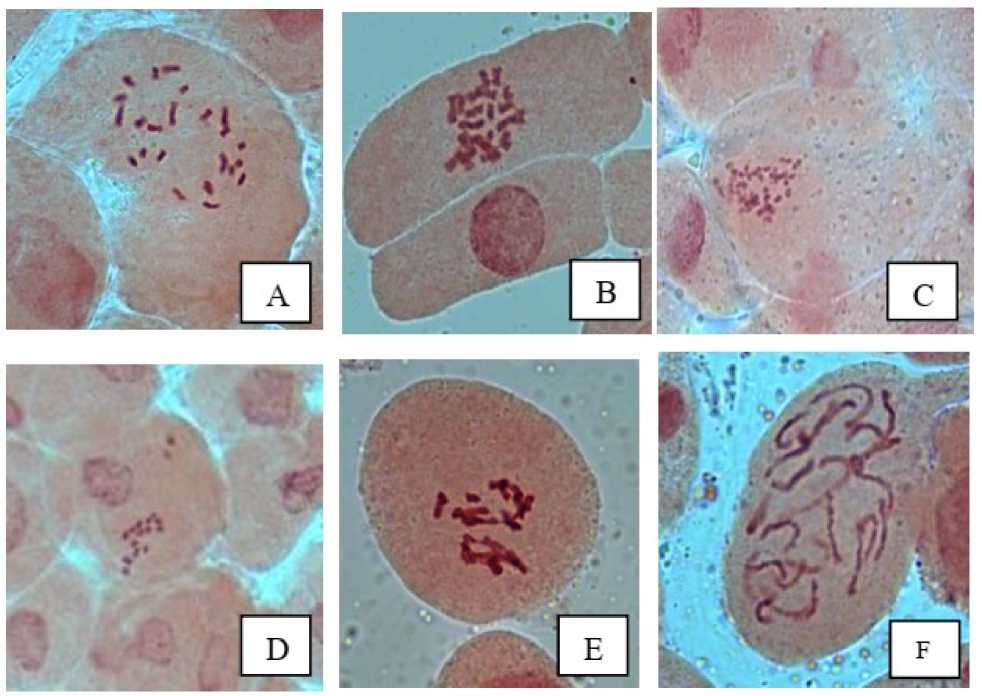
Figure 2: Mitotic patterns in the cytochimeral mutant of S. bispinosa (Jaque.) W. Wight 2n=24. Mitotic metaphase: A ) Control 2n=24 (8I+6II+1IV; B ) Mutant 2n=2X=24 (8II+4IV; equatorial distribution; C ) Tetraploid Mutant 2n=4X=48 (12II+6IV); D ) Tetraploid Mutant 2n=4X=48 (12II+6IV) equatorial distribution; E ) Mutant 2n=2X=12 (8I+2II); F ) Mutant 2n=2X=24 equatorial distribution and laggard
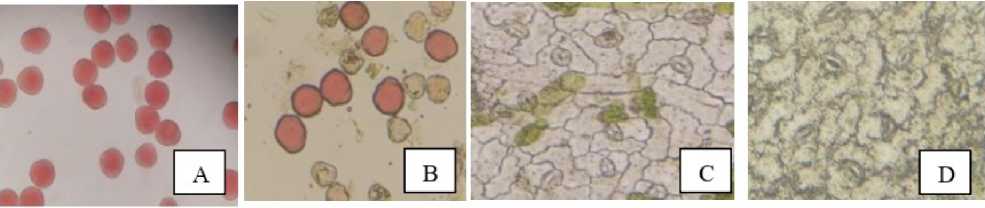
Figure 3: Sunnhemp ( Crotalaria juncea L.) pollen sterility and stomatal density. A ) control plant pollen grains with equal size with rounded shape. B ) Polyploid plant pollen with irregualar shape and unstained sterile pollen. C ) and D ) stomata with more density and smaller size while stomata with less density and larger size in control and polyploid respectively.
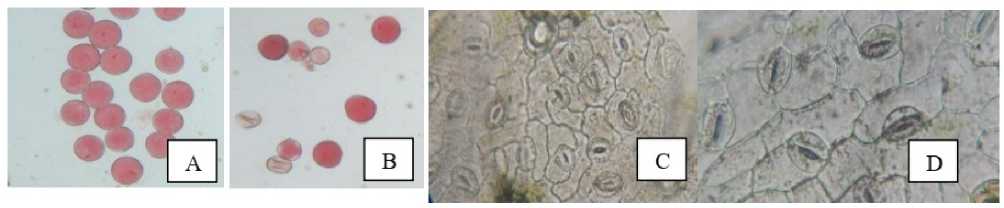
Figure 4: Dhaincha Sesbania bispinosa (Jaque.) W. Wight pollen sterility and stomatal density. A ) control plant pollen grains with equal size with rounded shape. B ) Polyploid plant pollen with irregualar shape and unstained sterile pollen. C ) and D ) stomata with more density and smaller size while stomata with less density and larger size in control and polyploid respectively.
However, majority of the stomatal density was indifferent statistically. The mean of the stomatal density of colchiploid plants was varied from 651-869 stomata per mm2, while the control was 773 stomata per mm2 (Fig. 3-4). The stomata length and width of colchiploid plants were significantly affected by colchicine treatments. The stomata length of those colchiploid plants were measured averagely ranging from 18.09 to 21.08 μm while control at 9.92 μm. Similarly, the stomata width of those colchiploid plants were measured averagely ranging from 16.05 to 19.98 μm, while control at 7.62 μm (Fig 3-4). The mean of chloroplast number in guard cells of colchiploid plants was varied from 17 – 24 which are 13.96 – 53.08% higher than control.
The mean stomata size of the control plants was recorded to be 18.17 um while the colchicine treatment gave a mean stomata size of 23.02 um. This result indicates that colchicine induced epidermal polyploidy in the leaves from treated plants.
CONCLUSION
Here we reported a colchicine induced cytochimeral plant in M 2 generation of Crotalaria juncea and Sesbania bispinosa (Jacq.) Wight. Induced tetraploid seemed to grow more slowly and growth abnormalities were the first indication of successful colchicine treatment.
Polyploids induced by colchicine may retain a small number of undetected chimeric cells even after regeneration. The uniform distribution of diploid and tetraploid cells is that at the time of colchicine treatment those cells which were at metaphase stages may have under gone polyploidisation while others remained unaffected at premitotic stage. After resumption of growth both diploid and tetraploid cells were intermixed resulting a mixoploid composition. This mixoploidy was further confirmed by the intermixed distribution of diploid and tetrapoid cells.
The colchiploid plants were not grouped according to colchicine concentration and duration of treatment. In other word, the increasing of colchicine concentration and duration of treatment did not correlate with the increasing of ploidy number of colchiploid plants. The effectiveness of polyploidy depends on many factors, such as type and concentration of the antimitotic agent, exposure time, the method of antimitotic solution application.
Examination of anatomical characters especially those related to stomata is an easy and reliable method to identify polyploids in comparison with diploids. Polyploidy is commonly characterized by a stomatal density reduction, increase in stomata size, and increase in the number of guard cell chloroplast. The results suggested that colchiploid plants in this study have varied stomatal density, larger stomatal size, and larger chloroplast number than control.
CONFLICTS OF INTEREST
The authors declare that they have no potential conflicts of interest.
