
Conductivity control in SmxMn1–xS by magnetic field and current
Journal: Siberian Aerospace Journal @vestnik-sibsau-en
Section: Technological processes and material science
Article in issue: 2 vol.27, 2026.
Free access
Spacecraft electronics and onboard computer microchips are made of semiconductors. Radiation increases in near-Earth orbit, especially during solar flares, where the flux of high-energy particles and gamma radiation increases. This leads to defects in semiconductor transistors and failure of electronic devices. Therefore, replacing field-effect transistors with spintronics, which utilizes the spin degree of freedom of electrons, is becoming a pressing issue. Transport characteristics can be controlled by a magnetic field using samarium-substituted manganese sulfides. The conductivity of a sample was studied at low current in a magnetic field applied at an angle to the current, varying from 0° to 360°. Without a magnetic field, the conductivity remains constant. When a magnetic field is applied and the sample rotates, a change in conductivity is observed. In a magnetic field, conductivity decreases and reaches a minimum within a certain angular range. Upon heating, conductivity decreases in a magnetic field and reaches one order of magnitude near the magnetic phase transition. The current-voltage characteristics of SmxMn1–xS with a concentration of x = 0.1 were measured without a magnetic field of H = 0 kOe and in a magnetic field of H = 12 kOe, directed along the current and perpendicular to the current. The dependence of current on voltage is nonlinear and is associated with electrically inhomogeneous states in the sample. From the current-voltage characteristics, the dependence of the change in conductivity in a magnetic field on the current (voltage) and temperature was found. The maximum decrease in conductivity in a magnetic field was found at 200 K. Above room temperature, conductivity decreases by several percent due to the Hall contribution. Heating and increasing current lead to a decrease in magnetoconductivity. A comparison of the two methods for measuring conductivity in a magnetic field indicates that the regulation of conductivity by a magnetic field depends on the current value at which the conductivity is measured.
Short address: https://sciup.org/148333990
IDS: 148333990 | UDC: 537.312:538.911'956 | DOI: 10.31772/2712-8970-2026-27-2-373-382
Text of the scientific article Conductivity control in SmxMn1–xS by magnetic field and current
Electronics in spacecraft controls life support, navigation, communications, power supply and payload management systems. Microchips in on-board computers are made of semiconductors. The electron charge is used to record and read information in field-effect transistors. In near-Earth orbit, radiation levels increase; there is a rise in the flux of high-energy particles and gamma radiation, in particular, during solar flares [1; 2]. This leads to defects in semiconductor transistors and the failure of electronic devices. Consequently, there is a pressing need to replace field-effect transistors with spintronics, which utilises the electron’s spin degree of freedom.
Transport characteristics can be manipulated under the influence of a magnetic field [3–6]. The Nobel Prize was awarded for the magnetoresistance effect (the change in resistance under the influence of an external magnetic field) [7; 8]. There are several mechanisms of magnetoresistance in semiconductors [9; 10]. Depending on the material, conductivity can either increase or decrease in a magnetic field. Under the influence of a magnetic field, the magnetic structure changes and, as a result of exchange interactions with localised spins, the mobility of charge carriers changes. For example, in manganites, the magnetoresistance increases in the vicinity of the magnetic phase transition and decreases in antiferromagnets in the vicinity of the Néel temperature [11; 12]. This is due to the formation of ferromagnetic droplets (ferrons) in weakly doped antiferromagnets and ferromagnetic spin polarons in paramagnets [13; 14]. In the paramagnetic region, a change in the sign of the magnetoresistance with respect to the magnetic field is possible in the two-band model, when, under the influence of a magnetic field, the ratio of the occupancies of the conduction band and the impurity band changes [15]. In the absence of magnetic order, the rearrangement of the electronic structure may be induced by orbital magnetic moments [16–18].
Transport characteristics can be controlled by means of elastic deformations; this field is within the scope of straintronics [19]. Particular attention has been paid to straintronics in magnetic materials due to the significant reduction in energy consumption during the recording and reading of information. These materials are the most resistant to radiation exposure, as deformation is less dependent on defects. Under the influence of mechanical deformations, the band structure of a semiconductor is modified as a result of the interaction between an elastic calibration field and fermions [20]. This is most clearly observed in quasi-two-dimensional chalcogenide materials such as MoS2 [21], PdS2 [22]. Another mechanism in straintronics involves heterostructures comprising a magnetic layer, the anisotropy of which is determined by the deformation of the substrate. As the substrate deforms, the anisotropy changes and, consequently, so does the direction of the electron spin. In this case, the switching energy of straintronic memory devices will be less than 1 kJ [23].
In manganese chalcogenides substituted with rare-earth elements of variable valence, the position of the 4f level relative to the conduction band can be varied and transport characteristics adjusted through electron-lattice interactions [24–26]. The magnetic structure in semiconductors also depends on spin-phonon interactions; at certain interaction parameters, a gap appears in the spin excitation spectrum and the type of magnetic order changes [27; 28]. In samarium sulfide, the electronic structure is highly sensitive to external pressure [29–31].
The aim of this work is to establish whether the conductivity of samarium-substituted manganese sulfide can be modulated by an external magnetic field at different current levels.
Materials and methods
The SmxMn1-xS samples were prepared by the solid-state synthesis. The crystal structure of the synthesised samples was investigated at room temperature on a DRON-3 X-ray diffractometer using Cu K α radiation in ‘point-by-point’ data acquisition mode. According to the X-ray diffraction analysis, the lattice type is face-centred cubic (FCC), corresponding to NaCl (Fig. 1).
A cuboid-shaped sample measuring 2×3×5 mm was placed between copper plates (2), which were insulated from the cryostat insert by mica 1 . The sample, fitted with the copper contacts 2 , was held in place by the steel spring 3 , as shown in Fig. 2. A magnetic field was applied at an angle to the current; the angle varied within the range 0–360° (Fig. 2).
J л
I—I 2? 1

2 ®, degree
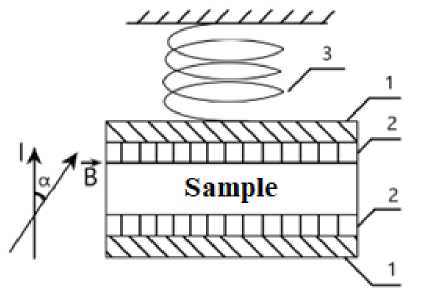
Рис. 2. Схема экспериментальной ячейки
Рис. 1. Рентгенограмма твердого раствора SmxMn1–xS с х = 0,1
Fig. 1. X-ray diffraction pattern of the SmxMn1–xS solid solution with x = 0.1
Fig. 2. The scheme of the experimental cell
Magnetic conductivity was determined from the current-voltage characteristics measured at fixed temperatures on a cuboid-shaped sample with ohmic contacts in the temperature range 80–400 K, in magnetic fields up to 12 kOe. The electrical resistance was measured using an Agilent 34410A instrument.
Results and Discussion
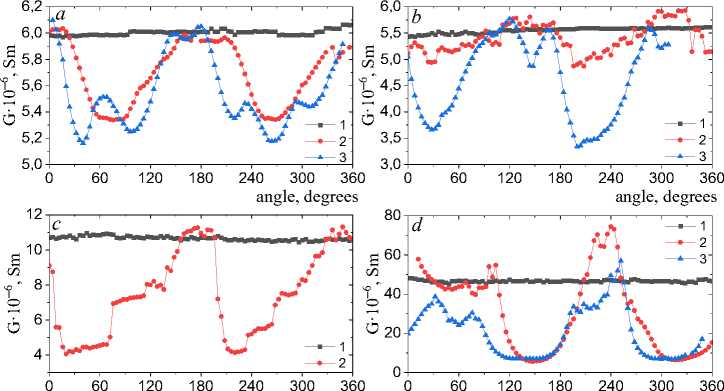
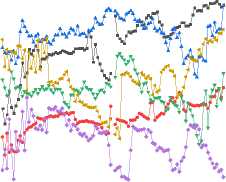
Let us determine the effect of the magnetic field on conductivity from the angular dependence of conductivity on the magnetic field, the rotation frequency of which is 0.02 Hz. Figure 3 shows the dependence G(α) for three values of the magnetic field: H = 0. 6 and 12 kOe. Conductivity remains con- stant in the absence of a magnetic field. When the magnetic field is applied and rotation is initiated, a change in conductivity is observed. In the magnetic field, conductivity decreases and reaches a minimum in the angular ranges 50–140° and 220–300°. Upon heating, the change in conductivity (G(H)– G(0))/G(0) increases from 20 % at 80 K, 62 % at 100 K, 148 % at 120 K, 1067 % at 140 K and 647 % at 160 K. The conductivity decreases by an order of magnitude in the vicinity of the magnetic phase transition at T_N = 140 K [32]. In the field of 12 kOe, the conductivity varies more significantly than in the field of H = 6 kOe.
The giant magnetoconductivity effect may be attributed to two factors. When the magnetic field rotates, an induced EMF εin(max) = ωBS is induced in the copper plates acting as contacts, where ω is the frequency of the alternating magnetic field, B is magnetic flux density, and S is the area. The order of magnitude of εin(max) ~ 1 μV if the magnetic flux density is perpendicular to the plane of the contacts, and tends towards zero when the flux density is directed along the surface of the sample. The resistance of the sample varies with temperature within the range 10³–10⁴ Ω, and the measurement current is 10⁻⁵ A; therefore, the voltage drop across the sample is four orders of magnitude greater than the induced EMF.
angle, degrees
angle, degrees
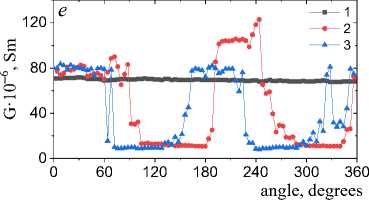
Рис. 3. Проводимость в зависимости от угла поворота магнитного поля в образце SmxMn1–xS с концентрацией x = 0,1 без магнитного поля H = 0 ( 1 ) и в магнитных полях
H = 12 кЭ ( 2 ), H = 6 кЭ ( 3 ) при T = 80 К ( a ); 100 К ( b ); 120 К ( c ); 140 К ( d ); 160 К ( e )
Fig. 3. Conductivity versus the rotation angle of the magnetic field in the Sm x Mn 1–x S sample with a concentration of x = 0.1 without a magnetic field H = 0 ( 1 ) and in magnetic fields H = 12 kOe ( 2 ), H = 6 kOe ( 3 ) at T = 80 K ( a ); 100 K ( b ); 120 K ( c ); 140 K ( d ); 160 K ( e )
The second mechanism may be related to the magnetostriction of the steel spring. The difference between the longitudinal and transverse magnetostriction of the spring may cause a change in the pressure on the copper plate and in the electrical resistance. In order to exclude dynamic processes, let us measure the current-voltage characteristics both in the absence of a magnetic field and in a magnetic field at different orientations.
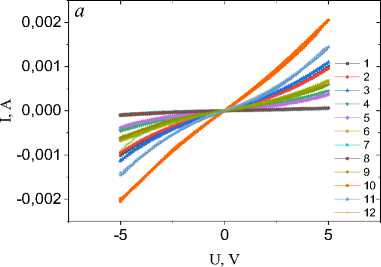
Рис. 4. I–V характеристика в образце Sm x Mn 1–x S с концентрацией x = 0,1:
а – без магнитного поля H = 0 ( 1 , 4 , 7 , 10 ) и в магнитном поле H = 12 кЭ для 270° ( 2 , 5 , 8 , 11 )
и для 360° ( 3 , 6 , 9 , 12 ) при T = 80 К ( 1 , 2 , 3 ), 120 К ( 4 , 5 , 6 ), 160 К ( 7 , 8 , 9 ), 200 К ( 10 , 11 , 12 );
b – без магнитного поля H = 0 ( 1 , 3 , 5 , 7 , 9 , 11 , 13 , 15 ) и в магнитном поле H = 12 кЭ для 270° ( 2 , 6 , 10 , 14 )
и для 360° ( 4 , 8 , 12 , 16 ) при T = 240 К ( 1 , 2 , 3 , 4 ), 280 К ( 5 , 6 , 7 , 8 ), 320 К ( 9 , 10 , 11 , 12 ), 390 К ( 13 , 14 , 15 , 16 )
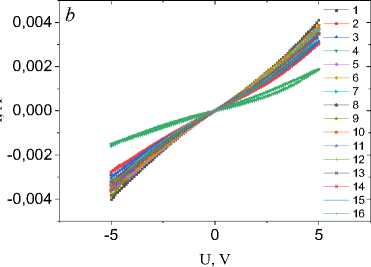
Fig. 4. I–V characteristic in SmxMn1–xS sample with a concentration of x = 0.1:
a – without a magnetic field H = 0 ( 1 , 4 , 7 , 10 ) and in a magnetic field H = 12 kOe for 270° ( 2 , 5 , 8 , 11 ) and for 360° ( 3 , 6 , 9 , 12 ) at T = 80 K ( 1 , 2 , 3 ), 120 K ( 4 , 5 , 6 ), 160 K ( 7 , 8 , 9 ), 200 K ( 10 , 11 , 12 );
b – without a magnetic field H = 0 ( 1 , 3 , 5 , 7 , 9 , 11 , 13 , 15 ) and in a magnetic field H = 12 kOe for 270° ( 2 , 6 , 10 , 14 ) and for 360° ( 4 , 8 , 12 , 16 ) at T = 240 K ( 1 , 2 , 3 , 4 ), 280 K ( 5 , 6 , 7 , 8 ), 320 K ( 9 , 10 , 11 , 12 ), 390 K ( 13 , 14 , 15 , 16 )
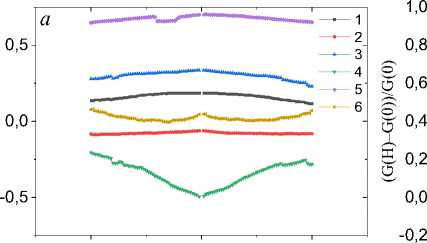
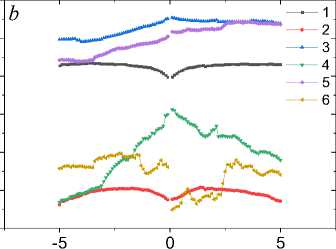
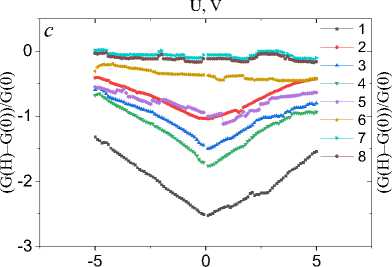
Figure 4 shows current-voltage characteristics in an Sm x Mn 1–x S sample with a concentration of x = 0.1, both in the absence of a magnetic field (H = 0) and in the magnetic field of H = 12 kOe, directed along the current and perpendicular to the current. The current-voltage relation is not linear. This slight non-linearity is due to the electrically inhomogeneous state of the sample. From the current-voltage characteristics, a relationship was determined between the change in conductivity in a magnetic field and the voltage of the external electric field, as shown in Fig. 5.
Anisotropy in magnetic conductivity has been observed from the current-voltage characteristics. Conductivity increases in the magnetic field when the field is directed perpendicular to the current, and depends on the current or voltage in the magnetically ordered region. Conductivity decreases in the magnetic field parallel to the current, and there is a tendency for magnetic conductivity to decrease as the current increases. As the voltage increases, the magnetic conductivity decreases by 30 % at 80 K and 100 K, and by 7 % at 120 K. In SmxMn1–xS, within the antiferromagnetic region, the influence of the magnetic field on conductivity tends to disappear as the current increases. Above the Néel temperature, conductivity increases in the magnetic field within the range 140 K < T < 190 K, regardless of the direction of the magnetic field, but the anisotropy of the quantity (G(H)–G(0))/G(0) is maintained. Heating the sample above 190 K reduces the conductivity in the magnetic field, with the change reaching its maximum at 200 K. Thus, conductivity decreases by 250 % at 200 K, by 150 % at 220 K, and by 96 % at 240 K. Above room temperature, conductivity decreases by a few per cent due to the Hall effect. In the temperature range around 220 K, the anisotropy of magnetoconductivity at a current of 1 mA virtually disappears. Heating and an increase in current lead to a decrease in magnetoconductivity. It is possible that there is a critical current at which the dependence of conductivity on the magnetic field disappears.
о
о к о
-5
0,02
U, V
d
--•--2
--А--3
--т--4
---♦---5
---«--6
0,00
-0,06
-0,08
-0,02
-0,04
-5 0
U, V U, V
Рис. 5. Магнитопроводимость в поле H = 12 кЭ в зависимости от электрического напряжения в образцах Sm x Mn 1–x S с концентрацией x = 0,1 для 0° ( 1 , 3 , 5 , 7 ) и 90° ( 2 , 4 , 6 , 8 ) при T = 80 К ( 1 , 2 ), 100 К ( 3 , 4 ), 120 К ( 5 , 6 ) ( a ); при T = 140 К ( 1 , 2 ), 160 К ( 3 , 4 ), 180 К ( 5 , 6 ) ( b ); при T = 200 К ( 1 , 2 ), 220 К ( 3 , 4 ), 240 К ( 5 , 6 ), 280 К ( 7 , 8 ) ( c ); при T = 320 К ( 1 , 2 ), 360 К ( 3 , 4 ), 390 К ( 5 , 6 ) ( d )
Fig. 5. Magnetoconductivity in the field H = 12 kOe depending on the electric voltage in the SmxMn1–xS samples with the concentration of x = 0.1 for 0° ( 1 , 3 , 5 , 7 ) and 90° ( 2 , 4 , 6 , 8 ) at T = 80 K ( 1 , 2 ), 100 K ( 3 , 4 ), 120 K ( 5 , 6 ) ( a ); at T = 140 K ( 1 , 2 ), 160 K ( 3 , 4 ), 180 K ( 5 , 6 ) ( b ); at T = 200 K ( 1 , 2 ), 220 K ( 3 , 4 ), 240 K ( 5 , 6 ), 280 K ( 7 , 8 ) ( c ); at T = 320 K ( 1 , 2 ), 360 K ( 3 , 4 ), 390 K ( 5 , 6 ) ( d )
The comparison of the two methods for measuring conductivity in a magnetic field indicates that magnetic conductivity depends on the magnitude of the current at which the conductivity measurement is taken. At a low current of 10 µA, the conductivity decreases by an order of magnitude in the vicinity of the Néel temperature; if the current is increased by two orders of magnitude, the maximum decrease in conductivity is reached at 200 K.
Conclusion
In the samarium-substituted manganese sulfide SmxMn1-xS, the change in conductivity in a magnetic field depends on the direction of the field relative to the electric current. In the vicinity of the Néel temperature, the conductivity decreases by an order of magnitude at a weak current in the magnetic field of 12 kOe. Weak non-linearity in the current-voltage characteristics has been observed in SmxMn1-xS. A temperature range has been identified in which the anisotropy of conductivity in a magnetic field relative to the direction of the current is at its maximum. The dependence of magnetoconductivity on the current magnitude and a tendency for it to disappear at high currents have been established. The effect of the magnetic field on conductivity decreases sharply in the room-temperature range and amounts to a few per cent.
Работа поддержана Российским научным фондом, Правительством Красноярского края и проектом Красноярского научного фонда № 23-22-10016.
Acknowledgements
The study was supported by the grant from the Russian Science Foundation Nо. 23-22-10016, the Krasnoyarsk Regional Science Foundation.
