
Correlation Analysis of Hydrochemical Indicators and Water Discharge in the Doslyk Canal (Karakalpakstan, Uzbekistan)
Free access
The article analyzes the correlation of water discharge and the main hydrochemical indicators of water in the upper section of the Doslyk Canal in Nukus city for 2019–2023. Based on data from the Water Management Department and the Ministry of Ecology of the Republic of Karakalpakstan (Uzbekistan), the concentrations of chlorides, sulfates, ammonium and nitrite nitrogen, iron, as well as indicators of total hardness, mineralization, COD and BOD5 were studied. The research confirms the important role of hydrological factors in regulating surface water quality and emphasizes the need to consider water availability when organizing environmental monitoring of canals and water management systems in the Republic of Karakalpakstan.
Similar articles in the section Special auxiliary subdivision for theoretical aspects, characteristics, factors, etc. in biology
Short address: https://sciup.org/148332430
IDS: 148332430 | UDC: 57.013 | DOI: 10.18101/2542-0623-2025-3-90-95
Корреляционный анализ гидрохимических показателей и расхода воды на канале Дослык (Каракалпакстан, Узбекистан)
Проведен корреляционный анализ взаимосвязей между расходом воды и основными гидрохимическими показателями воды в верхнем участке канала Дослык города Нукус за период 2019–2023 гг. На основе данных водного хозяйства и Министерства экологии Республики Каракалпакстан (Узбекистан) исследованы концентрации хлоридов, сульфатов, аммонийного и нитритного азота, железа, а также показатели общей жесткости, минерализации, ХПК и БПК5. Исследование подтверждает важную роль гидрологических факторов в регулировании качества поверхностных вод и подчеркивает необходимость учета водности при организации экологического мониторинга каналов и водохозяйственных систем Республики Каракалпакстан (Узбекистан).
Text of the scientific article Correlation Analysis of Hydrochemical Indicators and Water Discharge in the Doslyk Canal (Karakalpakstan, Uzbekistan)
Research on the hydrochemical composition and water content dynamics of Central Asian rivers reveals important patterns in surface water quality changes under the influence of natural and anthropogenic factors. In the works of Khodjiev [2025], it is noted that the condition of water bodies in the region is determined by the combination of hydrological conditions and the level of technogenic load. Chembarisov and Balliev [2023] analyzed long-term observations of the Amu Darya River from 2008 to 2022 and established a relationship between water content, mineralization, and seasonal changes in the water’s chemical composition.
Correlation analysis methods have proven to be an effective tool for determining relationships between hydrochemical parameters and water discharge [Mitryasova, Pohre-bennyk, 2020]. They allow not only to establish the degree of linear dependence between indicators but also to identify the main factors influencing the formation of the chemical composition of water resources. Research by Yalaletdinova et al. [2021] showed that changes in water flow through reservoir dams are related to variations in river water turbidity, color, oxidizability, and total hardness, which confirms the importance of a comprehensive analysis of such relationships. The application of correlation analysis contributes to a deeper understanding of hydroecological processes, identification of pollution sources, and development of predictive models for changes in natural water quality [Mitryasova, Pohrebennyk, 2020].
The aim of this study is to conduct a hydrochemical analysis and determine correlations between key water quality parameters and flow rate in the Doslyk Canal section upstream of Nukus city for 2019–2023. The results will reveal patterns in hydrochemical regime changes, identify potential pollution sources, and establish a scientific foundation for further ecological monitoring of the region’s water resources.
Materials and Methods
The study was conducted based on official data provided by the Water Management Department of the Republic of Karakalpakstan and the Ministry of Ecology, Environmental Protection and Climate Change of the Republic of Karakalpakstan for the period 2019–2023. The data included results of regular observations of water flow and hydrochemical indicators in the Doslyk Canal section upstream of Nukus city (Fig.).
The analysis included the main parameters characterizing surface water quality: total hardness, concentrations of chlorides (Cl-), sulfates (SO42-), iron (Fe3+), ammonium (NH4+) and nitrite (NO2-) nitrogen, biochemical oxygen demand (BOD5), chemical oxygen demand (COD), and total mineralization.
Correlation analysis methods were used to establish relationships between water flow and hydrochemical indicators. The main statistical indicator used was Pearson’s correlation coefficient (r), calculated using the formula:
2(Л “^(У; - У) г = =.
VSO; - -Ю2^ - у)2
where xi and yi are the values of the studied parameters, x̄ and ȳ are their arithmetic mean values.
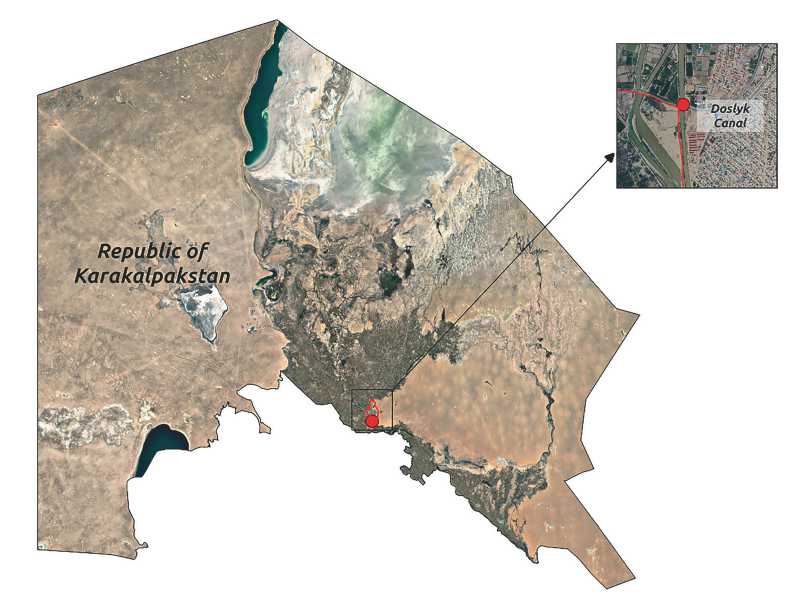
Fig. Location of the sampling point the Doslyk Canal, upstream of the city of Nukus
The statistical significance of the correlation coefficients was assessed using Student’s t-test at a significance level of p < 0.05. Data processing, construction of correlation matrices and diagrams were performed using SPSS Statistics 18.0 and Microsoft Excel 2016 software.
Statistical data processing was performed using standard mathematical statistics methods by Gmurman [2024].
Results and Discussion
Analysis of long-term data (2019–2023) has shown that the surface water quality of the Doslyk Canal is characterized by significant variability due to both natural (hydrological and climatic) and anthropogenic factors. General hardness and mineralization indicators suggest a moderately mineralized type of water with seasonal fluctuations related to water content and the inflow of wastewater and drainage water. Elevated COD and BOD5 values are recorded during periods of low flow, reflecting the impact of organic pollution from domestic and agricultural sources.
To quantitatively assess the relationships between hydrochemical indicators and water discharge (Q), Pearson’s correlation analysis was conducted. The calculations made it possible to assess the degree of influence of water discharge on each of the hydrochemical parameters. The results of the calculations are presented in Table.
Correlation relationships between hydrochemical indicators and water discharge (Doslyk Canal, 2019–2023)
Table 1
|
Indicator |
r (Pearson) |
p-value |
Significance (p<0.05) |
|
Hardness |
-0.59 |
0.295 |
No |
|
COD |
-0.746 |
0.148 |
No |
|
BOD5 |
-0.074 |
0.906 |
No |
|
NH4+ |
-0.42 |
0.481 |
No |
|
NO2- |
-0.05 |
0.994 |
No |
|
Cl- |
-0.916 |
0.029 |
Yes |
|
SO42- |
-0.525 |
0.364 |
No |
|
Fe3+ |
0.06 |
0.914 |
No |
|
Mineralization |
-0.883 |
0.047 |
Yes |
Note: statistically significant correlations at p <0.05 are highlighted in bold.
As shown in Table 1, negative correlations of varying strengths have been established between water discharge and several hydrochemical parameters. The strongest negative correlation was observed between water discharge (Q) and chloride concentration (r = -0.916, p = 0.029), as well as between Q and total mineralization (r = -0.883, p = 0.047).
The observed relationships indicate a decrease in the concentration of dissolved ions with increased water content, which is associated with an increase in flow volume and subsequent dilution.
For COD and hardness indicators, strong negative coefficients were found (r = -0.746 and -0.59, respectively), however, with a small sample size (n = 5), the level of statistical significance (p < 0.05) was not reached. This indicates a tendency towards a decrease in the concentration of organic matter and calcium-magnesium ions as water discharge increases, confirming the influence of the hydrological factor on the self-purification of the watercourse [Singh, 2025].
The remaining indicators (Fe3+, NH4+, NO2-, BOD5) did not show significant correlations with water discharge, which is likely due to their local sources of input and biogeochemical inertia. Moderately positive values between water level (H) and discharge (r=0.581) confirm the overall synchronicity of fluctuations in these parameters, typical for channel systems with regulated flow.
The obtained relationships indicate that the formation of the hydrochemical regime of the Doslyk Canal is determined by a combination of natural and anthropogenic factors. During periods of low water content, ion concentration and organic pollution increase, while during increased runoff, water quality indicators improve due to dilution. Similar patterns were observed in studies of water bodies in Central Asia [Ruman et al., 2025; Elshaarawy, Eltarabily, 2024].
Thus, the results of the correlation analysis confirmed that changes in water discharge directly affect the dynamics of the chemical composition and quality of surface water in the Doslyk Canal. This is important for developing a regional environmental monitoring system and assessing the sustainability of Karakalpakstan’s water resources in the context of climate variability.
Conclusion
The conducted correlation analysis showed that water discharge (Q) is a key factor determining the dynamics of the chemical composition of surface water in the Doslik Canal. The most significant negative correlations were established between water discharge and chloride concentration (r = -0.916, p = 0.029) and total mineralization (r = -0.883, p = 0.047). The identification of a trend towards a decrease in COD and hardness with an increase in discharge confirms the dependence of watercourse selfpurification processes on hydrological conditions. The research results emphasize the need to consider water discharge fluctuations when assessing the quality and ecological condition of surface waters in the region, and can also serve as a scientific basis for improving the water monitoring system of the Republic of Karakalpakstan.
