
Criteria of the digital well-being of the population: Current state and problems
Journal: Economic and Social Changes: Facts, Trends, Forecast @volnc-esc-en
Section: Social and economic development
Article in issue: 5 т.18, 2025.
Free access
The current stage of societal development is inevitably linked to rapid digital transformation, the results of which permeate the economy, governance, and virtually all spheres of life. This confirms the relevance of addressing this issue, expanding the information base, and developing tools for assessing the impact of these new conditions on human life. The paper focuses on the digital well-being of the population, with its aim being the development of methodological approaches for its measurement. The article provides a critical analysis of theoretical and methodological approaches to studying well-being and digital well-being, presents an original assessment methodology based on subjective data, and tests it using data from a 2021 representative survey of the population in the Vologda Region. The novelty of the results is confirmed by the proposal of a new assessment approach and the applied results obtained through its implementation, which expand the regional picture of digital development and allow for comparisons and typologization of regions based on the level of the population's digital well-being. The characteristics of the population's digital well-being in the region are analyzed across types of settlements, levels of education and income, and by gender and age characteristics. Many conclusions regarding the persistence of digital divides and obstacles to achieving well-being in the digital environment are confirmed, and the most vulnerable socio-demographic groups are identified. A significant influence of place of residence and age on digital well-being parameters is shown; other factors are less pronounced and require deeper study. The findings concerning society's acceptance of potential digital risks require separate discussion and research. The practical significance of the results is determined by their potential use for managerial purposes, including the strategic planning for achieving national and regional development goals, and the classification and typology of regions based on digital development characteristics. Furthermore, the availability of information on the population's digital well-being can contribute to enhancing the investment attractiveness of the region's IT sector, developing digital education, introducing high-tech goods and services to the market, and other areas of digital transformation
Similar articles in the section Economic situation. Economic policy. Management of the economy. Economic planning. Production. Services. Prices
Short address: https://sciup.org/147252468
IDS: 147252468 | UDC: 338.001.36; 004 | DOI: 10.15838/esc.2025.5.101.10
Text of the scientific article Criteria of the digital well-being of the population: Current state and problems
The study was supported by the Russian Science Foundation, grant 25-28-01422, “Conceptual foundations and practices for achieving digital well-being of the older generation in the sphere of consumption” .
Well-being is a rather complex and uncertain category. Many modern researchers turn to its conceptualization and evaluation; it significantly complements and expands the existing aspects of the concept of quality of life, as it includes subjective assessments. Russian society is highly differentiated; it is insufficient to use only objective indicators of income, material wealth, education, health characteristics, and social environment to better understand the current situation, so the concept of well-being is becoming more widespread, including in assessments and analysis the subjective aspects of human satisfaction with their lives, confidence in the future, security, and emotional state, and self-realization in various fields, etc. Authors studying the quality of life also use a subjective factor in their tools in addition to objective data, some of them identify these concepts (Kislitsyna, 2016). The Stiglitz – Sen – Fitoussi report is considered a milestone in the development of the measurement of well-being, in which they noted that “... it is time to shift the focus from measuring economic production to measuring human well-being” (Stiglitz et al., 2009, p. 12). They emphasized the importance of an integrated approach to the parameters of human well-being, namely, paying attention to living standards; health; education; personal activities, including work; political orientation and management; social ties and relationships; the environment (current and future conditions); insecurity, both economic and physical (Noll, 2011; Kruger, 2011).
Contemporary research includes an appeal to a variety of types of well-being, the most voluminous and multidimensional type among which, perhaps, is social well-being. It is recognized as one of the key non-material factors in the development of society (Sushko, 2023). The second important type is economic or material well-being, which is closest to the concept and assessment of the quality of life. It is generally understood as a state of economic systems, processes and reproduction of a particular economic system that ensures the satisfaction of reasonable vital material and spiritual needs of society (Medvedeva et al., 2023; Dvoryadkina, Belousova, 2023). Depending on the parameters studied, it is also considered demographic (Ryazantsev, Miryazov, 2021), financial (Belekhova, 2023), psychological or emotional well-being (PsychoEmotional..., 2020; Laktionova, Matyushina, 2018), etc.
It is impossible to ignore the fact that researchers turn to the concepts of well-being and happiness. In our opinion, all these views strive for a common goal – improving people’s lives, so they do not conflict with each other, but, on the contrary, complement each other. This article uses the concept of digital well-being, as we strive to study its levels specifically for the population (not for the economy, but for the country), basing the construction of the toolkit on subjective information obtained using sociological methods.
The term “digital well-being” is only becoming widespread in connection with the understanding in Western and Russian science of the course and effects of total digitalization (Aseeva, 2023).
The aim of the article is to develop methodological approaches to measuring digital well-being. To achieve this aim, we set the following tasks: to conduct a critical analysis of theoretical and methodological approaches to the study of digital well-being; to develop our tools for assessing digital well-being; to test the tools based on data from a survey of the Vologda Region population conducted in 2021.
The scientific novelty of the paper lies in the proposed approach to assessing the level of digital well-being based on the index method, as well as in the applied results related to assessing this level for the Vologda Region population. The results obtained, as well as the methodological approach, are new and have the potential for practical application.
The object of the study is the adult population of the Vologda Region (over 18 years old, the upper limit is usually determined by the age of 79), living in urban and rural areas.
The information base of the research was data from a sociological study by Vologda Research Center of RAS: a survey of the Vologda Region population “Socio-cultural portrait of the region” in 2021 (sample size – 1,500 people over 18 years old, the sample is representative by gender, age, place of residence, the error does not exceed 5%). The method of conducting is a survey at the respondent’s place of residence, conducted in two large cities of the region, Vologda and Cherepovets, 8 municipal districts / okrugs, including centers and rural areas.
Theoretical review
The term “digital well-being” was initially used to refer to a healthy relationship with digital devices (gadgets), other technologies and information posted on the Internet. Changing behavioral attitudes and information channels, the so-called digital fatigue, have prompted society to raise the issue of increasing awareness of using digital services without harm to mental, emotional and physical health. For example, leading manufacturers of hardware and operating systems (Android, iOS, Windows, macOS) are introducing services and applications into their practice, as well as a set of functions and settings that allow the user to control the time spent at the screen, set restrictions on viewing information (including parental controls), notifications, and adjust the rest mode, eye strain, etc. They help users become aware of their digital habits and change them if it is necessary.
The modern development of digital technologies and their active introduction into all spheres of human activity determine the expansion of scientific understanding of the concept of “digital wellbeing”. This term is becoming increasingly popular in the scientific literature and is considered in the context of a comprehensive assessment of human interaction with the digital environment. In a broad sense, digital well-being is interpreted as a balance between the conscious use of digital technologies to improve the quality of life, minimize possible risks and maximize the benefits provided by the digital environment.
Foreign research discourse focuses on the construction of the concept of digital well-being and considers it as the most important component of the stage of transition from the digital age to the era of digital well-being. Analysis of the database of the international research social network Researchgate (https://www.researchgate. net/) indicates a significant increase in scientific publications on this issue: as of 2023, more than 100 papers have been published on aspects of digital well-being (Zangogianni, Kavakli, 2025; Hayama, Desai, 2025). This growth indicates a global trend toward an active study of the role of digital technologies in human life against the background of the accelerating digitalization of social and individual processes, despite the continuing digital inequality between countries.
Our review of foreign studies shows the consistency of hypotheses and conclusions indicating that digital well-being is an important and integral result of the modern development of society. The researchers emphasize the need for a systematic analysis of the factors determining the achievement of digital well-being both at the level of individuals and groups, as well as at the level of society. Within the framework of this paradigm, special importance is attached to a conscious approach to using technology to ensure that people live healthier and more comfortable lives (Fan, Li, 2021; Wanju et al., 2025; Ghosh, 2024). This approach is the basis for effectively realizing the transformational potential of digital technologies and minimizing the negative consequences of their implementation.
A natural consequence is the appeal to the parameters and conditions of ensuring the digital well-being of certain groups of the population, either vulnerable, as in the case of the elderly or people with low incomes (Nuzzaci, Maviglia, 2025; Kawinska, 2024; Wanju et al., 2025), or those that require more attention and special management tools – in the case of adolescents and young people (Febrieta, Gina, 2024; Charmaraman et al., 2024). Attention is also focused on professional groups using digital technologies in their activities, for example, doctors, education and IT workers (Pisarska et al., 2025; Digital Well-Being ... 2025).
Russian research in the field of digital well-being remains relatively less represented despite the intensive growth of thematic interest at the international level. At the same time, digital wellbeing is considered as a defining characteristic of people’s lives: “It is understood as including the fullness of social integration and communication activity, the level of satisfaction of needs and empowerment through digital technologies” (Aseeva, 2023, p. 138). Important areas of digital well-being are education, with separate areas of research on the digital well-being of students, as well as in resource management and socio-economic systems (Meikshane, 2021; Chubukov, 2022; Prikot, 2022). Within the framework of the social structure, attention is also paid to various groups of the population. Research shows that young people with a high level of digital literacy and IT education are more likely to feel positive about the digital future, while older and less affluent segments of society are prone to pessimism, which hinders their achievement of digital well-being.
It is worth noting that we are still talking about a new category for science, which makes it relevant to study and measure it. In this study, we approach digital well-being as a state of accessibility of ICT infrastructure, communications, digital literacy and motivation of the population, which determines the possibilities of using the digital environment to meet the needs of the population while maintaining a balance of benefits and minimizing possible risks. It remains possible to further adjust these grounds due to the new features of the phenomenon being studied.
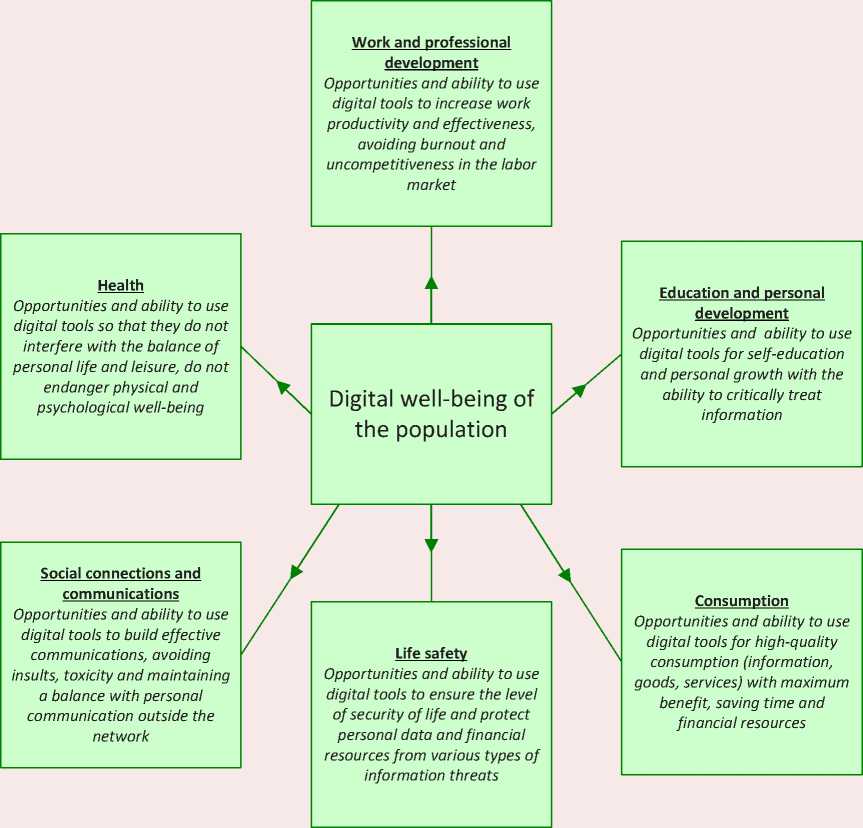
We suppose that digital well-being can manifest itself in different spheres of human life ( Figure ).
Understanding the versatility of the concept under consideration and its mobility due to rapid digitalization and the emergence of new forms, we are attempting to develop and test tools for its assessment.
Materials and methods
A consistent study of the scale and factors concerning digital inequality, socio-cultural transformations of society generated by digitalization, prompted us to turn to the concept of digital wellbeing of the population. This concept is still rarely used in the scientific field. At the same time, interest in this concept is growing, which confirms the relevance of the development of theoretical and methodological foundations for the study of digital well-being. We used the provisions of a three-level model of digital inequality to develop
Manifestations of digital well-being of the population in various spheres of life
a methodology based on both objective and subjective data. This concept is the most widespread and recognized by researchers in the world (Gladkova et al., 2019; Nieminen, 2016; Ragnedda, Kreitem, 2018; Ragnedda, 2018; Shinyaeva et al., 2019, etc.).
The research uses a set of scientific methods, in particular, comparative analysis, statistical analysis, and sociological methods, to achieve its goals and objectives. Our toolkit for the sociological measurement of the digital well-being of the population has been developed. To analyze the results, we use methods of system-structural and cross-tabulation analysis, and compare nationwide and regional data. The theoretical basis of the research is scientific work on the issues of digital inequality, digital well-being, digital readiness, virtualization of life, digital dividends, etc.
Development of methodology for assessing subjective digital well-being
Table 1 presents a step-by-step algorithm for developing a methodology for the subjective assessment of the digital well-being of the population.
A detailed procedure for obtaining sub-indices presents below:
-
1. The virtualization depth sub-index of everyday life was calculated based on the answers to the question “For what purposes and how often do you use the Internet?”. The respondents were asked to indicate the frequency of Internet use for 22 different purposes (communication, information
-
2. The digital competencies sub-index was calculated based on the answers to the question “What personal computer/tablet/phone skills do you have?”. The respondents were asked to assess the level of development of their skills in 12 core competencies. If the answer was “the skill is sufficiently developed”, the respondent was awarded 2 points, “the skill is insufficiently developed” – 1 point, “I do not have such a skill” – 0 points. To normalize the index within the range from 0 to 1, the total score of each respondent was divided by the maximum possible value – 24 points. The closer the index value is to one, the higher the level of proficiency in basic digital competencies.
-
3. The sub-index of integration into digital interactions with authorities was calculated based on the answers to the question “Have you applied for the following categories of public services in the last 12 months, and in what form?”. The respondent needed to indicate in what form the interaction took place in the case of receiving the listed 11 groups of public services. If the answer option was “applied online”, the respondent was awarded 1 point, “applied in person” – 0 points. The index was calculated as a quotient of the number of online interactions and the total number of cases of applying for various public services. The index is 1 if all interactions with government agencies were carried out in an online format. The index is 0 if the respondent received public services exclusively in person, or did not apply for them at all.
-
4. The sub-index of awareness of potential digital risks was calculated based on the answers to the question “How do you think modern people are protected from the following risks of using the Internet?”. Respondents were asked to rate the degree of protection from the listed 5 threats related to Internet use on a scale from “absolutely not protected” (1 point) to “absolutely protected” (4 points). Suggested threat assessments are: receiving negative information (violence, aggression, obscene language, propaganda of racial hatred, drug addiction, alcohol, unhealthy behavior, etc.); negative communication (humiliation of dignity, intolerance, discussion of personal characteristics of a person, harassment, including on gender and national grounds); fraud (theft of personal information, financial resources, blackmail); consumer risks (abuse of consumer rights, purchase of low-quality goods, forgery, falsification); coercion to commit illegal acts (including sexual ones). To normalize the index within the range from 0 to 1, the total score of each respondent was divided by the maximum possible value of 20 points. The higher the index value, the more the respondent is aware of the potential risks of using the Internet.
search, household, personal, public, political and other purposes). For each practice of using the Internet from among the listed purposes, 1 point was awarded if one of the answer options was selected: “every day or almost every day”, “at least once a week”, “at least once a month”, and for the answer option “never” – 0 points. Thus, the maximum value for the sum of all practices was 22 points. To normalize the index within the range from 0 to 1, the total score of each respondent was divided by 22.
The question “For what purposes and how often do you use the Internet?” in the questionnaire was asked only to those who use the Internet. For respondents who do not use the Internet, the digital skills index is 0. The questions for which the other indexes were calculated were asked to all respondents.
Table 1. Consistent algorithm for developing research tools
|
Step one |
Development of sociological tools for monitoring aspects of the digitalization of everyday life |
|
Step two |
Approbation of the developed tools in the framework of the Vologda Region population survey |
|
Step three |
Sub-index development
Each of the sub-indices is calculated for certain issues of sociological monitoring (the procedure is described below) |
|
Step four |
Creation of a comprehensive index of digital well-being of the population The index is calculated as the arithmetic mean of the sub-indices |
|
Step five |
Interpretation of results |
Thus, sub-indices and a comprehensive index of digital well-being were calculated for each respondent in the sample. The values of the subindex and the complex index range from 0 to 1. In this case, we do not deduce which index value is optimal or characterizes well-being levels, but use the results for comparison within the sample under study; obtaining more data for observation will make the analysis more differentiated. At the moment, the results are being considered for different groups of the population living in different territories, of different ages, genders, material wealth, educational level, marital status, etc.
Let us look at the results obtained.
Results
Territorial factor
Considering the results of the assessment of the digital well-being of the population living in various territories of the region confirms the conclusions made earlier by us and other researchers about the spread of digital inequalities along the “urbanized-agrarian” axis (Shabunova et al., 2020; Gruzdeva, 2020). The values of all sub-indices and the complex index are higher in urban areas than in rural areas ( Tab. 2 ). There are minor discrepancies in the use of digital interactions with government authorities by citizens and villagers. Back in 2019, regional surveys showed that rural residents prefer to contact the agency in person for all types of services (Gruzdeva, 2021), but by 2023 the situation began changing. The reasons for this may be the expansion of the range and accessibility of services, ensuring stable Internet access for households and socially significant facilities in rural areas according to the Strategy for the Development of the Information Society in the Russian Federation for 2017–2030. In addition, many informatization processes during the constraints of the COVID-19 pandemic have become a catalyst for obtaining online services. When comparing two large cities in the region (Vologda and Cherepovets), interesting differences are revealed: residents of the regional capital show
Table 2. Results of calculating the digital well-being index. Territorial factor
However, the region, in addition to the large cities of Vologda and Cherepovets, has small towns – regional and okrug (after municipal reform) centers, which, despite their small number of inhabitants and relative provinciality, have an urban lifestyle, in particular in matters of digital development, using the advantages such as more stable connectivity, the ability for online shopping (receiving orders via mail and marketplace pick-up points). Field observations conducted with our direct participation, as part of working out of strategies for the development of municipal okrugs and rural settlements of the region, prove that the infrastructure for online shopping is the most important criterion for the quality of life in peripheral territories, even if it is the closest agglomeration zone to cities. Calculations based on the methodology confirm this, the digital well-being index in urban areas is higher than in rural areas, but is inferior to large cities. The same trend can be seen in the components of the index (with the exception of integration into digital interactions with authorities in areas where they are less popular), in such close communities, people still trust personal communication with the agency more.
Age factor
Age is a determinant that, despite the convergence of generations in the context of modern technological transformations, still has a significant impact on the parameters of digital well-being. The assessment carried out according to the developed methodology confirms these conclusions: for all the parameters studied, the values for the youngest of the groups (18–24 years old) are higher, the slight difference with the older group of young (25–34 years old) in the sub-indices is offset in the consolidated index of digital well-being ( Tab. 3 ). Thus, such a heterogeneous cohort of young people living at these ages at various stages of personal becoming, education, career building and family, in fact, has a comparable level of digital well-being. Despite the fact that some of them are mostly digital migrants (their active acquaintance with digital technologies began already in adolescence, while the former became familiar with digital tools many earlier, which, of course, affected their socialization, skills development and integration into the digital environment). The data allow concluding that the speed and depth of modern digital transformations are working toward the convergence of people of different ages.
The parameters of the digital well-being of elderly deserve special attention. The sub-indices clearly show that in all aspects of well-being, this age group is significantly inferior to the younger ones. This once again draws us to the conclusion that age is the most important determinant of digital
Table 3. Values of the digital well-being index. Age factor
Despite the conclusion that the older a person is, the lower their level of digital well-being, it is worth noting that representatives of all age groups are similar in how they recognize potential digital risks. In this aspect, representatives of all of them do not show a high level of awareness: values range from 0.40 to 0.45 for young and middle-aged people, and the group of elderly residents of the region is characterized by an even lower level of attention to digital risks (0.31). These results cannot be interpreted positively, as respondents may feel a sense of false security in digital interactions, including if they themselves or their friends have not personally experienced such manifestations. It may also indicate paternalistic sentiments – efforts to protect are shifted to the state and established institutions.
We also examined the influence of the gender and age determinant on digital well-being, but it did not show a significant impact.
Educational factor
Education has a direct impact on the depth of virtualization of everyday life, digital competencies, and integration into digital interactions with government authorities: the higher the level, the more developed they are ( Tab. 4 ). The exception is the level of awareness of the riskiness of the digital environment, this factor is not determined by education in any way.
Despite the fact that digitalization has a huge potential for bringing together different socioeconomic groups of the population and territories, it exacerbates social inequality. In the early 2000s, analyzing the role of digital technologies in society, Pipa Norris called them “Pandora’s box, opening up new inequalities of power and wealth, which deepens the differences between the information rich and the poor, connected and unplugged, active and passive” (Norris, 2001, p. 13). The influence
Table 4. Values of the digital well-being index. Educational factor
|
Sub-Index / Index |
Secondary general and primary vocational education |
Secondary vocational, secondary specialized education |
Higher education and academic degree |
|
Sub-index of the depth of virtualization of everyday life |
0.29 |
0.43 |
0.62 |
|
Digital competencies sub-index |
0.23 |
0.34 |
0.52 |
|
Sub-index of integration into digital interactions with authorities |
0.17 |
0.35 |
0.50 |
|
Sub-index of awareness of potential digital risks |
0.34 |
0.39 |
0.39 |
|
Digital well-being index |
0.26 |
0.38 |
0.51 |
Table 5. Values of the digital well-being index. Self-assessment of income
Conclusion
We can draw the following conclusions based on the research findings:
– The concept of digital well-being is only getting its development, and the foreign research sector is addressing it more actively than the Russian one. Nevertheless, it is recognized as a defining characteristic in the life of a modern person. Indicators of digital development are among the most unstable modern characteristics of socioeconomic development and human well-being. Therefore, due to the rapid digitalization, we reserve the possibility of future adjustments in the developed theoretical and methodological foundations of studying digital well-being.
– The article develops a methodology for assessing a person’s subjective digital well-being. It proved its worth and, in fact, reflects the differences in the digital well-being of the regional community, taking into account various factors. This characterizes its strengths. Reproducing these tools in other territories is costly and time-consuming, as it will require conducting sociological research, creating and processing a database. At the same time, if we consider the Vologda Region as a typical (model) region for Russia, at least for the non-metropolitan territories of the Central Federal District and the Northwestern Federal District (similar sociodemographic and economic situation, parameters of digital infrastructure development), these data can conditionally characterize the digital wellbeing of the population in other Russian territories, and therefore create an empirical basis for making managerial decisions in this area.
– The results of the methodology testing showed a significant influence of place of residence and age on the parameters of digital well-being, other factors are less pronounced and require more in-depth study.
– The results obtained on awareness of the potential risks of the digital environment require special attention. The results were low for the entire surveyed population and were not determined by the factors under consideration. We assume that if a person themselves or their close environment has not faced certain risks, or their impact has not been noticeably negative, then they feel a sense of false security, or shift the need for their protection to state institutions. In this case, online behavior may be less alert to possible dangers, and therefore more vulnerable to various types of social engineering and psycho-emotional effects. This carries the threat of both a subsequent loss of trust, one of the key factors in building digital interactions, and real financial losses.
The findings confirm many of the theses of Russian and foreign researchers, and also allow expanding the regional picture of the mechanisms and factors concerning territorial development and identify those risk areas where in-depth study and influence from managers are required.
For instance, the results obtained can become the basis for strategic planning by state and municipal authorities of the territory’s development in aspects of digital development, data on the digital well-being of the population, determining its factors, will allow making informed decisions within the framework of national projects, including the “Data Economy”, identify “bottlenecks” and allocate resources purposefully. In addition, classifications and typologies of regions can be constructed based on the assessed levels of digital well-being, reflecting their specifics and the interconnectedness of development trends, which can also become an important management tool, including from the perspective of the federal level. Regions with a high level of digital well-being of the population may be more attractive for investments in the IT sector, digital transformation of education, public administration, location of high-tech industries, stimulating innovative development and other areas.
The prospects for continuing the research are seen in a more detailed study of the manifestations of digital well-being in various spheres of human life, considering the risks of subject-environment interactions in the digital environment.
