
Current issues in the development of a regional economic security monitoring system
Журнал: Economic and Social Changes: Facts, Trends, Forecast @volnc-esc-en
Рубрика: Regional economy
Статья в выпуске: 4 т.19, 2026 года.
Бесплатный доступ
The article addresses issues of economic security in Russia’s regions. The relevance of the study stems from the need to transform the country’s existing economic security framework in light of the considerable disparities among the constituent entities of the Russian Federation. The aim of the work is to develop an approach to monitoring regional economic security based on a vector entropy model. The research identifies three fundamental properties of a socio‑economic system – stability, resilience, and progressive development – to be used in the comprehensive monitoring of a territory’s economic security. The paper presents a vector entropy model that decomposes the total entropy of the system into components: measures of disorder, self‑organization, development, and stability, along with the results of testing the model on Rosstat data for Russia as a whole and for five constituent entities (Moscow, Moscow Region, Sverdlovsk Region, Vladimir Region, and Amur Region) covering the period 1992–2024. The monitoring results reveal regional differentiation in the resilience and adaptability of socio‑economic systems. An analysis of the entropy‑monitoring findings shows that, in the current period (since the early 2020s), the economic security of Russia’s regions is only partially assured. The mounting number of new challenges and threats exposes the limitations of the existing adaptation mechanisms. The observed rise in the system’s disorder, without a commensurate rise in self‑organization, indicates that its short‑term adaptive capacity is exhausted. The system’s dynamism comes at the price of greater vulnerability, as reflected by declining stability amid growing development. The conclusions underscore the need for a differentiated approach to ensuring economic security that takes regional specificities into account. The proposed model can serve as a tool for adjusting strategic directions, prioritizing government support measures, and building adaptive mechanisms to respond to emerging challenges.
Короткий адрес: https://sciup.org/147255181
IDS: 147255181 | УДК: 338.23 | DOI: 10.15838/esc.2026.4.106.7
Текст научной статьи Current issues in the development of a regional economic security monitoring system
The article was prepared in accordance with the research plan of the Institute of Economics of the Ural Branch of the Russian Academy of Sciences.
The scientific substantiation and development of mechanisms for ensuring the economic security of Russian regions are becoming particularly relevant amid growing socio-economic challenges and a highly dynamic external environment. The strengthening role of regions in implementing national economic interests necessitates the transformation of the existing system of economic security assurance in the country. The considerable differentiation among the constituent entities of the Russian Federation in terms of the level and pace of infrastructural, industrial, social, and innovative development calls for the formation of differentiated approaches that account for regional specificities and provide adaptive response mechanisms to changes for each region. The central scientific and practical task is to develop a regional system of economic security assurance based on effective support for managerial decision-making and implementation processes. Addressing this task presupposes the preliminary identification of each region’s development trajectory, which will create a basis for timely adjustment of strategic directions and the design of effective protective mechanisms.
Research approach
In modern studies of economic security, the indicator method dominates; it involves quantitatively assessing its level by comparing the actual values of indicators with established threshold values. This approach has received official recognition (the indicator systems of S.Yu. Glazyev and V.K. Senchagov) and was implemented at the state level within the framework of the State Strategy for Economic Security of 1996 (Tseikovets, 2016). However, despite its widespread use in scientific research, the indicator approach faces a number of methodological problems. Researchers at the Financial University rightly point out that one of the most problematic aspects of the methodology is the definition and use of threshold (extremely critical) values of the indicators selected for assessing and analyzing the state of security (Pobyvaev et al., 2018). In many cases, threshold values are determined based on expert assessments, which introduces an element of subjectivity. Furthermore, as G.B. Kleiner notes, the theory of maximum permissible indicators considers each indicator together with its maximum value for the country’s security, but does not take into account their interdependencies, substitutability, and complementarity (Kleiner, 2016). However, the economy is a complex dynamic system in which a change in one parameter can have multidirectional effects on other indicators. To overcome the identified limitations and increase the reliability of the assessment, S.Yu. Glazyev and V.V. Lokosov propose expanding the expert testing of the method of extremely critical indicators through imitation design and modeling of social processes based on the analysis of statistics, empirical data, probabilistic analysis, and the construction of threat graphs. They also suggest taking into account important features of how society functions when building and using the system: the compensatory mechanism of interaction between the structures and elements of the system, the synergistic effect, and the “domino principle” (Glazyev, Lokosov, 2012). However, the increasing complexity of analytical tools is associated with certain difficulties in practical application. The growing complexity of the methods limits their use in the process of making management decisions. Moreover, rapidly changing external and internal conditions require a flexible approach to selecting and adjusting indicators and their thresholds, which is difficult when using cumbersome models. As it is noted in the report by the Institute of Economics of the Russian Academy of Sciences, the system of state management of economic security is severely lacking a modern monitoring component that would reflect the established methodological traditions of modern science, the rapid global and internal changes, as well as the development of strategic planning and management reforms1. L.A. Belyaevskaya-Plotnik emphasizes that the existing practice of indicative monitoring limits the management potential in the field of economic security, as it is focused on tracking indicators rather than analyzing the effectiveness of government measures and the coherence of strategic documents in this area (Belyaevskaya-Plotnik, 2025). The current situation leads to the fact that the diagnosis of economic security is carried out quite effectively, while the assessment of the effectiveness of the measures taken remains insufficient. Figuratively speaking, we diagnose the “disease” well, but we have a poor understanding of how well the
“prescribed treatment” matches the diagnosis and whether it will lead to recovery.
A number of authors emphasize the importance of the stability of a socio-economic system for ensuring its economic security. O.V. Mikhalev notes that stability, in conjunction with other primary qualities of the system – namely, reliability, manageability, and self-organization – ensures its vitality, i.e. a relatively long period of the system’s existence during which it performs its main inherent functions, striving to achieve its set goals, and also contributes to its efficiency, which ultimately shapes the system’s security (Mikhalev, 2010). S.A. Afontsev characterizes economic security exclusively through the concept of “stability”. According to his interpretation, national economic security is the resilience of the national economic system to endogenous and exogenous shocks of economic or political origin, manifested in its ability to neutralize potential sources of shocks and minimize the damage associated with shocks that have actually occurred (Afontsev, 2002). In his view, stability is a state of the economic system that can be disrupted by endogenous and exogenous shocks, while resilience is the system’s ability to maintain or restore stability in the face of these shocks. T.Yu. Feofilova and E.V. Radygin view economic resilience as the highest form of economic security, when the system remains within the defined parameters. According to their position, even if resilience is disrupted, the system remains in a state defined as “economic security,” since it expends resources to prevent damage to itself. They believe that stability is a dynamic category, so the defined parameters change over time, but at the same time, it is not equivalent to development (Feofilova, Radygin, 2024). For economic development, a temporary loss of economic stability is possible.
To build flexible and reliable systems for assessing economic security, it is necessary to have a clear understanding of the content of the concept itself and its key characteristics, as this allows for an adequate interpretation of the state of the economy. According to L.I. Abalkin’s definition, economic security is a set of conditions and factors that ensure the independence of the national economy, its stability and resilience, and its ability to constantly renew and improve (Abalkin, 2002). Developing this approach, scientists from the Ural School of Economic Security Research adapted it to the regional level. In their interpretation, the economic security of a region is understood as a set of conditions and factors characterizing the current state of the economy, the stability, resilience, and steady progress of its development, and the degree of its independence and integration with the economy of the Federation (Tatarkin et al., 1996). This approach to the content of the concept shows that the emphasis on ensuring economic security shifts at different levels of management. At the state level, the key priorities for ensuring economic security are independence, sovereignty, and the ability to self-sustain; at the regional level, they are the preservation of a unified economic space and territorial connectivity. However, regardless of the level of management, the basic characteristics that determine the provision of economic security are stability, resilience, and the progressive development of the socio-economic system.
Thus, to monitor the maintenance of economic security, it is required a combination of these three characteristics of the socio-economic system:
– system stability – a situation in which there are no significant random changes in indicators.
– system resilience – the ability to perceive changing conditions and adapt to them, as well as to withstand failures and recover quickly from them.
– the progressive development of a system – a characteristic of directed change, expressed in the preservation of the overall development trajectory despite the presence of local fluctuations2 (Ayyub, 2014).
Structural shifts in the economy can create imbalances, increase risks, and temporarily destabilize the system; conversely, an excessive focus on stabilizing the economy can hinder development. Therefore, in studies aimed at ensuring economic security, it is advisable to use a systemic approach, within which the territory is viewed as a complex system with many interacting components. The studies of A.I. Tatarkin and D.A. Tatarkin emphasize that the stability of any complex system, when minimizing risks, requires the coordination of all its parts within the integrated whole and is determined by the balance between order and disorder; a disruption of this balance leads to malfunctions in functioning, loss of development guidelines, and the collapse of the system. According to them, the level of stability of an economic system that ensures its self-development consists of two components: the majority of processes within the system that maintain “order” and stability, and a smaller part of the factors that destabilize the system’s self-development and undermine its stability – the total value of which equals one (Tatarkin, Tatarkin, 2010a; Tatarkin, Tatarkin, 2010b).
One of the common approaches to analyzing the reliability of complex systems is the use of multivariate copula functions. They allow separating the dependence structure from the marginal distributions, which makes them a flexible tool for constructing multivariate stochastic models (Behrensdorf et al., 2019; Li et al., 2021; Dewick, Shuangzhe, 2022). However, finding an appropriate copula structure is not a trivial task; it suffers significantly from the “curse of dimensionality” and requires large data samples, which is unfeasible in macro-economics (Li et al., 2021).
Furthermore, specific types of distributions do not in themselves affect the risk, so refining them seems unnecessary in risk analysis tasks.
A fundamental characteristic of any systems exhibiting ambiguous or probabilistic behavior is entropy (Klimontovich, 2002; Haken, 2006; Prigogine, 1967).
The concept of entropy is often used in modern science to describe behavior, structural organization, and disorganization, as well as the degree of disruption of connections between elements of various systems (Purvis et al., 2019; Jakimowicz, 2020; Ishii et al., 2022). However, as a rule, Shannon’s information entropy is used, which does not allow for an explicit consideration of the behavior and interrelationships between elements and subsystems (Shannon, 1948).
A universal characteristic is known – it is a functional of the probability density pY(x) of the m -dimensional continuous random variable Y :
H(X) = - f-2 - £2 Py (x)ln PY (x) dx- (1)
in particular, for a one-dimensional random variable: H(Y) = - $ -2 Py (x)ln PY (x) dx.
Formula (1) was proposed by Claude Shannon as a formal analogue of information entropy for continuous messages (Shannon, 1948). Later, I.M. Gelfand, A.N. Kolmogorov, and A.M. Yaglom studied this quantity and called it differential entropy (Gelfand et al., 1958).
Within the framework of this study, it is proposed to use a vector entropy model to monitor the basic characteristics of ensuring the economic security of a region. This model is based on decomposing H(Y) into two components — the “measure of chaos” and the “measure of self-organization” (Dewick, Shuangzhe, 2022). This approach makes it possible to obtain a more accurate picture of the system’s state, to assess its stability, resilience, and forward momentum in development, which directly characterizes the provision of economic security in the region (Ayyub, 2014).
Vector entropy model
We will use a systems approach since systems can be different and have different efficiency criteria. Ensuring the economic security of a region can be quantitatively assessed and qualitatively interpreted within the framework of a vector entropy model. Let us consider the change in entropy over time using the example of a Gaussian data representation: 1) the use of the normal distribution law is based on the central limit theorem; 2) the analyzed samples are small, which does not allow identifying the distribution law of the random vector.
In the vector entropy model, a system of continuous random variables is understood as a set of analyzed socio-economic indicators Y = (Y 1 ,..., Ym ) (Musso, 2019; Vizjak, Pavic, 2025). According to the vector entropy model, differential entropy (hereinafter referred to as entropy) is expressed through entropy measures of chaos Hv (Y) and self-organization (dependence) GR (Y) as:
H(Y) = H„(Y) - GB(Y), (2)
where Hv (Y) = Z j=i ln a Y j + m ln V2?re,
GR (Y) = -0.5ln|R Y |,
|RY | – determinant of the correlation matrix R Y (Tyrsin, 2022).
When analyzing indicators over time, each component Yj represents a time series consisting of the sum of the trend Yj and a random component (noise) f7-:
Yj = Yj + ^j.
Since the trend and the random component are mutually independent, the variance of the Y j component can be represented as the sum of the variances of the trend and the noise:
2 _ „.2 2
= +%■.
We decompose it into two terms: In oy . = , , ^i 1
= In oy . + ln—. Then we transform formula (2)
into the following form:
H(Y) = HD(П + Hs(Y) -GB (Y), (3)
where HD (Y) = ^^ 1 In oY . + m ln ^2ne — entro-pic measure of development,
^i
^ s (Y) = S^i ln—L — entropic measure of 11 G y .
stability, 1
Gr (Y) = —0,5ln|R Y | — entropic measure of self-organization.
It is worth noting that the minimum Hs (Y) is bounded by zero, and in this case, all uY . = uY . , or o^ = 0. In practice, situations involving insignificant negative values of Hs (Y) can sometimes arise due to a small sample size and the simultaneous occurrence of sharp changes in several indicators. In this case, to identify trends Yj, it is necessary to use robust smoothing methods (Golovanov, Tyrsin, 2025; Clarke, 2018). We should note that the trend can be either deterministic (due to changes in the average level of the Y j component) (Zhechev, 2024) or stochastic (due to unaccounted factors, for example, random walk) (Ji et al., 2023).
Formula (3) represents the entropic measure of chaos as the sum of the entropic measures of development and stability, Hv (Y) = HD (Y) + Hs (Y). This makes it possible to distinguish fundamentally different sources of chaos in the entropic measure of chaos, caused by the dynamics of the system’s state indicators (HD (Y)) and the influence of random and unaccounted-for factors on the system (Hs (Y)). This clarification expands the possibilities of vector entropic modeling for the analysis of complex systems.
Within the framework of the vector entropy model (3), we will express all three characteristics of the socio-economic system.
The progressiveness of system development will be characterized by the trend of joint changes in the entropic measures of chaos and self-organization.
These measures characterize different aspects of the system’s functioning (integrity and additivity) and must be taken into account jointly when assessing the system’s development. The progressiveness of system development can be described as the behavior of the vector (Hv (Y), GR (Y)). This value makes it possible to take into account both the overall development trajectory and local fluctuations (the influence of the random component is present in both Hv (Y), and GR (Y)).
The stability of a system can be interpreted as the dynamics of relative fluctuations in the entropy measure of development. It can be quantitatively assessed in the form of a vector (HD (Y), Hs (Y)). At each point, the value Hs (Y) will quantitatively characterize the relative deviation (fluctuations) of the indicators from the current level of development.
Random changes in the indicators are numerically equal to the difference between the actual values Yj and their conditional mathematical expectation, which is estimated using smoothed data Yj; therefore, we describe the stability of the system as an entropy-based measure of stability Hs (Y). The distinctive feature of this measure is that it numerically characterizes the relative random deviations of the indicators Yj, i.e., Hs(Y) is dimensionless quantity, and this makes it possible to standardize the assessment of behavioral stabi- lity across different systems.
We transform the entropy-based measure of stability:
H s (Y) = ^ ln ^ = - 1 X 7=! ln 2Y =
YJ4
-
1 , 7m7,
-
2 ln W^. 2 ln ^ Y ’
I 2 _____________________ ml^
where R? = In™!^ = ^П”^. G [0; 1] - average coefficient of determination for all indicators Y = (Y1,..., Ym), equal to the geometric mean of the determination coefficients RY. for all rj indicators Yj.
From here, we get the following after simple transformations:
Ry = exp(- 2HS (Y)/m).
Let us introduce a relative quantity – the proportion of noise variance relative to the total data variance w Y = 1 — R Y . For it, it is the following wY = 1 — exp(- 2Hs(Y)/m).
The simplicity, dimensionless nature, and interpretability of R Y and wY make it possible to introduce a threshold level for the entropy-based measure of stability relative to specific values of these indicators:
H S,thres
-
у In RY = - ^ ln(1 -W y ) .
It is worth noting that the threshold level should be formed based on prior information and knowledge about the system being analyzed. As an illustration, Table 1 shows some values of threshold levels for 9 indicators ( m = 9).
The logarithmic scale of entropy measures makes it possible to unify the analysis of its dynamics. Indeed, the difference between any of the measures in the current and previous periods is a dimensionless quantity.
Each region, as a multidimensional stochastic system, is represented in the form of a random vector of indicators described in Table 2 . Within the framework of the Strategy for the Economic Security of the Russian Federation3, monitoring
Table 1. Examples of threshold levels of H S,thres the entropy measure of stability, depending on the values of R Y and w Y for m = 9
|
R Y |
0.10 |
0.20 |
0.30 |
0.40 |
0.50 |
0.60 |
0.70 |
0.80 |
0.90 |
0.95 |
1.00 |
|
w Y |
0.90 |
0.80 |
0.70 |
0.60 |
0.50 |
0.40 |
0.30 |
0.20 |
0.10 |
0.05 |
0.00 |
|
HS,thres |
10.36 |
7.24 |
5.42 |
4.12 |
3.12 |
2.30 |
1.61 |
1.00 |
0.47 |
0.23 |
0.00 |
|
Source: own compilation. |
|||||||||||
Table 2. Indicators used to construct vector entropy model
|
Population |
|
|
Y 1 |
Overall rate of natural increase, per mille |
|
Y 2 |
Share of population engaged in the economy, % of the total population* |
|
Y 3 |
Incidence rate of the population, registered diseases per 1,000 people** |
|
Economy |
|
|
Y 4 |
Volume of construction work per capita, in 2024 prices, million rubles*** |
|
Y 5 |
Retail trade turnover per capita, in 2024 prices, thousand rubles |
|
Y 6 |
Investment in fixed capital per capita, in 2024 prices, thousand rubles. |
|
Standard of living |
|
|
Y 7 |
Per capita average monthly income of the population, in 2024 prices, in thousands of rubles |
|
Y 8 |
Consolidated budget per capita, in 2024 prices, thousand rubles |
|
Y 9 |
Housing availability per capita, m2 per person**** |
|
Note: since the official statistical methodology changed during the period under consideration, alternative indicators were used to compile the study data for the earlier period:
Source: own compilation. |
|
3 On the Strategy for the Economic Security of the Russian Federation for the Period up to 2030: Presidential Decree 208, dated May 13, 2017.
is envisaged for an extensive list comprising about 40 indicators. At the same time, this approach is subject to significant criticism in academic circles. For example, researchers point to the dominance of macroeconomic and externally oriented indicators in the list, the shortage of key metrics reflecting social well-being and spatial development, as well as the existence of gaps between the identified threats, the set tasks, and the established target parameters (Serebrennikov et al., 2018).
For the purposes of this study, we compiled a shortened but representative list of 9 indicators, distributed across three groups: “population”, “economy”, and “standard of living”. The rationale for selecting these indicators is based on their high informational value, which has been confirmed by their practical applicability in Russian studies on economic security, in particular in the works of V. K. Senchagov and A. I. Tatarkin (Senchagov, 2008; Tatarkin, Kuklin, 2012). The indicators in the “population” group reflect trends in the reproduction of the labor force, the efficiency of labor use, and the burden on social infrastructure; those in the “economy” group reflect business and consumer activity, the modernization of the economy, and growth potential; and those in the “standard of living” group reflect the well-being of the population and the risks of social tension. Thus, the proposed system of nine indicators provides a balanced reflection of the most important aspects of economic security. It combines scientific validity, practical applicability, and continuity with the methodological approaches established in the Russian scientific tradition.
The information base for the research was the statistical collections of Rosstat “Regions of Russia. Socio-economic indicators”. We used data from 1992–2024 when constructing the vector entropy model to monitor the economic security of the region.
We carry out monitoring using samples spanning 12 years: 2000–2012, 2001–2013, …, 2012–2024. This period turned out to be optimal in terms of statistical smoothing (the sample size should be greater than the number of indicators being analyzed), on the one hand, and in terms of taking into account the dynamics of entropy changes (the larger the volume of the non-stationary sample being analyzed, the less sensitive the monitoring is to changes in the system being analyzed), on the other. Data smoothing was performed using a sliding window of seven neighboring observations. Second-order polynomials were used as a filter.
Monitoring of entropic indicators for ensuring the economic security of Russia and several of its regions
The proposed vector entropy model was tested using data for Russia as a whole and for five constituent entities of the Russian Federation, selected in such a way as to represent various types of regions identified in accordance with the synthetic classification (Grigoryev et al., 2011):
-
– highly developed regions: Moscow and the Moscow Region;
-
– developed regions: the Sverdlovsk Region;
-
– medium-developed regions: the Vladimir Region;
-
– less developed regions: the Amur Region.
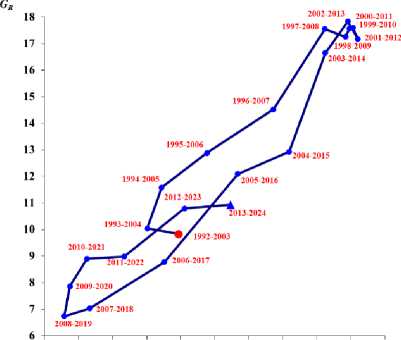
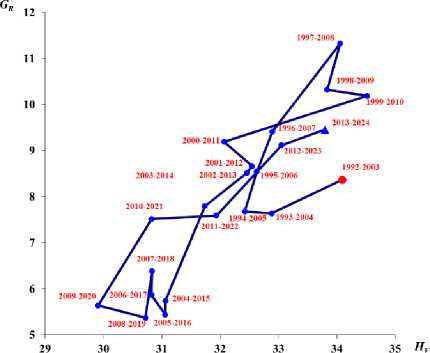
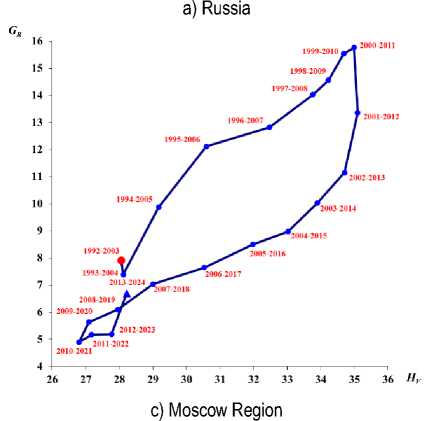
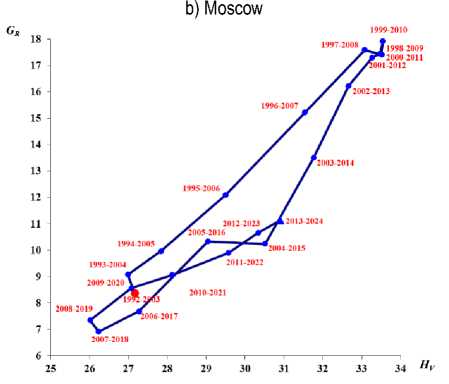
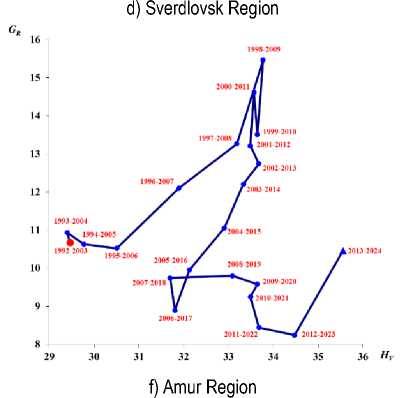
Figure 1 shows the dynamics of entropic measures of chaos ( HV ) and self-organization ( GR ) for indicator values across the constituent entities of the Russian Federation and for Russia as a whole for the period 1992–2024, presented in the form of vector entropy hodographs. The results demonstrate a clear cyclical pattern in the dynamics of entropic measures. The progressive development of the socio-economic system is adaptive in nature. An increase in the system’s chaos provokes the activation of self-organization mechanisms, which serves as a driver of adaptation and directed change in the system.
We identified five distinct periods based on the results of monitoring entropy indicators for data on Russia. The first period (until the mid-1990s) was characterized by a decrease in the entropy measure of chaos and a simultaneous slight increase in the entropy measure of self-organization. It corresponded to the initial stage of market reforms after the collapse of the USSR. Against the backdrop of a large-scale
Figure 1. Hodographs of the entropic measures of chaos ( HV ) and self-organization ( GR ) for the indicator values across the constituent entities of the RF and Russia as a whole for the period 1992–2024
e) Vladimir Region
Note: the starting point of the period under consideration is marked with a red circle, and the ending point is marked with a blue triangle.
Source: own compilation.
crisis that included decline in production volumes, surge in inflation, and significant population decline (Smirnov, 2016), new economic relations were spontaneously emerging, economic ties were being streamlined on new principles, and primary market institutions and mechanisms (barter, mutual settlements) were taking shape.
The second period (until the mid-2000s) presented an increase in the entropic measure of chaos and the entropic measure of self-organization, which was a consequence of the post-crisis development of market relations after the transformational shock of the 1990s (Tatarkin, Bersenev, 2016). The chaos of the socio-economic system manifested itself in institutional instability, price and exchange rate volatility, uncertainty regarding property rights, and significant share of the informal economy. At the same time, processes of self-organization of the socio-economic system intensified, business associations were formed, trade and logistics networks developed, and financial markets and business groups were created as mechanisms for coordinating economic actors (Manturov, 2016).
The third period (until the mid-2010s) was characterized by a reduction in the entropic measure of chaos and the entropic measure of self-organization, which was due to macroeconomic stabilization. This included reducing inflation to 6–7 % by 2013 (from double-digit values), accumulating reserves (creation of the Stabilization Fund in 2004 and the Reserve Fund in 2008), and strengthening state regulation and banking supervision. The reduction of chaos in the socio-economic system was ensured by the formalization of rules and the standardization of business processes. At the same time, the decline in self-organization of the socio-economic system was linked to the centralization of management, bureaucratization, and a reduction in competition in a number of economic sectors (Leksin, 2013).
The fourth period (until the end of the 2010s) is associated with a new increase in the entropic measure of chaos and the entropic measure of self-organization. The dynamics was a response to a set of external shocks. The increase in the system’s chaos was due to factors such as sanctions pressure on the Russian economy, volatility of oil prices, geopolitical tensions, and the COVID-19 pandemic. In response, the mechanisms of self-organization of the socio-economic system became more active; in particular, parallel imports developed, digitalization processes accelerated, and cooperatives were formed to achieve import substitution.
In the fifth period (from the early 2020s), further increase in the entropic measure of chaos is observed, while the entropic measure of self-organization remains unchanged. The intensification of chaos in the socio-economic system is linked to the persistence of geopolitical tensions, the tightening of sanctions pressure, and the need for a structural restructuring of the economy under new restrictions. As a result of reaching a certain limit of the adaptive potential, the growth of self-organization of the system has practically stopped. This is due to the exhaustion of short-term reserves for digitalization and restructuring of logistics chains, limited access to technology and capital, increase in bureaucracy as part of the crisis response, and decline in entrepreneurial initiative amid high uncertainty.
Regional dynamics differ and reflect the varying levels of development of the constituent entities of the Russian Federation and their ability to adapt to changes. The specific features of the dynamics of entropy measures in the Moscow and Sverdlovsk regions, compared to the nationwide trend, are evident in the first and last periods. In the first period, the significant potential of the Moscow Region (highly developed region) helped to mitigate the most acute manifestations of the crisis, and the higher adaptability of local institutions to changes prevented a surge in uncertainty. As a result, the system’s chaotic nature did not change. Although the mechanisms of its self-organization developed moderately, they did not collapse under the influence of the crisis, but neither did they receive a powerful impetus for growth due to the overall instability in the country. A distinctive feature of the fourth period in the Moscow Region is its later start compared to the nationwide trend, which was accompanied solely by an increase in the entropic measure of chaos, without any significant changes in the entropic measure of self-organization. In the fifth period, the growth of the entropic measure of chaos continued, and an increase in the measure of self-organization was recorded. This is due to a number of competitive advantages of the Moscow Region, which ensure increased resilience and mitigate external shocks: a highly diversified economy, proximity to federal resources, a well-developed infrastructure, a significant volume of investment, and human potential.
In the Sverdlovsk Region (developed region), a slight increase in the entropic measure of self-organization was observed in the first period, while the value of the entropic measure of chaos remained virtually unchanged. In the early years of market reforms, attempts were made to build new economic ties around local industrial giants to replace the destroyed planned-economic chains. The fifth period is not distinguished in the region; the dynamics of the fourth period are maintained.
The trajectories of the dynamics of entropy measures in the Vladimir Region (moderately developed region) and Moscow virtually follow the overall Russian trend. However, in the latest period, in the Vladimir Region, the entropy measure of chaos is growing at a faster rate than the entropy measure of self-organization. The dynamics may be linked to the structural dependence on certain sectors of the region, limited access to investments, and the outflow of skilled labor to the capital region. Although the dynamics of entropy measures in Moscow generally align with the overall Russian trend, they are characterized by more pronounced fluctuations. During crisis periods, the growth of chaos is promptly compensated for by the accelerated self-organization of the socio-economic system. Thanks to the high concentration of financial and managerial resources, as well as the dominance of the service sector and digital technologies, Moscow demonstrates a rapid response to changes.
The dynamics of entropy measures for the Amur Region (less developed region) demonstrate significant differences in the previous two periods. In the fourth period (2010s), there is an increase in the entropy measure of chaos, while the value of the entropy measure of self-organization remains unchanged or even decreases. This means that the region’s socio-economic system is becoming less ordered, imbalances in the development of sectors are intensifying, and uncertainty in ongoing processes is growing. At the same time, the mechanisms of self-organization (adaptation of institutions, redistribution of resources, development of infrastructure), which could compensate for the chaos, do not become active in response to crisis phenomena or operate less effectively. This situation may be due to the weakness of local institutions, high dependence on external decisions (federal programs and investments), and the inertia of the economy, with traditional sectors predominating. This situation is reflected in the region’s financial and economic indicators. In 2015, the Amur Region was included in the list of constituent entities of the Russian Federation where the volume of public debt exceeded their own revenues. The region has joined a group of 12 federal subjects with the highest debt burden, which serves as an indicator of increased financial risks and limitations in implementing independent regional policy (Ivanov et al., 2018).
In the fifth period (starting from the early 2020s), a sharp increase in the entropic measure of self-organization is observed, despite the persistence and even intensification of its chaotic nature, which is explained by the implementation of major projects (the Amur Gas Processing Plant, the Vostochny Cosmodrome)4. The Amur
Region’s GRP has been growing annually over the analyzed period from 2017 to 2023, and in 2023 the figure increased 2.6-fold compared to 2017 due to the completion of major investment projects in the region (Zakharova et al., 2025). An additional factor driving development is the inflow of foreign capital. As of early 2022, the accumulated volume of Chinese investments in the region had reached 280 million dollars (Gao, 2025). Such projects serve as “growth points” around which resources and management decisions are concentrated; however, in peripheral sectors (for example, in agriculture or small businesses), imbalances may grow, which is reflected in the increasing chaos within the socio-economic system.
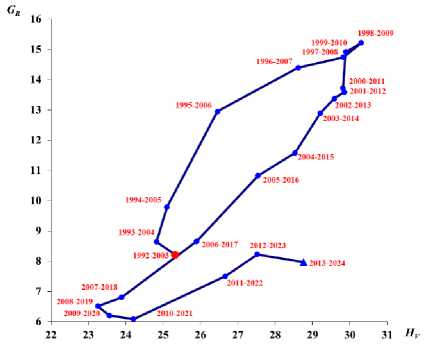
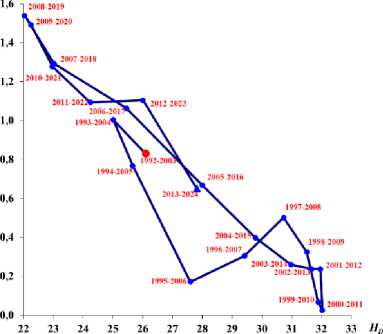
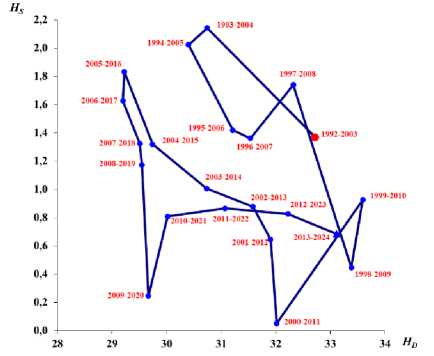
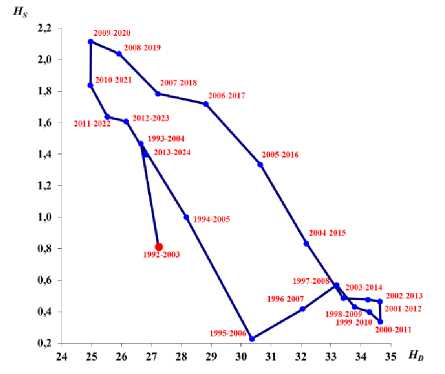
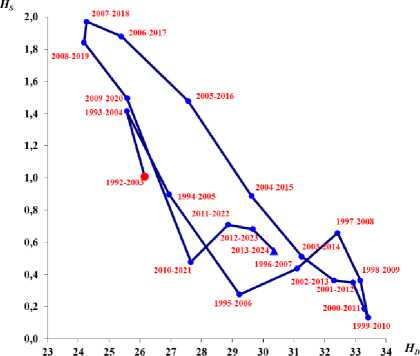
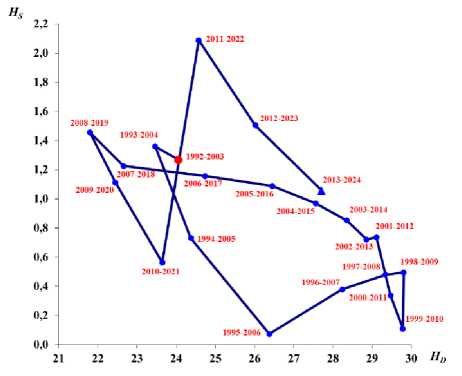
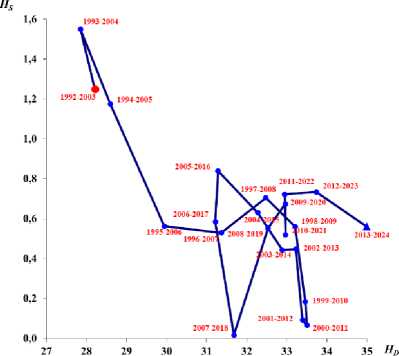
Figure 2 shows the dynamics of entropy-based measures of development ( HD ) and stability ( HS ) of indicator values for the constituent entities of the Russian Federation and for Russia as a whole for the period 1992–2024, presented in the form of vector entropy hodographs. The dynamics of entropy-based measures have a certain cyclical character. The results show that the stability of the socio-economic system is dynamic and consists of cycles of stabilization and development. In the stabilization phase, the system consolidates resources, strengthens institutional mechanisms, minimizes vulnerabilities, and reduces risks, which creates a solid foundation for further development. Then comes the development stage, when the system adapts to new external and internal challenges, transforms its structure, introduces innovations, and seeks promising growth areas. Alternating these phases makes it possible to maintain a balance between preserving the achieved results and the need for change, which ensures the long-term viability of the socio-economic system in conditions of uncertainty. The decline in the stability of the socio-economic system in recent years reflects the natural process of the system adapting to new realities, which in the long term may increase its resilience.
The results of the calculations for Russia make it possible to identify four qualitatively distinct periods in the dynamics of the processes under consideration. The first period (until the end of the 1990s) is characterized by an increase in the entropic measure of stability, which may indicate the formation of basic institutions and mechanisms that ensure the relative stability of the socio-economic system under the conditions of the transformational crisis of the 1990s, and a simultaneous decrease in the entropic measure of development, reflecting the slowdown of positive structural changes, a decline in adaptive potential, and limited opportunities for innovative growth during the formation of the new economic model.
The opposite pattern is observed in the second period (until the mid-2000s). The decline in the entropic measure of stability, likely related to the intensification of structural changes, the growth of economic dynamics, and the increase in uncertainty under conditions of rapid growth and integration into the global economy, is combined with an increase in the entropic measure of development, which indicates the strengthening of development processes, the diversification of economic activity, an increase in the system’s adaptability, and implementation of growth potential against the backdrop of favorable external conditions, including high energy prices. It is noteworthy that in the early 2000s, there was a short-term increase in stability, possibly due to the consolidation of power.
The third period (until the mid-2010s) was accompanied by a decline in the entropic measure of development and increase in the entropic measure of stability. The dynamics may reflect the growing systemic constraints on growth (institutional, technological), a decline in the system’s adaptive capacity, the influence of global factors (global financial crisis of 2008–2009, subsequent sanctions, and the volatility of commodity markets), as well as the emergence of a “middle-income trap” and the exhaustion of the growth model based on commodity exports (Lyakin, 2013).
И,
а) Russia
Figure 2. Holograms of entropy-based development measures ( HD ) and stability ( HS ) for the indicators’ values across the constituent entities of the RF and for Russia as a whole for the period 1992–2024
c) Moscow Region
b) Moscow
e) Vladimir Region
d) Sverdlovsk Region
f) Amur Region
Note: the starting point of the period under consideration is marked with a red circle, the ending point is marked with a blue triangle.
Source: own compilation.
The fourth period (from the mid-2010s) is characterized by opposite trends: there is an increase in the entropy-based measure of development against the backdrop of a decline in the entropy-based measure of stability. The dynamics is driven by a complex of external and internal factors, among which the key role is played by global digital transformation, sanctions pressure, the need for accelerated import substitution, changes in the geopolitical situation, and the need to ensure technological sovereignty. As a result, the socio-economic system demonstrates increased flexibility and adaptability. This period has a pronounced transformational character. The growth of entropic measures of development indicates an increase in the dynamism of the system, the activation of mechanisms for qualitative changes, and the search for new growth points (development of digital technologies and transformation of economic relations). At the same time, decrease in the entropic measure of stability reflects the natural process of adaptation of the socio-economic system to new realities (transformation of financial flows, changes in logistics chains, etc.).
The results of entropy modeling in the fourth period demonstrate noticeable differences in the dynamics of entropy measures across Russian regions, reflecting their structural characteristics, resource potential, and adaptive capabilities. In Moscow, the fourth period began in the early 2010s, and from the middle of the decade, a sharper increase in the entropy measure of development is observed, which indicates the activation of innovation processes, the development of high-tech industries, the strengthening of financial and business activity, and the expansion of digital services and services. At the same time, gradual decline in the entropic measure of stability is observed, which is associated with the restructuring of the socio-economic system under the influence of new conditions.
The Sverdlovsk Region generally follows the overall dynamics observed in Russia; in the fourth period, it also shows an increase in the entropybased measure of development against the backdrop of a decline in the entropy-based measure of stability. However, since the late 2010s, the entropy-based measure of stability has practically stopped changing and has stabilized at a single level. This may indicate the achievement of a new equilibrium in the socio-economic system and the formation of a sustainable development model based on industrial potential and infrastructure projects.
In the Vladimir Region, the trends largely mirror the nationwide picture, but with a characteristic feature in the latest period. In 2022, the region recorded a sharp increase in the entropic measure of stability, followed by restoration of the previous trend. This is likely due to the implementation of anti-crisis measures to support the regional economy, the intensification of import substitution processes in key sectors, an increase in budgetary capacity, and launch of infrastructure projects.
The Amur Region also demonstrates the overall national trend, but with a noticeable deviation in 2017–2018, when a sharp decline in the entropybased measure of stability was observed; after that, the indicator’s value recovered and stabilized at a single level against the backdrop of a slow growth in the entropy-based measure of development. Such dynamics may have been influenced by the implementation of major infrastructure projects (construction of bridges and development of transport corridors), a shift toward Asian markets and associated changes in the structure of exports and logistics, and fluctuations in investment activity due to the launch of mega-projects.
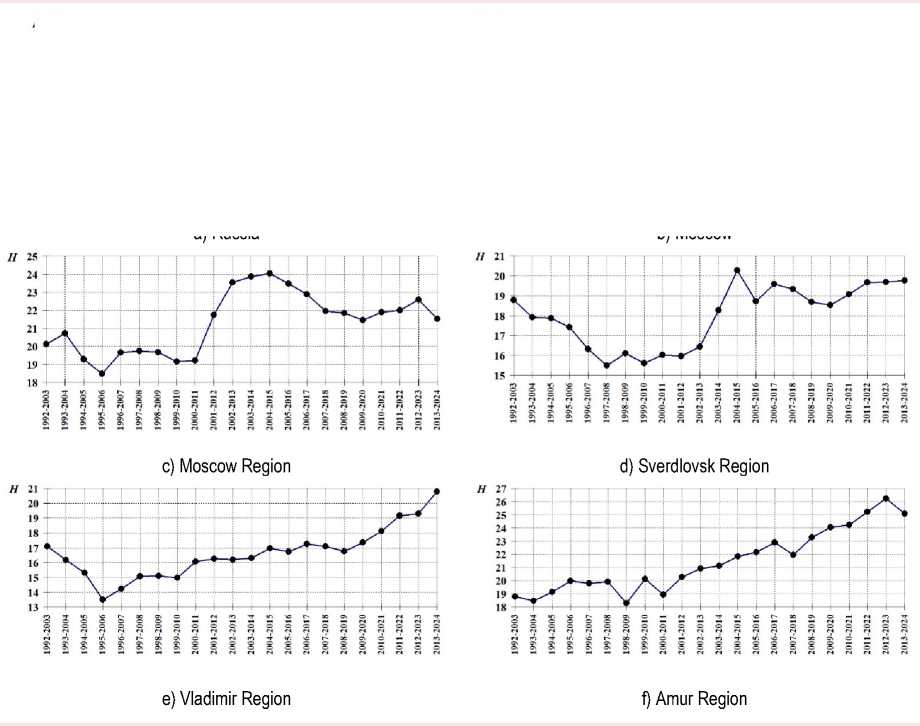
The dynamics of entropy H in the values of the indicators demonstrate significant differences at the level of particular constituent entities of the Russian Federation and on a national scale ( Fig. 3 ). Overall, a decrease in entropy was observed in Russia in the 1990s, which reflected the processes of stabilizing the economic system after a period of turbulence,
Source: own compilation.
Figure 3. Dynamics of entropy H values for indicators across the constituent entities of the RF and for Russia as a whole for the period 1992–2024
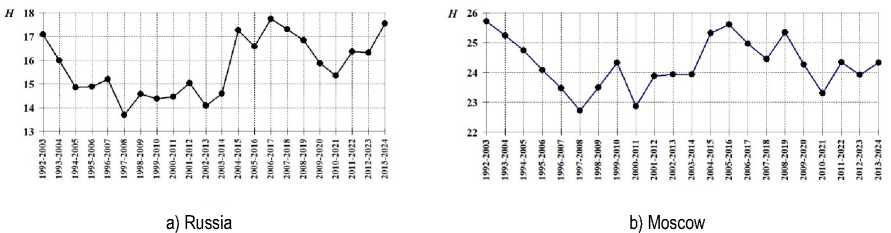
accompanied by the formation of large economic structures, including monopolies. In the 2000s, entropy remained at the same level, which indicated a stable equilibrium in the socio-economic system. During this period, a stable structure of economic relations was formed, and there were no drastic structural changes. The period up to the mid-2010s was characterized by an increase in entropy, which indicates the activation of innovation processes and the diversification of economic activity. From the mid-2010s to the end of the 2010s, a decrease in entropy was observed, обусловленное by the strengthening of regulatory measures, market consolidation, and the optimization of business processes. The state and large corporations increased their control, which contributed to the streamlining of economic relations and a reduction in the variety of development scenarios for individual segments of the economy. Since the early 2020s, an increase in entropy has been recorded, indicating growing uncertainty in the socio-economic system. This stage is associated with the emergence of new economic challenges, the transformation of traditional business models, and an increase in the diversity of economic scenarios. Against the backdrop of global crises, technological changes, and geopolitical factors, the system has become less predictable.
Figure 4. Increase in entropy-based measures of indicators for Russia and its regions over the period from 2012 to 2024
Source: own compilation.
The results of monitoring the entropy dynamics show that in Russia’s regions, the trajectories of changes in this indicator are to varying degrees consistent with the nationwide trend. This indicates the presence of common macro-economic factors influencing the level of uncertainty and diversity of economic indicators across the country. However, the Amur Region demonstrates a significant deviation from the general pattern: during the period under consideration, a steady increase in entropy was recorded there, which may indicate an increase in the heterogeneity of intra-regional development processes.
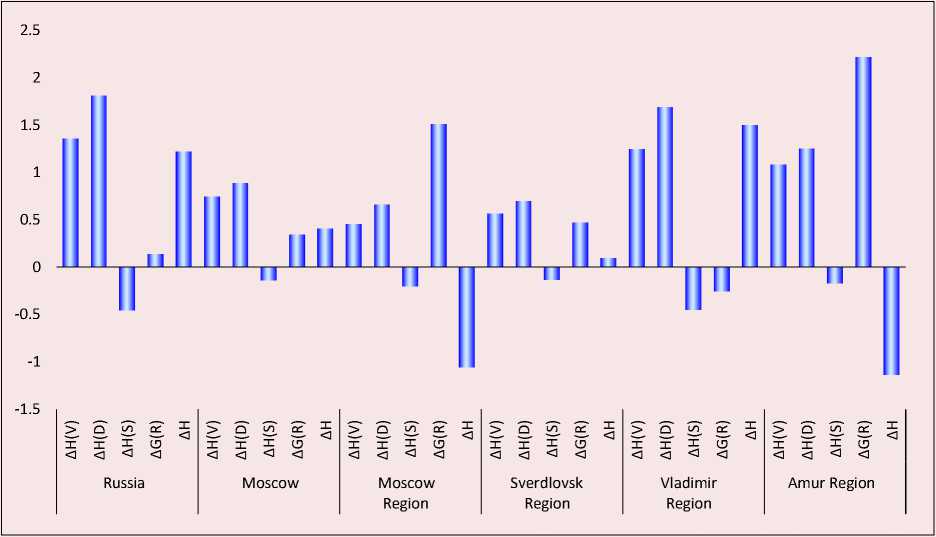
Figure 4 shows the increase in the entropy indicators for Russia and its individual regions from 2012 to 2024. The results of monitoring the entropy dynamics measures in the context of ensuring the country’s economic security over a thirty-year period demonstrate a number of significant trends. An analysis of changes in entropy indicators revealed an increase in entropy alongside an increase in entropy measures of chaos, development, and self-organization, while entropy measures of stability decreased. This combination of dynamics in entropic measures reflects a non-equilibrium but productive state of the socio-economic system and indicates its active transformation. On the one hand, the system gains greater flexibility, which is reflected in an increase in entropy and a decrease in the entropic measure of stability. On the other hand, the growth of entropic measures of development and self-organization compensates for the potential decline in stability, and the growth of the entropic measure of chaos is combined with the strengthening of adaptation mechanisms. This combination indicates that the socio-economic system has developed the ability to function effectively under conditions of increased variability, when uncertainty ceases to be a barrier and becomes a resource for finding new solutions.
From the perspective of ensuring economic security, this combination of dynamics in entropy measures reflects not a crisis, but a purposeful transformation of the socio-economic system into a more stable and adaptive model. The growth of the entropy measure of chaos, coupled with the simultaneous strengthening of adaptation mechanisms, indicates an increase in adaptive potential. The system learns to function under conditions of uncertainty, which reduces its vulnerability to unexpected external shocks (sanctions, price fluctuations in commodity markets, global crises), builds “immunity” to typical threats through the diversification of response strategies, and ensures the ability to quickly adapt to new conditions without losing key functions. An increase in entropy and a decrease in the entropy-based measure of stability indicate a departure from the “frozen stability” model in favor of dynamic equilibrium. This is positive for ensuring economic security in the long term, since rigid stabilization often masks structural problems, whereas flexible resilience allows them to be identified and addressed. The increase in entropic measures of development and self-organization reflects the formation of internal mechanisms for ensuring economic security. The identified dynamics also show that the system is not merely reacting to threats but is learning to benefit from variability. In the context of ensuring economic security, this manifests itself in the transition from reactive risk management to the proactive use of opportunities.
The trajectory of changes in the entropic measures of socio-economic indicators across Russian regions reflects the overall national dynamics, but the amplitude of the changes (the difference in the values of the entropic measure between the final and initial points of the period under consideration) varies significantly. Moscow and the Sverdlovsk Region demonstrate dynamics similar to the national average, but with a more moderate amplitude of changes. Identical trends in the changes of entropic measures are observed in the Moscow and Amur regions, where the socio-economic system is becoming less predictable, yet at the same time increasing its capacity for self-regulation and adaptation. This may be a sign of movement toward a more complex and stable state, albeit one that is associated with short-term risks of instability. The similarity of trends in two regions with different geography and economies may indicate the influence of common factors, in particular, the strengthening of centralized management. The Vladimir Region is characterized by a noticeable increase in entropy and entropic measures of chaos and development, while there is a slight reduction in entropic measures of stability and self-organization. This may indicate a high sensitivity of these regions to external shocks, underdeveloped adaptive institutions, and the inertia of the economy, where development is primarily driven by extensive factors rather than by internal restructuring of the system.
Conclusion
The study conducted is devoted to the development of an approach to monitoring the economic security of Russian regions, based on a vector entropy model. The approach makes it possible to assess the stability, resilience, and progressive development of the socio-economic system under consideration, which directly characterizes the provision of economic security in the region. The application of the proposed model makes it possible to decompose the overall entropy of the socio-economic system into components (entropy measures of chaos, self-organization, development, and stability), the combination of which describes three key characteristics of the socio-economic system. The use of a logarithmic scale of entropy measures ensures the unification of the assessment of system dynamics. Each region, as a multidimensional stochastic system, is represented as a random vector of nine indicators.
The approach was tested using data for Russia as a whole and for five constituent entities of the Russian Federation (Moscow, Moscow Region, Sverdlovsk Region, Vladimir Region, and Amur Region) for the period 1992–2024. The monitoring results revealed a cyclical nature of the dynamics of entropy indicators, with periods of stabilization being followed by stages of increased diversity and volatility. At the same time, there is a significant differentiation of regions in terms of the level of stability and adaptability of socio-economic systems, as well as the influence of macroeconomic factors on the nationwide dynamics, with possible deviations of the trajectories of individual regions from the general trend. An analysis of regional specifics has shown that Moscow and the Moscow Region demonstrate high resilience and adaptability due to the diversification of their economies, proximity to federal resources, and well-developed human resource base. The Sverdlovsk Region follows the nationwide dynamics with a moderate amplitude of changes, relying on its industrial potential and infrastructure projects. The Vladimir Region is characterized by high sensitivity to external shocks, economic inertia, and limited capacity for endogenous transformation. The Amur Region is experiencing a steady increase in entropy, which indicates growing heterogeneity in development and dependence on external decisions (federal programs and investments). The study’s findings allow concluding that an increase in entropy is not always negative; it can indicate development potential and the emergence of new opportunities, whereas an excessive decrease in entropy threatens stagnation, and a sharp increase in it leads to instability and risks.
The analysis of the results of entropic monitoring demonstrates that the economic security of Russian regions is partially ensured in the current period (since the beginning of the 2020s), but it is under pressure from external and internal destabilizing factors. Despite the preservation of the adaptive potential of the socio-economic system, there is a clear trend toward a decline in its stability. The growing number of new challenges and threats reveals the limitations of the existing adaptation mechanisms. The observed increase in the system’s chaos, in the absence of a proportional increase in self-organization, indicates the exhaustion of its short-term adaptive potential. The dynamism of the system is achieved at the expense of increasing its vulnerability, which is indicated by a decline in stability as development progresses.
The developed approach to monitoring the economic security of Russia’s regions, based on a vector entropy model, makes it possible to identify structural shifts, assess risks, and adjust policies. Differences in the dynamics of entropy measures of socio-economic indicators underscore the need for a differentiated approach to ensuring economic security, taking into account regional specifics — in particular, assessing the region’s resource potential, analyzing the maturity of the institutional environment, considering the quality of management impact, and identifying key factors of the system’s stability and adaptability. The obtained results can serve as a basis for adjusting the strategic directions for ensuring economic security, determining priority measures of state support, and developing adaptive mechanisms for responding to external and internal challenges. Depending on the combination of values and vectors of characteristics that determine the provision of economic security (entropic measures of chaos, self-organization, development, and stability), management decisions should be developed in a differentiated manner. Thus, if the entropic measure of stability exceeds the threshold value (HS > HS,thres), stabilization measures (formation of reserves, provision of subsidies, and systematic risk monitoring) become a priority. In the event of an increase in the entropic measure of development (HD), it is advisable to support transformation processes by stimulating innovation, diversifying the economy, and launching new projects, while simultaneously implementing risk control mechanisms to minimize negative consequences. If the level of self-organization (GR) is low or declining, it is necessary to strengthen interdepartmental coordination, develop the institutional environment, scale up digital platforms, and support industry associations. Analysis of the vector (HV, GR) allows for differentiation of management responses: if both HV and GR are growing simultaneously, indicating “adaptive growth,” measures should be aimed at supporting and scaling up the existing positive trends; if HV is growing while GR is stagnating, which corresponds to a “destabilization” scenario, the key priorities become strengthening institutions and improving coordination of actions; in a situation of low and declining values of HV and GR, reflecting a state of “stagnation,” it is necessary to stimulate the diversification of economic activity and the development of competitive environment.
The developed approach to monitoring economic security based on a vector entropy model is a significant analytical tool that naturally complements the approach based on indicator analysis. These approaches do not contradict each other but form a mutually reinforcing assessment system. Their combined use makes it possible to form a more complete and balanced picture of the state of economic security in the region. The indicative method is focused on operational diagnostics; it records deviations of actual indicator values from established threshold levels and thereby provides a clear picture of the current state of the system “then and there”, but it does not take into account the interdependence of indicators and their dynamics. The vector entropy model, by contrast, reflects structural shifts, adaptive potential, and accumulated uncertainty, and therefore can signal risks earlier than the indicative index goes beyond critical threshold values. A clear example of the complementarity of approaches is the comparison of the results of calculations using the methodology of the Institute of Economics of the Ural Branch of RAS (Tatarkin et al., 2003) for the Moscow Region. In some years, the indicative index remained within the “normal zone,” without recording critical deviations. At the same time, the vector entropy model demonstrated an increase in the entropy measure of chaos (HV) while maintaining the level of the self-organization measure (GR). The dynamics is interpreted as “adaptive growth,” i.e., a state that is not critical, as it remains within the threshold values, but requires close attention to maintaining a balance between transformational processes and the stability of the socio-economic system. Thus, the vector entropy model is a promising tool for monitoring the economic security of regions, enabling a shift from reactive risk management to proactive use of opportunities in conditions of increased uncertainty.
