
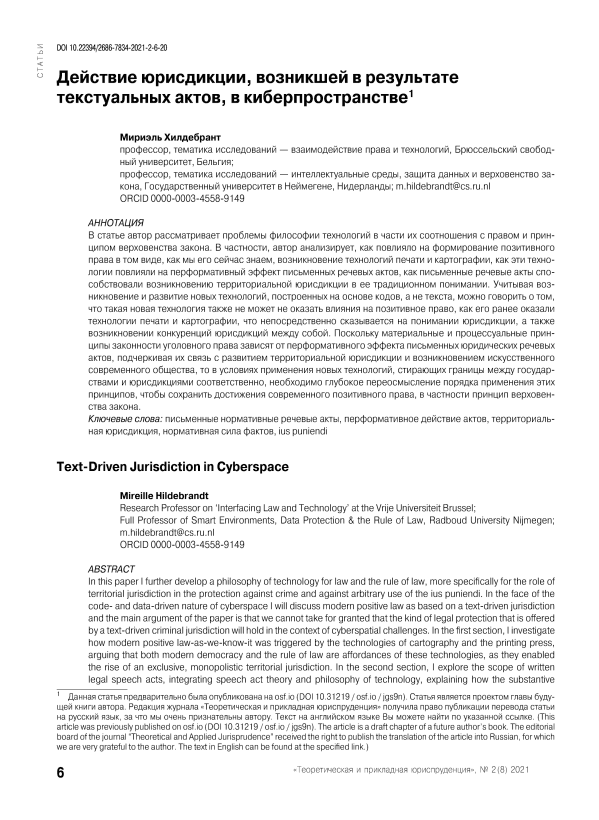
Действие юрисдикции, возникшей в результате текстуальных актов, в киберпространстве
Журнал: Теоретическая и прикладная юриспруденция.
Рубрика: Статьи
Статья в выпуске: 2 (8), 2021 года.
Бесплатный доступ
В статье автор рассматривает проблемы философии технологий в части их соотношения с правом и принципом верховенства закона. В частности, автор анализирует, как повлияло на формирование позитивного права в том виде, как мы его сейчас знаем, возникновение технологий печати и картографии, как эти технологии повлияли на перформативный эффект письменных речевых актов, как письменные речевые акты способствовали возникновению территориальной юрисдикции в ее традиционном понимании. Учитывая возникновение и развитие новых технологий, построенных на основе кодов, а не текста, можно говорить о том, что такая новая технология также не может не оказать влияния на позитивное право, как его ранее оказали технологии печати и картографии, что непосредственно сказывается на понимании юрисдикции, а также возникновении конкуренций юрисдикций между собой. Поскольку материальные и процессуальные принципы законности уголовного права зависят от перформативного эффекта письменных юридических речевых актов, подчеркивая их связь с развитием территориальной юрисдикции и возникновением искусственного современного общества, то в условиях применения новых технологий, стирающих границы между государствами и юрисдикциями соответственно, необходимо глубокое переосмысление порядка применения этих принципов, чтобы сохранить достижения современного позитивного права, в частности принцип верховенства закона.
Похожие статьи в разделе Виды и формы права. Направления в теории права
Короткий адрес: https://sciup.org/14121180
IDS: 14121180 | DOI: 10.22394/2686-7834-2021-2-6-20
Text-driven jurisdiction in cyberspace
In this paper I further develop a philosophy of technology for law and the rule of law, more specifi cally for the role of territorial jurisdiction in the protection against crime and against arbitrary use of the ius puniendi. In the face of the code- and data-driven nature of cyberspace I will discuss modern positive law as based on a text-driven jurisdiction and the main argument of the paper is that we cannot take for granted that the kind of legal protection that is offered by a text-driven criminal jurisdiction will hold in the context of cyberspatial challenges. In the fi rst section, I investigate how modern positive law-as-we-know-it was triggered by the technologies of cartography and the printing press, arguing that both modern democracy and the rule of law are affordances of these technologies, as they enabled the rise of an exclusive, monopolistic territorial jurisdiction. In the second section, I explore the scope of written legal speech acts, integrating speech act theory and philosophy of technology, explaining how the substantive and procedural principles of criminal law legality depend on the performative effect of written legal speech acts, highlighting their connection with the rise of territorial jurisdiction and the creation of an artifi cial, modern demos. In the third section, I discuss the new challenges of competing territorial jurisdictions that claim legal powers outside their territory, coupled by the challenges posed by new types of ‘brute jurisdictions’ that are based on the force of technological infrastructures that may overrule the performative effect of written legal speech acts. In the conclusions I call for keen attention to which affordances of cartography and the printing press we need to preserve in cyberspace to uphold criminal law principles such as the presumption of innocence, the right to a fair trial and the legality principle, taking note that preservation will require reinvention and imagination rather than taking for granted the mode of existence of text-driven jurisdiction.
Список литературы Действие юрисдикции, возникшей в результате текстуальных актов, в киберпространстве
- Anscombe, G. E. M, 'On Brute Facts' Analysis, Volume 18, Issue 3, January 1958. Pp. 69-72.
- Anter, A., Die Normative Kraft Des Faktischen: Das Staatsverstandnis Georg Jellineks: 6. 2020.
- Austin, J. and Rumble, W. (eds), The Province of Jurisprudence Determined. Cambridge University Press, 1995.
- Austin, J. L., How to Do Things with Words. 2nd edn, Harvard University Press, 1975.
- Beccaria, C., An Essay on Crimes and Punishments. By the Marquis Beccaria of Milan. With a Commentary by M. de Voltaire. A New Edition Corrected. Gale ECCO, Print Editions, 2010.
- Been, W. de, Arora, P. and Hildebrandt, M. (eds), Crossroads in New Media, Identity and Law: The Shape of Diversity to Come. 2015th edition, AIAA 2015.
- Berman, H., Law and Revolution. The Formation of the Western Legal Tradition. Harvard University Press, 1983.
- Bodin, J., Bodin: On Sovereignty. Julian H. Franklin ed, Cambridge University Press, 1992.
- Cohen, J. E., 'Cyberspace As / And Space'. 2007. 107 Columbia Law Review. Pp. 210-256.
- DuBois, J. and Smith, B., 'Adolf Reinach' in Edward N. Zalta (ed), The Stanford Encyclopedia of Philosophy. Fall 2018, Metaphysics Research Lab, Stanford University 2018 [Electronic resource]. URL: https://plato.stanford.edu/archives/ fall2018/entries/reinach/ (accessed 19 October 2020).
- Duff, R. A., Punishment, Communication, and Community. Oxford University Press, 2001.
- Dworkin, R., Law's Empire. Fontana, 1991.
- Eisenstein, E. L., The Printing Revolution in Early Modern Europe. 2nd ed., Cambridge University Press 2012 [Electronic resource]. URL: http://ebooks.cambridge.org/ref/id/CBO9781139197038 (accessed 2 May 2019).
- Ford, R. T., Law's Territory (A History of Jurisdiction). 97 Michigan Law Review 843, 1999.
- Fraenkel, B., 'Actes écrits, actes oraux : la performativité à l'épreuve de l'écriture'. Études de communication. Langages, information, mediations, 2006. No. 29. Pp. 69-93.
- Friend, C., 'Social Contract Theory', Internet Encyclopedia of Philosophy [Electronic resource]. URL: https://iep.utm. edu/soc-cont/ (accessed 26 March 2021).
- Georg Jellinek, Allgemeine Staatslehre. O Häring, 1905 [Electronic resource]. URL: http://archive.org/details/ allgemeinestaat00jellgoog (accessed 31 March 2021).
- Gleick, J., The Information: a History, a Theory, a Flood. First Edition, Pantheon, 2010.
- Glenn, H. P., Legal Traditions of the World. Oxford University Press, 2007.
- Goldsmith, J. and Wu, T., Who Controls the Internet?: Illusions of a Borderless World. Oxford University Press, USA, 2008.
- Hart, H. L. A., The Concept of Law. Clarendon Press, 1994.
- Henttonen, P., Records, Rules and Speech Acts. Archival Principles and Preservation of Speech Acts. Tampere University Press, 2007.
- Hildebrandt, M., 'European Criminal Law and European Identity'. Criminal Law and Philosophy, 2007. No. 1. Pp. 57-78.
- Hildebrandt, M., 'Extraterritorial Jurisdiction to Enforce in Cyberspace? Bodin, Schmitt, Grotius in Cyberspace'. University of Toronto Law Journal, 2013. No. 63 (2). Pp. 196-224.
- Hildebrandt, M., Smart Technologies and the End(s) of Law. Novel Entanglements of Law and Technology. Edward Elgar, 2015.
- Hildebrandt, M., 'Radbruch's Rechtsstaat and Schmitt's Legal Order: Legalism, Legality, and the Institution of Law'. Critical Analysis of Law, 2015. Vol. 2 No. 1 [Electronic resource]. URL: http://cal.library.utoronto.ca/index.php/cal/ article/view/22514 (accessed 24 March 2015).
- Hildebrandt, M., 'A Philosophy of Technology for Computational Law'. LawArXiv 2020 [Electronic resource]. URL: https://osf.io/preprints/lawarxiv/7eykj/ (accessed 7 December 2020).
- Hildebrandt, M., 'Chris Reed and Andrew Murray, Rethinking the Jurisprudence of Cyberspace, Cheltenham: Edward Elgar, 2018, 256 Pp., n/a The Modern Law Review [Electronic resource]. URL: https://onlinelibrary.wiley.com/doi/ abs/10.111 1/1468-2230.12491 (accessed 19 December 2019).
- Hobsbawm, E., The Invention of Tradition (Canto). Publisher: Cambridge University Press, 1992.
- Kantorowicz, E. H., The King's Two Bodies. A Study in Mediaeval Political Theology. Princeton University Press, 1957.
- Kelsen, H., Pure Theory of Law. Lawbook Exchange, 2005.
- Ladavac, N. B., Bezemek, C. and Schauer, F. (eds), The Normative Force of the Factual: Legal Philosophy Between Is and Ought. 1st ed. 2019 edition, Springer, 2019.
- Lefort, C., Democracy and Political Theory. John Wiley & Sons, 1991.
- Lévy, P., Les Technologies de l'intelligence. L'avenir de La Pensée à l'ère Informatique. La Découverte, 1990.
- MacCormick, N., Institutions of Law: An Essay in Legal Theory. Oxford University Press, 2007.
- Mueller, M., 'The New Cyber-Conservatism: Goldsmith/Wu and the Premature Triumphalism of the Territorial Nation-State: A Review of Goldsmith and Wu's 'Who Controls the Internet? Illusions of a Borderless World'. Internet Governance Project. Paper IGP06-003, June 2006 [Electronic resource]. URL: http://internetgovernance.org/pdf/ MM-goldsmithWu.pdf (accessed 24 May 2021).
- Mueller, M. L., Ruling the Root: Internet Governance and the Taming of Cyberspace. New e edition, MIT Press, 2004.
- Mueller, M. L., Networks and States: The Global Politics of Internet Governance. The MIT Press, 2010.
- Paolo, E. A. D., Cuffari, E. C. and Jaegher, H. de, Linguistic Bodies: The Continuity between Life and Language, 2018.
- Peirce, C. S. and Turrisi, P. A., Pragmatism as a Principle and Method of Right Thinking: The 1903 Harvard Lectures on Pragmatism. State University of New York Press, 1997.
- Radbruch, G., 'Legal Philosophy', The Legal Philosophies of Lask, Radbruch, and Dabin. Reprint 2014, Harvard University Press, 2014 [Electronic resource]. URL: https://www.degruyter.com/view/product/252229 (accessed 28 June 2017).
- Reed, C. and Murray, A., Rethinking the Jurisprudence of Cyberspace. Edward Elgar Pub, 2018.
- Ricoeur, P., 'The Model of the Text: Meaningful Action Considered as a Text'. New Literary History, 1973. Vol. 5. No. 1. Pp. 91-117.
- Searle, J., The Construction of Social Reality. The Free Press, 1995. Searle, J. R., Speech Acts, an Essay in the Philosophy of Language, 1969.
- Stiegler, B., 'Die Aufklaerung in the Age of Philosophical Engineering' in Mireille Hildebrandt, Kieron O'Hara and Michael Waidner (eds), The Value of Personal Data. Digital Enlightenment Forum Yearbook2013 (IOS Press 2013) [Electronic resource]. URL: https://digitalenlightenment.org/2013-digenlight-yearbook-the-value-of-personal-data (accessed 24 May 2021).
- Taylor, C., Philosophical Arguments. Harvard University Press, 1995.
- Taylor, C., The Language Animal: The Full Shape of the Human Linguistic Capacity. Belknap Press: An Imprint of Harvard University Press, 2016.
- Tonnies, F., Tonnies: Community and Civil Society. Cambridge University Press, 2010. Vandenberghe, F., What's Critical About Critical Realism? 1st edition, Routledge, 2014.
- Waldron, J., 'The Rule of Law' in Edward N Zalta (ed), The Stanford Encyclopedia of Philosophy (Summer 2020, Metaphysics Research Lab, Stanford University 2020) [Electronic resource]. URL: https://plato.stanford.edu/archives/ sum2020/entries/rule-of-law/ (accessed 3 May 2020).
- Wittgenstein, L. and Anscombe, G. E. M., Philosophical Investigations: The German Text, with a Revised English Translation, 3rd edition. Blackwell Pub, 2003.
- Young, D. B., 'Cesare Beccaria: Utilitarian or Retributivist?' Journal of Criminal Justice, 1983. Vol. 11, issue 4. Pp. 317326.
