
Development of a Relay-Based Control System for a Robot Swarm Used for Agricultural Operations
Журнал: Инженерные технологии и системы @vestnik-mrsu
Рубрика: Технологии, машины и оборудование
Статья в выпуске: 3, 2026 года.
Бесплатный доступ
Introduction. Agriculture requires efficient processing of large land areas (fields, orchards, pastures). The use of distributed swarm robotics systems allows automating these processes, reducing labor costs and increasing the precision of operations. The efficiency of these systems largely depends on the control methods ensuring coordination of robots, optimal task distribution, and reliable communication between them that is critical for parallel processing and minimizing downtime. Aim of the Study. The study is aimed at improving the robot swarm control efficiency by developing an advanced method with the use of relay communication and a distributed ledger. Materials and Methods. The object of the study was a swarm robotics system for processing agricultural areal objects. The study was conducted using a software model implemented in Python, which simulated the operation of a robot swarm with relay-based communication. At the first stage, there was implemented an improved control method involving a distributed ledger of processed targets and a mechanism for dynamic role redistribution among robots. At the second stage, the system operation was simulated using a set of synthetic test tasks with varying sizes of the objects processed and different robot numbers in the swarm. At the final stage, the improved method was compared with baseline control method terms of task execution time, followed by a statistical evaluation of the obtained results. Results. There has been developed an improved robot swarm control method with a relay-based communication involving a distributed ledger of processed objects and a mechanism for dynamic redistribution of roles among robots. The simulation results demonstrated a 5.75% reduction in the average time of execution of full set of test tasks compared to the base approach. For performing the subset of tasks when the proposed method can realize fully its advantages, the reduction in processing time reaches 10.34%. Conclusion. The improved robot swarm control method enables more effective task distribution and an increased degree of parallelism in processing. This has high practical significance for application in agricultural robotic systems, especially when using budget-friendly equipment. The development prospects include adaptive control, integration with other optimization methods, and the expansion of the approach to heterogeneous swarms.
Короткий адрес: https://sciup.org/147255045
IDS: 147255045 | УДК: 63:004.896:621.395.642 | DOI: 10.15507/2658-4123.26363.500-517
Разработка системы релейного управления роем роботов для сельскохозяйственных работ
Введение. Сельское хозяйство требует эффективной обработки больших площадных объектов (поля, сады, пастбища). Использование распределенных роевых роботизированных систем позволяет автоматизировать эти процессы, снижая трудозатраты и повышая точность операций. Эффективность таких систем в значительной степени зависит от методов управления, обеспечивающих координацию роботов, оптимальное распределение задач и устойчивую связь между ними, что критично для обеспечения параллельной обработки и минимизации простоев. Цель исследования. Повышение эффективности управления роем бюджетных роботов путем разработки усовершенствованного метода использования релейной связи и распределенного реестра. Материалы и методы. Объектом исследования являлась роeвая робототехническая система, предназначенная для обработки площадных объектов сельхозназначения. Исследование проводилось с использованием программной модели, реализованной на Python, в которой моделировалась работа роя роботов с релейной связью. На первом этапе был реализован усовершенствованный метод управления, включающий распределенный реестр обработанных целей и механизм динамического перераспределения ролей между роботами. На втором этапе выполнялось моделирование работы системы на наборе синтетических тестовых задач с различными размерами обрабатываемых объектов и численностью роя. На заключительном этапе проводилось сравнение с базовым методом управления по времени выполнения задач и статистическая оценка полученных результатов. Результаты исследования. Разработан усовершенствованный метод управления роем роботов с релейной связью, включающий распределенный реестр обработанных объектов и механизм динамического перераспределения ролей между роботами. Проведенное моделирование показало сокращение среднего времени выполнения полного набора тестовых задач на 5,75 % по сравнению с базовым подходом. Для подмножества задач, в которых предлагаемый метод может в полной мере реализовать свои преимущества, сокращение времени обработки достигает 10,34 %. Заключение. Модернизированный метод управления роем роботов позволяет более эффективно распределить задачи и повысить степень параллелизма обработки. Это имеет высокую практическую значимость для применения в агротехнологических роботизированных системах, особенно при использовании бюджетной техники. Перспективы развития включают адаптивное управление, интеграцию с другими методами оптимизации и расширение подхода на гетерогенные рои.
Текст научной статьи Development of a Relay-Based Control System for a Robot Swarm Used for Agricultural Operations
ТЕХНОЛОГИИ, МАШИНЫ И ОБОРУДОВАНИЕ / TECHNOLOGIES, MACHINERY AND EQUIPMENT
EDN: updates УДК / UDK 63:004.896:621.395.642
Agriculture is a strategically significant sector of any economy, because of it provides food security, ensures regional development, and maintains rural employment. Improving the efficiency of agricultural production remains a key problem, especially considering the growing demands for the volume and quality of production, and the need to reduce labor costs. Traditional methods of field cultivation and crop tending require significant time and human resources that limit the scale and speed of operations, particularly over large areas.
One of the most promising approaches to solving this problem is the automation of agricultural processes using robotic systems. Automation increases the accuracy and speeds up the execution of operations, and optimizes the use of resources. In recent years, there has been active implementation of unmanned aerial vehicles, autonomous land robots, and swarm control systems. These technologies enable the execution of a wide range of tasks, including the inspection of agricultural lands, monitoring crop conditions, assessing soil moisture and plant health, chemical treatment of crops, and many others.
The use of robots processing agricultural areas, such as fields, orchards, and pastures, where cyclic operations must be performed regularly, is of particular importance. In these cases, controlling robots as part of a swarm makes it possible to distribute the tasks among individual robots and perform these tasks in parallel reducing the time required to process large areas and decreasing labor and equipment costs. However, existing swarm control methods have a number of limitations, namely, many methods require expensive devices, provide limited coordination over large areas, or do not consider the potential for optimal task distribution when using budget robots. These issues significantly constrain the practical application of swarm systems in general and in agriculture in particular that is especially relevant for small and medium-sized farms.
In this and previous articles, the term budget robots refers to mass-produced, compact, autonomous or semi-autonomous robotic systems designed to minimize the 502 Технологии, машины и оборудование
Vol. 36, no. 3. 2026 ENGINEERING TECHNOLOGIES AND SYSTEMS .^Ts unit cost while maintaining a basic set of navigation and sensing functions enough to perform typical agricultural tasks.
These platforms include inexpensive unmanned aerial vehicles and mobile land robots of consumer-level, whose cost is several times lower than that of semi-professional systems and approximately by 1–3 orders of magnitude lower than of specialized industrial solutions. The significant difference in cost enables the use of a larger number of robots in a swarm to scale task execution while maintaining overall system efficiency. At the same time, low-cost platforms remain financially accessible for small and medium-sized farms, where budget constraints are a critical factor.
The term budget robots is not term of marketing, but it is used in a strictly applied context meaning economically accessible robotic systems that allow scaling the system by increasing the number of robots rather than by increasing the complexity and cost of individual units.
Previously presented by the author and colleagues concept and method of using a swarm of low-cost robots with relay-based communication, have demonstrated significant advantages over using a single expensive robot [1; 2].
The aim of the study was to develop an improved method capable of achieving higher performance while relying on the same core idea: the effective use of less expensive robot models while maintaining the same level of reliability and increasing swarm productivity.
The study objectives include the development of an improved swarm control method with relay-based communication and the implementation of a distributed ledger of processed objects. A further task is the design of a mechanism for dynamic redistribution of roles among robots within the swarm, and the development and implementation of a software simulation model of the system. The study also includes the execution of computational experiments to evaluate the effectiveness of the proposed method, followed by a comparative analysis with the baseline control method and statistical processing of the obtained results.
LITERATURE REVIEW
The search for a simple yet effective way to organize the operation of a robot swarm for processing areal objects is a highly relevant problem, as evidenced by the considerable number of publications devoted to this topic. However, the studies presented in this area have not sufficiently considered the issue from the perspective of using budget devices while simultaneously ensuring a high level of system reliability.
The analysis of the scientific and technical literature has shown that the existing articles in this area can be conditionally divided into several groups.
The first group includes the studies in which the authors consider relay-based data transmission over long distances using robots organized into a swarm [3–5]. Additional studies investigate communication performance and data throughput in multi-hop UAV relay networks [6; 7]. These studies are difficult to use for solving the problem considered in this article, since they primarily address the formation of static or low-dynamic robot swarm configurations, when active robot movement is generally not assumed. In addition, in this group of studies there are often used computationally intensive algorithms
^® ИНЖЕНЕРНЫЕ ТЕХНОЛОГИИ И СИСТЕМЫ Том 36, № 3. 2026 that raise questions regarding their applicability when using budget-level computing equipment.
The second group consists of the studies that investigate the approaches based on the use of separately designated relay robots [8–10]. It should be acknowledged that this is a very simple and reliable approach. However, at the same time, the acquisition of dedicated robots solely for relaying functions undermines the budget-oriented nature of such systems: resources that could otherwise be used to solve the primary task processing agricultural land) must instead be allocated to building an infrastructure that ensures the operability of the robotic swarm system.
In addition to the groups mentioned above, there is a number of studies that employ predefined behavioral scenario constructions to organize robot swarm operation. As a rule, these approaches rely on efficient but very resource-intensive algorithms (for example, those reduced to solving multiple traveling salesman problems [11] or based on multiagent learning methods [12]). This makes it impossible to ensure dynamic swarm reconfiguration without the use of expensive computing equipment that excludes these solutions from the category of budget-oriented ones. It is possible to apply an approach based on the preliminary computation of all possible scenarios, which take into account various system failures and corresponding responses [13]. However, this approach is extremely difficult to implement, because of its high computational complexity, even for relatively small robot swarms.
A separate category of the studies is focusing on the reconfiguration capabilities of robot swarms [14–16]. Additional studies consider formation reconfiguration and structural control strategies for multi-robot systems in complex environments [17–19]. Another group of studies is devoted to swarm resilience, collision avoidance, and recovery mechanisms under disturbances and attacks [20–22]. Finally, several studies consider general approaches to swarm topology organization and reconfiguration optimization methods [23; 24]. Although the number of these studies is quite large, all of them either do not consider the possibility and/or necessity of relay-based communication (which is the basis for achieving a low-budget solution) or are computationally complex, or require additional extensive research aimed at adapting these methods to comply with existing constraints and requirements.
Based on the review of scientific and technical sources, the following conclusions can be drawn:
– Since the publication of the previous article on this topic, there have been no fundamentally new approaches or results that would provide a solution to the problem under consideration;
– A large number of robot swarm organization methods applicable to areal object processing satisfy only one criterion: either budget minimization or reliability assurance;
– Attempts to combine different methods in order to obtain a hybrid solution that satisfies both requirements are likely to lead either to conflicts between the requirements of the combined technologies or to significant time and resource expenditures.
Despite the significant number of studies in the field of swarm robotics, several important aspects remain insufficiently explored. In particular, there is a lack of approaches that simultaneously integrate relay-based communication, low-cost hardware
Vol. 36, no. 3. 2026 ENGINEERING TECHNOLOGIES AND SYSTEMS .^Ts constraints, and dynamic task reconfiguration within a unified framework. Existing methods typically address these aspects separately, focusing either on communication efficiency, system reliability, or optimization of swarm behavior, but not on their joint implementation under strict budget limitations.
Moreover, the behavior of swarm systems operating under conditions of distributed relay communication with continuously changing topology is not yet fully understood, especially in scenarios involving resource-constrained robotic platforms. This creates a gap between theoretically developed models and their practical applicability in real-world agricultural environments.
These limitations define the necessity of developing new approaches that combine relay-based coordination, distributed control, and adaptive reconfiguration while maintaining computational and hardware efficiency.
Based on these considerations, there is a clear need for the development of a new improved method that would satisfy all the stated requirements. The approach proposed in this article is aimed at addressing these limitations by combining relay-based coordination, distributed control, and adaptive reconfiguration while maintaining computational and hardware efficiency.
MATERIALS AND METHODS
Description of the baseline method
As a basis for developing the improved swarm control method with relay-based communication, there was used a previously developed method [2], which ensures coordinated robot behavior based on the mFabrik algorithm and data exchange among the robots within the swarm.
The swarm operation scheme is based on forming a chain in which the terminal robot (the one farthest from the base) is assigned as the leader, while the remaining robots act as followers.
The leader task is to process the assigned area object within its area of responsibility by visiting predefined points and performing the required actions at those points (mapping [25], monitoring [26], chemical treatment of crops [27], pollination [28], etc.).
The primary task of the followers is to ensure communication between the leader and the base, for example, for transmitting monitoring data or progress reports on task execution. In addition, the followers, within their capabilities, perform tasks similar to those of the leader in their own areas of responsibility in parallel (without compromising their primary function of maintaining communication between the base and the swarm).
After completing its assigned tasks, the leader transfers the leadership role to the nearest follower in the chain and returns to the base. The swarm operation then continues with the new leader.
During operation, the movement of all robots is determined by the leader robot, which constructs the trajectories of the other swarm members using a modified Fabrik algorithm (Forward and Backward Reaching Inverse Kinematics). Modified Fabrik, or mFabrik, is a modified version of the algorithm that allows robots to change the distance between each other while keeping it within specified limits, that is, without exceeding the communication range between robots.
This algorithm enables the search for the required robot positions through a computationally simple problem of finding a point on a line. Despite the iterative nature of the algorithm, this provides a significant advantage over other, more computationally demanding methods used for the same purposes: Fabrik and mFabrik are several times faster than the Follow-the-Leader method [29], an order of magnitude faster than the Cyclic Coordinate Descent method [30], and several orders of magnitude faster than approximation methods based on Jacobian matrices (Jacobian Transpose1, Damped Least Squares (DLS)2, DLS with Singular Value Decomposition3, Selectively DLS [31], etc.).
During operation, robots may be in one of four states (modes): normal operation, task is completed, task is completed with failure, and loss of one or more robots in the swarm for any reason. In each state, robot behavior is determined by its role – leader or follower. A detailed description of the FABRIK algorithm [32], as well as the mFabrik algorithm and the swarm control method based on it [2], is provided by their authors in the corresponding publications.
Analysis of the baseline method and identified limitations
The results of the baseline method analysis, carried out using a software model implementing its principles, revealed the presence of two characteristic features. Although these features do not have a critical impact on the overall method performance, elimination of them could potentially increase the method effectiveness and further enhance its performance.
First, during the process of assigning target areas to the robots within the swarm, a situation may arise when multiple robots simultaneously select the same target point. Since, at the target assignment stage, each robot makes decisions based only on locally available information and current optimality criteria, the system lacks a mechanism to prevent such overlaps. As a result, a collision is formed, representing competition for a limited resource in the form of an object (point) available for processing.
Upon reaching the selected point, only one robot can perform the actual calculating, while the others, arriving later, are forced to abandon the operation and initiate a repeated search for a new target. This process leads to inefficient consumption of time and fuel resources, as the functional capabilities of such robots remain underutilized during movement. As a result, these effects reduce the overall productivity of the swarm by limiting the degree of process parallelism.
Second, in the original version of the method, each leader robot returns to the base after completing its assigned tasks. If, for any reason, the swarm loses one or more active robots, the system compensates for these losses by dispatching robots from the base that have already completed their part of the task (provided that sufficient fuel reserves are available). However, this approach contradicts the general concept of parallel task execution: the robot expends fuel first to return to the base and then again to re-enter the operational area. Although, during movement, it may additionally process parts of the assigned areal object, this remains a secondary function and does not make such an operational mode truly efficient.
Proposed modifications
In using the baseline method, the process of assigning target areas to the robots within the swarm often turns out to be suboptimal. There are numerous methods to solve this problem, including resource contention and coordination approaches in multi-agent systems4 [33], game-theoretic and optimization-based allocation strategies [34], and concurrency orchestration techniques for swarm systems [35], but they are computationally demanding As a simpler and more efficient solution, the use of a distributed ledger is proposed.
In the proposed approach, robots pre-book a specific portion of the areal object, before starting their movement, effectively securing it for themselves. The robot that successfully accomplishes this begins to move to its new position. Other robots that could have claimed the same location select a different target point for processing. This approach can be implemented using synchronization mechanisms analogous to semaphores or mutexes, which ensure the atomicity of resource pre-booking operations.
The recommendations of the International Telecommunication Union, ITU-T Y.23455 and ITU-T Y.23486, consider mechanisms for coordinating access to limited resources in distributed digital environments. The Y.2345 document defines approaches for monitoring resource status, automating their allocation, and preventing conflicts among participants, which functionally corresponds to a semaphore model for restricting parallel access. The Y.2348 standard describes an architecture for the shared use of network resources based on a distributed ledger, within which smart contracts provide coordinated access control, constraint enforcement, and conflict resolution. The combination of these features allows the distributed ledger to be regarded as an effective mechanism for coordinating access to limited resources, functionally equivalent to classical semaphores.
Moreover, distributed ledger can be implemented with low resource requirements, making it ideally suited for the problem under consideration7.
The second feature of the baseline method, as noted earlier, is the not always optimal behavior of the leader robots. A solution to this problem is the introduction of an additional operational mode in the robot behavior model – the satellite mode.
After completing its assigned tasks, the leader, as in the baseline method, relinquishes its leadership role by passing it to the next robot, but instead of returning to the base, it enters the satellite mode. In this mode, the former leader begins operating by moving around the current leader, assisting in the processing of its portion of the areal object and thereby parallelizing the process.
Since the current leader will eventually complete its own tasks and transfer leadership further, it also enters satellite mode in the same manner. That is, the number of satellites can, in general, be arbitrary, and accordingly, a procedure regulating their behavior is required to maximize the overall efficiency of the robotic system. In particular, the satellite robots must: not interfere with the work of the current leader; not interfere with each other; maintain connection with the swarm.
To satisfy all the above requirements, the following satellite robot behavior model is proposed.
All satellites calculate target points for their movement, so that they are located at a sufficient distance from the leader. The satellite distance R sat from the leader is chosen to maximize communication efficiency and prevent conflicts. For example, it could be half the length of the stable communication range. After obtaining the target point, a satellite robot assigns as its goal the nearest point of the areal object that requires processing. This ensures the first requirement – minimizing interference with the leader’s work.
It is evident that, under this behavioral model, the satellite robots will tend to position themselves on a circle. Accordingly, to satisfy the second requirement – minimizing interference among satellites – it is sufficient to arrange the leader – satellite vectors for each satellite at angles of 360°/ N , where N is the number of satellites.
Finally, to satisfy the last requirement, a satellite robot must abandon its current task and move toward the leader if it comes too close to the limits of the communication zone R comm (i. e., beyond a certain return distance R return ). Proximity to this limit should be determined empirically, based on current conditions, for example, those affecting the quality of the wireless connection at a given place and time.
A diagram illustrating the described principles for forming the swarm subsystem leader – satellites is shown in Figure 1.
The described satellite robot behavior can be implemented as follows. A notional circle is constructed around the leader, on which target points are evenly distributed in a quantity equal to the number of satellites.
Since the problem of evenly placing N points on a circle has multiple solutions, it is desirable to find the most optimal one. The criterion of optimality in this case is the path length that the satellites need to travel to reach these points. Minimizing this value allows the swarm to expend the least amount of fuel, thereby increasing the overall system operating time.
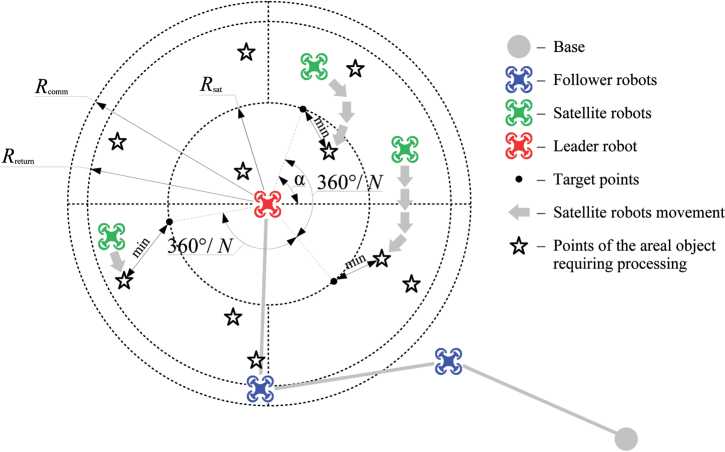
F i g. 1. General diagram of the satellite robots’ operation
Note: R return – return distance threshold for satellite robots, m; R comm – communication range radius, m; R sat – satellite distance from the leader, m; min – minimum distance between satellite robot’s current target point and closest target point to process, m; α – rotation angle of the satellite constellation, °; 360°/ N – angular spacing between adjacent satellites in an ideal uniform configuration, ° (where N is the number of satellites).
Source: Figure 1 is compiled by the author using OpenOffice Draw.
Ideally, the satellite robots should be positioned on the circle around the leader at equal angular intervals. Essentially, all solutions differ only by the rotation of the satellite constellation around the circle’s center. Accordingly, the search for the optimal orientation of such a constellation reduces to selecting the angle α defining this rotation. Any one-dimensional numerical optimization method can be used for this purpose.
Next, for each target point, the nearest point of the areal object requiring processing (i.e., to be visited by a swarm robot) is determined. The assignment of these points to the satellite robots can be carried out using any algorithm for solving optimal assignment problems.
The choice of specific algorithms, including methods of one-dimensional numerical optimization and optimal assignment, is made taking into account the technical characteristics of the robotic system, accuracy requirements, and other constraints.
Implementation
To verify the proposed approach, a software model of the swarm was created, implemented in Python (Fig. 2).
Since the proposed method does not assume the use of strictly defined algorithms, their selection is carried out according to the implementation conditions. In the software model developed to verify the method, the following algorithms were used:
– The angle α, which defines the rotation of the satellite robot constellation around the leader, is determined using a one-dimensional numerical optimization method – the bounded golden-section search8;
– The determination of target points for the satellites is performed using the Kuhn – Munkres algorithm (the Hungarian algorithm)9.
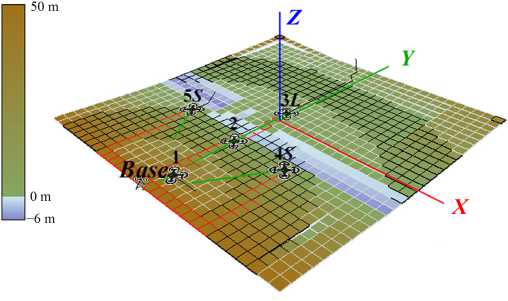
F i g. 2. Software model in operation (example with a swarm of 5 robots and an areal object with dimensions of 3,000×3,000 meters)
Note: L – leader robot; S – satellite robot; numerals denote robot IDs.
Source: Figure 2 is a screenshot of the developed simulation program.
The following parameters should also be noted:
– The satellite distance R sat , which defines the optimal radius for positioning satellites around the leader, was chosen as 5 diagonals of the rectangular sections into which the areal object is divided, with the points requiring processing (visitation) located at their centers;
– The return distance R return = 0.99 ×R comm , which provides a reserve to safely keep the satellite within the reliable communication zone during unpredictable maneuvers of the leader robot, external disturbances (e. g., strong wind gusts), and possible errors in coordinate determination.
Methodology for testing and evaluating efficiency
The study did not aim to compare the performance of a swarm of budget robots with that of a single expensive robot. The effectiveness of the swarm approach was substantiated and demonstrated in a previous publication [2]. The main focus was on comparing the baseline method with the newly proposed improved method. This approach allows evaluating the impact of introduced changes and innovations on the swarm’s performance under various conditions and operational scenarios.
The methods were compared according to the following scheme: for each experiment, a set of maps of different sizes and varying numbers of robots were selected. For each combination, swarm operation was simulated, and a key metric was recorded – the time required to complete the assigned tasks. This metric indicates task execution speed and allows evaluating the efficiency of the task allocation method used among the robots.
The potentially new software model is capable of handling three-dimensional landscapes; however, only two-dimensional (flat) maps were used for method comparison, as the previous version implementing the baseline method did not have this capability. This ensured equal conditions for comparing the methods.
There was no guarantee that all maps would be fully processed, as some maps were intentionally designed with conditions under which the robots would not be able to complete the task entirely. This experimental setup allows testing the methods’ resilience to unforeseen situations that may arise in real-world operation, for example, when robots are forced to return to the base without completing the processing of an areal object due to communication range limitations.
This methodology allows not only evaluating the overall effectiveness of the swarm but also identifying the advantages and limitations of each method under random and potentially extreme conditions. Such comparison provides a quantitative basis for analysis and enables an objective assessment of how the proposed modifications enhance the robotic system’s efficiency.
Initial conditions and test parameters used to evaluate the proposed method:
– Areal object sizes: 1,000×1,000 m, 2,000×2,000 m, 3,000×3,000 m, 5,000×5,000 m, 7,000×7,000 m, and 10,000×10,000 m (each object was divided into 100×100 m sections, with a processing point located at the center of each section);
– Number of robots in the swarm: 1–3, 5, 7, and 10.
The tests comprised 36 trials, covering all combinations of object sizes and swarm sizes.
The software model operated with a homogeneous swarm of robots possessing identical characteristics: stable communication range of 1,500 m, movement speed of 16 m/s, fuel reserve sufficient for 2,500 seconds of flight, and a coefficient for increased fuel consumption during hovering due to the absence of translational lift10 – 1.15 (it was assumed that a swarm of aerial robots was modeled, although for ground robots, this coefficient could potentially be set to 1.00).
RESULTS
As a result of the conducted study, data were obtained that make it possible to compare the baseline method with its improved version proposed in work (Fig. 3).
As can be seen from the diagram presented below, the improved method demonstrates a clear advantage in scenarios where the number of robots is sufficiently large (the lower-left region of the diagram below its main diagonal), such that the surplus of robots enables faster task completion through parallel execution.
|
761/761 (0.00%) |
2108/2108 (0.00%) |
2471/2471 (0.00%) |
2470 / 2470 (0.00%) |
2470 / 2470 (0.00%) |
2470 / 2470 (0.00%) |
|
412/412 (0.00%) |
1679/1754 (4.28%) |
2468 / 2468 (0.00%) |
2469 / 2469 (0.00%) |
2469 / 2469 (0.00%) |
2469 / 2469 (0.00%) |
|
408/488 (16.39%) |
1512/ 1533 (1.37%) |
2474 / 2804 (11.77%) |
2470 / 2470 (0.00%) |
2471 /2471 (0.00%) |
2471 /2471 (0.00%) |
|
236/255 (7.45%) |
1024/1089 (5.97%) |
2495 / 3090 (19.26%) |
2491/2494 (0.12%) |
2469 / 2469 (0.00%) |
2469 / 2469 (0.00%) |
|
234/261 (10.34%) |
906/ 1130 (19.82%) |
1497/ 1736 (13.77%) |
2493/3171 (21.38%) |
2478 / 2495 (0.68%) |
2474 / 2474 (0.00%) |
|
211/211 (0.00%) |
643 / 844 (23.82%) |
1748/2483 (29.60%) |
2486 / 3028 (17.90%) |
2481/2544 (2.48%) |
2478 / 2490 (0.48%) |
1,000x1,000 3,000x3,000 7,000x7,000
2,000x2,000 5,000x5,000 10,000x10,000
Test areal object size (m)

Task execution time for improved method (s)
1679/ 1754' (4.28%)
" Task execution time .jHbr baseline method (s)
Relative reduction in execution time
F i g. 3. Comparison of execution times for equivalent tasks using the baseline and improved methods
Source: Figure 3 is a Python-generated plot, enhanced in OpenOffice Draw.
The only anomalous values in this areal correspond to tests with 1, 2, and 10 robots prcocessing n area object of size 1,000×1,000 m. However, these anomalies have a simple and logically consistent explanation.
In the first case (1 robot), the improved method cannot demonstrate its advantages, since only a single robot is present in the system and no other robots are available to act as satellites. As a result, the final outcome fully coincides with that of the baseline method.
In the second case (2 robots), the size of the test area is too small: after completing its assigned tasks, the leader transitions into the satellite mode, but does not have sufficient time to influence the process, as the new leader completes all remaining work before any noticeable effect can occur.
The third case (10 robots) demonstrates that an excessive number of robots operating within a limited area begins to interfere with swarm operation, thereby reducing all advantages of the improved method to zero, although at first glance an increase in the number of robots would be expected to accelerate task execution. Moreover, in the general case, these conditions may even result in the baseline method being more efficient.
Overall, the obtained results indicate that the proposed improved swarm control method with relay-based communication outperforms the baseline method in terms of execution speed. The average task completion time was reduced by 5.75%.
It is worth noting separately that, when comparing the methods, the quality of task performance remained the same in both cases.
To assess statistical significance, a paired Student’s t-test was performed, yielding a t-statistic of approximately 3.16 and a significance level (p-value) of approximately 0.0032, indicating a statistically significant reduction in execution time. It should be noted that the paired Student’s t-test is robust to moderate deviations from normality, 512 Технологии, машины и оборудование and the number of observations (n = 36) is sufficient for its application. Nevertheless, to verify the normality of the differences, a Shapiro – Wilk test was conducted, which revealed some deviation from a normal distribution. Consequently, the nonparametric Wilcoxon signed-rank test was additionally applied, confirming the statistical significance of the observed speedup (test statistic = 0, p-value ≈ 0.0002).
Thus, the experimental data demonstrate that the proposed method provides a stable and statistically significant reduction in task execution time compared to the baseline method.
At the same time, the obtained results reflect the effect across the entire set of test tasks, including those in which the method cannot fully realize its advantages. For the subset of tasks in which the method is able to fully exploit its capabilities, the average reduction in execution time reaches 10.34% and remains statistically significant, as confirmed by both the Student’s t-test and the Wilcoxon test.
DISCUSSION
The conducted study has demonstrated that the proposed improved swarm control method with relay-based communication provides more efficient task distribution and reduces the time required to process agricultural areal objects compared to the baseline method. The improvement is mainly achieved through the introduction of a distributed ledger of processed objects, which eliminates conflicts in target assignment among robots and increases the degree of parallel task execution. In addition, the satellite robot mechanism contributes to further parallelization of processing while preserving communication stability and coordination within the swarm.
The proposed improved method, building upon the previously suggested swarm control approach, introduces new coordination elements, allowing the potential of budget robotic systems to be more fully realized. This new approach enables more optimal task distribution among robots through enhanced coordination and data exchange within the swarm, reducing operation times and the number of units required. Thus, the method allows for increased efficiency in processing areal objects without increasing capital or operational costs.
In the available literature on swarm robotic control, the considered models predominantly rely on direct or quasi-global communication among robots and do not account for relay-based data transmission or the use of a distributed task ledger. For this reason, a direct quantitative comparison of the obtained results with those reported by other researchers under a comparable problem formulation is limited. Nevertheless, the effects identified in the present study-namely, an increased level of parallel task execution and a reduction in processing time are qualitatively consistent with the general findings reported in studies focused on relay-based communication and connectivity maintenance in mobile robot swarms [7; 8; 11]. These results are also consistent with studies addressing dynamic topology organization and swarm maintenance [22]. Further agreement can be observed with research on decentralized resource allocation and coordination11 [33; 34] mechanisms, as well as on concurrency orchestration in robot swarms [35].
To ensure the consistency of the results and confirm the applicability of the proposed method, robots with characteristics similar to those previously described in [2] are modeled in this study.
Experimental data obtained through simulation confirm that the improved method achieves a statistically significant reduction in task execution time, with the effect being most pronounced for swarms of medium and large sizes. An analysis of anomalous scenarios revealed limitations of the method at very small or excessively large swarm sizes, enabling more accurate identification of the conditions under which the method demonstrates maximum efficiency.
A comparison of the obtained results with the stated objectives of the study indicates that the primary goal has been achieved: improving an existing approach in a manner that enables efficient use of budget robotic platforms while maintaining high swarm performance. Achieving this result opens opportunities for large-scale deployment of robotic systems in agriculture, particularly in small and medium-sized farms, where budget constraints are a critical factor.
The behavior of the proposed method in boundary (extreme) operating modes of the swarm deserves separate consideration. Such modes were not the subject of direct simulation within the scope of the present study, but they are fundamentally important from the standpoint of system reliability.
At an extremely small number of robots (1–2 units), the algorithm degrades to the baseline method, since the mechanisms of role distribution and formation of satellite robots cannot be fully realized. In this case, the expected performance does not deteriorate compared to the baseline approach, but it also does not demonstrate any advantages, which is consistent with the obtained experimental data.
In the opposite extreme case (an excessively high density of robots in a confined area), mutual interference effects, increased coordination overhead, and a decrease in the efficiency of parallel task execution may occur. As demonstrated by the simulation results for the case of 10 robots operating in a 1,000×1,000 m area, this effect can neutralize the gain provided by the improved method and, in certain configurations, may lead to its performance being comparable to or even inferior to that of the baseline approach.
In scenarios involving partial robot failures or temporary loss of communication between robots in the swarm, it was assumed that the mechanisms of the distributed ledger and role reassignment would allow the system to adaptively redistribute unfinished subtasks among the remaining robots. Within the logic of the algorithm, this may lead to an increase in the overall task completion time; however, it does not result in a complete loss of swarm operability, provided that the connectivity of the communication graph is preserved.
Under conditions of abrupt changes in the external environment (emergence of obstacles, deterioration of weather conditions, changes in terrain traversability, etc.), a temporary decrease in efficiency is expected due to the disruption of the initial processing plans, after which the system stabilizes through the assignment of new leaders and task redistribution. A detailed investigation of these modes represents a separate direction for future research.
CONCLUSION
The article demonstrates that the use of a swarm with the improved control method provides greater efficiency to a greater efficiency with similar resource expenditures, representing a novel approach compared to the previously proposed method. This opens up opportunities for more extensive implementation of robotics in agriculture.
The practical significance of this study is in the fact that the proposed method reduces time and labor costs associated with processing agricultural areal objects without increasing expenditures on robotic equipment. The approach can be adapted for both unmanned aerial vehicles and autonomous land robots, thereby expanding the range of agricultural tasks that can be performed swarm-based robotic systems.
Promising directions for future research include:
-
– Optimization of satellite robot behavior under dynamic external conditions, such as terrain, weather factors, and obstacles;
-
– Development of adaptive real-time task redistribution algorithms to handle failures or unforeseen changes in the operational area;
-
– Investigation of integration possibilities with other planning and optimization methods to further improve overall swarm performance;
-
– Formulation of methodological guidelines for deploying swarm systems under various operating conditions;
-
– Application of the proposed approach to heterogeneous swarm systems composed of robots with different characteristics and functional capabilities.
In summary, this work demonstrates that employing an improved swarm control method for budget robotic platforms enhances the efficiency of area object cultivating, ensures reliable system operation, and provides a foundation for the further development of robotic agricultural technologies. It is expected that the continued implementation of these solutions will contribute to the expansion of agricultural automation, increased productivity, and reduced labor costs.
