
Economic reforms, modernization and the “special path” ideology in Russia
Journal: Economic and Social Changes: Facts, Trends, Forecast @volnc-esc-en
Section: Theoretical and methodological issues
Article in issue: 5 т.18, 2025.
Free access
The article explores the “special path” ideology as a significant factor in Russia's economic modernization and development in the constructive context. The concept of the special path is considered within the perspective of the evolution of economics, emphasizing its differences from radical denial of universal laws. The special path is presented as a strategy for adapting institutions and policies to unique national and historical conditions, closely related to sovereignty and national interests. Research methods are based on the use of bidirectional LSTM neural networks for classifying texts of scientific articles by their ideological color and analyzing representation of bigrams in publications categorized as "special path" with the Lekta software product. The authors substantiate four main characteristics of the special path: economic sovereignty, historicism, adaptability and pragmatism. The special path is not considered to be a denial of universal laws, but rather as a way to adapt the institutional structure to national particularities. The study emphasizes the importance of considering historical context and practical experience when shaping economic policy, while criticizing attempts to mechanically adopt foreign models without consideration of national specifics. The “special path” ideology does not reject the achievements of science or the experience of reforms in other countries, but instead emphasizes the need to adapt them to the specific circumstances of Russia, including historical, institutional, and geopolitical factors. The synergy of sovereignty, historicism, flexibility, and pragmatism is seen as the foundation for developing a strategy for modernization that can ensure sustainable development in an uncertain world. China’s success in implementing this approach demonstrates its feasibility
Similar articles in the section Economic policy. Control of the economy. Management of the economy. Economic planning
Short address: https://sciup.org/147252461
IDS: 147252461 | UDC: 338.24.021.8 | DOI: 10.15838/esc.2025.5.101.3
Text of the scientific article Economic reforms, modernization and the “special path” ideology in Russia
This work was supported by the grant of Russian Science Foundation No. 24-18-00665, en/project/24-18-00665/ “Ideological landscape of Russian economic science” at Southern Federal University.
In Russia, intellectual movements periodically emerge that are associated with conceptualizing a “new modernization” affecting all spheres of public life. In such projects, a significant, if not central, role is assigned to economic modernization. In this article, we demonstrate how the ideology of a “special path” is connected to the development of domestic economic science and how its concepts can contribute to contemporary progressive economic development.
Economic science has achieved very significant successes over the past century. Sometimes there are assertions that among the social sciences, economics has become the most influential, representing a deideologized and politically neutral scientific method that allows us to think clearly and arrive at correct answers (Rodrik, 2015, p. 197). The 2008 economic crisis became a reason for doubting the scientific reliability of modern economic theory (Krugman, 2009). Certainly, even before the “Great Recession”, works on the crisis in economic science were periodically published, but it was this event that drew significant attention to the fact that the “scientific method” used by economists is not always valid. Moreover, it became obvious that the universal prescriptions of modern economic theory work poorly for ensuring economic well-being in many countries. Therefore, theories that view economic systems as non-ergodic (North, 2005) and in which a special role is assigned to specific institutions and development trajectories (Reinert, 2016) are gaining increasing relevance and significance.
What is the special path as an economic ideology?
Research on ideological currents in economic science is associated with difficulties in the ambiguous interpretation of the very concept of “ideology”. Within the framework of this study, we use an approach that combines the Schumpeterian tradition, interpreting ideology as a “pre-scientific cognitive act” (Schumpeter, 2012), and North’s concept of an “aggregate of mental models” (North, 1994). Therefore, we follow the scientific tradition developing the approaches of J. Schumpeter and D. North, which is most concisely presented in V. Tambovtsev’s interpretation of ideology as a “vision of the economy when building models” (Tambovtsev, 2024, pp. 15–18). Hereafter, we will use the following definition: “Ideology is the general mental models shared by groups of individuals. With the help of these models, groups of individuals explain the supposed and real connections between the means and results of policies aimed at transforming society. Key importance belongs to groups of individuals (scientific schools, political organizations) and their actions to establish and promote a supposed or real connection between means and results” (Volchik, 2024, p. 28).
In previous articles within this project, we investigated ideal types of ideologies, such as neoliberalism and socialism (Volchik, Shiryaev, 2024) and ecologism (Maskaev et al., 2024). In this work, we focus on the ideology of the special path in order to show the possibilities and directions for the constructive use of this concept in modern economic science.
In the history of economic science, there exist and evolve schools that emphasize the national characteristics of the development of economic orders. The German Historical School can be considered the most influential. The famous “Methodenstreit” (dispute over methods) between G. Schmoller and C. Menger, in the context of the rivalry between universalist and nationally oriented approaches, retains its significance and relevance in modern conditions (Efimov, 2007; Schmoller, 2011).
The ideology of a special path in economics possesses its own specificity and undeniable differences from similar political or sociological concepts. Here, the unique development path of the People’s Republic of China serves as an excellent example. Indeed, it was the creation of the concept of a “socialist market economy” that allowed for the formation of a “constellation” of theoretical narratives, models, and economic policy measures which contributed to phenomenal economic progress.
The special path ideology does not always constitute a radical denial of universal economic laws and theories. The special path can be viewed as a way of adapting the institutional structure of the economic order to national and historical characteristics.
The special path ideology can combine with or complement other ideological tenets. However, it is precisely within the “special path” that institutional specificity is reflected to the greatest degree, and the importance of national interests is emphasized.
It is also necessary to consider that universal entities associated with “economic laws” and “widely recognized models” may or may not align with national interests. Therefore, the special path ideology is closely linked to concepts such as sovereignty and national interests.
Special path ideologies: the empirical research base for Russia
In Russian public discourse, the special path ideology has become quite widespread. The significance of the “special path” concept for the population of the Russian Federation is indirectly demonstrated by data from the sociological monitoring project “How are you, Russia?”1 (“Kak
Table 1. Respondents’ opinions on the most acceptable path of economic development for Russia, % of respondents
|
Response option |
1992, VIII |
1996, V |
2004, VII |
2009, VI |
2010, XII |
2011, VI |
2017, VI |
2020, XII |
2023, VI |
2024, IV |
|
Russia should have its own special path of development |
52 |
53 |
44 |
48 |
45 |
45 |
42 |
33 |
52 |
51 |
|
Socially-oriented economy like Sweden’s |
8 |
11 |
14 |
13 |
12 |
16 |
13 |
17 |
10 |
13 |
|
Free market economy like in the USA, UK, Germany, France |
11 |
7 |
9 |
11 |
12 |
8 |
9 |
9 |
4 |
4 |
|
Economy with predominance of state ownership following China’s model |
5 |
8 |
9 |
11 |
10 |
11 |
10 |
11 |
15 |
19 |
|
Difficult to answer |
24 |
21 |
24 |
18 |
21 |
20 |
26 |
30 |
18 |
13 |
Source: Levashov V.K., Velikaya N.M., Shushpanova I.S. et al. (2024). “How are you, Russia?”. Express information. 54th stage of the sociological monitoring, April 2024: Bulletin. FCTAS RAS. Moscow. P. 57.
zhivesh, Rossiya?”). According to the 54th stage of this monitoring in the fourth quarter of 2024, 51% of respondents, when asked “Which path of economic development is most acceptable for Russia?”, chose the answer “Russia should have its own special path of development”. It is noteworthy that the second most popular answer was “An economy with a predominance of state ownership, following China’s model” (19%; Tab. 1 ).
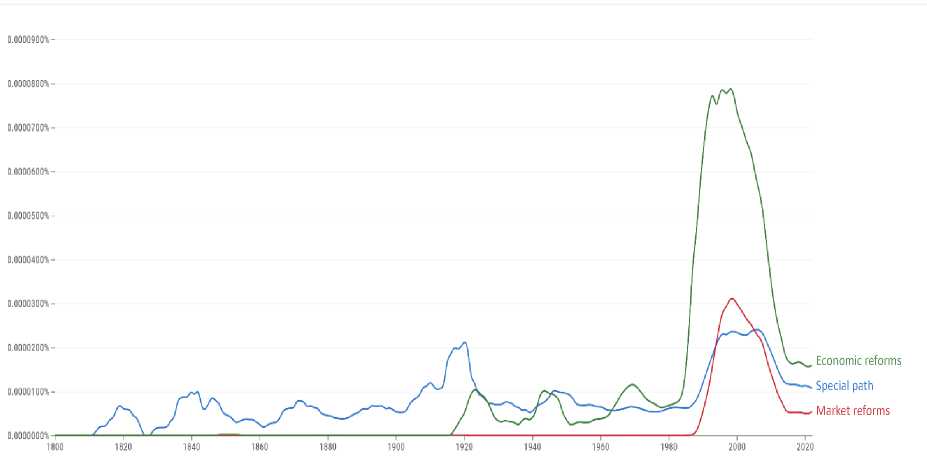
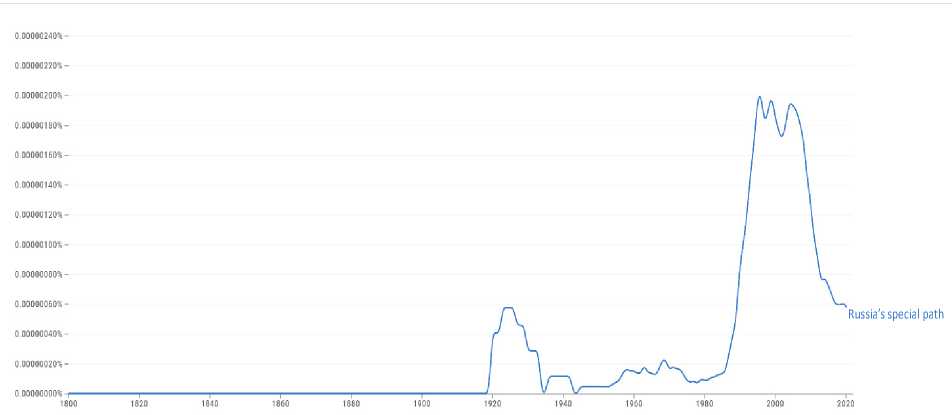
Data from Google Ngram Viewer ( Fig. 1 and 2 ) serves as an important illustration of the significance of the “special path” concept. According to this data, changes in the frequency of mentions of “special path” in texts of books and articles published in Russian correlate with changes in the frequency of usage of the compound phrases “economic reforms” and “market reforms.” The increased use of phrases like “Russia’s special path”
Figure 1. Analysis of the frequency of bigrams “special path,” “market reforms,” “economic reforms”
Source: own compilation.
Figure 2. Analysis of the frequency of the phrase “Russia’s special path”
Source: own compilation.
or simply “special path” began from the late 1980s to early 1990s, peaking in the first decade of the 21st century (2004–2006). These data show that when conceptualizing economic reforms, issues related to understanding the importance of the unique historical, institutional, and cultural characteristics of the Russian economic order occupy an important place.
Within our work, the primary data source for researching the evolution of ideologies in Russian economic science was materials from scholarly articles. The empirical base consisted of 134,124 scientific publications from 165
journals, covering the period 1992–2023. To study the ideological leaning, five categories were identified through expert assessment: neoliberalism, dirigisme, socialism, special path, and ecologism. A training sample of 1,487 articles (5% of the data) was formed. The initial processing involved vectorization using the SciRus-tiny model, followed by the application of a bidirectional LSTM neural network (32 units per layer + Softmax) for classifying texts based on their ideological leaning. The distribution of articles into groups according to their ideological orientation is presented in Table 2.
Table 2. Distribution of articles by ideological orientation
|
Ideolog y |
Number of articles |
Share, % |
|
Neoliberalism |
19489 |
14,53 |
|
Socialism |
16312 |
12,16 |
|
Dirigisme |
40045 |
29,86 |
|
Special path |
22264 |
16,60 |
|
Ecologism |
25283 |
18,85 |
|
Undetermined |
10731 |
8,00 |
|
Total |
134124 |
100 |
|
Source: own elaboration using machine analysis of scientific article texts (Volchik et al., 2024, p. 49). |
||
The distribution of articles by ideology across time periods is reflected in Table 3 .
Following text preprocessing (removal of nonCyrillic characters, tokenization, lemmatization using the re and PyMystem3 libraries), a frequency analysis of the representation of various n-grams within each ideology was performed using the Lekta software product. For substantive analysis, all n-grams were divided by expert assessment into “general” (frequent but neutral) and “characteristic” (ideologically significant) ones.
The analysis of the representation of bigrams in publications classified under the “Special path” group allowed for the identification of the main scientific problems discussed in each time period ( Tab. 4 ).
Table 3. Distribution of articles by ideology across time periods, %
|
Period |
Neoliberalism |
Socialism |
Dirigisme |
Special path |
Ecologism |
Undetermined |
|
1992–1997 |
26.63 |
20.20 |
14.69 |
19.83 |
8.26 |
10.38 |
|
1998–2002 |
28.53 |
14.59 |
16.28 |
19.69 |
9.27 |
11.64 |
|
2003–2007 |
19.54 |
12.11 |
33.81 |
14.89 |
10.81 |
8.85 |
|
2008–2012 |
15.07 |
12.32 |
35.39 |
17.16 |
11.69 |
8.36 |
|
2013–2017 |
12.35 |
11.60 |
32.34 |
17.10 |
18.80 |
7.80 |
|
2018–2023 |
13.39 |
12.23 |
23.97 |
16.09 |
26.91 |
7.40 |
Source: own elaboration using machine analysis of scientific article texts (Volchik, 2025).
Table 4. Top-20 Bigrams in articles classified under the “Special path” ideology
|
Period |
Bigrams |
|
1992–1997 |
«Former USSR»; «economic growth»; «economic security»; «securities»; «Central Bank»; «money supply»; «Russian economy»; «economy of Russia»; «market economy»; «structural adjustment»; «foreign investments»; «economic policy»; «national economy»; «economic reform»; «commercial banks»; «state regulation»; «industrial policy»; «foreign policy»; «federal budget»; «Reform strategy» |
|
1998–2002 |
«Securities»; «economic growth»; «exchange rate»; «real sector»; «Central Bank»; «commercial banks»; «Russian economy»; «banking system»; «economic policy»; «money supply»; «ruble exchange rate»; «interest rate»; «developed countries»; «economic development»; «foreign investments»; «growth rate»; «CIS countries»; «monetary policy»; «world economy»; «Western Europe» |
|
2003–2007 |
«Economic growth»; «Russian economy»; «developed countries»; «economic development»; «money supply»; «foreign investments»; «federal budget»; «Bank of Russia»; «world market»; «securities»; «fixed capital»; «wages/ salaries»; «Central Bank»; «higher education»; «economic development»; «socio-economic development»; «exchange rate»; «banking system»; «interest rate»; «investment policy» |
|
2008–2012 |
«Economic growth»; «Russian economy»; «global crisis»; «world economy»; «economic development»; «banking system»; «financial market»; «securities»; «Bank of Russia»; «innovative development»; «socio-economic development»; «financial crisis»; «world market»; «innovation activity»; «higher education»; «economic development»; «foreign investments»; «interest rate»; «national economy»; «Central Bank» |
|
2013–1017 |
«Economic growth»; «Russian economy»; «world economy»; «economic development»; «innovative development»; «Bank of Russia»; «socio-economic development»; «quality assessment»; «federal budget»; «Central Bank»; «developed countries»; «economic development»; «national economy»; «international relations»; «wages/salaries»; «economic policy»; «financial market»; «securities»; «developing countries»; «social responsibility» |
|
2018–2023 |
«World economy»; «economic growth»; «economic development»; «Bank of Russia»; «developed countries»; «human capital»; «public administration»; «Central Bank»; «higher education»; «socio-economic development»; «financial market»; «Russian economy»; «developing countries»; «e-commerce»; «innovative development»; «labor market»; «national economy»; «interest rate»; «federal budget»; «state policy» |
|
Source: own compilation. |
|
Publications from 1992–1997 focus on the transformation of the Russian economy following the collapse of the USSR. The most frequent phrase in this period is “former USSR”, which corresponds to the historical context, as many publications began with a reference to the past. This is followed by a large body of economic vocabulary related to market reforms: “economic growth,” “economic security”, “securities”, “Central Bank”, “market economy”. A significant portion consists of bigrams related to public administration and the role of the state: “state regulation”, “federal budget”, “industrial policy”. Bigrams such as “commercial banks” and “private property” also appear frequently, indicating increased attention to the development of the nonstate sector, while phrases like “money supply” and “ruble exchange rate” recall the hyperinflation of those years. Note should be taken of terms specific to the transition period – “structural adjustment”, “transition economy” (63). Social aspects are relatively underrepresented: only the phrases “wages/ salaries” and “civil society” made it into the top 50.
During the 1998–2002 period, financial themes dominate as a reaction to the financial turmoil of the late 1990s – hyperinflation and the ruble’s collapse: “securities”, “exchange rate”, “interest rate”, “monetary policy”. The bigram “economic security”, which was in the top 3 of the previous period, did not even make the top 100, while bigrams like “natural monopolies” and “Tax Code” appear in the top 50, indicating an interest in systemic regulation. Attention to the role of human capital is also noted, evidenced by the bigrams “vocational education” and “higher education” appearing in the top 20. During this time, the bigram “information technologies” appears for the first time (in 60th place). This period is characterized by a decrease in the frequency of reform-related terms and the emergence of bigrams like “world economy”, “developed countries”, “CIS countries”, and “European Union”, pointing to a trend of globalization in research topics.
The dominant themes of the 2003–2007 period are economic growth and economic development in both national (“Russian economy”, “economic development”, “national economy”) and global (“developed countries”, “world economy”, “developing countries”) contexts. Phrases reflecting an interest in regional development (“development of regions”, “regional development”), the financial system, investments (“foreign investments”, “investment policy”, “investment project”), state regulation (“state support”, “state regulation”, “state policy”), the social sphere, and human capital (“standard of living”, “population incomes”, “socio-economic development”, “social policy”, “quality of life”) are also popular. We should also note the strengthening role of the state in regulation (budget, taxes, support), the emergence of new priorities: innovations, high technologies, modernization of industry, and the expansion of the global agenda – not only the CIS and Europe but also Asia (“East Asia”), and world markets.
In the subsequent period (2008–2012), the theme of economic growth, its sources, and sustainable development remains dominant. The emergence of new terms related to the global crisis should be noted: “global crisis”, “financial crisis”, “anti-crisis measures”; the strengthening of the innovation theme, accompanied by a sharp increase in the number of relevant terms (“innovative development”, “innovation activity”, “innovation system”); the popularity of social topics (“human capital”, “quality of life”, “wages/salaries”); as well as increased attention to integration processes and foreign economic orientation (“Customs Union”, “CIS countries”, “European Union”). Overall, significant attention is paid to the role of the state, with the emphasis shifting from institutionbuilding (1990s) to strategic management (2000s) and anti-crisis regulation (2008–2012). The social sphere, a secondary theme in the 1990s, moves to the forefront in 2008–2012 (“human capital”, “education”, “quality of life”).
The period 2013–2017 is characterized by increased interest in macroeconomic processes and Russia’s role in the global context. The following thematic blocks clearly stand out: macroeconomics (“economic growth”, “economic development”, “development of the economy”, “national economy”, “GDP growth”); the financial sector (“financial crisis”, “economic crisis”, “sustainable development”); the social sphere (“quality of life”, “social policy”, “standard of living”, “higher education”, “human capital”, “scientific research”, “healthcare”); foreign economic relations (“world economy”, “international relations”, “foreign trade”, “international cooperation”, “economic integration”, “foreign economic activity”); public administration and regional economics (“state policy”, “tax system”, “state regulation”); innovations and technologies (“innovative development”, “new technologies”, “innovation infrastructure”).
In publications from 2018–2023, the main thematic cluster is still associated with economic growth and development; however, new bigrams appear, related to the COVID-19 pandemic, sanctions, digitalization, and the development of artificial intelligence (e.g., “coronavirus pandemic”, “digital transformation”, “antiRussian sanctions”, etc.), which were absent in previous periods. Themes related to researching the financial system and banking sector (“Bank of Russia”, “central bank”, “key rate”, “financial market”) and the re-evaluation of human capital with new emphases on psychological aspects and the development of digital skills (“quality of life”, “distance learning”, “level of trust”, “emotional intelligence”, “psychological health”, “digital literacy”, “professional competencies”) are also relevant. A noticeable focus on the Asian direction should be noted (decreased frequency of mentions of “European Union” alongside growing bigrams like “BRICS countries”, “EAEU countries”, “Chinese investments”, “Chinese economy”).
The conducted analysis of bigrams vividly reflects the evolution of Russian economic thought in the analyzed publications. The concept of sovereignty evolved from defense during the transition period, through a temporary weakening, to renewed relevance in the last decade against the backdrop of geopolitical tensions. Historicity was extremely significant only at the very beginning of the transition period (1992–1997) as a basis for understanding the ongoing transformations. Subsequently, the research focus shifted to current challenges and future development, rather than interpreting the Soviet past.
A cross-cutting and strengthening concept is adaptability. The publications clearly reflect reactions to internal crises, global shocks (financial crisis, pandemic, sanctions), and technological trends. The research focus gradually restructures itself (“anti-crisis measures”, “innovation”, “digitalization”). Furthermore, a dominant concept throughout the entire period is pragmatism. The works consistently focus on solving pressing practical tasks: building market institutions, overcoming crises, stimulating growth, attracting investments, implementing technologies, improving the efficiency of public administration, and developing specific competencies.
The use of this empirical base in the article helped trace the evolution of research interests and problem areas within the body of texts identified as pertaining to the “special path”. This allowed for an analysis of which challenges and problems this ideological paradigm responded to in different periods (the collapse of the USSR, financial crises, sanctions). We should clarify that the specificity of the special development path is revealed not through the frequency of the words, but through their context and semantic connections: how the same phenomena are interpreted, what cause-and-effect relationships are built, and what policy measures are proposed.
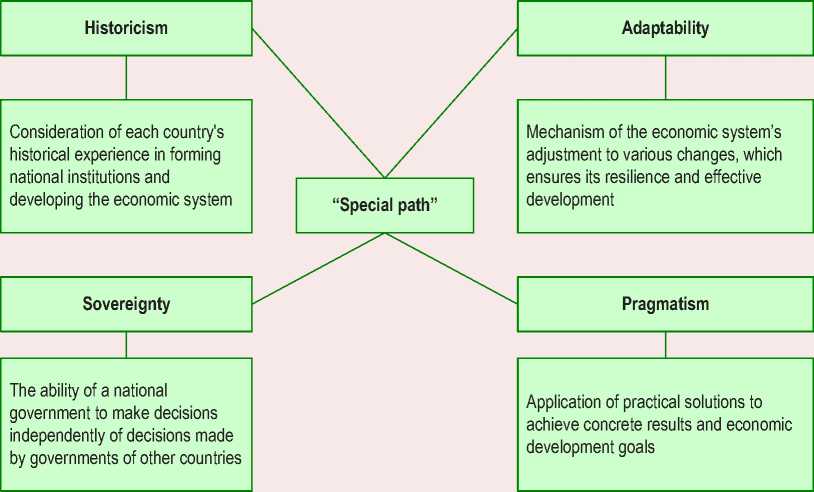
Figure 3. Fundamental characteristics of the “special path” of development
Source: own compilation.
Sovereignty, historicity, adaptability, and pragmatism in the context of the “special path” ideology
Amid the intensification of the geopolitical situation, large-scale sanctions, and economic isolation, the Russian economy is experiencing severe external pressure and undergoing a significant transformation of the traditional market-based management system. Disappointment with the experience of reforming the Russian economy, specifically the implementation of successful institutions borrowed from developed countries without considering the features of the national institutional structure formed over a long period, contributed to the development of a discourse on finding alternative paths for modernizing the economy (Pliskevich, 2019, pp. 44–45). In Russian economic science, such an alternative became the special path of economic development, based on national identity and interests when developing a new strategy aimed at modernizing the Russian economy under conditions of geopolitical turbulence.
The special path of economic development must account for the historical, economic, geographical, social, and other characteristics of the country’s development, while also ensuring a balance and the reproduction of the fundamental conditions for economic development (economic resilience, entrepreneurial initiative, increasing returns) (Volchik, 2022). In contemporary realities, achieving these goals requires the special path of economic development to be based on four fundamental characteristics: sovereignty, historicism, adaptability, and pragmatism ( Fig. 3 ).
The achievement and preservation of sovereignty form the foundation for implementing a country’s special path of economic development and its further modernization. As E.V. Balatsky notes, considering sovereignty can be the first step “in building renewed social knowledge capable of systematically explaining events of the present and future. Ignoring the category of sovereignty in economic research impedes a relevant description and assessment of the majority of modern processes in the world economic system” (Balatsky, 2025, p. 63).
Considering the sovereignty factor is especially important in the long term, as “the effectiveness of managing internal processes in a country directly depends on the government’s freedom in making appropriate decisions. External influence from other states can limit many options for effective domestic policy” (Balatsky, 2025, p. 61). Thus, the lack of sovereignty for over 30 years led to Russia being “a classic example of a country whose development was under external management, and with a clearly expressed vector towards containment” (Balatsky, 2024, p. 55).
The term “economic sovereignty”, which denotes the ability of a national government to make decisions independently of decisions made by other governments, is also often used in political and public discourse when discussing the topic of economic patriotism (Sapir, 2020, p. 3). According to E.V. Balatsky, economic patriotism reflects “a surge of patriotic and quasi-patriotic feelings among the peoples of states experiencing pressure from a hegemonic country, including in the form of economic sanctions” (Balatsky, 2025, p. 60). According to data from VCIOM (Russian Public Opinion Research Center), in 2024, 94% of Russians considered themselves patriots, with 62% being unconditional patriots. This indicator increased by 10 percentage points compared to 2014 (84%) and is the maximum for the entire observation period, thereby reflecting a surge in patriotic sentiment among the Russian population2.
Under conditions of geopolitical turbulence and large-scale sanction pressure on the Russian economy, research concerning the achievement and preservation of sovereignty has acquired particular relevance and significance in Russian economic science. Various works are dedicated to this issue, ranging from those of neoclassical economists, who view the concept of sovereignty as a factor interfering with the optimization process to which standard macroeconomic policy tools from traditional economic growth theories cannot be applied, to institutionalists, who, conversely, emphasize the importance of sovereignty in economic research (Sapir, 2020, p. 5). For example, the representative of original institutionalism, J. Commons, in his work “The Legal Foundations of Capitalism”, identified three types of sovereignty: state sovereignty (based on fear of physical power), corporate or business sovereignty (based on fear of economic power), and the sovereignty of religious and moral institutions (based on fear of public opinion) (Commons, 2011, p. 77; Sapir, 2020, p. 5).
Currently, Russian economic science features various research directions on economic sovereignty. For example, M.N. Dudin, S.V. Shkodinsky, and I.A. Prodchenko analyzed four approaches to considering economic sovereignty: “from the perspective of legal rights and the independence of the state as a political and economic actor (N. Machiavelli, T. Hobbes, and J. Bodin), from the perspective of realizing citizens’ property rights to the national wealth of the state (A. Smith, D. Ricardo, T. Sandler), from the perspective of exercising market rights to influence international economic relations (C. Schmitt, J. Bordo, D. Rosenberg), from the perspective of the resilience of the socio-economic system to external political and economic challenges and threats (J. Westermann, V. Dhar, J. Perritt, J. Rauhouter, C. Bowden)” (Dudin et al., 2022, pp. 61–63).
S.A. Afontsev analyzed four research directions on economic sovereignty: “1) the contribution of economic factors to ensuring national sovereignty;
2) autonomy of national economic policy; 3) high degree of independence in achieving economic development goals (‘sovereign development’); 4) the ability to successfully withstand negative external shocks” (Afontsev, 2024). At the same time, according to S.A. Afontsev, there is currently a lack of a “theoretical basis” for analyzing economic sovereignty, which could serve as an impetus for further research in this area.
After the collapse of the USSR, various knowledge-intensive sectors in science and industry, such as mechanical engineering, microelectronics, instrument making, shipbuilding, pharmaceuticals, and others, were destroyed during the radical economic reforms. This led to the loss of technological sovereignty in the Russian economy, a problem that became particularly acute after 2022. Issues related to technological sovereignty began to be actively discussed in Russian economic research. Thus, E.V. Balatsky and N.A. Ekimova emphasize the importance of achieving technological sovereignty as the “ability to ensure, in close interaction with the progressive development of human potential, the creation of one’s own technologies and infrastructure on one’s own territory” (Balatsky, Ekimova, 2023).
It should also be taken into account that to achieve technological sovereignty in Russia, “it is not enough to focus only on the latest technologies. The relationships between old and new industries do not boil down to competition for resources. It is necessary to identify bottlenecks in the development not only of the latest widely applicable technologies but also in traditional industries based on previously mastered technologies, which determine the country’s economic potential. The effectiveness of the Russian strategy for developing digital technologies, and artificial intelligence in particular, can be discussed if its implementation allows for equal cooperation with foreign partners in global value chains and a real claim to innovation rent” (Dementiev, 2023, p. 16).
Iran can be cited as an example of a country that, despite prolonged international pressure and numerous sanctions, has managed to preserve its sovereignty and achieve significant success in developing a national innovation system (Volchik et al., 2023). Therefore, in the context of globalization and growing interdependence among states, it is crucial for countries implementing a special path of economic development to preserve their national sovereignty.
Thus, in current conditions, it is very important for the government to be able to make decisions based on national interests and economic patriotism. This does not preclude international cooperation but limits those areas which, in the medium term, may clearly be associated with negative consequences for economic development.
One of the core values underpinning the special path ideology is national identity, which is directly linked to historicism – a methodological approach based on the historical experience of each country in forming its national institutions. This experience largely determines the specifics of the institutional structure of the economic order. Here, it is important to understand that comprehending one’s own unique experience, on the one hand, and considering the general patterns of economic system development, on the other, are important conditions for formulating and implementing economic policies that contribute to achieving national interests. China serves as a good example in understanding the features of socio-economic development: “China’s socio-political system represents a unique combination of two-thousandyear-old traditions with the revolutionary legacy of the Communist Party – a model that cannot be replicated anywhere else. The Chinese leadership and elites understand perfectly well: their system, for all its effectiveness domestically, is not for export. Moreover, this very system requires China to focus on solving internal tasks while gaining respect from the international community” (Li, 2025, p. 15).
When forming a special path of economic development, it is necessary to consider various historical processes and events that have shaped a specific national code, characterized by a particular institutional structure, population mentality, traditions, and values. Past failures and successes, features of the country’s socio-economic and political structure, serve as the basis for developing future economic policies aimed at modernizing the economy. At the same time, ignoring the historical context can lead to serious errors in planning long-term economic development strategies. For example, during the transition from a socialist economy to a market one in the 1990s, Russia should have taken into account its strong traditions of state economic regulation and could have chosen a development trajectory close to dirigiste ideology, which incorporates mechanisms of state control, planning, and partnership. Considering this historical context would have made it possible to avoid past mistakes and develop new priority areas of development that take into account the strengths and weaknesses of the Russian economy at that time. As D. North notes: “History matters. It matters not just because we can learn from the past, but because the present and the future are connected to the past by the continuity of a society’s institutions. The choices we make today or tomorrow are shaped by the past. And the past can only be understood by us as a process of institutional development. To integrate the concept of ‘institutions’ into economic theory and economic history is to take an important step in the development of that theory and history” (North, 1997, p. 12).
The use of historicism as a methodological approach in implementing a special development path is connected to the concept in economic science known as “path dependence”, or the terms “dependence on prior development”, “the rut effect”, which are accepted in domestic literature. This theory reflects how future development depends on choices made much earlier. Thus,
P. David, one of the first to point out this dependence using the example of the QWERTY keyboard, gave the following characterization of “path dependence”: “the sequence of economic changes is an example of how events far removed in time, including situations caused more by chance circumstances than by the action of systemic forces, can have a significant impact on the final outcome” (David, 2007, p. 139).
At the same time, dependence on prior development can manifest at two levels: that of individual institutions (e.g., legal, political, economic, organizational) and that of institutional systems, i.e., national economic systems (Nureev, 2010, p. 27).
The analysis of the historical context within the ideology of a special development path is the very tool that allows identifying the influence of both formal (laws, rules) and informal institutions (customs, traditions) on contemporary economic development. This makes it possible to analyze the opportunity costs of prior development and to choose a more effective strategy that considers national characteristics. Attempts to implement institutions that function successfully in other countries, without taking historical context into account, can lead to institutional incompatibility (where introducing institutions leads to destabilization and inefficiency of the economic system), social resistance (new institutions contradict national interests, values, and traditions), dependence on developed countries (loss of sovereignty), and ultimately, failure.
Thus, evaluating the effectiveness of past economic development strategies helps to avoid repeating past mistakes and allows for the adaptation of modern successful practices within the national economy.
In conditions of geopolitical instability, global challenges, economic crises, rapid technological transformations, and environmental problems, adaptability becomes one of the main conditions for the success of a special development path. The importance of adaptability, which is most evident in economic activity, was noted by F. Hayek in his works: “The structure of human activity constantly adapts (and functions by adapting) to millions of facts which, in their totality, are unknown to anyone. The significance of this process is most obvious in the economic sphere, where it was first noticed” (Hayek, 2006, p. 32).
Adaptability as a property inherent to all economic systems can vary depending on the opportunities, capabilities, and speed of response to external and internal transformations through the development of a specific mechanism, thanks to which the economic system can acquire new characteristics and subsequently be stable and develop effectively (Markovskaya, 2013, pp. 7–8).
The economic essence of adaptability, implying the adjustment of the economic system to various changes, fits very well into the concept of adaptive efficiency by D. North, who links it to institutional features and defines it as the “ability of some societies to cope with shocks, flexibly adapt to them, and form institutions that work effectively with the altered reality” (North, 2010, p. 21). He also notes that institutions must conform to certain principles according to which the political order will be preserved, despite any economic changes (North, 2010, p. 155). D. North also considers adaptive efficiency as a rule that shapes the direction of development of the entire economic system over time and is “associated with a society’s desire for learning and knowledge acquisition, for encouraging innovation, risk-taking, and various forms of creative activity, as well as for solving problems and eliminating ‘bottlenecks’ that hinder the development of society” (North, 1997, p. 106). It is innovations and experiments that are adaptively efficient; therefore, the economy and society must develop and facilitate their dissemination. Innovations and experiments as incentives embedded in the institutional system promote
“the development of a body of knowledge that pushes decision-making individuals to gradually change the system compared to the state of the system they initially dealt with” (North, 1997, p. 106). Thus, according to D. North’s concept, when implementing the special path ideology in the economy, it is necessary to develop the adaptive efficiency of the economic system, as it “creates incentives for the development of a decentralized decision-making process that allows societies to maximize efforts towards possible alternative ways of solving problems and to learn from mistakes and failures” (North, 1997, pp. 106–107).
Thus, under conditions of uncertainty and rapid changes in global trends, for the successful implementation of a special development path, the economic system must respond promptly and adapt to new challenges and opportunities through the flexibility of economic policy, institutional structure, and the development of innovations and technologies to avoid economic stagnation, social and political instability, and loss of sovereignty. For example, China, which through reforms managed to integrate market elements into a socialist economy, is a vivid example of a high degree of adaptability in an economic system.
The adaptability of economic systems to external and internal changes in the modern world is dictated primarily by the pragmatism of governments’ actions in different countries to maintain the stability of the state’s economic and political system, as well as to ensure further economic growth. Countries that were based not only on the institution of private property but were also guided by a pragmatic approach achieved greater success than Russia, which relied on neoclassical principles for building its national economy (Porokhovskiy, 2017, pp. 100–101).
The concept of pragmatism is one of the most important in original institutional economic theory. Pragmatism as a philosophical and methodological school is based on the practical application of knowledge aimed at achieving specific results and goals. It emphasizes the importance of practical experience and the ability to adapt to changes, offering an alternative perspective on economic theories and their application.
The foundations of pragmatism as a philosophical direction and its subsequent theoretical development are reflected in the works of W. James, C. Peirce, J. Dewey, and others. Later, the principles of pragmatism were linked to postmodernism in the works of R. Rorty.
Currently, issues related to pragmatism are very rarely studied in the Russian economic community; moreover, “the research principles of the pragmatists were pushed out of the economic discipline” (Kurysheva, 2022, p. 98). However, primarily in institutional economics, pragmatism traditionally persists as a methodological principle: “Pragmatism has repeatedly been of use to economists. Even A. Marshall’s synthesis, which laid the foundations of the mainstream with its theoretical-applied character, had a pragmatic hue. A. Smith, J. Mill, and J. Keynes also respected practice and solving various specific tasks” (Oleinik, 2021, p. 47).
Scientific discourse also includes the concept of “new pragmatism” by G. Kolodko, who notes that economic science and policy should be oriented toward practical results and use an interdisciplinary approach to analyzing economic processes (Kolodko, 2015). This illustrates the fact that the concept of pragmatism is used by representatives of various scientific schools and ideologies in the context of implementing economic reforms. It is very important to note here that the pragmatism discussed by G. Kolodko opposes the ideology of neoliberalism, which uses simple and attractive economic concepts. However, neoliberalism, which uses the “achievements of world economic thought”, is: “...not only economic doctrinairism and ideological dogmatism. It is primarily an effective method of enriching the few at the expense of the many. That is its essence” (Kolodko, 2016, p.
167). New pragmatism thus represents an adaptive strategy that considers cultural, historical, and institutional characteristics during the systemic transformation of the economy (Kolodko, 2016, p. 170).
When analyzing Russian economic reforms, it is also important to maintain pragmatism that considers specific institutional characteristics and long-term development trajectories. For example, the French economist H. Clement-Pitiot notes that the long-term development strategy of the Russian economy should be based on new theoretical approaches such as viability and pragmatism, which can “ensure the possibility of authentic formalization of dynamic processes in the economy, taking into account external circumstances and challenges” (Clement-Pitiot, 2014, p. 16). It is precisely the “pragmatic concept that emphasizes that a simple but adequate and timely decision is preferable to an optimal solution made without considering the time factor” (Clement-Pitiot, 2014, p. 6). To modernize the economy, it is necessary to propose and implement pragmatic solutions to support small and midsize enterprises in various sectors of the Russian economy (Clement-Pitiot, 2014, p. 24). Applying a pragmatic approach when implementing policies aimed at modernizing the economy also allows the economic system to adapt quickly, taking into account the characteristics of national institutions, which subsequently contributes to the country’s sustainable economic development.
Pragmatism occupies an important place in the ideology of the special development path, as it is based on the search for practical solutions and the achievement of concrete results in conditions of variability and uncertainty in the economic environment. Currently, the People’s Republic of China demonstrates a distinctly pragmatic approach in implementing economic policy. Thus, one of the directions of China’s economic policy is the principle of “Seeking Truth from Facts”
(orientation toward practical effectiveness), which was initially put forward by Mao Zedong and subsequently became one of the main tenets of Chinese socialist ideology thanks to Deng Xiaoping (Xiangping, 2017, pp. 54–55). This principle implies that economic decisions should be based not on abstract theories and dogmas but on the analysis of empirical data and the real conditions of the economic system’s functioning. At the same time, Chinese economic policy is flexible and quickly adapts to changing conditions, is not afraid to admit mistakes and correct them, using various pilot projects and experiments to assess the effectiveness of implemented economic measures and mechanisms. National scientific discourse notes the influence of pragmatism on theory in the implementation of economic policy: “The spirit of pragmatism requires that theories, especially those related to modernization, be rooted in social reality. When a discrepancy arises between theory and reality, there is no doubt that theory should conform to reality, not the other way around. Any theory that is detached from reality cannot be used to manage the real process of modernization, as this will inevitably lead to serious errors” (Wu, 2025, p. 304).
In Chinese practice, the principles of the special path are implemented through the development of sovereign economic policy that considers the country’s real specific conditions: “Deng Xiaoping’s conclusion about the need to ‘emancipate the mind, think independently, and develop policy based on one’s own real conditions’ (Deng, 1994, p. 328) is commendable. Systems and strategies most favorable for development must be developed through trials, practice, and research; subjective justifications are unacceptable. This is one of the most important experiences of China’s economic reform” (Li, 2024). Such a reform policy is both adaptive and pragmatic. The adaptability of Chinese economic policy during reforms was fully demonstrated during the gradual transition to a market economy, which allowed for avoiding shock therapy (Weber, 2021).
The special path means not moving along the track of, for example, the “Washington Consensus” toward building a normal country, but rather, by adapting to economic realities, pragmatically choosing not some “capitalism” from a proposed menu, but, for instance, building a specific effective economic order – a socialist market economy”, as in China (Shleifer, Treisman, 2004). Certainly, any “special path” is associated with a complex set of various factors influencing development. But it is precisely the four characteristics taken together that allow us to see that the “special path” concept implies not only “developmental dead ends” and “native science”, but also reindustrialization, a green economy, and an advanced national innovation system.
In scientific literature, there are two opposing approaches to the special path. One conventionally relies on sovereignty as the starting point of the special path (Balatsky, Ekimova, 2022). The other appeals to universalism and universal values, which, based on a “truly scientific approach”, lead to the triumph of progress. This second approach to analyzing the “special path” concept has strong negative connotations (Mamedov, 2011; Travin, 2018). This article attempts to move away from unequivocally negative connotations regarding the concept of the “special path”. Therefore, we propose a constructive approach to analyzing the “special path”, which focuses on four fundamental characteristics: sovereignty, historicism, adaptability, and pragmatism. A comprehensive analysis of the special path through the lens of these characteristics is both novel and constructive, aimed at identifying the sources and opportunities for progressive and balanced economic development in the modern world.
Conclusion
Any economic ideology can be viewed from two perspectives: first, as a pre-scientific cognitive act or a vision of economic processes for building theories; second, as an aggregate of theories themselves that fit within one or another “fundamental scientific paradigm” (Samuels, 1992, p. 239). In this work, we analyze the special path ideology within the context of a grand narrative based on simple principles that can lead to progressive changes during reforms. Such a narrative of the special path is connected to the concepts of sovereignty in designing and implementing reforms, historicism, adaptability, and pragmatism. The negative connotations typically associated with the special path ideology complicate the understanding of the fact that modernization in countries claiming sovereignty and representing distinct civilizations (e.g., Russia, China) is inherently linked to the creation and gradual promotion of a concept of a unique development path. However, the special path ideology does not mean that the achievements of social sciences and the experience of other countries should be disregarded during modernization.
In contemporary conditions, economic and innovative development is associated with fulfilling three fundamental conditions: political stability, entrepreneurial initiative, and increasing returns (Volchik, 2022). However, achieving each condition is possible in various forms: for example, political resilience can be achieved through mechanisms of liberal democracy (the West) and democratic centralism (China); entrepreneurial initiative can be successfully realized within the framework of liberal capitalism (the West) or a socialist market economy (China). Therefore, the special path ideology emphasizes those specific features that must be considered to ensure the prerequisites for dynamic growth during reforms.
The four fundamental characteristics of the special path ideology in economic development discussed above – sovereignty, historicism, adaptability, and pragmatism – not only complement each other in the implementation of economic policy but also create a synergistic effect that will contribute to Russia’s successful economic development under conditions of variability and uncertainty.
