
Effect of compost on yield of potato under agro-ecological conditions of Mongolia (Selenge Province)
Free access
Under the agro-ecological conditions of Mongolia, agricultural enterprises and individual farmers cultivating potatoes and vegetables have the potential to achieve stable yields. However, in recent years, declining soil fertility and increasing dependence on mineral fertilizers have highlighted the need to expand the use of naturally derived organic fertilizers. Compost, which contains essential macro- and micro-nutrients, has shown positive effects on crop performance in international studies. Given Mongolia’s increasingly arid climate, determining an optimal compost application rate is crucial for promoting ecological and sustainable agriculture. This study evaluated the effect of compost on potato (Gala variety) yield and aimed to identify an appropriate application rate under Mongolian field conditions. The research was conducted in 2021 at the experimental field of Polytechnic College in Mandal soum, Selenge Province, using four compost treatments (0, 5, 10, and 15 t/ha) arranged in a Latin square design with four replications. Results indicated that compost rates of 5–15 t/ha produced standard tuber yields ranging from 224.3 to 254.0 c/ha, with the 10 and 15 t/ha treatments achieving the highest yields (247.9–254.0 c/ha). Compost application at 15 t/ha increased total yield by 101 c/ha compared with the unfertilized control. Based on these findings, compost application, particularly at 10–15 t/ha, is recommended to improve potato yield while supporting soil health in similar agro-ecological environments.
Similar articles in the section Agriculture in general
Short address: https://sciup.org/148333178
IDS: 148333178 | UDC: 631.87+635.21 | DOI: 10.18101/2542-0623-2026-1-73-79
Влияние компоста на урожайность картофеля в агроэкологических условиях Монголии (Селенгинский аймак)
В агроэкологических условиях Монголии сельскохозяйственные предприятия и отдельные фермеры, выращивающие картофель и овощи, способны обеспечивать стабильные урожаи. Однако в последние годы снижение плодородия почвы и растущая зависимость от минеральных удобрений указывают на необходимость более широкого применения органических удобрений природного происхождения. Компост, содержащий необходимые макрои микроэлементы, показал положительное влияние на урожайность сельскохозяйственных культур в международных исследованиях. Учитывая все более засушливый климат Монголии, определение оптимальной нормы внесения компоста имеет решающее значение для развития экологичного и устойчивого сельского хозяйства. В данном исследовании оценивалось влияние компоста на урожайность картофеля (сорт «Гала») и ставилась цель определить подходящую норму внесения в полевых условиях Монголии. Исследование проводилось в 2021 г. на экспериментальном поле Политехнического колледжа в сомоне Мандал Селенгинского аймака с использованием четырех вариантов внесения компоста (0, 5, 10 и 15 т/га), расположенных по схеме латинского квадрата с четырьмя повторениями. Результаты показали, что внесение компоста в количестве 5–15 т/га обеспечило стандартный урожай клубней в диапазоне от 224,3 до 254,0 ц/га, при этом максимальные урожаи были достигнуты при внесении 10 и 15 т/га (247,9–254,0 ц/га). Внесение компоста в количестве 15 т/ га увеличило общий урожай на 101 ц/га по сравнению с необработанным контролем. На основании этих данных рекомендуется внесение компоста, особенно в количестве 10–15 т/га, для повышения урожайности картофеля и поддержания здоровья почвы в аналогичных агроэкологических условиях.
Text of the scientific article Effect of compost on yield of potato under agro-ecological conditions of Mongolia (Selenge Province)
Potato is one of the most important food, feed, and industrial crops worldwide. As its cultivated area continues to expand, the diversity of its uses has also increased, driving new research directions in modern agricultural science [Davaadorj, Tormandakh, 2011]. In Mongolia, the growing production of potatoes and vegetables highlights the critical importance of maintaining soil fertility for sustainable developmentof the sector. To prevent the depletion of natural soil fertility, nutrients removed through harvested tubers and biomass must be replenished through appropriate fertilization strategies [Mijiddorj, 2010].
International and regional studies consistently indicate that organic amendments, particularly compost, can significantly improve crop yield [Choijamts, 2009]. For instance, data demonstrated potato yield increases in 27 % when bio-compost was used [Seraya, 2017]. Mongolian research findings similarly confirm the positive effects of organic and mineral fertilizers. S. Ichinkhorloo (1957) recommended applying 20 t/ha manure together with 60 kg/ha nitrogen and phosphorus and 40 kg/ha potassium. A. Choijamts (2009) reported that producing 100 c/ha tubers requires 49.3 kg nitrogen, 14.3 kg phosphorus, and 80.3 kg potassium, suggesting an N90P90K90 fertilization rate and founded the manure application in crop rotations increased potato yield by 19–31.1 с/ha and also improved yields of subsequent crops, showing the extended benefits of organic inputs.
Since soil is a living system and the foundation of sustainable food production, enhancing its productivity through organic fertilizers is very important. Organic amendments not only improve yield but also enhance crop quality. Compost and organic fertilizers are key components in agroecosystems that ensure soil fertility [Litterick et al., 2004]. Compost enhances soil health by fostering a diverse community of beneficial microorganisms, boosting plant resistance, improving soil structure and water retention, and ultimately optimizing water-use efficiency [Enkhtuya, 2020]. Proper fertilization that aligns with soil conditions and varietal characteristics is essential for achieving high yields [Tormandakh, Suvd, 2011].
According to V. G. Mineev’s principles of rational fertilizer application, both nutrient deficiencies and excesses entail adverse effects. A lack of nutrients restricts crop yield and quality, whereas excessive fertilizer doses not only raise production costs but also threaten soil and groundwater contamination, disrupting the ecological balance of cropland.
Under Mongolia’s rapidly warming and arid climate, the implementation of environmentally friendly fertilization methods is becoming increasingly necessary. In this context, newly produced organic compost fertilizers represent a promising alternative, as compost naturally contains essential macro- and micro-nutrients and has shown superior effects compared to other organic amendments in various studies.
Therefore, this study aimed to determine the optimal application rate of newly developed organic compost fertilizer under Mongolian field conditions by evaluating its effect on potato yield. The findings of this research are particularly relevant for promoting ecologically sustainable agriculture in the face of ongoing climate change and increasing aridity.
Materials and Methods
The experiment was conducted in 2021 at the Polytechnic College in Mandal soum, Selenge Province on chestnut soils. Climate of the region is extra-continental, the annual precipitation level is of 350–400 mm.
The compost applied in the study was prepared at the Mongolian University of Life Sciences (Darkhan-Uul Province) from agricultural organic wastes. It was deeply decomposed with characteristic earthy smell, 40 % moisture content, and granular texture. The compost characteristics: pH 6.75, Organic matter 31.8 %, total N 0.84 %, total P 1.7 %, total K 2.58 %, C/N ratio — 14 : 1.
A Latin square design with four replications was used for the experiment. Compost was applied at four rates: 0, 5, 10, and 15 t/ha. Each plot had an area of 9 m², 16 plots or 144 m² in total. The potato variety Gala was planted in rows spaced 70 cm apart with 30 cm between plants. Soil samples were collected from the depth 0–20 cm during planting time for agrochemical property analysis. The results are presented in Table 1.
Soil agrochemical properties
Table 1
|
Characteristic |
Soil depth, cm |
OM, % |
рН(н2o) |
N-NO3 mg/kg, |
P2O3 |
K 2 O |
|
mg/100g |
||||||
|
Value |
0–20 |
1.77±0.25 |
7.28±0.4 |
1.05±0.15 |
1.2±0.1 |
8.5±0.5 |
Yield components included: number of tubers per plant, average tuber weight per plant, average tuber weight per tuber, standard yield, and total yield. Statistical processing of the data obtained was performed using Microsoft Excel and Statistica 10.
Results and discussion
Effect of Compost on potato yield components
Proper regulation of potato nutrient supply not only increases tuber and green biomass production but also positively influences tuber shape and both internal and external quality characteristics. Yield components were evaluated based on the number of tubers per plant, average tuber weight, standard yield, and total yield.
Table 2
Effect of compost application rate on potato yield components (2021)
|
№ |
Compost rates |
Replication |
Number of tubers (pcs) |
Weight per plant (g) |
Average tuber weight (g) |
Total yield (c/ha) |
|
1 |
Control |
4 |
8 |
455.5 |
60.5 |
182.2 |
|
2 |
5 t/ha |
4 |
9 |
614.5 |
71.0 |
245.1 |
|
3 |
10 t/ha |
4 |
10 |
686 |
71.8 |
274.4 |
|
4 |
15t/ha |
4 |
10 |
708 |
72.1 |
283.2 |
Comparative analysis revealed that unfertilized potato plants produced 8 tubers per plant. Upon compost application, tuber numbers increased to 9–10 per plant, with variation linked to the application rate. This finding underscores the role of compost in enhancing tuber initiation processes. The highest tuber number (10 tubers per plant) was observed in both the 10 t/ha and 15 t/ha treatments.
Average tuber weight per plant also increased markedly with compost application. The 5 t/ha, 10 t/ha, and 15 t/ha treatments produced 614.5 g, 686.0 g, and 708.0 g per plant, respectively, which represents an increase of 159–252.5 g compared to the control. On a per-tuber basis, average tuber weight improved from 60.5 g in the control to 71.0– 72.1 g in the compost treatments. Minimal compost rate increased this value reliably. The results indicate that compost application enhanced key yield components — tuber number, tuber weight, and plant productivity — most notably at the 15 t/ha rate.
Effect of Compost Application Rate on Potato Yield
Yield was assessed by harvesting five plants from each treatment, calculating the average yield per plant, and extrapolating to per-hectare yield. Tubers weighing more than 40 g were classified as “standard”, while those below 40 g were considered “non-standard”.
The standard yield in the unfertilized control was 169.5 c/ha. In comparison, the standard yields of the compost treatments were 224.3 c/ha (5 t/ha), 247.9 c/ha (10 t/ha), and 254.0 c/ha (15 t/ha), representing increases of 54.8–84.5 c/ha over the control (Fig. 1).
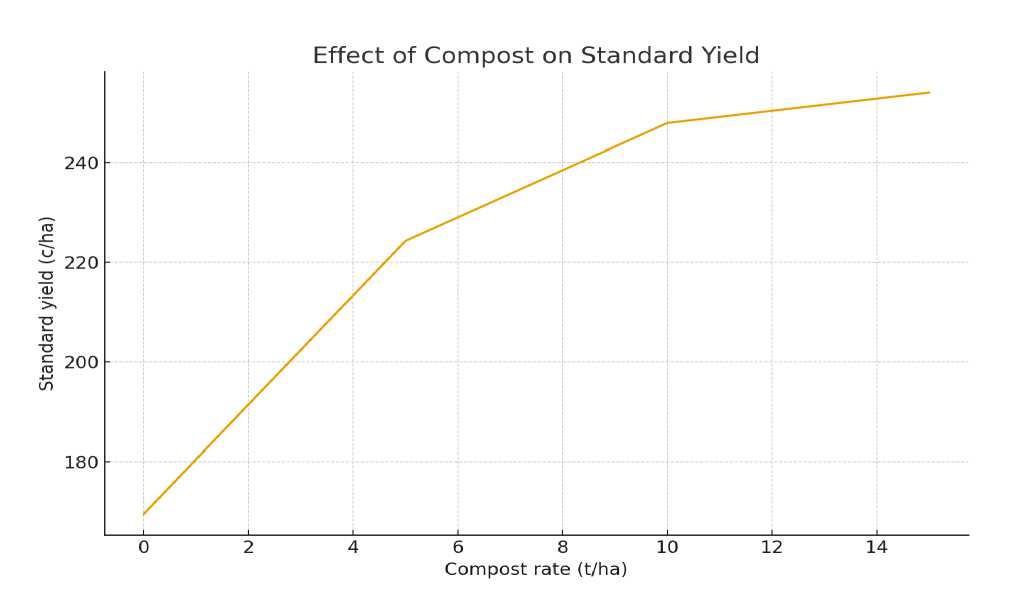
Fig. 1. Effect of Compost on Standard Yield
Total yield followed a similar trend. Compost-treated plots produced 245.8–283.2 c/ha, all higher than the control. The highest total yield, 283.2 c/ha, was obtained from the 15 t/ha treatment, which was 101 c/ha greater than the unfertilized control (Fig. 2).
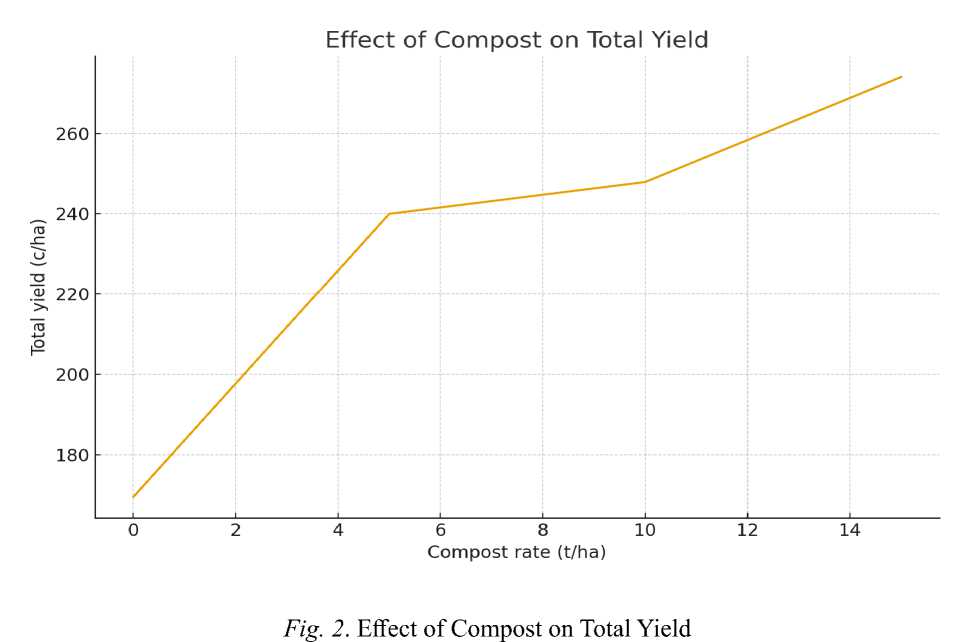
These results demonstrate that compost application, particularly at higher rates, significantly enhances both standard and total yield. The improvements are likely due to increased nutrient availability, better soil structure, and enhanced water retention.
Conclusion
This research demonstrated that compost application had a significant effect on potato yield. Compost influenced key yield components depending on the application rate. The results showed that compost application increased average tuber weight, standard yield, and total yield compared with the unfertilized control.
The 15 t/ha compost treatment produced the highest number of tubers per plant (9–10), which exceeded the control treatment. It also resulted in the highest average tuber weight (708 g), which was 252.5 g greater than the control and 22–93.5 g higher than the other compost treatments.
The highest total yield was also obtained at the 15 t/ha rate, reaching 283.2 c/ha. This yield was 101 c/ha higher than the control and 8.8–37.4 c/ha higher than the other compost treatments.
Based on the observed yield components and total yield, a compost application rate of 15 t/ha is recommended as the most beneficial for improving potato productivity in the studied agro-ecosystem.
