
Efficiency of strategic public administration: The state of Russian society following four years of the special military operation
Journal: Economic and Social Changes: Facts, Trends, Forecast @volnc-esc-en
Section: Editorial
Article in issue: 1 т.19, 2026.
Free access
The deep civilizational crisis that humanity is currently experiencing, the emergence of a new multipolar world order, and the challenges confronting Russia in this context underscore the urgent need to examine the strategic effectiveness of public administration. The authors emphasize the importance of a rigorous scholarly approach to understanding Russia’s role in the ongoing historical shift toward multipolarity, as well as in the wake of four years of the special military operation. To evaluate the effectiveness of strategic governance, the study employs the “evolutionary leap model” developed by E.V. Balatsky, which draws on the classical theories of historians, philosophers, and sociologists such as L. Gumilev, A. Schopenhauer, A. Toynbee, and E. Todd. The article also traces the evolution of Russian society and scrutinizes the caliber of the ruling elites as bearers of what Gumilev termed “passionarity energy” – the decisive factor determining whether the country will make an “evolutionary leap” to the next stage of historical development or face a crisis of statehood that directly threatens its very survival. The authors’ conclusions are grounded in data from nationwide and regional sociological surveys, official statistics, empirical evidence, and expert opinions, enabling a holistic assessment of public administration effectiveness, including its strategic dimensions: goal-setting, long-term consequences, and the motivations of decision-makers. Both the subjective evaluations and objective data presented in the article point to an acute need for improving the strategic effectiveness of governance. The President of Russia, who over the past quarter-century has consistently demonstrated strategic foresight, must now bring this quality to bear on the ruling elites, many of whose decisions continue to run counter to national interests and, as the study reveals, deepen the rift between society and the state. The study’s scholarly contribution lies in applying the “evolutionary leap model” to assess not only the effectiveness of strategic public administration but also the state of society and the quality of ruling elites in contemporary Russia.
Similar articles in the section High level, top level of administration. Central, national government
Short address: https://sciup.org/147253444
IDS: 147253444 | UDC: 354 | DOI: 10.15838/esc.2026.1.103.6
Text of the scientific article Efficiency of strategic public administration: The state of Russian society following four years of the special military operation
The first half of the 21st century has found global civilization in the grip of yet another profound socio-cultural, civilizational, and geopolitical crisis. As Russian President Vladimir Putin emphasized back in 2021 (prior to the start of the Special Military Operation), “the crisis we are facing is conceptual, even civilizational... it is a crisis of the approaches and principles that define human existence on Earth”. This circumstance, naturally, brings to the fore the critical task of enhancing the effectiveness of strategic public administration – that is, the ability to foresee the future strategically and to think in terms of grand historical and civilizational categories.
It is worth noting that Russian legislation lacks a clear definition of the term “strategic public administration”1. However, the head of state 2
“We are already living [in an era of change], whether we want it or not, and these changes are becoming ever deeper, ever more fundamental... The crisis we are facing is conceptual, even civilizational. In essence, it is a crisis of the approaches and principles that define the very existence of man on Earth... This is not simply a shift in the balance of power or a scientific-technological breakthrough, although both, of course, are also taking place. Today we are confronted with simultaneous systemic changes across all fronts: from the increasingly complex geophysical state of our planet to ever more paradoxical interpretations of what man himself is, and what the meaning of his existence is” 2 .
1 Instead, Federal Law 172-FZ of June 28, 2014 (as amended on July 13, 2024) “On Strategic Planning in the Russian Federation” provides the following definitions:
2008 : “Today we are already setting goals and objectives for ourselves not for a month or two ahead, but for 20–30 years ahead” 3 .
2012 : “What is needed is precisely a long-term state approach, taking into account the interests of the regions, practically all sectors of the economy, as well as geopolitical and social factors. We need to look 10, 20, 30 years ahead” 4 .
2022 : “Always – when making any decisions – one must identify the main thing. What is the main thing for us? To be independent, self-reliant, sovereign, and to ensure development for the future – both now and for future generations...” 5
2025 : “...the very idea [of building the TransSiberian Railway across the entire country to the Pacific Ocean] serves for us as an example of strategic vision of the future, when not only current needs and circumstances are taken into account, but also the country’s interests for centuries to come...” 7
consistently draws attention to the absolute necessity of a strategic, long-term approach in implementing managerial decisions, urging that we consider “ not only current needs and circumstances , but also the country’s interests for centuries to come”.
For the Russian Federation, the urgency of issues related to improving the effectiveness of strategic governance stems from two key factors.
First, today, during the Special Military Operation, which began on February 24, 2022, and whose fourth anniversary is now being marked, Russia is navigating a pivotal chapter in its history.
The fact is that every major state-civilization – one with a long historical trajectory that has played and continues to play a significant role in the cultural, economic, and geopolitical landscape of global civilization – develops cyclically. Such states repeatedly overcome critical periods that demand the mobilization of all their strength and resources8.
As the Russian sociologist and philosopher N. Ya. Danilevsky wrote – and his views have been cited twice by the President in public speeches (on November 1, 2018, at the World Russian People’s Council9, and on October 27, 2022, at the plenary session of the Valdai International Discussion Club10) – “history is not linear; it is a totality of civilizations that are in a constant cycle of formation and decline... Each civilization passes through certain stages of development: emergence, flourishing, decline, and demise” 11.
A “test of strength” in the form of critical stages in the life cycle of a state-civilization truly tempers it, makes it stronger, and enables it to reach new historical frontiers of development. But this holds true only if it proves capable of learning from previous experience and, drawing on that accumulated wisdom, finds an effective and swift response to the challenges of the present.
This is precisely the challenge facing the President and the entire system of governance he leads. Russian (or Rus) civilization is no exception to this rule. Over its more than thousand-year history, it too has repeatedly faced crises of statehood, at times teetering on the brink of disappearance12.
Today, during the Special Military Operation, Russia is once again undergoing such a stage in its development. As Vladimir Putin stated, “ Everyone must understand the times we live in and the historical stage Russia is going through. And if we understand this, then everyone – everyone – must work as if on the front line. Everyone must feel mobilized. Only then will we achieve the goals we have set for ourselves” 13.
M. Yemelyanov 14 : “Some Russian political scientists believe that overcoming the unipolar world is the ultimate goal of Russian foreign policy, after which bliss in international relations will follow. This is not so! A multipolar world order gives rise to exceptionally serious challenges for Russia and its diplomacy ” 15 .
The second factor driving the urgency of enhancing the effectiveness of strategic public administration is linked to the fact that the process of shaping a new multipolarity in the 21st century “gives rise to exceptionally serious challenges for Russia and its diplomacy”.
The formation of a multipolar world, as Putin has repeatedly noted, is not a process contingent on the wishes of Russia, China, or any other single actor. It is driven by the objective trends in the development of the potential of the world’s leading powers. “We can accelerate this process, we can, or someone might try to slow it down, and perhaps they might even manage to reduce the pace at which the multipolar world is being built. But its creation is inevitable” 16.
-
2023 : “The multipolar world is creating itself, as a matter of fact. And it is happening due to the growth of the potential of many countries” 17 .
-
202 4: “It is precisely on the basis of the new political economic reality that the contours of a multipolar and multilateral world order are being shaped today, and this is an objective process” 18 .
-
2025 : “The new world order is emerging naturally. It’s like the sunrise. There’s no getting away from it” 19 .
Moreover, as many experts point out, this process is unfolding not along state (national) lines, but along civilizational ones. In other words, the emerging multipolar world is likely to be a world not of numerous nation-states, but a world of macroregions, or “pan-regions”.
“The most likely scenario for the world’s development over the next twenty years is a ‘world of pan-regions’... That is precisely what the world will look like after a New Yalta: rights for the great powers, law and taxes for the rest...” 20
In such circumstances, the question of who holds the initiative in shaping their own “pan-region” and in the broader process of forming a multipolar world becomes fundamentally important . And it is precisely this point that places heightened demands on the effectiveness of strategic state governance.
“The structure of the situation is simple to the point of banality: whoever takes the initiative sets the rules of the game, the level of escalation, the fabric of misconceptions, the dynamics of traps, the labyrinths of intrigue” 21 .
It is worth noting that the Russian Federation effectively led and for a long time remained “at the vanguard”22 of this new multipolarity. The beginning of the “passive”, or latent, phase of this process was marked by Vladimir Putin’s speech in Munich on February 10, 2007.
It was then that Putin, addressing the so-called Western “civilized” world, drew attention to the fact that “a world with one master, one sovereign, is ultimately destructive not only for all those within this system, but also for the sovereign itself, because it destroys it from within... For the modern world, a unipolar model is not only unacceptable, but also entirely impossible. And not only because, with a single leader in the modern – precisely the modern – world, there will be a shortage of both military-political and economic resources. But more importantly, the model itself is unworkable, as it lacks, and cannot have, a moral and ethical foundation for modern civilization”23.
In this forecast, the President of the Russian Federation demonstrated his strategic foresight. Essentially, all his subsequent actions within the country24 were aimed, as Aleksandr Dugin writes, at “purging the West from within itself”25 – at preparing Russia for the moment when the unipolar world model would collapse, and amidst its ruins, an even more complex, brutal process of forming a new, multipolar model would begin, fraught with military conflicts and artificially created cultural and value ruptures.
Russia also initiated the “active” phase of shaping the new multipolarity. This occurred with the Supreme Commander-in-Chief’s announcement of the Special Military Operation in Ukraine on February 24, 2022. “Since then”, experts note, “Russia has led the struggle for a multipolar world, drawing in a cautious China, a wavering India, and other international players striving for genuine independence”.
However, three years later, a new stage has begun in the historical process of forming a new multipolarity. This is linked to Donald Trump’s victory in the US presidential elections in early 202526.
“The first powerful blow to the unipolar world was struck by Russian President Vladimir Putin with his famous Munich speech in 2007. Since then, Russia has led the struggle for a multipolar world, drawing in a cautious China, a wavering India, and other international players striving for genuine independence” 27 .
The US withdrawal from 66 international organizations; the imposition of trade tariffs on virtually every country in the world; territorial claims against Canada, Greenland, Venezuela… With all these moves, the United States is demonstrating a “readiness to disregard anything – anyone’s sovereignty, any international law, any public opinion, and even the official position of any state or group of states)” 28 .
On January 22, 2026, at the Davos forum, Donald Trump officially announced the creation of a “Board of Peace”. Its “sole chairperson is Trump himself” 29 . As experts noted, “Trump seems to simply want to replace institutions with himself – and this is one of the most striking demonstrations of their current state and weakness” 30 ;
“The US actions are not the arbitrary folly of a weakening global hegemon, but the desire of a metropolis to establish its own order within the territory of the pan-region it is shaping for itself... The US considers the entire Western Hemisphere its exclusive sphere of influence, whether others like it or not” 31 .
The key characteristic of this new stage is, firstly, a change in the very nature of the process itself: it is no longer merely a struggle between the “new” and the “outgoing” models of world order, but a struggle among the world’s major powers (“metropolises”) for spheres of influence (“pan-regions”).
Secondly, the initiative in this new stage of forming a multipolar world is increasingly being seized by the very actor that led the outgoing unipolar model into global crisis – the United States.
As experts note, the new Trump administration “is implementing a decision to completely demolish the entire visible layer of the Western elite, its basic principles and laws... we are witnessing a deliberately provoked catastrophe of the Western elite system, not a crisis, but a catastrophe” 32.
Thus, “right before our eyes, the architecture of the world order, built on the basis of the Yalta-Potsdam agreements following World War II, is crumbling” 33. And, of course, such qualitative, systemic transformations of the entire global architecture cannot but pose a challenge for the Russian Federation. It is no coincidence that the first meeting of the Russian Security Council in 2026 (on January 19) was devoted by Vladimir Putin precisely to two themes: “issues in the sphere of security” and Russia’s participation “in the construction of a multipolar world and our actions in this regard” 34.
Based on this, we see that the increased demands on the effectiveness of strategic public administration are dictated by the dynamics of the historical process not only at the national, but also at the global level. As experts note, “a long solo voyage lies ahead of us, and it requires a radical improvement in public administration at all levels”.
“The Munich Security Conference in 2026 showed that the Third World is unlikely to rally around Russia on an anti-colonial basis ...
India, Brazil... all it takes is for the Americans to push a little, offer a profitable deal/transaction, and these countries act in their own interests...
A long solo voyage lies ahead of us. It requires a radical improvement in public administration at all levels ” 35 .
How can we ensure that, at this pivotal moment in history that Russia is navigating at the end of the first quarter of the 21st century, we not only preserve the state, literally survive, but perhaps even strengthen our geopolitical standing? How do we avoid being left “by the wayside” of the chaotic and rapidly unfolding process shaping a new multipolar world? And, ultimately, how do we keep from ending up on the “backburner” of history?
The fact is that the speed of technological change is accelerating rapidly, going sharply upwards. The one who rides this technological wave will leap far ahead. Those who cannot do so will be overwhelmed and drowned by it ” 36 .
These are all questions of strategic public administration, and it is crucial to emphasize that finding answers to them is particularly vital for our country. For many states around the world, a pessimistic scenario might mean being, as President Putin has noted, simply “overwhelmed and drowned by the wave of technological change”. But for Russia, this carries the additional, direct threat of military intervention. As Foreign Minister Sergey Lavrov underscored after the start of the Special Military Operation, “Russia is fighting for its very survival, for the right to remain on the political map of the world”37, and moreover, “for the first time in its history, Russia is fighting alone against the entire West”38.
It is important to note, however, that four years into the Special Military Operation, some experts – notably D.R. Belousov39 – continue to point to troubling symptoms within the system of state economic management, symptoms that create risks for sustaining the course of national development in the 21st century. 40
The systemic problems highlighted by this leading forecasting expert41 demand deep scholarly analysis and a thorough understanding of their root causes. In our view, these causes are convincingly revealed in the “ Structural Model of the Evolutionary Leap ”, presented by Doctor of Sciences (Economics) Professor E.V. Balatsky, in his article “Russia at the Epicenter of Geopolitical Turbulence: The Accumulation of Global Contradictions”42.
“At present, the formation of a long-term development strategy has, at the very least, slowed down. We are making a number of important decisions regarding space and digitalization, but unfortunately, we lack coherent strategic constructs that integrate technology, the economy, and socio-cultural aspects:
^ In current economic policy, very harsh decisions are being made that paralyze investment . I am referring primarily to fiscal consolidation and maintaining the Central Bank’s key rate at a very high level in real terms.
^ A marker of the absence of a wartime economy is that we still haven’t abandoned the inflation targeting concept adopted in the first half of the 2010s…
^ Overall, it must be said that the economy is experiencing stagnation, even stagflation... In the coming year… the risk of a recession is quite real, especially at the beginning of the year.
^ A decline in output is observed in a large segment of manufacturing industries. There is a severe crisis in the automotive industry, with no end in sight…
^ At the instigation of the Central Bank, behind-the-scenes discussions have already begun on whether to lower the target inflation rate to two percent per year… In a worst-case scenario, instead of accelerating economic growth to above three percent, we could slide into stagnation with growth rates below one percent, accompanied by fairly high inflation…
The previous model of our integration into the global economy… is completely exhausted. It cannot be replicated under any circumstances… What is needed is to extend the planning horizon for development prospects… to break free from the trap of short-term balancing” 40 .
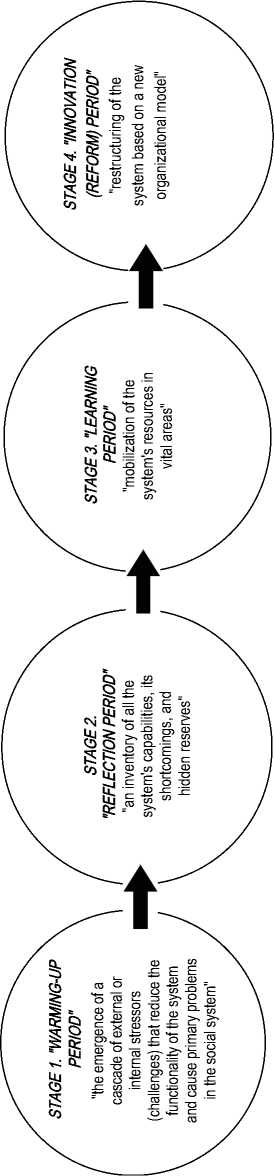
The “evolutionary leap” model itself, along with some key characteristics necessary for understanding its essence, are presented in Inserts 1 and 2 . Here, we will highlight the main point — the advantages of this model from the perspective of strategic effectiveness of public administration:
^ first, the approach proposed by E.V Balatsky draws upon and synthesizes knowledge from the classical theories of historians, philosophers, and sociologists (notably figures such as L. Gumilev43, A. Schopenhauer44, A. Toynbee45, E. Todd46, and others);
^ second (and most importantly), the “evolutionary leap” model allows us to analyze the historical stage of multipolarity formation not from the perspective of global processes and events unfolding on the geopolitical arena, but from the standpoint of internal changes, mechanisms, tasks, and challenges at the level of a specific state (a statecivilization). In other words, it enables an assessment of the effectiveness of strategic public administration . It is precisely this feature that ensures the practical significance of the model.
It is also worth noting that in the first quarter of the 21st century, within the dynamics of successively unfolding stages of evolution (“warming-up period”, “reflection period”, “learning period”, and “innovation period”; Insert 1), the Russian Federation, in our view, finds itself situated between the first and second stages (between the “warming-up period” and the “reflection period”). This is because a “cascade of internal and external challenges” is present but has not yet been overcome; an “inventory of all the system’s capabilities, its shortcomings, and hidden reserves” is underway, but it is still too early to speak of all the system’s resources being “mobilized”.
As can be seen from the key propositions presented in Insert 2 , the crucial factors in the development of a state-civilization are the “ level of well-being ” (which, upon reaching certain limits, causes the passionary energy to wane) and the state of the elites (among whom, at a certain point in time, individuals emerge who are oriented not toward national, but toward personal interests).
This is precisely how, in their time, the Roman Empire and the Soviet Union faded into oblivion. Regarding the latter, E.V. Balatsky writes: “ The USSR lasted 70 years and, due to errors in public administration, disappeared irretrievably. The question boils down to details, which become decisive” 47.
“The main criterion of a ‘national elite’ is its ability to implement policy in the interests of society, aimed at strengthening the country’s sovereignty. There are situations where an elite either has not yet become national, remaining a kind of ruling force representing the interests of individual territorial communities; or it has already ceased to be such, having incorporated itself into the ‘global elite’ or become a comprador elite...
The degeneration of the elite, an important sign of which is its loss of national identity, leads to the decline of society... As soon as the elite loses its quality as a national force, becoming supranational, the stage of civilization’s decline begins, the final point of which is its demise” 48 .
Insert 1

-
49 Balatsky E.V. (2025). The extinction of passionarity in E. Todd’s demographic concept. Sotsialnoe prostranstvo, 11(3), p. 3.
-
50 Ibidem. P. 4.
Insert 2
|
-о © = a я v J ^ л я _c S oj 05 'W jg >■ W «М о о u я я U .ею 'Й ■o я v u я СЛ и Ф Ф Л ■w M .я ф > <л Я О © а £ а >> ф W |
15 -2 2 ед аг ф ф ед ф £ S 8 я s Зоя ® 2 2 я * я ° О Я © ф о — ф ф ” 2 х а о я S - 1 © ° 43 й и И 2 - 2 £ S У © я £ 8 £ я | - S Й Р н и -2 й ® s 5 я > я “ 1 з я о "3 оз й ф тз 2 d > d ф Й Ф сл Й 73 Й 7 S » х : £ ^ й ® li Л О 5^ 3 2 я “2 Ф 'в ° а S g 7 а Н Й Ф • © .SP я 2-2 8 3 S а ф я о |
3 ф я 8 ф ед 2 ^ 43 Ф w « £ Ф Ф С -W оз оз X Й « Ф Й Ф й й Ф S3 S3 Я я я 8 я ® ф а я 2 5 6 © © ф U Ф Й 5 w ед 5 -2 Ф С ед а ед 8 я © © 43 ®" Я оз я Ф ею 8 я я • ею © : £ S -Е 5 5 2 |
оз & Он ф £ 8 о £ § 3 © 8 ■я Р ф 3 S ею — ею £ & я •Я Ф сл О сл я 2 6 t - Ф оз © я н 13 .2 £ * 5 ОЗ {/5 ф аг ф ф ед ф Й Ф ^ § я |
£32 Й о Р 43 я £ 55 я О ф я d X а Я “ О аг Id ”-| й О 2 © д © 3 я й & аг о Ф £ £ У я 2 © Ф 3 о я 8 ° я £ Я я £ 3, ©за 03 73 я Й О g С 0 8 2 © I । © я | я S3© © > I О сл So я 2 “ © ^ а Я 7 га 3 я: © й О S 2^2 2 ЛЙ я ^ ’аг .й £ 3 |
д я <□ я © s 1 3 £ S 3 3 га । 43 В ьо >^ й з О д © । 3 8 ° я -^ ©? £ 3 я га ©ОЙ S3© Р 2 о £ £ © 8^3 £ © о я я >? . w О 02 я В ° £ £ £ й о й 8 z—s 2 > о • d £ оз я £ ©3 X й О В 8 Е Й 73 Ф & Й 2 « д £ ф ® i S £ 1 I 1 8 я £ £ s 8 & ■© |
• ф ф ф ■о _о 5 € С/З Й "О 73 Л w я ^ О- a о О © и -^ а я я ф Я XJ 43 £ Ф у я с/з U ф а 8 © ф •- © 3 ф 3 .2 8 ° 43 ® £
s S $ .8 й ф Ф Й ® ^ ■§ 8 £ § * 3 я в © о 2 © н » © 3 £ a л £ я S
о л Р u > ф - й ® Р сл Ф а a ■Я® 8 5 оз О ф $ о *
оз ф й Ф Ф Л 73 В о я х ^ £ 3 3 О О | я 2 S3 .2 S х 8 я © ® н -о 3 © ф S я Я ф сл i s з о g « © ф w 8 я 5 х 2 Я © £ £ £ о © © й 7 © “ © . оз i ^ .2 1 £ £ g я |
Balatsky E.V. (2025). The extinction of passionarity in E. Todd’s demographic concept. Sotsialnoe prostranstvo, 11(3), 1–23.
It is worth noting that we have discussed these “decisive details” in detail in our previous articles52, when we addressed the specific personal characteristics of the so-called “grave-diggers of the USSR” – representatives of the ruling elites personally responsible for the collapse of the Soviet Union.
“No objective circumstances led to that geopolitical catastrophe [the collapse of the USSR]. Here, the subjective factor played an enormous and decisive role – people who, due to their position, whether consciously or through thoughtlessness, did everything to ensure that the Soviet state ceased to exist...
These phantom-like individuals developed completely different, hypertrophied social qualities – an inordinate thirst for power, an unlimited desire for wealth, a morbid craving for fame...
Their behavior completely (or significantly) diverges from, and even contradicts, what interests and concerns the majority of the country’s population” 53 .
The “evolutionary leap” model precisely describes the global processes unfolding today, including the most important aspect – the state of “passionary energy” within our own country. As E.V. Balatsky writes: “The conditions for the decline of passionarity in Russia are fully met: a high rate of marital dissolution and low birth rate; low religiosity and blurred ethical norms; the erosion of the Russian language... in Russia, which for 30 years has strived for integration into the Western community, cosmopolitan values and a model of behavior have taken shape that are not characteristic of a unified nation with a high degree of self-identification and the desire to overcome external pressure”54.
In these circumstances, the “existential challenge from the surrounding world” (which, theoretically, should have led to the “emergence of a hypercompensation effect, or, in other words, a passionary explosion of the nation”) for Russia undoubtedly became the Special Military Operation – or, more precisely, the sharply increased threats to national security from the united Collective West that emerged after its commencement... Yet, no “passionary explosion” or “evolutionary leap” has occurred in Russia so far. Why?
In our view, the answer to this question lies precisely in the fact that even with the accumulation of a critical mass of passionary energy in society, Russia lacks “ the very possibility of realizing a passionary explosion” 55. And this possibility is absent precisely for the two key reasons highlighted by E.V. Balatsky: the dominance within the state of elites guided by personal rather than national interests, and the “iron law of welfare”, according to which “the main ‘culprit’ in the decline of passionarity is the growth of well-being” – more precisely, that stage of it when “ excessively comfortable life ” sets in, which is relevant above all for the ruling elites.
A caveat should be made here: the term “ excessively comfortable life ” is highly subjective. It is virtually impossible to give an objective assessment (that is, to specify a concrete value) of what level of well-being constitutes “comfortable” and what constitutes “excessively comfortable”. These magnitudes differ for different countries of the world, for representatives of different social strata, and so on.
However, if we set aside all this “political correctness” and call things by their proper names (as the situation in the country demands), then, at the very least, an understanding of “excessively comfortable life” is quite illuminated by descriptions of the assets of specific representatives of the ruling elites and members of their families that become public knowledge after criminal cases are opened against them56.
It should be noted at this point that episodes of corruption and bribery among representatives of the ruling elites continue on a daily basis (over the last two months, from December 19, 2025, to February 19, 2026, at least 26 episodes; Insert 3 ).
According to the monthly reports of the Ministry of Internal Affairs of the Russian Federation on the state of crime in Russia over the four years of the Special Military Operation (from 2022 to 2025):
/ the level of corruption-related crime increased by 22% (from 35,000 to 43,000 cases);
^ the number of bribery-related crimes increased by 38% (from 19,000 to 27,000 cases) 57 .
|
ОС in N О N Л н а я 5 А 1 IT) N о (Ч О' ^ Е Ф о Q сл о WD .S 3 -С ■W О сл ■^ ■^ а о сл ф а fa о «1 (Л Л ■о я и я ■н ■Я fa О (Л fe |
с 2 ^ fa 2 я fa 2 2 § а ON Й 2 ^ 73 р Q О tn 2 2 2 2 Е fa о JS Я га fa 2 Ь 2 я I S ”3 3 28 ° я < | * * £ о я Я | Я 3 g § * 2 | | Я 2 g Е | * 1 | Е § ^ | 2 § 2 2 я 2 я « '& 2 £ о я £ ° ^ 2 Й -Яо -я % о Q о ■я о й Е 2 й 2 ё 2 в | я 2 § Е 2 8 .So * «2 Е 2 2 2 fa -4 & ^Ня^-2о?^“й1М И ?° । И ш « I г= ^ S ^ t 2 2 • О 2 Я $ 2 3; ° ^ ы fa я ё а о fa 2 fa a q . 2 a fa я 22 fa S 2 о 22 2 2 2g 3 23 | я ® я яя а я fa Е м 2 OS Й И n и 2 ~ о а В 3J «fao-§^fa^2^ 2 8 g > я i? и » = = “oS°fS2fcig-g£S^ll”'g I ■ 1 .= Е S g-S^^a^^-SE-f^lIla 1“ е.|е-а '^ 8 ^ S ^ ,е к 5 g | £ | & |; 1 2 ^ »° ^ ??2гЁг5««-&гс:5°.§ £| B^f 11 ^l^l S2 М’^° *3 S I * 2 3 6fa2'^b'BP°sa222&2 2^g за Йг -S 145|58ssj°8O3ss’S Ss 5йг ^&Я°|5^2Як-|^1 — — fa — -о а ~ а ^ я ^ о — о я; х- fa -fa 0 ьо § a i | a fa а а ° а а .е a g g лл^н«.ял5««Я|Я.Я1Я«_сзлО|яа!«о_>(!зЕ ЕЕ2ЕааеёеЕозйз=«з£з§з£о«£ Л Ол,— Л Л г р Я to to Я to ^ £ to 3 to to E fa -a fa fa a fa 0 fa Eto & о ^ Q 0 га 2 0 о М о и В о о |
Source: RT in Russian. Latest news on detentions. Available at:
End of Insert 3
p 5
я
E о
р о
Е о
S
p о a о
Ki
■w
P
P
ь
о
Ki
.о
p Ki
ьо кЗ а р
а Я в S я
о p
p
p
<□ p o’
p
p
о
p о
E
P
p
p
£
о
p
о р^
X
о
p
P
p
о
p
О Р
£
p
p о
о
p
Р
Р
р
о p о
p
с/э
о
2 о Е Р Ki
<□
О сл Р О
5 Й
p
<□
ЬО
Е и
p
p
Q
о
а я я Й я
p
p
p
N N
о p о
Е о
СЛ p сл
P О
Q
p
p p
о p
p о
£
£
о
о
E
,o
p о
p p
| О
p
,o
•p
P
•р о
P
о
о
p
о
Й
о
•a s
p о БЬ
р О Е Р Ki &
о
p
Ь0
p
о
I
р'
N N Ki
Qi
о S р
я 3 s Я
p
p о
p
о
СЛ
p
о
о
•р
о р
p
а я я я я
p p р о р £
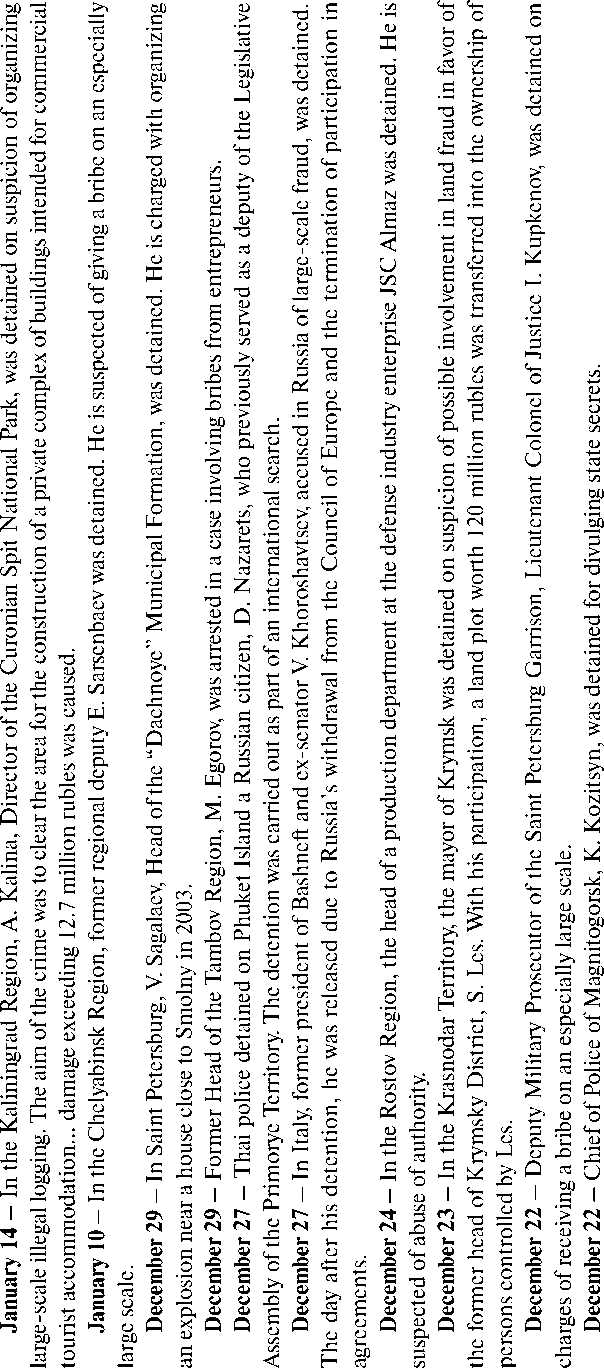
The facts presented above, testifying to the frequency of corruption and the approximate level of financial, material, and other assets discovered among the corrupt officials themselves and their relatives, are important for gaining a rough understanding of what constitutes “excessively comfortable life” – the very thing “thanks to” which state servants and elites begin to be guided by personal rather than national interests.
However, the issue, of course, extends far beyond mere corrupt officials. As Aleksandr Dugin notes, it concerns a “special group of the population” – the “global class” ; that is, people with a different worldview, a different operating system,” who form the “core of the sixth column operating within our society”.
For instance, in a previous editorial article, “What Kind of State Do Russians Want to Live In? What Kind of State Has Been Built?”59 we cited the opinions of many experts pointing out that the entire “modern monetary system effectively blocks economic development”60, that “virtually the entire liberal part of state administration works in the interests of the banking system”61 and that, by some assessments, the Central Bank’s policy simply “contradicts the Constitution of the Russian Federation”62.
S.Yu. Glazyev : “Russia’s current monetary policy, based on a high key rate, effectively blocks economic development, creating a vicious circle of stagnation ” 63 . 64
“Over the past 35 years in our country – as in almost the entire rest of the world – a special group of the population has formed, which can be called the ‘global class’. These are people who, either during this period, managed to amass huge fortunes or become integrated into global processes at the level of culture, science, and technology...
In Russia, over these 35 years, this class has become so intertwined with the ruling class as to be almost indistinguishable. I am not asserting that our entire elite is like this, but its most influential and prominent representatives are precisely part of the ‘global class’...
Those representatives of the global class who remained in Russia and still constitute a significant part of our ruling elite in the broad sense are hindering our further development... without systematically eliminating this ‘global class’ from Russian reality, the country will not be able to move forward. Preserving this class within the political elite condemns Russia to sabotage and an inability to move into the future.
Let me emphasize, this is not just about corruption. The ‘global class’ consists of people with a different worldview, a different ‘operating system’. Appeals to simply obey the law do not work on them. They form the core of the ‘sixth column’ operating within our society ” 64 .
M.G. Delyagin : “The Russian banking system today is the largest, institutionally recognized speculator. Virtually the entire liberal part of state administration works in their interests ” 65 .
V.Yu. Katasonov : “Take, for example, the current policy of the Central Bank. It’s called inflation targeting. These guys have become utterly brazen...! Inflation targeting contradicts what is written in the Constitution of Russia ” 66 .
However, following the “Direct Line with Vladimir Putin,” which took place on December 19, 2025, experts from the Center for the Study of Political Culture of Russia (CISPKR) concluded that the head of state “ expressed full support for the Central Bank’s policy: the President reaffirmed the ultra-liberal economic policy in the financial sector, supporting the ‘independence of the Central Bank ’. The recent reduction in the key rate was described by the president as ‘probably sufficient’. The policy of ‘cooling down’ the economy received positive appraisals, which may be perceived by the Central Bank’s leadership as a ‘green light’ to continue curbing inflation, even at the cost of slowing production growth rates” 68.
On February 13, 2026, at its first meeting of the year, the Bank of Russia lowered the key rate by 0.5 percentage points, to 15.5% per annum. This marked the sixth consecutive reduction of the key rate.
Expert assessments 69 :
-
1. “The Central Bank’s actions did not fit into the worldview of the majority of analysts who were trying to build consensus forecasts... the standard communication channel between the Central Bank and the market has been destroyed and is beyond resuscitation... Apparently, the Central Bank knows information about the economy and bank balances – information the market does not know – which led to yet another 180-degree turn in rhetoric, where inflation problems supposedly no longer exist... decisions have to be made ‘literally on the fly,’ maneuvering between inflationary and economic risks that are layering on top of each other. And this problem has become acute not only for business, but apparently even for the departments authorized to manage and regulate” (P. Ryabov, financial analyst).
-
2. “Despite the fact that a rate cut of 0.5% will not be able to significantly impact macroeconomic indicators , it was generally a positive signal for the market” (E. Zinoviev, analyst at “Tsifra broker”).
-
3. “This decision will not have a significant impact on the real estate market, but it should be perceived as a signal that the Central Bank is consistently pursuing a policy of monetary policy easing” (S. Lobzhanidze, Director of the bnMAP.pro analytical platform).
It is also worth noting that it is far from the first time experts have pointed to the problem of imperfections in Russian legislation, which introduces confusion into the interpretation of the official status of the Central Bank, and consequently into its functions, goals, and the rules governing its activities. As State Duma Deputy M. Delyagin notes, “Officially, we consider that the Bank of Russia is not a body of state administration. Contrary to what is written in the Constitution, contrary to what is written in the Federal Law on the Bank of Russia” 70.
Another striking example of how highly controversial, contradictory decisions – ones that do not correspond to national interests yet are highly significant – are made within the system of public administration lies in the sphere of culture. This sphere (like education) “is not only a purely humanitarian field, but also an area for shaping society and managing consciousness ... during the educational process, the consciousness of people is formatted, sometimes of entire generations, entire countries... it was precisely through the sphere of education that the colonization of Russia at the mental level took place ”71.72
“ ...in the entire body of Russian legislation, you will not find a definition of what the Central Bank of the Russian Federation is... In federal legislation... regarding the Central Bank, it is stated that its status shall be determined by the law on the Central Bank of the Russian Federation. The circle is closed: the Constitution refers to the Civil Code of the Russian Federation, the Civil Code refers to the law on the Central Bank, the law on the Central Bank refers back to the Constitution!
The Central Bank is indeed an unusual phenomenon, a kind of hybrid of a state body and a commercial (or non-commercial?!) organization. On the one hand, the Central Bank has the right to issue regulations binding on all, controls financial organizations, registers credit institutions and non-state pension funds, and exercises other executive and administrative powers. That is, it performs functions that can only be carried out by a body of state authority. On the other hand, it earns a profit, 75% of which goes to the state, and 25%, by decision of the Board of Directors, is transferred to certain funds. Profit is a characteristic of commercial organizations. But Article 3 of the law on the Central Bank states that the Central Bank does not aim to make a profit. This is a characteristic of a non-commercial organization...
In the Russian Constitution, the independence of the Central Bank from other bodies of state authority is enshrined only in the exercise of one, albeit the main, function — protecting and ensuring the stability of the ruble. The law on the Central Bank already ‘adjusts’ the Constitution and speaks of the independence of performing all functions. In practice, all activities of the Central Bank turn out to be ‘independent’...” 72
Specifically, we are referring to the decision by Minister of Culture O. Lyubimova to appoint K. Bogomolov as acting rector of the Moscow Art Theatre School-Studio. This decision provoked widespread public outcry73 and, within just a few days, forced the scandal-plagued theater director to resign74.
“Public indignation managed to shift what seemed like a done deal... Even the attempt by those promoting Konstantin [Bogomolov] to quickly fashion a patriot out of him did nothing to save the situation – the people unequivocally said ‘no,’ and it worked” 76 .
“The [Moscow Art Theatre] School is considered one of the main training grounds for representatives of the acting profession in Russia and a cultural brand of the country, which means the post of its director is a matter of virtually state importance ” 75 .
It must be noted that the episode with Bogomolov’s appointment in early 2026 is far from the first “unsavory incident” to occur in the sphere of culture with a context that is far from merely cultural, but distinctly political and social . This includes episodes during the period of the Special Military Operation ( Insert 4 ).
Nevertheless, whereas in the past, in similar episodes, the opinion of society was simply ignored by decision-makers, today, in early 2026, public indignation led to the reversal of a decision — effectively, a victory over yet another almost-accomplished act of injustice.
This says a great deal about the state of contemporary Russian society and how the situation in the country has changed over the past four years of the Special Military Operation. Yet the fact remains:
^ the Minister of Culture’s decision to appoint K. Bogomolov, a former (or current) “Navalny supporter”, was made and would most likely have stood, were it not for public outrage;
^ many representatives of elite circles from government bodies (including the Presidential Administration), culture, and show business spoke out in support of this decision77;
^ on February 6, 2026, K. Bogomolov served as the host of one of the country’s main national literary awards, “Slovo” (“The Word”), and none of those present (among whom there were also many representatives of elite circles78) saw anything reprehensible in this.
к
|
1 о Q £ О СЛ О 04 Е ел 2 5 •о д d о О ^ to г К d и о ■д & ел н о о ^ £ О о Е о И Д О ^ 2 о Р Q чз Q 03 2 Р X ^ И 75 _р д СЛ > й й £ Е Ч * гм £ еч ею о cd ^ Д . cd гм S ^ Д ы : д й < d О 75 -4 X) ел |
•2 ^ 2 £ м ■а 1 д о 2 = •rt о ч ад тз ® ° Е ад о £ о "Й Е “ о й Я ел ел £ д £ -й £ : о с '5 о Е & О д = й К м d У од В ^ h од ^ ел р 75 ^ О Р Р Д О -Р Д ^ О Й & У Н .2 ад ° О и н п Д ел Д О о У Д д др 9 § d р й & ДИД р? & Рн Д 'Й ° d 0 й 0 д’ ел .2 о .2 "й 33 й
Д ’Д О -д ЗД Д Н и д Е ч .Е д д
Мир 1 Е В d М ^ а ~ Д £ Д Д Д
& 9 ч й о й <£ Мой й Е д ел Й d 7 О § д “ й ц Д 0 "й Д о salt all 11 - ^ S d S о и Д £ ° о 9 М1 Д о В ДОД1 . й о 0 дуд О Д Й й еч £ Н Д 9 д О £ ч Я й •дЭДДО-н^Д О ММ ME Д а Й ь Й 9 о о р S ° ад р СМ И Е Д М О й 1 .S ^ I 1 ? |
ел ел । С д ^ ^ pg Д ди Р О ел оЗ ел О Ш ед ел ta 9 й н-* О Л Р ’ел Й 7 ^ .Р еЛ й £ £ - I ад Е д д ° а £ д & д о а ? ^ Ь 0 д 9 о ^° 0 н □ .д ~ й О О О -w д 2 S .S ? S К s
S 2 .2 .2 < Й й Е 9 2 - о й -Д Д о О Г 2 Е -g О д Р 2 73 р 73 О - 75 ел "Й I в а s :е f J § ^ | О о О п Д й 0 2 н cd ° с - й Е о и й +2 о й ел Р Рч 0 'Й £ £ о й Й | о о о и Д Д ® о О й g д Д 9 Й О о а 2 д ел М М £ 1 2 i 2 с -g ° -3 ■& cd -Ч о о Д те .р 0 ^ оз о : ел -о А о ел Я и а Й £ 43 g О о й Й о •£ “ о Е • =М й С & £ чз ;5 - И В S £ । ВЗ Й g.,-7 d й д Е2 -^ й о | g & J о § ^ 2 22 'д -й 2 а я а ^н |
"cd 'о О Д cd Д О ел ХЗ Л ■о cd ■д О ел Е? cd о Д О ■о _Д cd н О ■д ел cd > 2 < и о н ел ’Е § ел О S S о гч 1—н £ s’ О о 7t- О н ей 1 । |

End of Insert 4
д д о
§
д и
д
д
о
д
а д Q
сл
о д о
р?
Д Д
д
о
д
д
Д
Д .О
д
•с
д
р4 д
д и
.о
.о
о
£ о
о
о
а
а
to
а
а
а
д о а о
д
•с
о
д
д
д о
> д д о
д о о
с
•с
д
§
>8 а
а а а
§ а
а
а
а а 1
to
g
s
Z а о
х
И
>
S
а
£
а
а а
а а
а £
1 а
а
а
<3
"а к а i а
к а
<3
к
Э
о
к
,§
к
чу
о
£ з
О
к
а
I а
а
а а
а а
•« ,8 а
а
* а а
£$
а а
*
в а а
В £ в а а
а 3
а t
а £ ■а а а во ,а
а
£
=§
£
« а
.а
а
а
£
а
а
а
§ £ в
а
о о ел О
S
о О
о о
Q
"а
Д о О •д д кЗ ьо д
д
Ki
о о
Q
д кЗ а
д д О
д
Д О а
ьо о
а а о U
ьо
g
о
д о а а д
£
£
о
о
о
.о
о
д о И
Й О а
д о
д
д о сл
Р?
N
КЗ
& ел
О
Д
^ д о
д КЗ n д и о
Д
д о
д
£
I £
д
•с о
д
a
а
а
д о а
ьр
д о
о
о
£
р?
X о
о
й о а о
N N
£
м
д
д
КЗ а
о р?
а
а i
х
о
а
ел 2
и
д
£
g
сл
•с
о
5
и о
•а
§
к!
д
о
в £
а
а
а
а
i 1
а
а
а t
о д ел к 4>
д .д
ьо д
О а U а а
N N
£ а ел
<3
<3
£ а
с •а
к
о а
£ а о
к о
а
а 5 а «3
а
•S'
■в
i
а
а
£
во а
а
.£
а
а
с к
к о
о
5
о
.а
с'
к а ^
а
к' с
§ £
а
1 и
а
а а<
а
а
а
а а
•« а а
а а
а
£
а
-
83 Speech by N.S. Mikhalkov at the Plenary Session of the State Duma on June 17, 2025. Available at: http://duma.gov.ru/news/61632/
-
84 Zhilyaeva A. The case of Vladimir Kekhman: How one businessman manages three theaters in the country. Available at: https://www.forbes.ru/forbeslife/541748-delo-vladimira-kehmana-kak-odin-biznesmen-upravlaet-trema-teatrami-strany?ysclid=mlrpng3r2m650101321
-
85 Skryp A., Senopalnikov A. The pianist played too far: Why was the minister of culture of Bashkortostan arrested? Available at: https://www.business-gazeta.ru/article/69520 3?ysclid=mlt1mjleju862328495 (the assessment of the political strategist A. Potylitsin).
Thus, the Bogomolov episode is not an isolated incident; it is a “system”, and for many experts it raises serious questions about the quality of administrative decisions and the goals pursued by those making them.
S. Mardan (host of Solovyov Live TV channel): “Questions remain regarding the Ministry of Culture’s personnel policy. Questions, however, that no one will answer anyway” 86 .
N. Burlyaev (First Deputy Chairman of the State Duma Committee on the Development of Civil Society, Issues of Public and Religious Associations): “This temporary misunderstanding has now persisted for decades, causing bewilderment among the overwhelming majority of normal people” 87 .
M. Raikina (Editor of the Literature and Art Department, Moskovsky Komsomolets): “What is happening with personnel policy in the sphere of culture? Rapid appointments and dismissals may indicate that there is an invisible battle of thrones going on – there’s no other word for it...
Who summoned whom, where, who announced what to whom, or, worse, ordered what – we cannot predict... One thing is clear, and the more time passes, the more convinced we become: to get a theater, a school, or indeed any post in another cultural institution, you need to have a resource. And this resource must be more powerful than all other resources. Where this battle of resources/thrones will lead, particularly in culture – one can only guess at the catastrophic nature of the consequences” 88 .
In the sphere of culture, we once again see confirmation of Aleksandr Dugin’s words that, regarding elites guided not by national but by personal interests, we must speak “not simply of corruption,” but of a “global class – people with a different worldview”89. It is precisely their administrative decisions, contradicting what the President says and does, that ultimately lead to the “decline” of passionary energy in society as a whole.
How does this work in a concrete example?
In December 2025, following the year’s end and, more broadly, four years of the Special Military Operation, a number of research organizations conducted public opinion surveys. Based on the results, experts concluded: “For the first time in many years, a clear demand for a constructive agenda has formed in public consciousness” 90 ; “the country is entering 2026 with weariness from geopolitics and a colossal demand for the normalization of everyday life ” 91.
“ For the first time in many years, a clear demand for a constructive agenda has formed in public consciousness. People are tired of the feeling of ‘empty talk’ and ‘stagnation’ that dominated in 2024. Instead, a demand for order and stability has come to the forefront (23% compared to 9% a year earlier). And crucially, the share of those who see development in the life of society has tripled (11%). This is not just adaptation to difficulties, but the formation of an expectation of positive dynamics and real deeds...
The outcome of 2025 is a transition from shock and disappointment to hard-won stability and constructive expectations. Society, having endured a severe crisis, is psychologically ready for a recovery agenda, but this demand requires concrete actions and results ” 92 .
In particular, a survey of experts conducted in December 2025 by the Center for the Study of Political Culture of Russia (CISPKR) revealed “three main demands that the authorities ignore or are afraid to discuss”93:
-
1. “Just PEACE” (66%) – ending the Special Military Operation as the primary unspoken desire.
-
2. “Let us breathe” (62%) – a demand to stop rising prices and tariffs.
-
3. “Give me back my internet” (62%) – a demand for digital normality without an “electronic concentration camp”.
Some conclusions from the CISPKR report on the state of Russian society following 202594:
-
1. United Russia (64%) blames economic failures solely on sanctions and hides behind “unity” (64%).
-
2. 55% of respondents believe that the voice of the people remains “a voice crying in the wilderness”.
-
3. “The battle of the refrigerator against the television” (55%) – prices and tariffs frighten more than external enemies.
-
4. The final diagnosis of the socia l situation on the eve of 2026: “anxious equilibrium ”:
-
5. The country is entering 2026 with weariness from geopolitics and a colossal demand for the normalization of everyday life – from price tags in stores to internet connection speeds and the functioning of messengers.
^ Experts rated the mood of society as “apathy and muted irritation” (4.2 points out of 5).
^ Weariness from geopolitics and longing for a “normal life” (3.95).
^ “Everyday concerns” outweigh the Special Military Operation (prices worry more than events on the line of combat contact) – 3.60.
^ Hope for the intervention and promises of the President as an “island of stability” fell to 2.43 points.
“This clear demand for a constructive agenda” is precisely the accumulation of a critical mass of passionary energy. At the same time, as V. Fedorov, Director General of VCIOM (Russian Public Opinion Research Center), emphasizes, the Russian people have “ become more complex. More diverse. Wiser... people have begun to value themselves more ..., have begun to feel our unity more deeply , to understand that we must be truly together. We have become more inclined towards what are called traditional spiritual and moral values . Strong family, patriotism, mutual assistance and mutual support...” 95.
“ We have managed to create something that ‘filters out’ the energetic, socially active, passionary part of society – those who have managed to change their social role and are ideologically charged . Moreover, in terms of their characteristics, these people are more of an entrepreneurial, ‘pioneering’ type than classical ‘service class people’ or, even more so, bureaucrats...
This new middle class also includes workers from the revitalized defense industry ... Volunteers a nd all those who, through deeds – actual deeds, not chatter that masks idleness and lack of will – demonstrate empathy for the events unfolding at the front and in the near rear, also gravitate toward this stratum in terms of values and function...
Until now, it seemed that our state rested on state servants – but no, it rests not only on them. It turns out that to no lesser extent, it rests on these very active young (and not only) technological entrepreneurs...
We now have a chance that this class of passionaries, its social energy, will allow post-war Russia to make a leap forward in the economy and in technology. For the first time, we may obtain a mass, patriotically minded class of entrepreneurs in terms of behavioral model...” 96
V. Fedorov : “In 2022–2023, the Special Military Operation was in focus. It was unclear, frightening. Remember, for example, in 2023 Ukraine promised a counteroffensive – it failed, but people felt danger. 2023 can be considered a turning point. Our offensive began, which has now been ongoing continuously for a year and a half. This is good from a military perspective. But from a socio-psychological perspective, there are other consequences. We are no longer afraid of losing: our heroic fighters are advancing. We, as a society, believe that all tasks will be achieved. Of course, we would like it to be faster, but if the enemy is not ready to accept fair terms, we will continue to fight...
Thus, various research organizations, independently of each other, are recording the same trend – a growing public demand for the “normalization of everyday life”; people’s primary concern is not the progress of the Special Military Operation, but the dynamics of their standard and quality of life.
In other words – along with people’s confidence in the success of the Special Military Operation, that demand from the population to the authorities which was relevant before the crisis is returning.
Only now:
A) this demand comes from a society that (in V. Fedorov’s words) has become “more complex, more diverse, wiser...”;
and B) the acuteness of this demand is “heated” by a period of almost six years of waiting (from 2020 to 2025), when society, quite understandingly and patiently, supporting the President and consolidating around him, “pushed” the agenda of standard and quality of life to the background, bringing the priorities of national security to the forefront.
Experts quite rightly draw attention to the fact that “this demand requires concrete actions and results” 98. And for this, as G. Zyuganov emphasizes, “the socio-economic course in Russia must be urgently changed... It is impossible to solve problems within the framework of that oligarchic capitalism that our Government demonstrates today” 99.
Nevertheless, decisions like those occurring in the sphere of culture, the financial system, etc., are effectively “dampening” this passionary energy accumulating in society, blocking the “demand for a constructive agenda”.
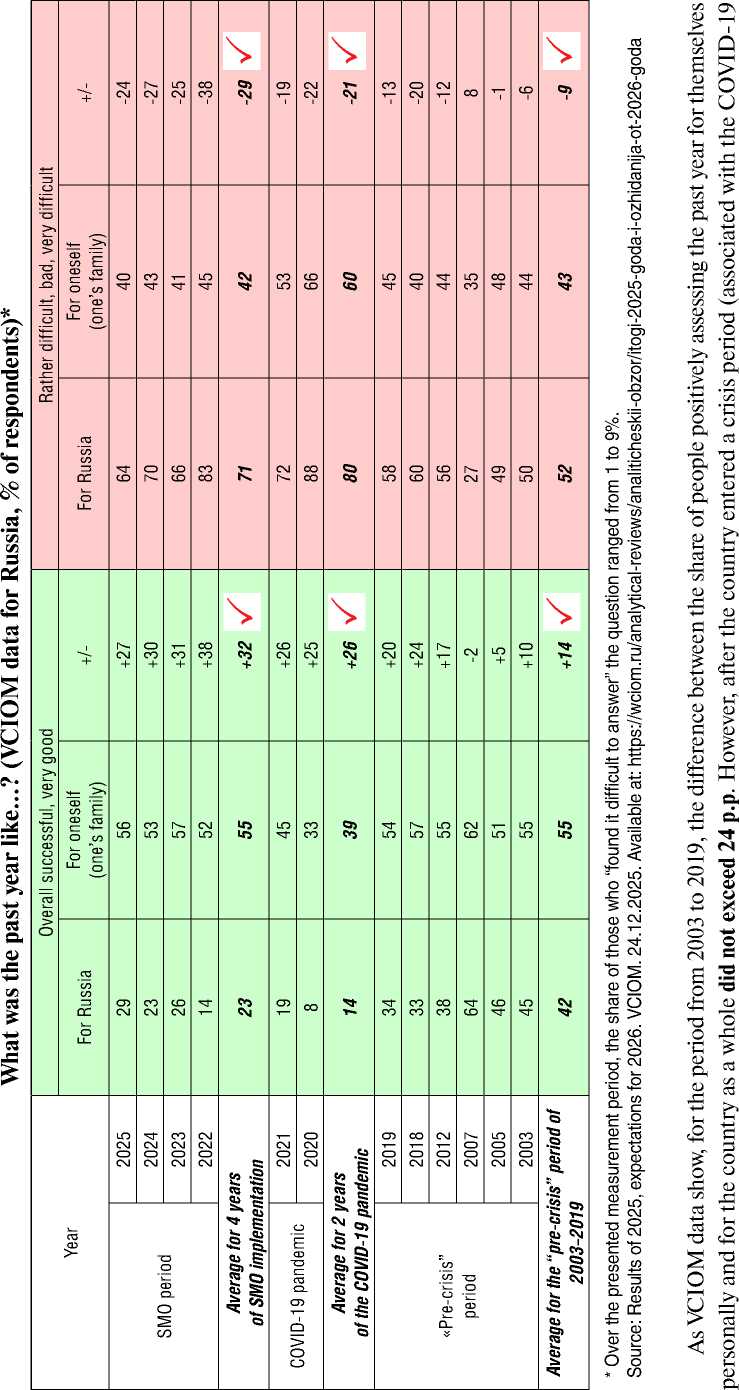
As a result, alienation of society from the authorities (the state) occurs. Thus, according to VCIOM research data on Russians’ subjective assessments of the outgoing year, the majority of Russian citizens noted that 2025 was for them personally “generally successful, very good” (56%), while for the country it was “rather difficult, bad, very hard” (64%, Insert 5 ). That is, Russians assess the results of the past year for themselves personally and for the country as a whole not just differently, but in opposite ways.
Moreover, in crisis periods for the country, this characteristic intensifies, and the specific nature of the crisis also matters here . Thus, for the period from 2003 to 2019 (preceding the COVID-19 pandemic), the gap between the share of people positively assessing the year’s results for themselves and for the country averaged 14 percentage points; during the pandemic period before the start of the Special Military Operation (2020–2021) – 26 percentage points; over the four years of its conduct (2022–2025) – 32 percentage points ( Tab. 1; Insert 5 ).
Table 1. Dynamics of assessments of the year’s results (VCIOM, data for the Russian Federation), % of respondents
Period For oneself (one’s family) For the country Difference + / – Share of positive assessments 2003–2019 (before COVID-19) 55 42 +14 2020–2021 (before the start of the SMO) 39 14 +26 2022–2025 (4 years of the SMO) 55 23 +32 Share of negative assessments of the year’s results 2003–2019 (before COVID-19) 43 52 -9 2020–2021 (before the start of the SMO) 60 80 -21 2022–2025 (4 years of the SMO) 42 71 -29 Source: Results of 2025, expectations for 2026. VCIOM. 24.12.2025. Available at: itogi-2025-goda-i-ozhidanija-ot-2026-goda
Table 2. Dynamics of assessments of the year’s results (VolRC RAS, data for the Vologda Region), % of respondents
|
Period |
For oneself/ one’s family |
For the country |
Difference + / – |
|
Share of positive assessments |
|||
|
2003–2019 (before COVID-19) |
46.6 |
37.6 |
+9 |
|
2020–2021 (before the start of the SMO) |
36.6 |
25.8 |
+11 |
|
2022–2025 (4 years of the SMO) |
45.2 |
24.9 |
+18 |
|
Share of negative assessments of the year’s results |
|||
|
2003–2019 (before COVID-19) |
44.5 |
45.0 |
-1 |
|
2020–2021 (before the start of the SMO) |
55.3 |
60.9 |
-6 |
|
2022–2025 (4 years of the SMO) |
48.8 |
64.0 |
-15 |
|
Source: VolRC RAS public opinion monitoring. |
|||
Thus, the majority of Russians positively assess the results of the past year for themselves personally and negatively for the country as a whole.
The same feature was noted based on the results of studies conducted at the level of a specific region – Vologda Region: the gap between the share of people positively assessing the year’s results for themselves personally and for the country as a whole averaged 9 p.p. in 2003–2019, 11 p.p. in 2020–2021, and 18 p.p. in 2022–2025 ( Tab. 2, Insert 6 ).
This discrepancy in the population’s assessments of their personal and public life intensifies during periods of crisis and (as the research results show) has manifested itself especially clearly precisely during the period of the Special Military Operation.
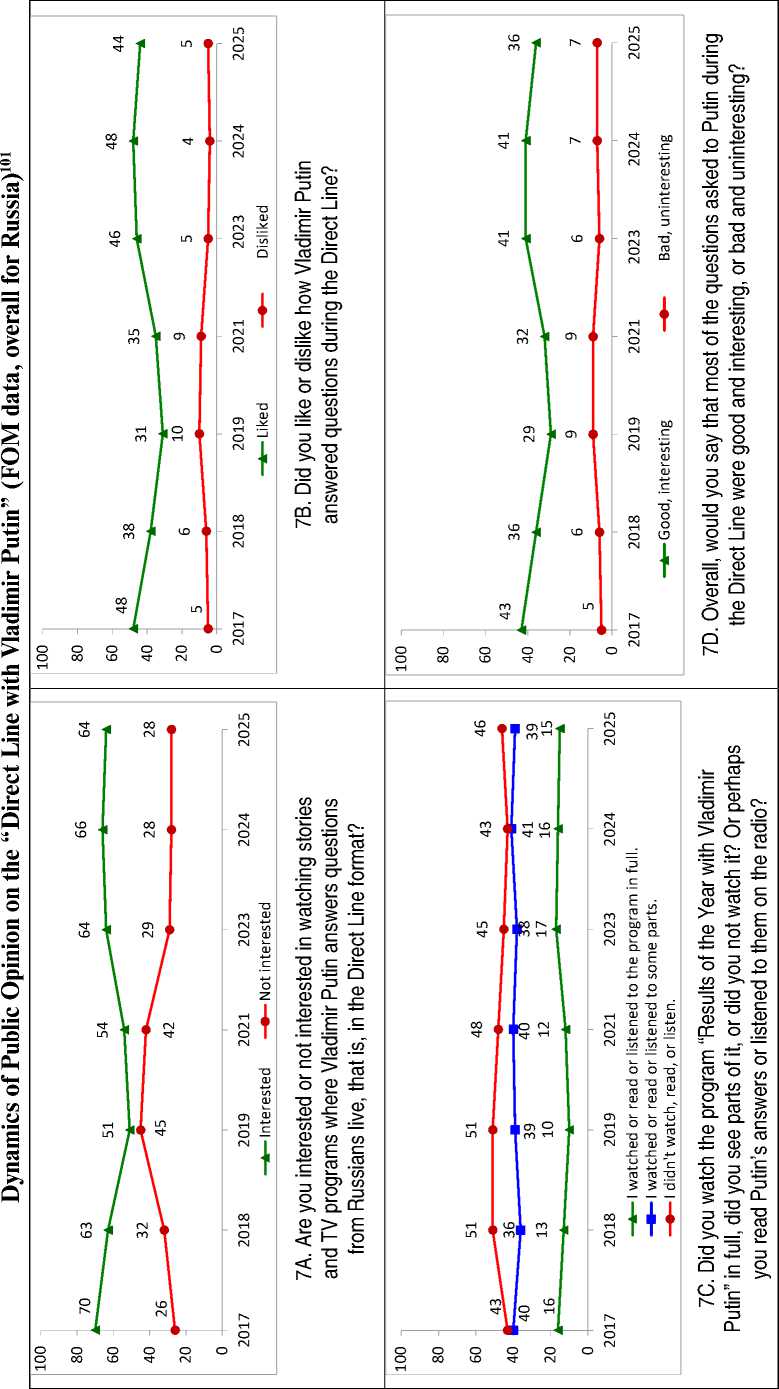
This same alienation of society from the authorities is evidenced by the decline in people’s interest in the “Direct Line with Vladimir Putin” (that is, in the President’s direct communication with the people, which has always formed the basis of the special, deep, trusting relationship that has developed between them; Insert 7 ).
According to FOM data, in 2025100:
^ for the first time since 2019, the share of Russians who were generally interested in the “Direct Line with Vladimir Putin” decreased (from 66 to 64%);
^ for the first time since 2018, the share of people who did not watch the “Direct Line” increased (from 43 to 46%);
^ for the first time, the share of people who liked the “Direct Line” decreased (from 48 to 44%);
^ for the first time, the share of those who noted that the questions asked during the “Direct Line” were “good, interesting” decreased (from 41 to 36%).
Thus, for the first time in the entire long crisis period in which our country finds itself (recall that the COVID-19 pandemic period can quite reasonably be included here), Russian society has demonstrated a decline in interest in what concerns our fellow citizens and in how V.V. Putin personally responds to this: what he says, what he does, and what he intends to do.
Insert 5
pandemic, then with the start of the Special Military Operation), this indicator increased and began to range from 25 to 38 p.p. A similar situation is observed in the share of those who negatively assess the year’s results for themselves and for the country: before the coronavirus pandemic, the difference between them did not exceed 20 p.p.; after 2020, it ranged from 19 to 38 p.p. Thus, during the crisis period (especially after the start of the Special Military Operation), the share of people who assess the results of the past year differently for themselves personally (their family) and for the country as a whole increases.
Insert 6

|
CD CD 03 ОС |
LQ |
LQ |
CM |
°? |
CO |
CD |
cd |
to |
°? |
||||||||
|
co E ш 'S ° 5° |
CO CO |
LQ |
IQ |
LQ |
*4 |
°* LQ |
LQ LQ |
LQ LQ |
oq oo |
CD |
LQ LQ |
LQ |
5 |
LQ |
|||
|
.55 00 ОС |
CD |
CD |
LQ LQ CD |
CD CD |
CD |
LQ s |
CD |
°? |
LQ |
LQ |
°? |
cd |
cd |
CD |
’St |
||
|
CD OO CO О О "2 CD О |
^ |
О 4- |
CD 4- |
LQ 4- |
co |
4- |
4- |
1— |
4- |
4- |
CD 4- |
LQ 4- |
4- |
^ |
^ |
||
|
5° "cd ш ~ co E Ш 45 £ |
LQ |
CM |
a |
C^ |
^ |
co |
°? LQ |
*4 CD |
°? |
5 |
LQ |
*4 LQ |
^ |
LQ |
to to |
||
|
.55 co co DC £ |
°? |
Si |
CO |
*4 |
CO |
cd |
ci |
CO |
CD |
*4 |
°? |
*4 CO |
c? |
LQ co |
|||
|
СП >- |
я |
ft e S S. e fit ft |
я |
CM |
И ft ^ ft ft |
O> |
oo |
Я |
g |
о |
§ |
■ft .ft s. Jo 01 “ ? 'M ft. co 3 о •s ° 5 |
|||||
|
О co |
E CD o> a о |
*52 CO -o |
|||||||||||||||
Insert 7
“Results of the Year with Vladimir Putin”. Interest in the program and impressions from the Direct Line. Available at:
The presented sociological data show that Russians are “withdrawing into themselves”, “distancing themselves” from the state and the country (55–60% of people assess the results of the past year differently for themselves personally and for the country as a whole; Russians’ interest in the “Direct Line” with the President is declining, and the assessment of the quality of the head of state’s direct communication with the people is decreasing). Consequently, the “hypercompensation effect” capable of leading to a “passionary explosion” and an “evolutionary leap” is not occurring”.
It is important to note that this trend is hidden, latent in nature, because the direct level of approval of the head of state’s activities in the country remains consistently high, and the assessment of the overall direction of Russia’s development remains significantly more positive than before the start of the Special Military Operation; the same can be said regarding people’s overall satisfaction with their living conditions.
According to VCIOM data 102 :
^ the approval rating for the activities of the President of the Russian Federation in January 2026 was 75%; the average for 2025 was 76%.
^ The index of the state of affairs in the country* averaged 59 points in 2025, compared to an average of 37 points in 2021 (i.e., before the start of the Special Military Operation).
^ The index of public sentiment** averaged 62 points in 2025, compared to an average of 50 points in 2021.
* Question wording: “To what extent do you agree that things in the country are going in the right direction?”
** “To what extent are you satisfied with the life you are currently leading?”
Incidentally, similar latent trends in the dynamics of public opinion are also noted in the results of regional studies, particularly those conducted by Vologda Research Center of the Russian Academy of Sciences (VolRC RAS) in the Vologda Region.
On the one hand, according to the results of monitoring surveys conducted in the Vologda Region ( Tab. 3 ):
^ throughout 2025 and the first months of 2026, the approval rating for the head of state’s activities remained stable at 64–66%, which is higher than the average for 2021 (before the start of the Special Military Operation; 52%) and for 2022 (the first year of the Special Military Operation; 57%);
^ at the same time, the share of people positively assessing their overall psychological state remained stable at 44–47% from February 2025 to February 2026, which is also higher than in 2021 and 2022 (41–42%).).
However, at the same time, over the last 12 months (from February 2025 to February 2026; Tab. 3 ):
^ the share of positive opinions about the head of state’s work in strengthening Russia’s international positions decreased by 3 p.p. (from 50 to 47%);
^ the proportion of people who believe that the President of the Russian Federation is successfully restoring order in the country decreased by 6 p.p. (from 54 to 48%);
^ the share of positive assessments of the head of state’ s work in protecting democracy and strengthening citizens’ freedoms decreased by 4 p.p. (from 45 to 41%);
^ the proportion of people positively assessing the President of the Russian Federation’s work in boosting the economy and increasing citizens’ wellbeing decreased by 4 p.p. (from 41 to 37%).
Thus, the overall approval rating for the activities of the President of the Russian Federation is significantly higher (65–66%) than the assessments of his success in almost all individual areas reflecting the most acute problems (40–50%).
Furthermore, more pronounced negative changes are observed in their dynamics: over the last 12 months, they are quite evident across all key areas of the tasks facing the head of state.
Table 3. Dynamics of subjective assessments of public opinion on the activities of the President of the Russian Federation and personal psychological well-being (VolRC RAS data for the Vologda Region), % of respondents
|
Indicators |
Average annual data |
Last 12 months |
Dynamics (+/-), Feb. 2026 to Feb. 2025* |
|||||
|
Year before the start of the SMO |
SMO period |
|||||||
|
2021 |
2022 |
2023 |
2024 |
2025 |
Feb. 2025 |
Feb. 2026 |
||
|
Share of positive assessments of the President’s activities |
51.5 |
57.0 |
61.4 |
66.7 |
65.9 |
66.3 |
63.7 |
-2 |
|
Share of positive assessments of social mood |
66.7 |
67.4 |
65.6 |
69.0 |
71.6 |
69.4 |
69.7 |
0 |
|
Share of positive assessments of the President of the Russian Federation’s success in addressing key national problems |
||||||||
|
Strengthening Russia’s international positions |
46.6 |
47.7 |
47.4 |
52.4 |
51.1 |
49.6 |
47.0 |
-3 |
|
Restoring order in the country |
43.1 |
44.4 |
39.6 |
49.7 |
50.1 |
53.7 |
48.0 |
-6 |
|
Protecting democracy, strengthening citizens’ freedoms |
33.3 |
36.8 |
40.8 |
44.9 |
43.1 |
44.8 |
40.5 |
-4 |
|
Boosting the economy, increasing citizens’ well-being |
26.0 |
31.5 |
36.1 |
39.0 |
40.5 |
40.9 |
37.1 |
-4 |
|
* Changes of +/- 2 p.p. fall within the margin of error and can be considered insignificant. Question wording: “How do you currently assess the activities of the President of the Russian Federation?”; “What could you say about your mood in recent days?”; “How successfully, in your opinion, is V. Putin coping with the problems...?” |
||||||||
The presented data indicate that recently, according to both Russian and regional sociological measurements, a latent trend of deteriorating assessments of public administration effectiveness has been observed. In our view, this reveals a quite obvious cause-and-effect relationship between the decisions made by individual representatives of the ruling elites and the dynamics of the state of Russian society.
This provides a direct answer to the question about the reasons for the “ decline of passionary energy ” required for the “ evolutionary leap ” of a statecivilization and its transition to a new stage of development: “ At the stage of societal consolidation, unity of the elites must also be observed ” 103 . If this unity is absent, then a transition to the next stage of the “evolutionary leap” is out of the question.
“ The most acute problem arising for the state lies in the degeneration of elites... when elites abandon a holistic systemic orientation and begin to pursue primarily their own selfish personal interests. In such cases, the public administration system loses effectiveness, and the country begins to move towards its demise. If such a process acquires sufficient scale and lasts long enough, the probability of a negative outcome rises to a critical level and may very well materialize” 104 .
It must be acknowledged, of course, that over the past 25 years, Vladimir Putin has taken many systematic steps to enhance the effectiveness of public administration in Russia.
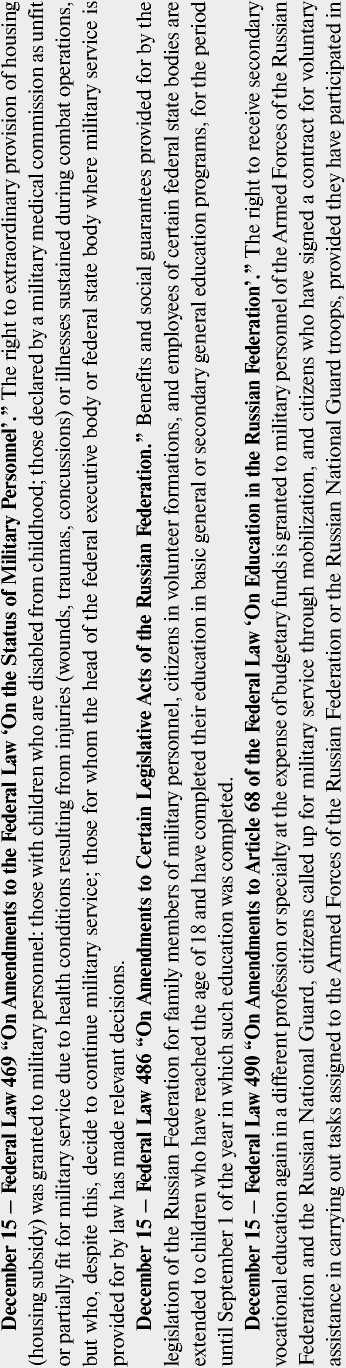
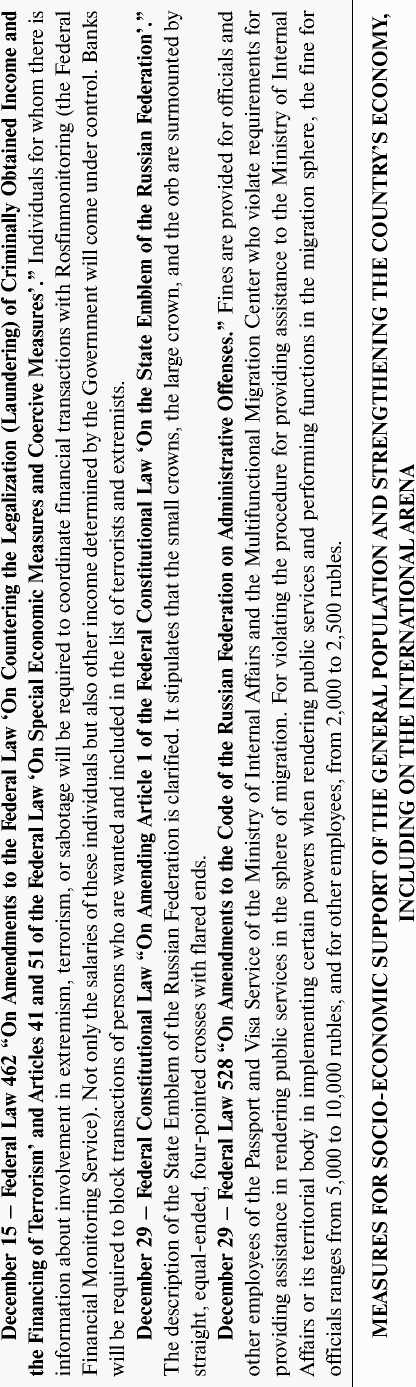
Furthermore, throughout the entire period of the Special Military Operation, the head of state, the Government, and the State Duma have been pursuing an active policy to strengthen the cultural and economic foundations of Russia’s sovereignty in the context of confrontation with the “collective West.” This includes measures for the socioeconomic support of broad strata of the population, participants in the Special Military Operation, and members of their families ( Insert 8 ).
However, despite all the measures taken, the expert assessments, facts, statistical data, and sociological survey results presented above indicate that the “ task of renewing/purging the elite remains as pressing as ever”. Consequently, the state and the country still need a “consistent continuation of the revolution from above begun by the president”.
This means that the paramount “questionchallenge” remains: whether the President and the country will have enough time to put the public administration system in order, to make it correspond to the goals and objectives of national policy dictated by the realities that have objectively changed since the start of the Special Military Operation.
N. Berdyaev: “Since the creation of the world, a minority has always ruled, rules, and will always rule, not the majority... The only question is whether the ruling minority is the better or the worse” 105.
“In the early 2000s, removing oligarchs from the levers of power and replacing the thieving liberal elite became an imperative for the country’s survival... Step by step, in the 2000s, the most odious comprador oligarchs were pushed away from the levers of power by V. Putin and replaced with more loyal state oligarchs. The country, it seemed, had stepped back from the edge of the abyss, but the liberal elite in power continued to guard the interests of the wealthy minority and siphon capital out of the country, while the scale of corruption and social inequality grew.
The start of the Special Military Operation showed that the steps taken by the president were clearly insufficient and the task of renewing/purging the elite remains as pressing as ever. The remaining supporters of the Gaidar-Chubais course in power have become less brazen, they speak in a new way, in the spirit of the times, but they have not linked their fate with the fate of the people, and they still do not...
It would seem that there is complete clarity on the question of what kind of elite we need. Its inherent qualities must be incorruptibility, readiness for Service, spirituality..., strategic vision of the situation... But how can we ensure that the political, cultural, scientific, and business elites all meet these strict criteria? Only through the consistent continuation of the revolution from above begun by the president...” 106
Insert 8
а S
НН ей § ей и
h
X и S и о
чо гч о гч
■^
ь ей НН и в
РЙ
ь
(Д и
и
X
ш гч о гч со
й
SJ НН ей
X
С ■а о
о и ь
ей
ь
и
о
й
• ■■
S
и и
§
ей
ей н
ь

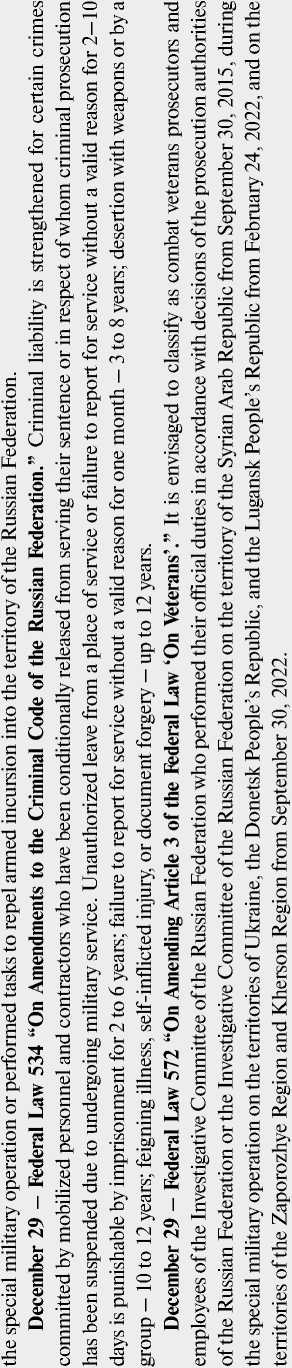
107 This insert is a continuation of the monitoring of the most important regulatory legal acts signed by the President of the Russian Federation, which has been conducted since June 2022 (the first issue of the monitoring was presented in the article: Ilyin V.A., Morev M.V. (2022). The difficult road after the Rubicon. Economic and Social Changes: Facts, Trends, Forecast, 15(3), 9–41).
End of Insert 8
z

I сл н Z и
Z О НН и РЙ
ь ь
И о Z и р J ь Z НН и в
ей
и
Z
Z НН о Z
2 м Рн
Рй
ь
Z
Рй
и И ей
О
г:
о
й
д о
О о й о
с
2 ф -я ГФ я я
ей
ф
св
ад ф
я я и ф о
я ф S я я ф
в
ш о ш i
2 ф -я ГФ
ф А S ф ф ф
о й о
=з
о
й о
с£
й
й
о
й
й о
I й о
8 о
6 о
й
д
В
с? о о й
О
й
о
й
о
д св
М
I сю О Рй
_с? о 'й о 8 й
(§
£
х
Ин
6 о
й о
6 в й
О
Й о
й
£
ад й
й о
й
й
8 6
Й о
8 Г) Й сю
О ч->
Й О
ад
о
о
й
8 о о й
о сю Й О
§
й
8 Г) Й сю
О
Й
О
5Р
й?
й
Й
о
о
й
Й
о
о
д о
_о д
Й
£
д д о
й
.5 й й1
о
00 д
й
д о
о
.о
8 о о й
д
в
X
Й
о
о
й?
Й
Й
X
с
2 ф -я ГФ я я
ей ф
ф
ев
ф
ф
я ф S ■я я ф
в
ш
i
2 ф -я ГФ
ф а S ф ф ф
д св О
д о
й
6 о
2 о
О
S
о
S
д о
N й св В? о
д св Й
О
£
о
д о
о to о я .о
Й
й
я св
6 о
й св О
й о
о в g
<8
й Й
й?
X
о
о
р
д д сю
Й
О
О ад й
й
Й о
й?
X
о
о
д св О
д о
й
О й й
о
S
о
о
о 8 о £
й св О
О
8 д о в
о
6 о £ о to о я .о
й
й
й
Й о й о
д и
й св О
8 3 д о
6 о
Й
й о
о
Й о
д а
ф сл
Я
ф
я
я
в о
в
2 ф -я Ф to я я
ЕЙ ф
ф
ф
я я
ш
ф
я ф 8 я я ф
в
ш
£ я
2 ф -я ГФ to
ф а S ф ф ф


In conclusion, it should be noted that “critical mass of passionarity,” the “life cycle of the state,” and the “level of well-being” (as the main factor in the decline of passionary energy) – all these are categories that can only be considered in longterm, historical dynamics, within the context of the evolution of a state-civilization. This means they are a matter of the effectiveness of strategic public administration, and most importantly, all these categories “are subject to management” .
“How can passionarity be maintained at the maximum possible level...? Through the support of effective public administration. This is the only way to extend the life cycle of the state and the nation.
It is possible to manage... the critical passionarity on which the existence of the nation and state depends. This should be the goal. The level of wellbeing [the main culprit in the process of passionarity’s decline] is subject to management, which makes it possible to prevent undesirable events in the country’s history. This is a subtle dialectical process, involving balancing a decent standard of living for the population against the backdrop of a social model that demands considerable effort from people to attain it. The combination of such developmental aspects constitutes the sacred essence of the art of public administration” 108 .
At this pivotal moment in history (which Russia is currently undergoing), a great deal (if not everything) depends on the President, as a person of a “passionary psychological type”.
It depends, on the one hand, on his ability to learn the lessons from the true causes of the USSR’s collapse; that is, to create such a structure of public administration in which new Gorbachevs, Yeltsins, Yakovlevs, and Chubaises could not emerge (and there are still many of them in the current system of public administration, as experts note and as real facts show, especially in the first years of the Special Military Operation).
“People of a passionary psychological type are individuals possessing very great energy and directing it towards great deeds, typically towards the transformation of society, ready to risk their own lives and the lives of their community in the name of a great goal. The main stimuli for the activity of a passionary personality, as a rule, are ‘supra-personal’ values and meanings – that is, not individual, personal interests, but spiritual-ideological essences or meaningful orientations connected with the life of the community with which they identify themselves ” 109 .
“Former Russian Prime Minister M. Kasyanov* has sailed off abroad and now resides in Latvia.
Deputy Prime Minister A. Dvorkovich moved to the USA.
Former Deputy Prime Ministers I. Klebanov, A. Khloponin, and ministers Ya. Urinson, M. Akimov chose Israel as their place of residence.
Former Head of State Property A. Kokh resides in Germany.
V. Khristenko has an apartment in Spain.
Former Deputy Prime Minister O. Golodets is also torn between two countries, one of them being the same Spain.
Also residing abroad are former heads of the Presidential Administration of the Russian Federation (V. Voloshin, V. Yumashev together with B. Yeltsin’s daughter Tatyana), former ministers and their deputies (A. Kozyrev, E. Skrynnik, A. Vavilov, I. Chuyan, A. Reimer, and others), numerous former governors and their deputies, and scores of federal government officials!” 110
* Entered in the register of foreign agents.
On the other hand, it depends on the President’s ability to initiate and lead the process of forming in Russia an Image of the Future as the main (and perhaps even the only) real instrument capable of resisting the power of capital, the power of money, and the lack of spirituality, which, in fact, has become a problem not only for our country but for the entire passing world of the “one hegemon”.
As E. Birov notes111, “when power is reduced to money, the image of the future becomes superfluous, which is why capital imposes on the masses a reluctance to strive for ideals.” But if there is an Image of the Future, then “capital loses its power, is reduced to the role of a servant,” and this is “the salvation of society from degradation”.
“ The Image of the Future, when it exists, actually shapes the future... Its absence, the absence of a goal and constructive meanings, leads to degradation...
When power is reduced to money, to the ownership of capital, then the image of the future becomes superfluous, unnecessary... Capital imposes on the masses a reluctance to strive for ideals... Hence the constant sabotage of attempts to formulate ideals, spiritual values, and the image of a just world order. Otherwise, capital will lose its power, be reduced to the role of a servant, which is what it should be.
Values are a threat to price tags. The Image of the Future is a threat to capital. But it is salvation for society from degradation” 112 .
But what should this image of the future look like? Judging by the results of mass sociological surveys113, Russian society expects from the head of state an Image of the Future based on concepts such as “law”, “order”, “justice”, “human rights”, “peace”, “freedom”, and “patriotism”.
“It can be stated that there is a clear deficit in society of politics based on law, order, justice, human rights, and peace. In terms of content, such a set of ideas correlates with the priorities of the value model of socialism present in the mass consciousness...” 114
This understanding of the Image of the Future, obtained by sociologists from research conducted in the early 2020s, remains stable and correlates well with what V. Fedorov, Director General of VCIOM, said in December 2025 : “In Russia, there are three Images of the Future. They do not contradict each other and overlap in many ways:
^ The first image: ‘Russia as a social state’. A very kind state that loves everyone, helps everyone, and protects everyone.
^ The second: ‘Russia as a comfortable country’. Everything is very convenient, well-ordered, polite.
^ The third image: ‘Russia the great’. That is, a Russia on which a great deal in the world de-pends” 115 .
-
1. Zh.T. Toshchenko : “ The social contract... is a fundamental but at the same time special state of relations between the state and the people, which is expressed in the philosophy of a shared destiny – an explicit (open) and latent mutually agreed-upon achievement of goals, means, and methods for their implementation in carrying out socio-economic, socio-political, and socio-cultural transformations” 116 .
-
2. S.A. Karaganov : “ An image of the world in which we would like to live, a living dream-idea of Russia, a state ideology put forward and promoted, is needed so that all of us, from the President to the farmer, worker, engineer, officer, scientist, entrepreneur, civil servant, understand what we want to be and what we want our country to be... The presence of a common ideological platform, a national idea, is one of the most important constitutive features of a sovereign state – and we do not want to be, nor can we be, anything else. Its absence is a sign of under-sovereignty ” 117 .
It is likely that such an Image of the Future – the creation of which is perhaps one of the main tasks facing the President after the conclusion of the Special Military Operation – could become the foundation of a new Social Contract. One based not on external (formal) agreement, but on a deeply internal, mutual understanding between society and the state.
This would contribute to enhancing the effectiveness of strategic public administration, enabling the President to continue implementing the course of national development, guided “not only by current needs and circumstances, but also by the country’s interests for centuries to come...”11611118
Vladimir Putin: “...the very idea [of building the Trans-Siberian Railway across the entire country to the Pacific Ocean] serves for us as an example of a strategic vision of the future, when not only current needs and circumstances are taken into account, but also the country’s interests for centuries to come...” 119
