
Evolution of Mongolia-Turkish Relations and Turkish Studies in the Institute of International Studies, MAS
Журнал: Восточный вектор: история, общество, государство @eurasia-world
Рубрика: Политология
Статья в выпуске: 2, 2026 года.
Бесплатный доступ
This article explores the origins and evolution of Turkish studies in Mongolia in particular through the case of the Institute of International Relations, Mongolian Academy of Sciences, situating its trajectory within the broader framework of Mongolia–Turkey diplomatic relations and domestic transformations. The study identifies three chronological phases: the foundational period (1969–1990s), the comprehensive partnership era (2000–2010), and the strategic cooperation phase (2010–2025). During the Cold War, Turkish studies stagnated, constrained by ideological barriers. However, Mongolia’s democratic reforms in the 1990s created new opportunities for academic inquiry, with the East–West journal by the Institute of International Studies, MAS providing an early platform for research on Turkey. The 2000s marked a turning point, as high‑level exchanges elevated bilateral relations to a comprehensive partnership under the Third Neighbor Policy. This diplomatic momentum stimulated scholarly output, with contribu- tions from J. Tserensodnom, M. Khurmetkhan, L. Khaisandai, and Ch. Tserennadmid ex- panding the field from cultural and linguistic studies to foreign policy and international relations. By the 2010s and 2020s, Turkish studies matured further, producing monographs that informed both academia and policy, while bilateral cooperation consolidated across trade, security, and education. The article concludes with recommendations for advancing Turkish studies through specia- lized training, institutional exchanges, and collaborative projects, underscoring its role in strengthening Mongolia–Turkey relations and aligning scholarship with contemporary inter- national relations and security research.
Короткий адрес: https://sciup.org/148334262
IDS: 148334262 | УДК: 327(517.3+560) | DOI: 10.18101/2949-1657-2026-2-34-45
Эволюция монголо-турецких отношений и турецких исследованиях в Институте международных исследований Монгольской академии наук (АНМ)
В данной статье исследуются истоки и эволюция турецких исследований в Монголии, в частности на примере Института международных исследований Монгольской академии наук, с анализом их развития в более широком контексте дипломатических отношений между Монголией и Турцией, а также внутренних трансформаций. В исследовании выделяются три хронологических этапа эволюции: период становления (1969–1990-е гг.), эпоха всеобъемлющего партнерства (2000–2010 гг.) и этап стратегического сотрудничества (2010–2025 гг.). В период холодной войны турецкие исследования находились в состоянии стагнации, будучи ограниченными идеологическими барьерами. Однако демократические реформы в Монголии в 1990-х годах создали новые возможности для научных изысканий, при этом журнал «Восток — Запад» Института международных исследований АНМ стал одной из ранних платформ для научных публикаций, посвящённых Турции. 2000-е годы стали поворотным этапом, когда взаимные визиты на высоком уровне вывели двусторонние отношения на уровень всеобъемлющего партнёрства в рамках концепции политики «третьего соседа». Этот дипломатический импульс стимулировал научную активность: вклад таких исследователей, как Ж. Цэрэнсодном, М. Хурметхан, Л. Хайсандай и Ч. Цэрэннадмид, позволил расширить горизонты исследований, выведя их за рамки культуры и лингвистики в сферу внешней политики и международных отношений. К 2010-2020-м годам турецкие исследования достигли более зрелого уровня, что выразилось в публикации монографий, ставших основой как для академической среды, так и для формирования политических решений. Параллельно двустороннее сотрудничество укреплялось в сферах торговли, безопасности и образования. В заключение статьи представлены рекомендации по развитию турецких исследований посредством специализированной подготовки кадров, реализации программ официального академического обмена и совместных исследовательских проектов, что подчёркивает их роль в укреплении монголо-турецких отношений и приведении научных исследований в соответствие с современными тенденциями в области международных отношений и безопасности.
Текст научной статьи Evolution of Mongolia-Turkish Relations and Turkish Studies in the Institute of International Studies, MAS
Tserennadmid Chuluunbaatar. Evolution of Mongolia-Turkish Relations and Turkish Studies in the Institute of International Studies, MAS. Oriental Vector: History, Society, State. 2026; 2: 34–45 (In Eng.)
Introduction. Before delving into Turkish studies, it is important to highlight that research in Turkic studies — encompassing history, archaeology, literature, and linguistics — has been quite robust at the Mongolian Academy of Sciences. Currently, scholars and researchers from both nations are still engaging in active collaboration in these fields of history, archaeology, and linguistics. Conversely, Mongolian studies have seen significant growth in Türkiye in recent years, with the breadth of research widening, which is closely linked to the advancements of Turkish studies in Mongolia.
As of now, in addition to the research currently underway in the aforementioned fields, there is an increasing demand for enhanced and more fruitful collaboration between scholars from both countries in the domains of area studies, international relations, and security. This need goes beyond the research initiatives of the Institute of International Studies, highlighting the importance of placing greater emphasis on Turkish studies within the wider context of science and higher education — especially in the realms of contemporary international relations, area studies, and security studies. In the field of foreign policy studies, particularly in relation to Türkiye, research remains at a relatively initial stage.
-
1. Diplomatic Foudations (1969)
On June 24, 1969, the People’s Republic of Mongolia and the Republic of Turkey officially established diplomatic relations. Since then, bilateral ties have steadily developed across all spheres. However, prior to the 1990s, cooperation was largely confined to historical and cultural studies, while political and international relations remained relatively weak. This was mainly due to the global impact of the “Cold War,” which left bilateral relations in a stagnant state. After 1990, the foundations for the development of Turkish studies were laid, influenced by several important factors. These include:
-
• First, although Mongolia and Turkey are geographically distant, the two nations have shared historical and cultural ties for centuries.
-
• Second, since 1990, the processes of democratization and reform in Mongolia, together with the adoption of an open foreign policy, have enabled Mongolia–Turkey relations to expand year by year. This growth has been grounded in common interests and shared values such as democracy, the rule of law, and respect for human rights and freedoms.
-
• Third, high-level and official visits between the two countries have significantly accelerated the development of cooperation in culture and education. For example, during the 1991 visit of representatives from the Ministries of Culture of both countries, Mongolia and Turkey signed a protocol on cooperation in the fields of culture and the arts for the years 1991–1993, marking an important step in strengthening cultural relations. Furthermore, in 1992, the official visit of Mongolia’s Minister of Foreign Affairs, Ts. Gombosüren, to the Republic of Turkey deepened bilateral cooperation in politics, socio-economic affairs, culture, and education.
-
• Fourth, following the dissolution of the Soviet Union, the Republic of Turkey pursued a more active foreign policy toward the region. In 1992, Turkey established the Turkish Cooperation and Coordination Agency (TİKA) with the aim of providing technical assistance to the development of newly independent states. Among TİKA’s first eight Program Coordination Offices abroad, the office in Ulaanbaatar began its activities in 1994 with a project focused on preserving and protecting Turkic-era monuments in Mongolia. Since then, through the implementation of numerous projects and programs across various fields, TİKA has continuously contributed to the expansion of Mongolia–Turkey relations.
-
2. Post-1990 Developments
Since the 1990s, the relationship between Mongolia and Turkey has progressed swiftly. Notably, collaboration in cultural and educational sectors has grown. Starting from 1992, both nations launched a Student Exchange Program, which, through an intergovernmental agreement, allowed 30 Mongolian students each year to participate in scholarship programs financed by the Turkish Government.
-
3. Early Publications and Scholarly Foundations
Building upon these elements, numerous scholarly articles regarding Mongolia– Turkey relations began to emerge from the 1990s onwards. From its foundation in 1968, the Institute of International Relations has concentrated its research on Russian studies, Chinese studies, international organizations, and Third Neighbor area studies, subsequently adapting its structure within this overarching framework. Within this context, Turkish studies are classified under the domain of Third Neighbor area studies. For example, in the East–West journal published by the Institute of International Studies at the Mongolian Academy of Sciences, J. Tserensodnom7 authored an introductory piece titled "On the Republic of Turkey." In this article, he offered succinct and clear insights into Turkey’s political and economic evolution, its role in regional cooperation organizations, and its primary economic sectors. He also highlighted that high-level visits and their resulting outcomes were crucial for enhancing Mongolia–Turkey relations.
-
4. Emergence of New Generation of Scholars (Mid — 2000s)
-
5. Expansion of Turkish Studies in Mongolia (2000-2010)
In 1998, during the official visit of the President of Mongolia, the Academies of Sciences of the two countries signed a cooperation agreement, which laid an important foundation for the further development of scholarly research. As a result, Mongolian and Turkish scholars began conducting joint studies in fields such as environmental science, agriculture, history, linguistics, and the social sciences, while also engaging in exchanges of researchers and young scholars. At that time, the level of political, social, and economic relations between the two countries was still at an initial stage, and accordingly, Turkish studies in Mongolia could likewise be regarded as being in their formative period.
In 2004, researcher M. Khurmetkhan8 from the Institute of International Studies released a publication titled "Mongolia and the Islamic States." This work marks the initial scholarly contributions from the Institute that focus specifically on Turkey, establishing a basis for future articles and research. These publications have continued to be integral to academic discussions, enhancing a more profound and ongoing comprehension of the Republic of Turkey.
Beginning in the mid-2000s, a new cohort of Mongolian researchers undertook studies on Mongolia–Turkey relations, thereby consolidating the foundations of Turkish studies within the country. Among them, doctoral candidate Ch. Tserennadmid pursued both master’s and doctoral theses that examined bilateral cooperation and foreign policy between Mongolia and Turkey. Her work marked a significant step in advancing the academic treatment of Turkey as a subject of Mongolian international studies.
In parallel, researchers such as Kh. Mandkhai and Kh. Selenge directed their scholarly attention toward the dynamics of bilateral relations, contributing to a more diversified research agenda. Collectively, these scholars represent the core of Turkish studies within the Institute of International Studies of the Mongolian Academy of Sciences, ensuring continuity from the early institutional efforts of the 1990s while also expanding the scope of inquiry to encompass political, economic, education and cultural dimensions.
This generational shift not only reinforced the institutional presence of Turkish studies but also signaled the maturation of the field in Mongolia. By embedding Turkey within broader comparative frameworks of foreign policy and bilateral cooperation, these researchers have provided scholarly foundation that continues to inform both academic discourse and policy considerations.
Research on Turkey — especially in the domains of international relations and area studies — may still be regarded as nascent. A bibliographic survey of nearly 20,000 works in Mongolian history, social sciences, and international relations reveals that only a handful address Turkish studies from the perspective of international relations and area research. The bulk of existing scholarship remains focused on Turkic studies, the Turkish language, culture, archaeology, and literary scholarship.9” Until the mid‑2000s, scholarship pertaining to Turkish studies was limited, with relatively few works addressing modern Turkish area research in connection with international relations and foreign policy. A significant milestone was reached in 2011, when Institute`s professor, Dr. L.Khaisandai and researcher Ch. Tserennadmid published a monograph on Turkey–Mongolia relations and cooperation10, situating Turkey’s foreign policy within the framework of area studies. Since the 2010s, the number of scholars examining bilateral relations and scientific collaboration between the two countries at a higher level has increased considerably. Since the mid-2000s, Turkish studies in Mongolia have expanded not only under the mandate of the MAS but also at National University of Mongolia, Dr. Ts.Battulga11, Dr. Ankhbayar12, and Dr. A.Enkhbat13 from Mongolian University of Science and Technology, along with researchers from think tanks and specialized institutes in regional and security studies — such as the Institute of Strategic Studies — have contributed significantly to this field. Their academic research, publications, and studies on history, linguistics, and cultural preservation have built upon earlier foundational works by Shinekhuu14, Kh.Perlee15 in 1970s. In addition, studies by Dr. Batkhishig,16 Dr.Batchuluun on bilateral relations between Mongolia and Turkey, particularly from the perspective of foreign policy analysis and Mongolia’s Third Neighbor Policy, were conducted during this period.
Nevertheless, as this article focuses specifically on Turkish studies within the framework of the Institute of International Studies, the publications and research papers examined here are limited to that institutional context.
Globalization and Policy Framework Shaping Bilateral Relations
With the advent of the 2000s, globalization expanded worldwide, advancements in science and information technology surged, and political and economic integration intensified, resulting in more robust international relations and collaboration. In this framework, various elements played a role in shaping the evolution of Turkish studies in Mongolia. Firstly, in 2004, President N. Bagabandi undertook a state visit to the Republic of Turkey, which elevated bilateral relations to a comprehensive partnership — an essential milestone in outlining future cooperation directions. Secondly, Mongolia’s ‘Foreign Policy Concept’17 highlighted the ‘Third Neighbor’ strategy, which prioritized relations with Turkey to enhance the effectiveness of cooperation. Thirdly, Turkey became increasingly proactive in the new international landscape, particularly by fortifying ties with Central Asian republics and other regional nations.
Comprehensive Partnership and Strategic Cooperation (2000–2010). Between 2000 and 2010, Mongolia–Turkey relations reached a high level of development across political, social, educational, and cultural spheres, marking the beginning of a comprehensive partnership. During this decade, political relations expanded steadily, and frequent high-level visits played a decisive role in advancing bilateral cooperation to a new stage.
In 2004, President N. Bagabandi paid an official visit to the Republic of Turkey — an event of great significance in the history of bilateral relations. During the visit, Presidents N. Bagabandi and Ahmet Necdet Sezer signed a joint declaration that set forth a strategic goal to develop relations at the level of a comprehensive partnership, thereby defining the main directions for future cooperation.
In 2005, Turkish Prime Minister Recep Tayyip Erdogan visited Mongolia, further elevating political relations. He emphasized the expansion of cooperation in political, economic, and cultural fields and reaffirmed Turkey’s support for the restoration of Turkic monuments in the Orkhon Valley — an important contribution to the preservation of cultural heritage. This visit also stimulated economic cooperation and strengthened the activities of the joint commission.
Progress at the political level was reflected internationally as well. Mongolia received Turkey’s support under NATO’s Partnership for Peace program, and in 2009– 2010, the two countries mutually supported each other’s candidacies for non- permanent membership in the UN Security Council — an event that underscored their collaboration on the global stage.
Although several proposals and projects were made to enhance trade and economic cooperation — such as loans from Turkey’s EXIM Bank, construction of the Orkhon– Kharkhorin highway, and establishment of a joint tourism center — implementation remained relatively slow.
In contrast, the field of education and culture achieved notable progress. Mongolian students studied in Turkey under intergovernmental scholarships, pursuing degrees in engineering, medicine, law, and social sciences — considered an “intellectual investment” in bilateral cooperation. By the mid-2000s, around 70 Mongolian students annually received Turkish government scholarships, a number that increased following high-level visits, reflecting the tangible realization of bilateral agreements.
In the domain of cultural heritage, joint restoration projects supported by TİKA successfully preserved monuments of Bilge Khan, KulTegin, and Tonyukuk, while plans for tourism complexes and infrastructure in the Orkhon Valley strengthened cultural diplomacy.
Defense cooperation also advanced rapidly during this decade, marking a strategic shift in bilateral relations. Turkey provided military equipment and training materials to the Mongolian Armed Forces in 2002 and 2003 and continued collaboration in officer training and joint exercises. Mongolian officers studied at Turkish military academies, and joint training programs yielded practical results, deepening defense cooperation between the two nations.
Scientific and Institutional Collaboration and Academic Publications
These developments underscored the necessity to promote Turkish area studies and motivated both parties to focus more on future collaborative opportunities. Given the prevailing circumstances, there was a strong emphasis on fostering partnerships in science and education. Since 2004, the Mongolian Academy of Sciences has upheld effective cooperation agreements with the Turkish Academy of Sciences (TÜBA) and the Scientific and Technological Research Council of Turkey (TÜBİTAK). Through these agreements, joint research efforts have been actively pursued in fields such as geology, seismology, linguistics, history, and archaeology, significantly contributing to scientific collaboration. A prominent instance is Academician L. Bold, who in 2018 was awarded the Social Sciences Award by the Turkish Academy of Sciences, presented personally by President R. T. Erdoğan — an accomplishment that illustrates the tangible outcomes of this collaboration.
Starting in 2007, the Institute’s International Studies journal consistently featured introductions to Turkey, concise reviews of bilateral relations and cooperation, as well as articles that reflected the evolving dynamics between the two nations — thereby deepening the understanding of Turkey’s history, culture, society, and economy. In 2011, Dr. Professor (Sc.D) L. Khaisandai and Dr. Ch. Tserennadmid18 released a monograph titled Turkey–Mongolia Relations and Cooperation. This publication analyzed the historical traditions and current state of bilateral relations and collaboration from an international studies perspective, providing insights and evaluations of significant issues while articulating the authors’ academic viewpoints. By placing bilateral relations and foreign policy within the context of broader international trends, this study set itself apart from previous works.
In 2020, Dr. Ch. Tserennadmid, who leads the Third Neighbor Area Studies Division at the Institute of International Studies, MAS published a monograph on Mongolia’s Third Neighbor Policy: Experience and Challenges — Mongolia–Turkey Relations which provides a comprehensive study of how Turkey fits into Mongolia’s Third Neighbor framework, highlighting both achievements and unresolved issues in bilateral cooperation. It emphasizes Turkey’s role as a Eurasian partner and examines the political, economic, and cultural dimensions of the relationship. This work, rooted in the theoretical and methodological foundations of foreign policy analysis, evaluated Mongolia’s relationship with Turkey through the lens of the Third Neighbor policy. It investigated the motivations and factors that led to Turkey being classified as a ‘third neighbor,’ highlighted the main challenges in bilateral cooperation, and suggested potential solutions, bolstered by recent statistical data and theoretical frameworks. Additionally, Dr. Tserennadmid has authored a series of scholarly articles and conference papers focusing on Mongolia–Turkey relations, foreign policy, and education. Notable works include: ‘The Social and Political Situation in Turkey as a Regional Geopolitical Issue’ (2016); ‘The Emergence and Development of Science and Technology Parks in the Republic of Turkey’ (2017); ‘Turkey’s Domestic Situation and Its Impact on Relations with Central Asia (2018), “Development of bilateral cooperation between Mongolia and Republic of Turkey in the last decades” (2018).
Consolidation of Strategic Partnership (2020–2024)
Despite the disruptions caused by the COVID-19 pandemic, Mongolia–Turkey relations remained stable under the framework of Mongolia’s Third Neighbor Policy and continued to expand across politics, economics, education, and culture.
Although high-level visits were limited during the pandemic, in 2021 the two foreign ministries held a virtual consultation meeting, and from 2022 onward bilateral exchanges resumed actively. On March 13–14, 2023, Foreign MinisterB. Battsetseg paid an official visit to Turkey. This visit, occurring in the aftermath of Turkey’s devastating earthquake, symbolized Mongolia’s solidarity and also advanced cooperation in diplomacy, infrastructure, metrology, science, and standardization. Four important agreements were signed, strengthening practical collaboration with direct relevance to citizens’ daily lives.
In terms of an economic cooperation, trade volumes declined to USD 50–60 million in 2020–2021 due to the pandemic, but recovered to USD 110 million in 2022. During Foreign Minister`s 2023 visit, the two sides set a new target of USD 200 million, aiming to expand cooperation not only in trade but also in agriculture, infrastructure, energy, and transport.
Historic State Visit (2025): In January 2025, President U. Khürelsükh undertook a state visit to Turkey — the first by a Mongolian head of state in 21 years. This visit elevated bilateral relations to the level of strategic partnership. Eleven agreements were signed, covering health, education, sports, environment, forestry, mining, broadcasting, and transport. Plans were also made to study new transport-logistics corridors, increase investment, and enrich the Third Neighbor Policy with economic substance. Cooperation in health included medical equipment supply, cancer diagnosis and treatment, and health tourism, while cultural projects focused on linking Turkey’s historical monuments in the Orkhon Valley with broader tourism initiatives.
O ve r a l l S i g n i f ic ance :
The 2020– 20 24 pe r io d c o nsol i da te d t he f o unda ti o ns of st r a t e gi c pa rtnership, dee pe ne d po li tical t ru st , d i v ersified economic cooperation, and expanded citi z en-centered i nit ia tiv e s. Th e 2025 s t ate visit marked a historic milestone, positioning Mong ol ia– T u r ke y re l a t io n s firml y w i t hin t he f r a me wo rk of s t ra t e g ic par t ne rs hip a n d opening new a ve nues f or co l l abo rat i on a c r os s mul ti p l e se ct or s.
Bel ow d i a g r a m ill ustrates the three major phases in the evolution of Mong ol i a – T u r ke y rel a t i o ns a nd t he parallel growth of Turkish studies in the IIS , M A S . The Founda ti on s ph ase (19 69 –1990s) marks the establishment of diplomatic relations and t he b e g i nni ngs o f a ca d emic inquiry. The Comprehensive Partnership phas e ( 2000 – 2010) highlights high ‑l evel visits, expanded cooperation under the Third N e i ghbor Po l i c y, a nd t he r ise of s chol ar l y r ese a r ch. T he Strategic Cooperation phase (2010–2025) r e f l e c t s t h e c onso l ida t i on of alliances, joint projects in security and development , a nd t he i nte g r a t i on o f T ur k ish studies into international relations and policy ana l y si s.
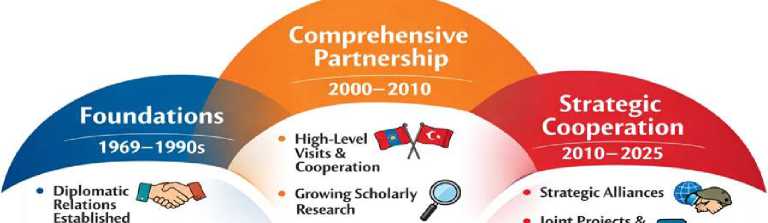
Strategic Alliances
High-Level ^ЖС^
Cooperation
Growing Scholarly Q)
Research #
2000-2010
Diplomatic Relations Established
Foundations
1969-1990s
Strategic Cooperation 2010-2025
Early Academic Initiatives
1969s
Key Takeaways
-
• F oun d at i ons ( 1969–1990s) Diplomatic relations established in 1969; early c oope ra tio n l i mi t ed by C old War context. Initial academic works focus e d on T ur ki c s tu d i es, l a n g uag e , arc ha eology, and culture rather than modern internationa l r el at i ons .
-
• Com prehens i ve P ar t n e r shi p (2000–2010) High-level visits (Bagabandi 2004, Erdoğ an 2005) e le vat e d ties to comprehensive partnership. Education and cul t u r a l e x c ha ng e s expa nde d, wi t h TİKA supporting heritage restoration. Early sc hol arly mi le s t one s i n c l u ded C h. Tse r enn admid ’s 2008 monog raph situating Turkey’s foreign policy within area studies.
-
• St rat egic Coop e r a t ion Fo und ati on s (201 0–2014) Erdoğan’s 2013 visit ad v ance d r el at io n s t ow a r d strategic partnership. Economic diversification ini t i a ti v es and visa-f ree tr av e l ag r e e me nt s booste d e xc hanges. Defense and security cooperation broa de ne d t hr ough ne w pro t ocols. Academic publications deepened, including the 2011 monograph Turkey– Mongo l ia Rel a t i ons an d Coope r ati on .
-
• Con s ol i dat ion of S tra te g i c P a rtne rsh ip (2 020 –2024) Despite pandemic disruptions , r el a t i ons r e ma i ne d sta ble und er Mong ol i a’s Third Neighbor Policy. Trade
recovered to USD 110 million in 2022, with a new target of USD 200 million set in 2023. The 2025 state visit by President U. Khürelsükh marked a historic milestone, with 11 agreements signed across diverse sectors. Scholarly output matured further, notably Tserennadmid’s 2020 monograph Mongolia’s Third Neighbor Policy: Experience and Challenges — Mongolia–Turkey Relations.
-
• Academic Publications and Turkish Studies. The trajectory of Mongolian scholarship evolved from early Turkic studies to modern foreign policy analysis. Key works by J. Tserensodnom (1990s), M. Khurmetkhan (2004), L. Khaisandai & Ch. Tserennadmid (2011), and Tserennadmid (2020) illustrate the maturation of Turkish studies in Mongolia, integrating international relations, area studies, and comparative foreign policy frameworks.
Table 1
Key Milestones in Mongolia–Turkey Relations and Turkish Studies
|
Year |
Event/Publication |
Domain |
Significance |
|
1969 |
Establishment of diplomatic relations |
Diplomacy |
Formal beginning of bilateral ties |
|
1991– 1992 |
Cultural cooperation protocol; Foreign Minister Ts. Gombosüren’s visit |
Culture & Politics |
Expanded cooperation in arts, culture, and foreign policy |
|
1992 |
Launch of Student Exchange Program (30 scholarships) |
Education |
Institutionalized academic exchange |
|
1994 |
TİKA office opened in Ulaanbaatar |
Development Cooperation |
Preservation of Turkic monuments; expanded projects |
|
1998 |
Academies of Sciences signed cooperation agreement |
Science |
Joint research in environment, agriculture, linguistics, history |
|
2004 |
President N. Bagabandi’s state visit |
Diplomacy |
Elevated relations to comprehensive partnership |
|
2005 |
Prime Minister Erdoğan’s visits to Mongolia |
Diplomacy & Culture |
Strengthened political ties; reaffirmed support for Orkhon Valley heritage |
|
2007 onward |
International Studies journal regularly featured Turkey |
Science &academia |
Deepened understanding of Turkey’s society and economy |
|
2013 |
Erdoğan’s official visit; Joint Commission 7th session |
Diplomacy & Economics |
Transition from comprehensive to strategic partnership; diversification of economic cooperation |
|
2014 |
Visa-free travel agreement |
People-to-People |
Boosted tourism and business exchanges |
|
2018 |
Academician L. Bold awarded TÜBA Social Sciences Award |
Science |
Recognition of Mongolian scholarship by Turkey |
|
2018– 2021 |
Social Protection Agreement signed and ratified |
Social Policy |
Equal social protection rights for Mongolian and Turkish citizens |
|
2020– 2021 |
Trade declined due to pandemic |
Economics |
Bilateral trade fell to USD 50–60 million |
|
2022 |
Trade recovered to USD 110 million |
Economics |
Economic cooperation revived |
|
2023 |
Foreign Minister Battsetseg’s visits to Turkey |
Diplomacy & |
Solidarity after earthquake new trade target of USD 200 mil- |
|
Economics |
lion |
||
|
2025 |
President U. Khürelsükh’s state visit |
Diplomacy & Strategic Partnership |
Elevated relations to strategic partnership; 11 agreements signed across multiple sectors |
Conclusions
This article has traced the origins and evolution of Turkish studies in Mongolia, situating its development within the broader trajectory of Mongolia–Turkey relations. The field has progressed through three major phases: the foundational period (1969– 1990s), when scholarship was limited and largely confined to Turkic language and cultural studies; the comprehensive partnership era (2000–2010), marked by high‑level exchanges, expanded cooperation under the Third Neighbor Policy, and the first monographs addressing Turkey’s foreign policy; and the strategic cooperation phase (2010–2025), when bilateral relations deepened across politics, economics, defense, and culture, accompanied by a surge in academic publications and institutional collaboration.
The contributions of scholars such as J. Tserensodnom, M. Khurmetkhan, L. Khai-sandai, and Ch. Tserennadmid have been pivotal in broadening the scope of Turkish studies, moving it beyond cultural and linguistic research toward international relations, foreign policy, and comparative analysis. Their works not only enriched the academic field but also provided insights that informed policy decisions and strengthened bilateral ties.
Looking forward, the advancement of Turkish studies in Mongolia requires sustained investment in specialized training, institutional information exchange, and direct academic collaboration. With thousands of Mongolian nationals studying and working in Turkey, the establishment of structured networks will enhance trust and cooperation in trade, tourism, and education. Furthermore, long‑term collaborative projects are essential to address the current gaps in foundational research and to align Turkish studies more closely with international relations and security studies.
In sum, the evolution of Turkish studies reflects both the maturation of Mongolia– Turkey relations and the growing recognition of Turkey as a strategic partner. Continued scholarly engagement, coupled with practical cooperation, will ensure that Turkish studies in Mongolia remain a dynamic and policy‑relevant discipline in the decades ahead.
