
Expanding the toolkit for poverty research: An analytical review of research practices
Журнал: Economic and Social Changes: Facts, Trends, Forecast @volnc-esc-en
Рубрика: Scientific reviews
Статья в выпуске: 4 т.19, 2026 года.
Бесплатный доступ
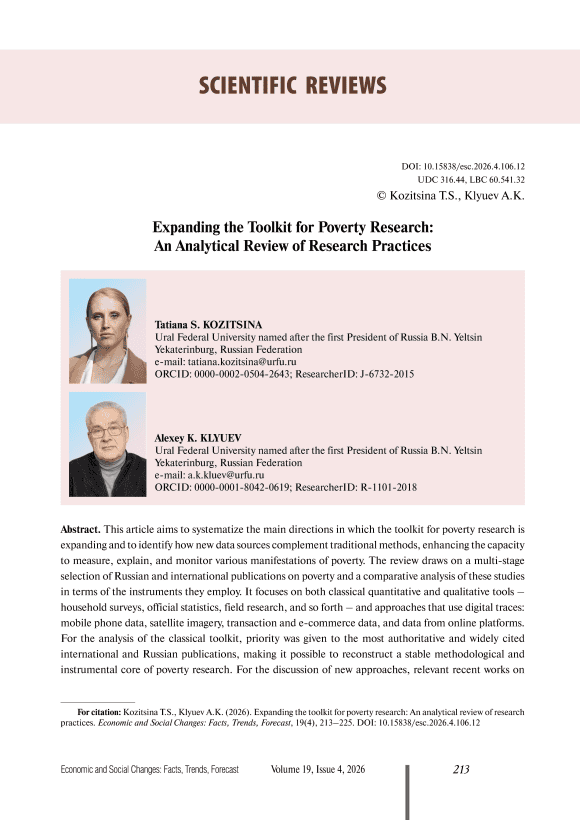
This article aims to systematize the main directions in which the toolkit for poverty research is expanding and to identify how new data sources complement traditional methods, enhancing the capacity to measure, explain, and monitor various manifestations of poverty. The review draws on a multi-stage selection of Russian and international publications on poverty and a comparative analysis of these studies in terms of the instruments they employ. It focuses on both classical quantitative and qualitative tools – household surveys, official statistics, field research, and so forth – and approaches that use digital traces: mobile phone data, satellite imagery, transaction and e-commerce data, and data from online platforms. For the analysis of the classical toolkit, priority was given to the most authoritative and widely cited international and Russian publications, making it possible to reconstruct a stable methodological and instrumental core of poverty research. For the discussion of new approaches, relevant recent works on big data, satellite imagery, digital traces, and other data sources were included, provided they offered sufficient methodological detail. The scientific novelty of the study lies in its contribution to the ongoing debate on the use of new poverty research tools and in substantiating hybrid approaches as one of the most promising strategies for studying poverty under conditions of digital transformation and increasingly complex social inequalities. Expanding the toolkit can help improve the spatial and temporal granularity of poverty measurement, better operationalize its multidimensional aspects, and more precisely delineate vulnerable groups. The limitations of the study stem from differences in the selection procedures for the two parts of the corpus, which allow configurations of practices to be compared but do not provide grounds for broad judgments about the theoretical elaboration of the digital literature. Prospects for further research lie in applying the proposed framework to a larger corpus of publications and in empirically testing hybrid designs.
Короткий адрес: https://sciup.org/147255186
IDS: 147255186 | УДК: 316.44 | DOI: 10.15838/esc.2026.4.106.12
