
Expression of PR2, PR3 and PR5 Correlates with the Resistance Level of Potato Plants to Late Blight
Journal: Journal of Stress Physiology and Biochemistry @jspb
Article in issue: 1 т.22, 2026.
Free access
Late blight (LB) caused by the fungus Phytophthora infestans (Mont.) de Bary, is one of the most economically important disease of potato crop worldwide. Cultivation of potato resistant cultivars is an effective and environmentally friendly method to control LB disease. The degree of resistance is often based on LB symptoms assessment, however molecular diagnostic could provide a more effective screening technique. We assumed that the degree of potato cultivars resistance to LB disease is correlated with defense related gene expression levels. Here, two potato cultivars with a low and severe appearance of LB symptoms on leaves were selected and cultivated under controlled conditions to analyze the constitutive expression of some important PR defense-related genes. Our data demonstrated that gene responses to LB infection were regulated differently depending on the susceptibility levels of potato cultivars. The resistant cultivar showed significantly higher constitutive expression levels of PR2, PR3 and PR5 genes except PR1. Notably, PR3 expression was much higher in the resistant cultivar when comparing with the expression of the other genes. It seems that LB symptom severity is associated with the degree of gene response in defense-related genes. Therefore, the obtained results may indicate that testing a number of defense-related genes in potato plants can be used as a useful predictor of resistance levels to LB disease.
Similar articles in the section Field crops and their production
Short address: https://sciup.org/143185420
IDS: 143185420
Text of the scientific article Expression of PR2, PR3 and PR5 Correlates with the Resistance Level of Potato Plants to Late Blight
Potato late blight, caused by the oomycete pathogen Phytophthora infestans (Mont.) de Bary, is one of the most economically costly fungal pathogens affecting potato crop, with yield losses up to 1 % globally (Olanya et al. 2 1; Tadesse et al., 2 21). Cultivation of resistant potato cultivars to P. infestans would be a maintainable disease-management strategy, and resistance of potato cultivars to this fungus appears to be a quantitative trait (Bradshaw et al., 2 4; Sullenberger et al. 2 22).
Knowledge of the mechanisms of interaction between potato and P. infestans can help to the development of screening approaches for selection potato resistant genotypes Moreover, understanding the resistance mechanisms at molecular level can be functionally translated to successful cultivars, which is an important area of research. However, it has been found that potato resistance to fungal disease is accompanied by increased expression of defense related genes (Mcleod et al., 2 3; Zhang et al. 2 24).
As a hemibiotrophic pathogen , P . infestans starts infections with biotrophic stage and as a necrotroph at later stage (Ali et al., 2 14 ; Kagda et al., 2 2 . Potato plants respond to P. infestans by using compound defense mechanisms , several common pathogenesis-related genes like PR1 , 1,3- β -glucanase ( PR2 ), chitinase ( PR3 ) and thaumatin-like ( PR5 ) were upregulated at early events of infection (Zaynab et al., 2 21 ; Aldaoude et al, 2 24) . Some studies found positive relationships between expression pathogenesis-related genes in potato plants and their resistance to P . infestans (Aldaoude et al., 2 22; Agho et al. 2 23). On the other hand, quantitative PCR (qPCR) has been used as an accurate method for measuring the relative gene expression level after plant infection with different fungal pathogens (Caballero-Solares et al., 2 22).
However, the question raised up; Is the quantitative potato resistance level positively associated to the constitutive expression levels of defense-related genes? For this purpose, two potato cultivars with different degrees of LB disease severity were used, and the resistance level was assessed under optimal growth conditions. A quantitative PCR (qPCR) was used for the evaluation of four PR1, PR2, PR3 and PR5 genes expression levels in potato leaves.
MATERIALS AND METHOD
Plant growth
Potato seed tubers of resistant ‘Sponta’ and susceptible ‘Draga’ (Salima 2 15) were grown in 2 cm plastic pots filled with sterilized peat moss in six replicates under growth chamber conditions. Pots were kept at 2 ° ±2 with 8 ± 5% % relative humidity.
P. infestans inoculation
The virulent isolate PiSYR1 (Salima 2 15) was used in the experiments. Small infected pieces of potato leaves were placed separately in sterile Petri dishes under disinfected tuber slices and incubated in a growth chamber at 2 °C for a week. When mycelium was growing on the surface of the potato slice, the mycelium was transferred to fresh rye agar (Caten and Jinks 1968). Inoculation wsa achieved at six weeks-old plants Each cultivar was sprayed with a conidial suspension (5 × 1 4 /ml) using an atomizer. Control plants were sprayed with distilled water. The disease severity index of foliar blight was expressed in percent of the infected leaf area used for disease rating scale given depending on the final record of percent severity index as per the scale (James 1971).
Expression analysis of Defense-Related Genes in Potato leaves
Analyses of the defense-related genes PR1 , PR2 , PR3 , and PR5 were carried out by using quantitative reverse transcription polymerase chain reaction (qPCR) with oligonucleotide primer given in Table 1. The total RNA was isolated from potato leaves (8 –1 mg) of infected and non-infected plants after four days of infection using Trizol Reagent (Macherey-Nagel, Germany). cDNA was synthesized with the QuantiTect Reverse Transcription Kit (Qiagen) following the manufacturer’s instructions.
Quantitative RT-PCR analysis
RT-qPCR assays were performed using SYBR
Green Master kit (Roche, USA). The PCR conditions were 95° for 5 min, followed by 4 cycles of 95° for 1 s, 6 ° for 2 s, and 72° for 2 s. Gene expression was calculated by the 2-ΔΔ C t method using EF1α as an internal reference gene according to Livak and Schmittgen (2 1). Means were compared using Tukey’s test at the significance . 5 level. Experiments were achieved in triplicate.
RESULTS AND DISCUSSION
In the current study, two potato cultivars Sponta and Draga with different resistance levels to P. infestans were used. The first symptoms were observed four days of inoculation under favorable conditions as irregularly shaped, water-soaked lesions with a lighter halo or ring around them. After 15 days, the severity of the disease on each cultivar was scored, the LB was significantly higher (P< . 1) in the susceptible cultivar as compared with the resistant one (Fig. 1; Table 2). These remarks are in agreement with those noted under natural field infections (Salima 2 15).
In order to get insight into the early responses of four PR1, PR2, PR3 and PR5 in potato inoculated with P. infestans, four days after infection when the first LB symptoms observed was chosen as being representative of biotrophic and necrotrophic phases (Birch et al., 2 3). The selected genes here are known to be pathogenesis related and are in many cases induced by infection with the fugal pathogens (Glazebrook, 2 5; Al-daoude et al ., 2 22). Here it was hypothesized that the resistance level of potato cultivars to LB disease might be positively associated to expression levels of some plant-defense-related genes.
Our data showed that the resistant cultivars showed significantly higher constitutive expression levels of PR2, PR3 and PR5 genes except PR1 . Notably, PR3 expression was much higher in the resistant cultivar when comparing with the expression of the other genes.
The results also revealed higher gene expression in resistant cultivar than susceptible one with expression for PR3 (6.1 and 2.5-fold) respectively, at 4 days’ post inoculation (Table 3). It seems that LB symptom severity is associated with the degree of response in defense-related genes. (Table 3). Our findings are in line with previous studies suggesting that the constitutive expression of PR genes in Solanum species leaves may contribute to nonspecific resistance to Phythophthora infestans (Vleeshouwers et al., 2 ) or is possible responsible for a large part of the partial resistance to Magnaporthe oryzae in rice (Vergne et al., 2 1 ).
The high induced expression of PR3 proteins in this work after infection suggests that it is part of a plant defense mechanism through inhibiting fungal growth by degrading heterogeneous polysaccharides of the fungal cell wall (Ali et al., 2 18), and this might be a good indicator for LB resistance level On the other hand, a major component of the P. infestons cell wall is 1,3-ß-glucan, and therefore 1,3-ß-glucanases are potentially capable of hydrolysing the cell wall of P. infestans (Mcleod et al., 2 3). This incident might be the reason of potato cell wall damage during infection with P. infestans. Our results are in line with Van Loon et al. (2 6) who stated that PR family proteins might have biochemical and biological properties against P. infestans .
Table 1. Late blight severity and symptoms on two potato cultivars used in this study
|
Cultivar |
severity % |
symptoms |
|
Sponta |
23.18b* |
Small blackish-brown lesions on leaves and stems |
|
Draga |
77.89a |
Necrotic or brown lesions surrounded by collapsed pale |
*Disease severity as described by Salima(2 15)
|
Table 2. Defense-related genes and nucleotide sequences of primers used in this study |
|||
|
Family |
Type number |
Properties |
Sequences |
|
PR1 |
PR1a |
cysteine-rich secretory protein |
ACTACCTTTCACCCCACAACGC TTTCTGTCCAACAACATTCCCG |
|
PR2 |
PR2 |
β-1,3-glucanases |
TCATCCCTGAACCTTCCTTG GGGGCTACTGTTTCAAGCAA |
|
PR3 |
Tobacco P, Q |
chitinases |
GGGGCTACTGTTTCAAGCAA GCAACAAGGTCAGGGTTGTT |
|
PR5 |
Tobacco S |
thaumatin-like |
GGGGCTACTGTTTCAAGCAA GCAGACTGTGGCGGTCTAAG |
|
EF1α |
Elongation factor-1 Alpha |
housekeeping gene |
TGGATTTGAGGGTGACAACA CCGTTCCAATACCACCAATC |
Table 3. Relative expression levels of PR1 , PR2 , PR3 and PR5 in leaves of potato cultivars used in the study
Defense-related genes
|
PR1 |
PR2 β-1,3-glucanases |
PR3 chitinases |
PR5 thaumatin-like |
|
|
Cultivars |
cysteine-rich secretory protein |
|||
|
Sponta |
2.48a* |
3. 1a |
6.1a |
2.95a |
|
Draga |
2.5a |
1.5b |
2.5b |
1.5b |
* Different letters indicate significance among cultivars within each gene expression analysis ( P < . 1)
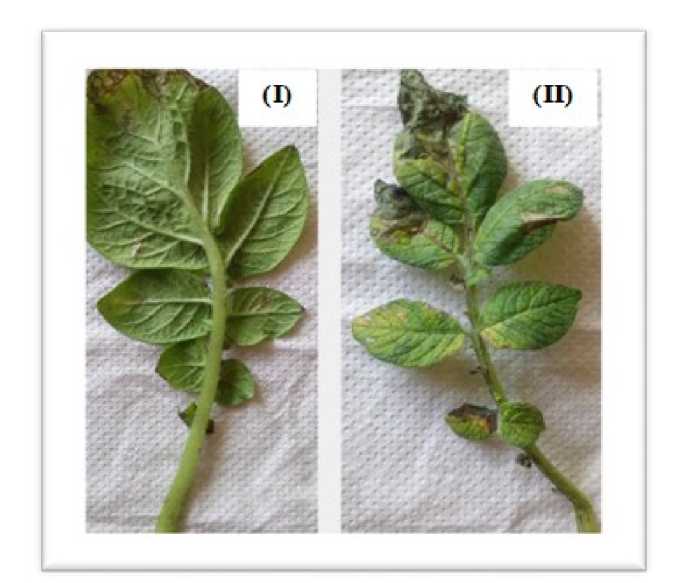
Figure 1. LB symptoms on the potato resistant cv. Sponta (I) and suspectible cv. Draga (II) by P. infestans .
CONCLUSION
Our experiments showed that the resistant cultivar ‘sponta’ had significantly higher constitutive expression levels of defense-related genes of PR2, PR3 and PR5 genes except PR1 as compared with the susceptible ones ‘Draga’. It seems that LB symptom severity is associated with the degree of gene response in defense-related. Therefore, with the results presented here, the hypothesis that the resistance level of potato cultivars to LB disease is positively related to the constitutive expression level of the studied defense-related genes could be accepted in case of testing a number of genes under similar conditions. The results may indicate that the expression levels of defense-related genes can be used as reliable predictors of the potato resistance to LB disease.
ACKNOWLEDGMENTS
The authors thank the Director General of AECS and the Head of Biotechnology Department for their help throughout the period of this research.
CONFLICTS OF INTEREST
The authors declares that they have no potential conflicts of interest.
