
FED-SCADA: A Trustworthy and Energy-efficient Federated IDS for Smart Grid Edge Gateways Using SNNs and Differential Evolution
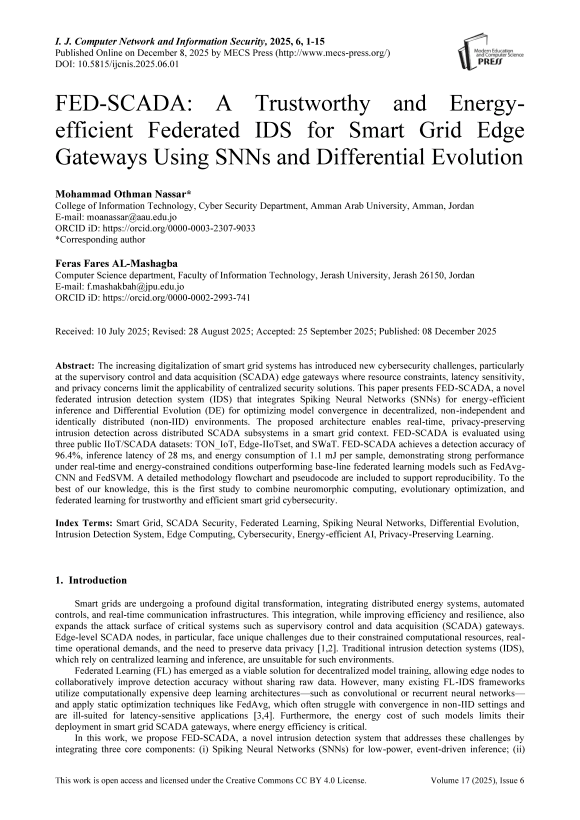
Journal: International Journal of Computer Network and Information Security @ijcnis
Article in issue: 6 vol.17, 2025.
Free access
The increasing digitalization of smart grid systems has introduced new cybersecurity challenges, particularly at the supervisory control and data acquisition (SCADA) edge gateways where resource constraints, latency sensitivity, and privacy concerns limit the applicability of centralized security solutions. This paper presents FED-SCADA, a novel federated intrusion detection system (IDS) that integrates Spiking Neural Networks (SNNs) for energy-efficient inference and Differential Evolution (DE) for optimizing model convergence in decentralized, non-independent and identically distributed (non-IID) environments. The proposed architecture enables real-time, privacy-preserving intrusion detection across distributed SCADA subsystems in a smart grid context. FED-SCADA is evaluated using three public IIoT/SCADA datasets: TON_IoT, Edge-IIoTset, and SWaT. FED-SCADA achieves a detection accuracy of 96.4%, inference latency of 28 ms, and energy consumption of 1.1 mJ per sample, demonstrating strong performance under real-time and energy-constrained conditions outperforming base-line federated learning models such as FedAvg-CNN and FedSVM. A detailed methodology flowchart and pseudocode are included to support reproducibility. To the best of our knowledge, this is the first study to combine neuromorphic computing, evolutionary optimization, and federated learning for trustworthy and efficient smart grid cybersecurity.
Similar articles in the section Special auxiliary subdivision for computing
Short address: https://sciup.org/15020110
IDS: 15020110 | DOI: 10.5815/ijcnis.2025.06.01
