
Financing environmentally sustainable agriculture
Journal: Ekonomski signali @esignali
Article in issue: 2 vol.20, 2025.
Free access
Financing ecologically sustainable agriculture is one of the basic tasks and the basis of economic growth and development of every country. Focusing on financial support from the state in the sustainability of agricultural financing, we will also look at the budget, so that we can present the degree and possibilities of meeting the basic needs related to the establishment and functioning of the agricultural fundamental ecologically sustainable component of every society. By applying statistical methods, primarily correlational links, we will present cause-and-effect relationships between the elements of agricultural financing and their main financial support in the economic power of the state in modern conditions.
Similar articles in the section Production and services according to economic sectors
Short address: https://sciup.org/170211625
IDS: 170211625 | UDC: 338.434:631.147 | DOI: 10.5937/ekonsig2502117M
Finansiranje ekološki održive poljoprivrede
Finansiranje ekološki održive polјoprivrede predstavlјa jedan od osnovnih zadataka i temelј ekonomskog rasta i razvoja svake zemlјe. Foku-sirajući se na finansijsku podršku države u obezbeđivanju održivosti finan-siranja polјoprivrede, u tekstu se razmatra i budžet kao polazište za sagle-davanje stepena i mogućnosti zadovolјavanja osnovnih potreba koje se od-nose na uspostavlјanje i funkcionisanje ekološki održive polјoprivrede kao fundamentalne komponente svakog društva. Primenom statističkih metoda, pre svega korelacionih veza, biće prikazani uzročno-posledični odnosi između elemenata finansiranja polјoprivrede i njihove glavne finansijske podrške u okviru ekonomske snage države u sav-remenim uslovima.
Text of the scientific article Financing environmentally sustainable agriculture
Agriculture is a very important economic activity that has economic, social and political importance. In more market-developed economies, agriculture has greater importance, whether we are talking about agriculture in a narrower sense as primary agricultural production or in a broader sense as multifunctional agriculture.
In the past loans from commercial banks to agriculture, which were financed from their own sources, were also under considerable state control. Short-term and long-term lending to agriculture in this period was under the control of the state, that is, the funds were directed administratively.
Financing is a basic factor in the survival and development of business systems, and if we present agriculture as a system, then financing is also directed towards it.
The majority of financial institutions in their business base necessarily condition profit, which is not the case for the budget as well. Therefore, the budget occupies an important place in the preservation and development of activities that are important for a country.
Taking into account the characteristics of the budget as a financial institution and agriculture as an economic branch, we can relate the dependence of agricultural development on financial allocations from the budget of the Republic of Serbia.
The budget as a financial institution
The basic instrument for financing public expenditures in all modern states is the budget. The budget represents the basic, and in some cases, the only instrument for collecting public revenues and financing public expenditures in a modern state. (Stiglic, 2008)
As a financial institution, with all the necessary elements and with respect to the prescribed procedure, the budget appeared only in the 15th century in Europe and in certain cities, i.e. in the 17th century in certain countries.
The budget is a complex document that is specific and uses elements of numerous other laws in a very specific way, whether it is about public revenues or public expenditures, it is normal for it to have numerous functions (Pušonja, 2025). The functions of the budget are related to the goals that the state wants and plans to achieve through the one-year opera- tion of the budget. In addition to several basic functions of the budget, we will mention the economic function of the budget as the most significant for us in terms of this research (Vasić, 2022). The economic function of the budget derives from the instruments used by the state to achieve goals through expenditure and revenue policy, since it directly affects the distribution of the gross domestic product (GDP). The total public spending is linked through the budget to the economic policy and goals to be achieved in the distribution and redistribution of the social product.
The part of the economic policy that regulates the achievement of certain goals by means of public revenues and expenditures is seen as fiscal policy.
Thanks to the theory of public choice created in the USA in the sixties of the last century, contemporary economic analysis and the theory of fiscal policy are gaining an increasingly significant socio-political and social role.
A key contribution in the development of the study of fiscal policy was made by John Miner Keynes, so the budget as a financial institution that is placed in the seat of fiscal policy is gaining importance. (Đorđević, Ig-njatijević, 2013)
In the modern economy, where conflicting interests of different social groups are increasingly expressed, it is not easy for economic policy holders to apply certain stabilization measures, despite the fact that information and communication technologies have significantly facilitated access to information. In this connection, the principles of public choice theories have become particularly relevant for state interventions in certain basic economic activities of importance to the state, such as agriculture.
Agriculture as an economic activity As one of the most important economic activities, especially after the long period of transition and the collapse of industry in those years, is the agricultural activity, which could be a significant foundation for the rise of our country (Stojić, Pejović, 2024). Either as primary agriculture or as multifunctional, agriculture in all market-developed economies has a privileged position compared to other economic branches.
As a sector of the economy, agriculture has come a long way from the primitive way of production to the modern, modern stage in developed countries. During a very long histo--rical period, the development of this activity was extremely slow, even if during all that time it represented the basic economic activity in which the largest part of the products was created until the industrial revolution. Of course, the progress of agriculture is conditioned by natural, but even more so by socio-economic factors. The change of attitude towards agriculture with the accelerated development of industry is taken as a confirmation of that attitude. (Devetaković, Jovanović Gavrilović, 2008).
In Serbia, according to the results of the 2022 census, there are a total of 631,552 farms in Serbia, where family agricultural farms predominate and make up 99.5% of the total number of agricultural farms in Serbia. (data from the Republic Institute of Statistics). Also, 85% of the territory, where 55% of the population lives, is considered rural areas in Serbia. The reason why such a way of farming is not sustainable is the impossibility of developing competitive production and the impossibility of reducing business costs. The average size of agricultural holdings in the European Union is 20 h hectares, which implies that with high productivity they can be competitive on the market, and they can also reduce business costs.
The specifics of agricultural production are: high dependence on natural conditions (land, terrain, soil configuration, climate, etc.), which leads to larger or smaller jumps/falls in production, greater business risks, which creates certain organizational-technological and socio-economic problems; the basis of agriculture is organic production, the products of which are, as a rule, the living world, which is why procedures, organization and economy are simplified by biological conditions and properties of plants and animals, and this allows a much larger mass of agricultural products to be obtained from the initial living material (Vučić, 2024). In addition, the time of the production process usually does not coincide with the nature of human work, so many different products whose production times and working periods are different are combined in production, thus implementing a specific division of labor and complementing each other in this activity. (Devetaković, Jova-nović Gavrilović, 2008).
Agriculture has biological specificities, which is why it is more demanding from the financial aspect compared to other economic activities. The most important factors are seasonal and organic production as well as high risks of the production cycle (Burda, Viploš, 2012). A big problem for farmers is the impossibility of specialization in production, the low level of capacity utilization and the slow turnover of capital. This implies that the mentioned specificities require that in agriculture there is a need to engage large financial resources in the short term that remain tied up for a long time, and all this does not favor the producers. Due to such specificities as well as the low profitability of agriculture, additional sources of financing are necessary.
Another big problem is low productivity, which requires higher product prices, which therefore become less competitive on the market.
A very important thing that should be mentioned when we talk about agriculture as an economic activity is the production of raspberries in Serbia, which for the last decade has taken the leading place in the export of agricultural products. Serbia is the largest exporter of frozen raspberries in the world. This is information that instills optimism in potential producers, but also a turning point in their decision whether to opt for that agricultural product (Radičić, Raičević, 2011). With the appearance of more raspberry buying stations, competition emerged that is not based on a monopolistic system of price formation, but the free market dictates the formation of product prices as well as the high demand for this product. The producers are satisfied, and the cold storers who buy the product are also satisfied. This satisfaction of the participants in the production and marketing of goods is partly preceded by the help of the state and the agricultural budget, which helped with subsidies. We believe that the state, in order to satisfy the income side of the state budget, should meet agricultural producers not only with subsidies, but also with favorable loans, with a low interest rate, without currency clauses and with a longer grace period. In that case, agricultural producers would be able to obtain high-quality machinery, equipment and working capital in time, loans would come due after several years of generating income, and the revenue side of the budget would be satisfied.
Agricultural budget and financing of agriculture
Agrarian policy is that part of the economic policy of a national economy or broader integrations that is focused on directing the development of agriculture and activities directly related to it on various grounds.
Agrarian policy consists of several interconnected elements - the goal of agrarian political activity, means, measures and methods of action, and the bearers of agrarian policy. All of them, of course, operate in a certain space and time, and as a result of them, changes are achieved in the field of agriculture or activities directly related to it. (Devetaković, Jovano-vić Gavrilović, 2008).
The example of Slovenia, as a country that carried out the most successful transition, which during the transition period until 2010 (Radović, 2011). Lending by commercial banks also plays an important role in encouraging agriculture. During the transition period, loans from commercial banks for agriculture were quite unfavorable with high interest rates, they were indexed in euros, high costs of loan insurance, no grace period for repayment and many other disadvantages (Milenković, 2023). With the arrival of a larger number of commercial banks on our premises, that bad trend has changed and now the conditions are much more favorable for farmers (Hemed, 2022). A lower interest rate and short-term loans indexed in dinars gave a great incentive to agricultural products to take out loans. In spite of that, the disadvantage of lending by commercial agricultural banks is that long-term loans are still indexed in euros. (Veselinović and Drobnjaković, 2014). We believe that agricultural entities in Serbia should be offered more adequate agricultural loans without currency clauses adapted to the seasonal character of agri- cultural production and the financial powers of agricultural producers.
Also, we think it would be good to offer commercial banks as well as other legal entities and investors the opportunity to invest in Serbian agriculture. Investment, that part of them that is financed from accumulation, represents the material basis of the expansion of reproduction, since they increase the fixed and working capital in the activity where the investment is made. Considering that, the growth of agricultural production is a function of investments in this activity and their functions. (De-vetaković, Jovanović Gavrilović, 2008).
One completely new financing model that is extremely common in our agriculture is financial leasing. This new financing system is regulated by the Law on Financial Leasing in 2013 and in the past period it played a very important role in the financing of investments in agriculture, primarily in the procurement of agricultural machinery and equipment (Bacior, Prus, 2018). According to some data, in the past year, 50% of purchases of combine harvesters and tractors were made through Serbian leasing companies.
Methods
For research purposes, we used the GDP=C+G+I+X-M model, an expenditure method for determining GDP in which C stands for personal consumption, G for public consumption, I for investments, X for exports, and M for imports.
During the research, we applied the Pearson coefficient correlation model rxy=Cxy/SDx ∙ SDy, where Cxy denotes the covariance, and
SDx ∙ SDy, the product of standard deviations h and y (Žižić, Lovrić, Pavličić, 2007)
In order to evaluate the value in the following period depending on economic trends, we used the time linear trend method ŷ = b0 + b1x, where ŷ represents a linear function, b0 (average) and b1 (mean absolute increase) represent parameter ratings, and x represents time data. The least square method is used to calculate the estimate of the trend parameters.
Results with discussion
In the research, starting from the data we collected and the methods we apply, we performed a statistical preparation of the data for the possibility of their processing.
Table 1. Indicators of financing agriculture in the Republic of Serbia
|
Year |
Allocations from the budget for agriculture (millions of dinars) |
The total balance of agricultural foreign trade (millions of dinars) |
The share of the agricultural budget in the total budget of the Republic of Serbia (%) |
|
1 |
2 |
3 |
4 |
|
2020 |
52.710,00 |
470.463,00 |
4,0 |
|
2021 |
52.820,00 |
590.511,45 |
4,0 |
|
2022 |
62.070,00 |
783.321,50 |
4,1 |
|
2023 |
79.700,00 |
770.100,80 |
4,3 |
|
2024 |
104.750,00 |
801.766,20 |
4,8 |
Sourre: httpsV/ rs/sr/o- ministarstvu’ 1/budzev ministerstva 1'1, 'latn/oblasti/spoljna'trgovina/spoljnotr|govinski'robm'promet/
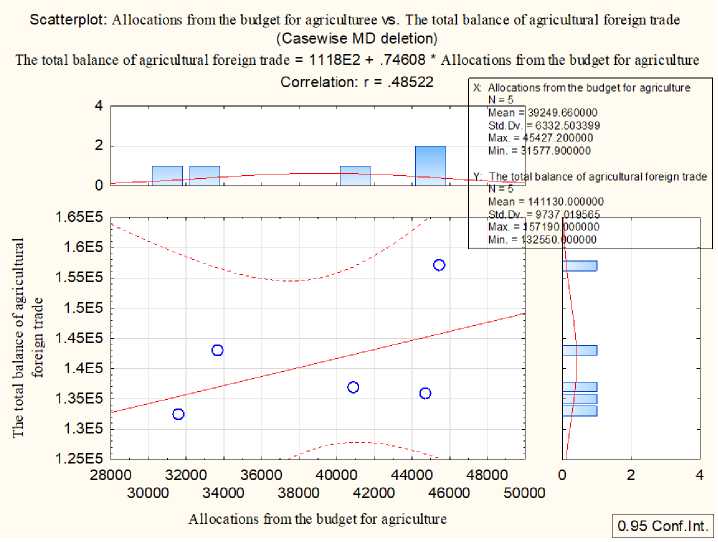
Picture 1 . By applying the PEARSON correlation method, we established that the value of the correlation coefficient, by analyzing (3) the allocation from the budget for agriculture of the Republic of Serbia and (6) the total balance of foreign trade agricultural and processing production, is rxy=0.48, which means that the correlation coefficient is not high correlated.
The share of the agricultural budget in the total budget
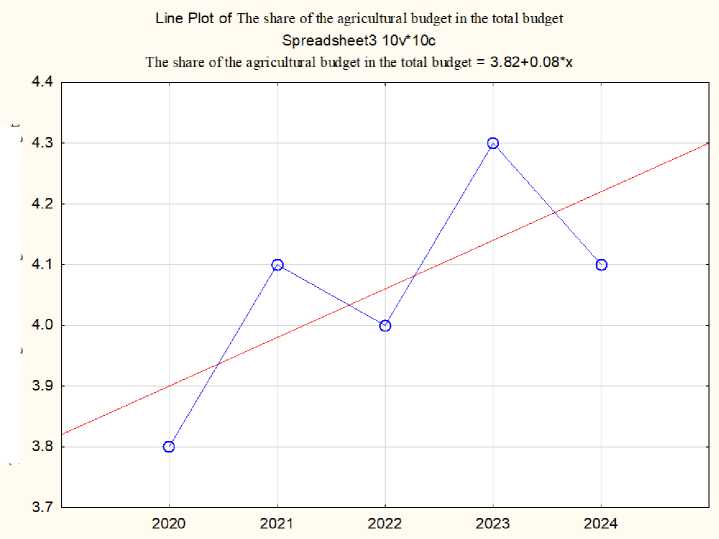
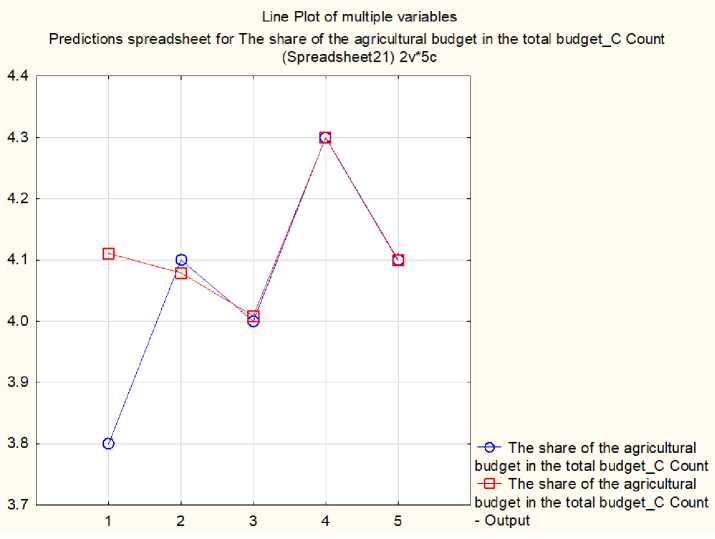
Picture 2. By calculating the time linear trend, we arrived at the linear trend model ŷ = = 3.82+0.08*x, where the mean absolute growth in the presented period. By calculating the value of the trend for the year 2030, we reached the result of 4,7%.
-©- The share of the agricultural budget in the total budget_C Count -S- The share of the agricultural budget in the total budget_C Count - Output
Line Plot of multiple variables
Predictions spreadsheet for The share of the agricultural budget in the total budget_C Count (Spreadsheet21) 2v*5c
Picture 3. Therefore, greater allocation from the state budget for agriculture resulted in higher productivity due to the possibility of agricultural subjects to more easily obtain more efficient mechanization and equipment and the acquisition of better working capital due to greater subsidies, which will later affect the yield. With a higher yield, agricultural producers will have the opportunity to set a more favorable price for their products, which will make them more competitive, and therefore the total balance of foreign trade agricultural production will grow. With this method of correlation, we confirmed that the importance of financing from the budget of the Republic of Serbia for agricultural production is of great importance.
Conclusion
Financing is the main problem of agricultural development. The difficult period of transition for our agriculture, as well as other valuable activities, left a deep mark.
This is why we have a fairly uncompetitive agriculture, with outdated machinery that cannot achieve a sufficient level of productivity, which is why the price of the product itself is higher and with which our agricultural producers are not competitive on the market. This especially applies to rural areas and small producers or producers in the narrower sense, which make up a significant majority.
Greater incentives in the form of subsidies that would also encourage agricultural production, especially subsidizing rural areas where due to the economy due to underdevelopment there was an outflow of population, and this and similar projects would prevent that outflow.
Another thing that our agrarian sector lacks, and which could greatly improve the position of our agriculture, is a strong agrarian bank. A real agricultural bank would have to be able to finance agriculture, to place capital, both domestic and foreign, for all agricultural subsidies to go through it, to be a privileged bank like some countries of the European Union have.
In finding a solution for financing agriculture, one must also know the way of financing agriculture in successful and developed countries, and that those systems should be a model to strive for.
Commercial banks on the territory of Serbia also play a major role in lending to agriculture. Serbia's agricultural potential led commercial banks to offer agricultural subjects favorable loans, with a lower interest rate for working capital and the purchase of fixed assets. But these are all short-term agricultural loans with a repayment period of up to 12 months, and these loans do not meet the needs of users. It is necessary to attract commercial banks to partly operate in the interests of farmers without harming their own interests. It would be a system of approving long-term agricultural loans with a lower interest rate, without a currency clause, with a longer grace period, which would greatly help agricultural subjects, because agriculture has a slow turnover of capital.
