
Implementation of Adaptive Sleep Modes for Enhancing Energy Efficiency of Ultra Dense Networks Using Traffic-Aware Grasshopper Optimization Algorithm
Журнал: International Journal of Computer Network and Information Security @ijcnis
Статья в выпуске: 5 vol.18, 2026 года.
Бесплатный доступ
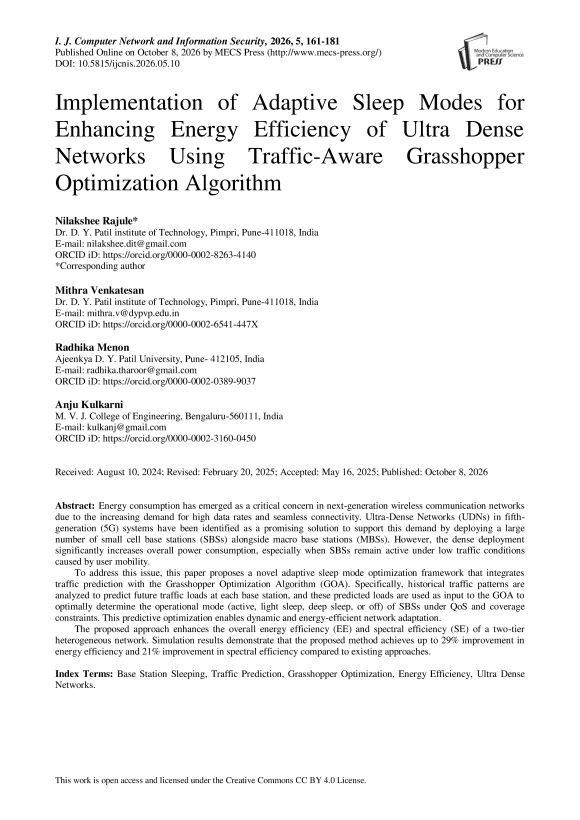
Energy consumption has emerged as a critical concern in next-generation wireless communication networks due to the increasing demand for high data rates and seamless connectivity. Ultra-Dense Networks (UDNs) in fifth-generation (5G) systems have been identified as a promising solution to support this demand by deploying a large number of small cell base stations (SBSs) alongside macro base stations (MBSs). However, the dense deployment significantly increases overall power consumption, especially when SBSs remain active under low traffic conditions caused by user mobility. To address this issue, this paper proposes a novel adaptive sleep mode optimization framework that integrates traffic prediction with the Grasshopper Optimization Algorithm (GOA). Specifically, historical traffic patterns are analyzed to predict future traffic loads at each base station, and these predicted loads are used as input to the GOA to optimally determine the operational mode (active, light sleep, deep sleep, or off) of SBSs under QoS and coverage constraints. This predictive optimization enables dynamic and energy-efficient network adaptation. The proposed approach enhances the overall energy efficiency (EE) and spectral efficiency (SE) of a two-tier heterogeneous network. Simulation results demonstrate that the proposed method achieves up to 29% improvement in energy efficiency and 21% improvement in spectral efficiency compared to existing approaches.
Короткий адрес: https://sciup.org/15020706
IDS: 15020706 | DOI: 10.5815/ijcnis.2026.05.10
