
Improving the population’s quality of life: The role of the socio-economic genotype in shaping the regions’ development strategy
Journal: Economic and Social Changes: Facts, Trends, Forecast @volnc-esc-en
Section: Regional economy
Article in issue: 6 т.18, 2025.
Free access
This article examines methodological approaches to studying the socio-economic genotype, as well as practical aspects of its application in the context of regional development. The obtained results demonstrate, for the first time, a stable and statistically significant relationship between the quality of life of the population and the socio-economic genotype within a regional framework. The study identifies three fundamental genes of the socio-economic genotype: production, innovation, and institutional-social, and elucidates their economic nature. The concept of the “genotype core” is refined, defined as the minimal set of indicators sufficient for identifying a region's type. As a result of the research, regions were grouped according to the dominant gene, which revealed stable economic patterns, strengths and weaknesses of different groups, “hidden” regional patterns, and specifics of regional development that impact the population's quality of life. The proposed regional classification is based not on traditional sectoral specialization, but on the identified genetic profile, which is analyzed within the context of quality-of-life quartiles – an approach not previously documented empirically. Statistical analysis using the Chi-square test confirmed a statistically significant relationship between the genotype core and the integral quality of life index. By comparing the genotype map and the quality of life index, it was established that the institutional-social gene contributes the most to a high quality of life, whereas the production gene, without reinforcement from innovation and institutional-social factors, does not lead to increased well-being. The paper concludes by justifying the integration of the socio-economic genotype into regional strategies and monitoring systems for socio-economic programs, thereby expanding the toolkit for governance. The scientific novelty lies in applying a new approach to studying regional development issues, involving the analysis of the simultaneous interaction between the socio-economic genotype and quality of life. The theoretical significance of the work is defined by the development of a conceptual model of the socio-economic genotype, based on a triad of socio-economic genes (production, innovation, and institutional-social) and the subsequent construction of the genotype core using the Frobenius norm applied to indicator matrices as a quantitative assessment of territories’ internal potential. The practical significance stems from the creation of a methodological toolkit that enables more precise and effective development of regional strategies aimed at improving the population's quality of life.
Similar articles in the section Regional economics. Territorial economics
Short address: https://sciup.org/147252993
IDS: 147252993 | UDC: 332.12 | DOI: 10.15838/esc.2025.6.102.3
Text of the scientific article Improving the population’s quality of life: The role of the socio-economic genotype in shaping the regions’ development strategy
Ensuring the sustainable socio-economic development of regions is accompanied not only by ongoing programs and managerial economic decisions, but also by the inherent regional features of the institutional, social, historical, and cultural past. In recent years, we can note an increasing interest in defining latent, time-invariant (like human DNA) regional features, which are revealed in the scientific literature through the definition of “socio-economic genotype”. The stable and inherited characteristics of the region make it possible to more accurately formulate strategic priorities and develop effective measures to improve the quality of life, which is key in developing a regional development strategy. The use of the scientific connotation under consideration expands the possibilities for analyzing and managing the quality of life, which is an important aspect in the context of strong regional differentiation in determining strategic vectors of regional development. The synthesis of economic and genetic approaches forms a new tool for a deeper analysis of regional differences, which increases the effectiveness of the entire strategizing process (Kvint, Okrepilov, 2013; Kvint, Okrepilov, 2014).
Currently, there are no universal methodological approaches to the definition, composition and structure of the genome of a region against the background of increasing interest in the genetic model of regional development. In this regard, it seems relevant to develop the theory of the socio-economic genotype of regions in terms of its structural analysis, which makes it possible to identify sustainable regional patterns, the analysis of which expands the mechanisms for making strategic decisions and improving the quality of life (Shakleina, Shaklein, 2017). The novelty of the proposed methodological approaches to the analysis of socio-economic genotype is to consider regional development in the genotype – quality of life coordinate system. The socio-economic genotype creates a kind of filter for the perception of quality of life factors. For example, commensurate investments in medicine are associated with different quality of life margins in regions with “innovative” and “industrial” genotypes. The integration of socio-economic genotype and quality of life is able to demonstrate how the “generic” potential of the region has been transformed into quality of life.
The aim of our study is to develop methodological aspects of the structural analysis of the socio-economic genotype of Russian regions in the context of the development of the quality of life.
We define the following tasks to achieve this aim:
-
1) to develop and describe the main methodological aspects of identifying key socioeconomic genes that reflect the unique features of the region, the development features;
-
2) to test this methodology and cluster regions based on the identified genotype;
-
3) to assess the relationship between the socioeconomic genotype and the quality of life;
-
4) to determine the prospects of using a genetic approach to analyze the quality of life.
The practical significance of the socioeconomic genotype in the practice of regional management and improving the quality of life lies in creating tools which can be used by executive authorities to improve the effectiveness of management decisions in terms of improving the quality of life, implemented through the prism of strategic priorities.
Materials and methods
Interdisciplinary nature of the genetic approach in socio-economic research
The gene field in economics is a relatively new area of scientific knowledge that has emerged at the intersection of genetics and economics (Benjamin, 2007; Benjamin et al., 2012). The main idea of the direction is to use biological models in business processes. The practice of such integration, the features and possibilities of using the biological idea for a better understanding of economic problems were first formulated by the Soviet and Russian economist E.Z. Maiminas.
In the research (Maiminas, 1989), the scientist gives the following definition of the socio-economic genotype: “The socio-economic genotype (SEG) is an information mechanism that ensures the reproduction of the structure, principles of functioning, processes of regulation and learning (selection, memorization and transfer of positive experience) in a given socio-economic system”. V. Mayevskii, N. Kondrat’ev, G. Kleiner, and
-
V. Polterovich considered this problem at different times (Mayevskii, 1994; Kondrat’ev, 1989; Kleiner, 2004; Polterovich, 1998).
The interdisciplinary nature of the research is the application of biological mechanisms and processes in economics, psychology, and sociology in foreign practice. A study of the American scientist V. Diego (Diego et al., 2023) presents an interdisciplinary approach combining genetic and economic research to assess the quality of life. Based on the interaction of genetics and environmental factors, the authors analyze the influence of education level and socio-economic status on the risk of cardiovascular diseases. The analysis allows concluding that with a higher level of education, the genetic influence increases, and genes begin “working brighter”. The social environment determines the degree of manifestation of the genetic potential. The work of other foreign colleagues (Biroli et al., 2025) shows that genes are another type of “source capital” that, interacting with the external environment, affects behavior and life outcomes (income, level of education, health).
Table 1 presents interdisciplinary connections of the genetic approach in socio-economic processes.
Despite the extensive nature of the interdisciplinary connections of the phenomenon under consideration in economic practice, the most well-known are the two main approaches of A. Auzan (Auzan, 2022) and E. Maiminas, Y. Myslyakova (Maiminas, 1989; Myslyakova, 2020, 2022) to understanding the socio-economic genotype.
Comparison of the main approaches to understanding the socio-economic genotype
A.A. Auzan’s approach (Auzan, 2022; Almond, 1963; Weiner, 1989), which we will call “sociocultural codes”, focuses on the behavioral and value aspects of society that determine how and what an individual does in economics, politics, and everyday life. A. Auzan shows that Russia does not have a single cultural code but there is a set of values that combine in different proportions. A. Auzan’s “Genetics” makes it possible to design institutions that will be consistent with the dominant code and turn strengths into long-term competitive advantages. Regarding the issues of improving the
Table 1. Interdisciplinary nature of the genetic approach in socio-economic research
|
Interrelationships of disciplines |
Theme of the relationship |
Literature |
Content |
|
Economics and Genetics |
How do inherited parameters affect economic development |
Ashraf, Galor 2013; Benjamin et al., 2007; Clark, 2007; Abdellaoui, 2022; Biroli et al., 2025 |
The idea that economic outcomes are linked to genetic prerequisites is tested. |
|
Sociology and Genetics |
Role of genes in the formation of behavioral attitudes, political activism, and social stratifications |
Mills et al., 2020; Fowler, 2008; Аузан, 2013; Hodgson, 2003; Ostrovitianov, 1977 |
These articles discuss how the social environment can include or, conversely, mute a genetic predisposition. Cultural codes are considered as an addition to biological uniqueness. |
|
Psychology, Sociology (behavioral sciences) and Genetics |
Individual economic behavior, well-being, and “personality genes” |
Fletcher, 2011; Fletcher, 2012; Fletcher, 2014; Benjamin, 2010 |
Conclusions about how genetic differences affect the propensity to take risks, accumulate capital, and choose a profession – through the prism of psychology and well-being. Based on a genetic approach, Fletcher developed and substantiated the idea that differences in the level of financial well-being and selfdevelopment are caused by genetics. |
|
Source: own compilation based on the literature analysis. |
|||
quality of life and comfortable living conditions, it is especially necessary to take into account the cultural code, since the effectiveness of any economic policy is aimed at improving the quality of life, and without taking into account the “embedded” attitudes of the population, views on the problem of improving the quality of life, living conditions, and values, measures to improve it will have a short-term and limited in nature.
The genetic approach, defined by other scientists (Maiminas, 1989; Myslyakova, 2020), considers the concept of the region’s genotype not only as a sum of cultural traditions and norms of behavior, but also as a system that includes institutional practices, economic strategies and models of social interaction.
Developing Maiminas’s concept (1989), Yu.G. Myslyakova (2021) focuses on institutional and cultural factors that play a fundamental role in economic behavior and regional development. The authors of this approach believe that since a region is a complex organism that combines different business entities, each entity needs to adapt to existing socio-economic relations, the study of this issue should focus not only on socio-cultural and value attitudes that have inherited the territory, but also on production and institutional parameters of the region, leading to its economic growth.
We can identify several key differences and similarities comparing the basic concepts within the framework of the genetic approach to regional development.
-
1. A. Auzan’s approach reduces the development of ideas of socio-economic genotype to the development of the “socio-cultural code” concept. The emphasis is on cultural attitudes and norms that influence economic behavior and shape regional development trajectories. This concept is more flexible and less formalized, which causes certain difficulties for practical use.
-
2. The concept of the socio-economic genotype by E. Maiminas and Yu. Myslyakova offers a
fairly clear framework for understanding and attributing socio-economic characteristics to the region’s genotype. This approach is better quantifiable to create tools for monitoring and managing regional development.
All the authors show that the genotype forms long-term patterns of behavior and development of regions despite the existing differences in the concepts presented, hence the failure to take this aspect into account makes effective regional management difficult.
It is impossible to ignore the work of Russian scientists (Ayvazyan, 2012; Kvint, 2009), who, although they did not directly use the concept of socio-economic genotype, made a significant contribution to understanding the sustainable components of institutional and cultural factors concerning territorial development. The research (Ayvazyan, 2012) proposes to use an institutional and cultural component in the model within the framework of modeling and integrated assessment of the quality of life. Kvint (Kvint, Okrepilov, 2014) proves the importance of these components in solving the issues of strategizing territories and developing strategic priorities.
In the framework of our study, we will use the concept of Maiminas and Myslyakova, since, first, this approach is more methodologically sound, allows making quantitative estimates of the elements of the socio-economic genotype; second, it has direct practical application – it allows identifying dominant genes and analyze typical regional profiles.
The similarity of the core of the socio-economic genotype considered in our study with the approach of Yu.G. Myslyakova lies in the recognition of heritability and minimal sufficiency of the core structure, while the difference lies in the emphasis on the institutional and social dimension, which is necessary to verify the relationship between the genotype and quality of life, as well as a strict quantitative procedure for integrating indicators, ensuring inter-regional comparability.
Table 2. Analysis of approaches to the definition and structural specification of the core of the socio-economic genotype
|
Source |
Core content |
Structural components |
|
“Theoretical aspects of modeling the socio-economic genotype of industrial regions of the Russian Federation” (Myslyakova et al.., 2019) |
The core is considered as a set of defining and dynamic codes that ensure the hereditary memory of the territory |
Production, social and innovation codes, interconnected with each other |
|
“Social and economic genotype territories of the advancing development on example of the Ural region” (Myslyakova et al., 2020) |
The core is defined as the hereditary morphological basis of the region |
Production, social and institutional codes. Each of them has a set of indicators, and a set of codes forms the morphology of the core |
|
“Genetic approach in studies of sustainable regional economic development” (Myslyakova, 2020) |
The concept of a core is generalized. It is interpreted as the core of the social immunity of the territory, including protective mechanisms and inherited parameters of the state of society |
Three blocks: indicators of the well-being of the population, labor potential and its activation (indicators of social sustainability) |
|
Source: own compilation on the basis of works (Myslyakova, Neklyudova, 2021; Myslyakova, Shamova, 2020). |
||
An analysis of scientific papers on the socioeconomic genotype shows that each territory has an information core containing unique stable codes that are practically unchanged throughout the entire stage of economic development and they determine the region’s response to external challenges and incentives.
The study of the development of single-industry towns, which are characterized by high dependence on a particular industry or enterprise, implies the identification and more detailed study of institutional and production codes. Institutional codes that characterize the maturity of institutions and the quality of governance play a crucial role in the sustainable development of territories and determine the possibilities of flexibility/ adaptation to changes in the external environment (Myslyakova, 2020).
When analyzing the quality of life and social comfort (Shakleina et al., 2021; Medyanik et al., 2024), it becomes necessary to include a sociocultural code covering the value and behavioral attitudes of the region’s population, which makes it possible to determine the impact of the sociocultural context on the subjective perception of social policy, as well as evaluate the effectiveness of investments in healthcare and education.
In accordance with the approach of E.Z. Maiminas and Yu.G. Myslyakova, it is advisable to group stable “inherited” features of regions in the framework of this study into a triad of production, innovation, institutional and social codes. Each code reflects a certain level of spatial development of the region.
The triad of codes forms a complex regional genotype, which can be interpreted as a structural trace of regional dynamics. Further research provides for the extensibility of the design by including socio-cultural parameters while meeting the requirements of representativeness and comparability of time series to determine the influence of value attitudes on the perception of quality of life and social comfort.
The production code reflects the inherited economic specialization, including the infrastructural component, technological structure and employment structure of the population. This code sets the foundation of the economic system and builds resilience to economic shocks and recessions. It is reflected in such aspects as changes in economic growth rates, employment sustainability, and specialization structure.
The institutional and social code of the region is a set of stable rules and interaction between the key actors of the region, reflected in the effectiveness of the implementation of strategies and the quality of management of the territory. The code combines indicators of the quality of institutions and the social environment, including the increase in the Gini coefficient, as a distributive indicator within the complex structure of the institutional-social code. Thus, the social characteristics of the population are not excluded, but are integrated into the core of the genotype through the institutional and social code, which includes not only a set of formal norms and institutions, but also ways of their intergenerational transmission. In this way, the hypothesis of an inherited form of interaction between government, business and society is confirmed, which gives the code genetic stability.
The triad of codes (industrial, innovative, and institutional-social) within the framework of the socio-economic genotype concept has a synergetic potential. In our study, the core of the genotype will be defined as a functionally integrated structure reflecting the interaction of the three codes. The genotype itself is considered as an indicator of the functional effectiveness of a socioeconomic region, while maintaining continuity in the application of the genetic approach and code modeling methods.
Results
We selected 9 indicators to determine the socioeconomic genotypes of the regions. They are divided into 3 components – production, innovation, institutional and social. Indicators related to the socio-economic genotype should meet the following methodological requirements:
-
– relative stability over time;
-
– low sensitivity to short-term political and economic shocks;
-
– historical depth (availability of a number of data for the previous 20–30 years).
All indicators of the information core of the socio-economic genotype are presented in the table ( Appendix ).
The choice of the triad of codes presented in Table 3 is justified by the fact that it is precisely this composition that provides a closed cause-and-effect relationship, where the transformation of the resource and industry base into social results takes place. The composition of the proposed code is minimally sufficient and robust to confirm or refute the statistical relationship with the quality of life,
Table 3. Indicators of socio-economic genotype, %
|
Production code |
Innovative code |
Institutional and social code |
|
Increase in the share of industry in GRP |
Increase in R&D expenses |
Increase in the region’s debt burden ratio |
|
Growth in the industrial production index |
Increase in the number of patents by 10 thousand people |
Growth in the number of small and medium-sized enterprises |
|
Increase in the number of all organizations |
Growth in the number of personnel engaged in scientific research and development |
Increase in the Gini coefficient |
|
Source: own compilation on the basis of works (Myslyakova, Neklyudova, 2021; Myslyakova, Shamova, 2020). |
||
which is also due to the avoidance of excessive multicollinearity between indicators of a similar nature.
The indicators of the production code record the steady specialization and dynamics of output, characterize the supporting forces of the region’s economy. The work (Myslyakova et al., 2020) uses incremental indicators for shipments, the share of manufacturing industries and investments as standard elements of the production unit. In our case, the use of the parameter of the increase in the number of all organizations characterizes the strengthening and expansion of the industrial and sectoral basis of the regional economy.
The indicators of the institutional and social code take into account the financial stability of management, the business environment, and the distributional results through which the economic success of the region is converted into a high quality of life. In the institutional block of the work (Myslyakova et al., 2020), variables are widely used to characterize the business environment (the presence of innovative small and medium businesses, the index of employment growth in SMEs, etc.). Adding a debt burden correctly describes the financial stability of management, and the inclusion of the Gini coefficient is used in the work (Myslyakova, 2021) as a social indicator associated with a predisposition to technological transformations, which makes it possible to expand the considered code to an institutionally social one. The integration of the Gini coefficient into the institutional and social code is justified as an element of the “inherited” rules of interaction between society, business, and government. Thus, the methodological requirements are set by the framework of the genetic approach of Yu.G. Myslyakova, and also expanded by us in the context of assessing the impact of the region’s genotype on the quality of life.
The study identified the genotypes of the regions based on an analysis of their growth rates for the period from 2022 to 2023 in 83 regions of the Russian Federation. The Jewish Autonomous Region and the Chukotka Autonomous Area were excluded from the research sample due to the lack of published statistical data on the innovative genotype due to the need to respect the confidentiality of primary information provided by organizations1. In addition, the Donetsk People’s Republic, the Luhansk People’s Republic, the Zaporozhye Region, and the Kherson Region were excluded in the sample due to the lack of relevant statistical data.
The paper uses the Frobenius norm to calculate the core of the socio-economic genotype, since this method ensures the objectivity and mathematical rigor of the integral assessment of the matrix of indicators. The Frobenius norm allows taking into account the contribution of each element of the matrix, while maintaining the internal structure of the interrelationships of indicators. When calculating using this method, we can not only determine the state of a region by its genotype, but also compare the positive and negative polarity of development, forming an indicator of genetic tension. In fact, the Frobenius norm performs the function of an integrator that reflects the latent state of the socio-economic system and ensures comparability of regions with different indicator structures.
At the next stage, after data collection, the core of the socio-economic genotype of the regions is modeled, which is presented in a matrix format: it consists of production (P), innovation (I), institutional and social (IS) codes. The matrix shows the incremental values of the indicators from the Table ( Appendix 1 ) .
P 1 P2 Р з
A = I / 1 / 2 / 3 I (1)
I IS1IS2IS3 I
After the formation of the “information matrix”, the size of the core of the territorial genotype was determined using the Frobenius norms. For this purpose, we calculated a measure of the generalized matrix in the positive and negative polarity of development.
1И+11 = JsBTs^l^ при ^7 >0, (2)
a i j – elements of the matrix A .
A positive transformation captures productive and progressive dynamics for each gene.
IK || = ^l^ a2 при a i} < 0 (3)
Negative transformation captures regressive and inhibitory development factors.
At the final stage, a matrix between the positive and negative core has been determined, which makes it possible to identify an indicator of the genetic tension or potential for the region’s development.
SEG = |К||-||Л-|| (4)
If SEG > 0, the regional core is development-oriented, and if SEG < 0, then stagnation, structural decline, or institutional degradation is observed.
Thus, the application of the Frobenius norm ensures objectivity and forms the basis for the distribution of regions by dominant gene.
Table 4 shows that the Sakhalin Region and the Republic of Ingushetia demonstrated a pronounced dominance of the innovation gene due to the predominance of positive polarity ( I+ = 1.38 and I+ = 1.00, respectively). Innovation processes in the regions are one of the key factors in improving the quality of life – the regions are included in the comprehensive state programs “Socio-economic Development of the Far East”, “Strategy of the North Caucasus Federal District-2025”, where the priority is the development of digital services and human capital. The dominance of the innovation gene does not mean that the regions of this group are technological leaders or leaders in socio-economic development. The disclosure of the available potential is determined by the economic development level, the availability of a resource and production base, and the quality of institutions.
Table 4. Results of the socio-economic genotype using the example of regions with different dominant genes
|
P+ |
p - |
I |
г |
IS+ |
IS - |
Gene |
Core |
|
|
Sakhalin Region |
0.12 |
0.01 |
1.38 |
0.04 |
0.02 |
0.44 |
I |
1.51 |
|
Republic of Ingushetia |
0.00 |
0.11 |
1.00 |
0.00 |
0.00 |
0.56 |
I |
-0.16 |
|
Kemerovo Region |
0.23 |
0.03 |
0.13 |
0.21 |
0.16 |
0.01 |
P |
0.51 |
|
Novosibirsk Region |
0.03 |
0.02 |
0.00 |
0.02 |
0.02 |
0.03 |
P |
-0.02 |
|
Perm Territory |
0.02 |
0.09 |
0.02 |
0.10 |
0.12 |
0.04 |
IS |
0.15 |
|
Saint Petersburg |
0.04 |
0.09 |
0.00 |
0.20 |
0.66 |
0.03 |
IS |
0.25 |
|
Source: own compilation based on Rosstat data. |
||||||||
The Kemerovo Region and the Novosibirsk Region are characterized by the dominance of the production genotype. It is worth noting that the Kemerovo Region is characterized by the intensity of positive production activity P+ = 0.23, while the Novosibirsk Region ( P+ = 0.03) retains only inertial elements of the production profile, the value of the innovation component remains at a low level.
The Perm Territory and Saint Petersburg demonstrate the dominance of the institutional and social gene. The stability of the institutional contour is observed in the Perm Territory, while in Saint Petersburg ( IS+ = 0.66) the institutional and social potential is clearly expressed, the leading role of the urban environment in the formation of infrastructure is confirmed.
The final indicator of the genotype core reflects the general vector of the region’s development. Positive values indicate the active development of the region, while negative values indicate the presence of structural constraints. The most pronounced innovative type of core is typical for the Sakhalin Region, which confirms the innovative orientation of the region. The negative value of the core is recorded in the Republic of Ingushetia, which indicates the instability of the institutional foundation. The Perm Territory and Saint Petersburg have the most balanced cores. In these regions, the positive effects of institutions and the social environment compensate for the weakness of other codes. Within the framework of this study, special attention is paid to the dominant genes, since the isolation of the dominant gene allows proceeding to a functional analysis, which helps to understand exactly which internal mechanisms determine the quality of life and economic dynamics of the region (Fig. 1).
The institutional and social code dominates in 34 regions of the Russian Federation, including both the largest megacities (Moscow, Saint
Figure 1. Map of the RF constituent entities by dominant genes
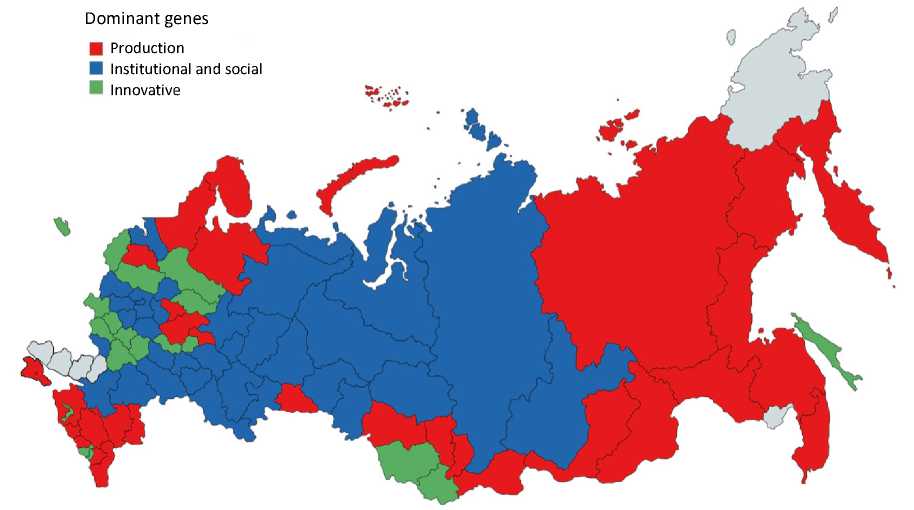
Dominant genes
Production
Institutional and social
Innovative
Source: own compilation based on the calculations performed.
Petersburg) and regions with a high level of urbanization and developed infrastructure (Samara, Tyumen, Sverdlovsk regions, Republic of Tatarstan, etc.). The regions of this group are characterized by the presence of developed digital services and a stable legal environment. as well as significant investments in social and transport infrastructure. The presence of strong universities contributes to the reproduction of institutional culture. The predominance of the social gene is reflected in the concentration of human capital – a high level of education, the presence of a developed medical and cultural infrastructure. In such regions, institutions effectively transform social potential into an increase in the quality of life.
The other two genes (production and innovation) play a supportive, but not a determining role.
The innovation code is registered in 19 Russian regions. The innovation gene in this group of regions performs a compensating function: in the absence of a strong production core and a stable institutional and social contour, room is made for quick and easy innovations (most often the creation of digital services, increasing the availability of services, etc.) that can meet the basic needs of the population and improve the digital infrastructure of life. The development processes of small and mediumsized businesses are also being launched. The dominance of the innovation gene is not identical to technological leadership; the presence of an innovation contour in the region is a tool for improving the quality of life. The geographical remoteness and peripheral location of a number of regions dominated by the innovation gene acts as a factor stimulating demand for highly qualified specialists through the implementation of remote solutions through the development of the digital infrastructure of the region, which is typical for regions with the status of an external or island border (Kaliningrad Region, Pskov Region,
Sakhalin Region), as well as for subjects with an agricultural and mountainous terrain (Republic of Adygea, Republic of Altai, Republic of Ingushetia).
One of the most numerous groups is regions with a dominant production code, with a total of 30 constituent entities in the sample, in the socioeconomic structure of which the key role is assigned to industrial and resource sectors. The formation of the genotype occurred under the influence of the industrialization of the Soviet period. Typical examples are the Kemerovo Region, the Murmansk Region, the Primorye and Khabarovsk territories, the Republic of Sakha, the Trans-Baikal Territory, etc. These regions are characterized by high employment in the mining, energy, forestry, and metallurgical industries. Despite its large role in the country’s economy, the dominance of the manufacturing gene is combined with low or below-average indicators of quality of life. This is due to the weak institutional maturity of the regional environment and the innovation contour. The innovation gene in these regions is poorly expressed and mainly serves requests for modernization of basic industries.
Development prospects of socio-economic genotype theory in the context of improving the quality of life
In the conducted study, the dominant gene was determined for each Russian region relative to the other two genes. In general, a triad of genes was analyzed: production, innovation, and institutional-social. If in the approach of Yu.G. Myslyakova (2020, 2021, 2022) the genotype core serves as a tool for typologizing territories, then in this study the dominant gene is considered as a functional basis for analyzing the relationship between the genotype and the quality of life of the population. The proposed genes are not mutually exclusive, but rather complement each other in the process of progressive regional development. The accumulated experience forms the basis for the future development of the region. Based on the results obtained, the following hypotheses about the relationship between the socio-economic genotype and the quality of life in the region are formulated.
Hypothesis 1. The production gene is an auxiliary gene for the formation of a strategic resource base as the basis for the further development of the region, while the production gene alone does not provide a high quality of life.
Hypothesis 2. The innovation gene is a kind of driver for the qualitative transfer of the economy to the next level of development, creating prerequisites for the formation of high-quality development institutions.
Hypothesis 3. The institutional and social gene ensures a high quality of life in the region after the accumulation of the necessary resource and innovation potential.
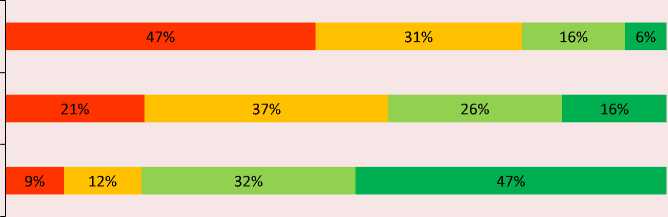
The Rating of Russian Regions on Quality of Life-2023 was used as a source of information on the quality of life, the methodology of which was developed and approved by the RIA Rating Center for Economic Research2. The rating is based on “indicators that capture the actual state of certain aspects of living conditions and the situation in the social sphere, allowing us to assess interregional differences in this area”3. The assessment is carried out in points on a scale from 0 (lowest quality of life) to 100 (highest quality of life). At the next stage, the regions are divided into four quartile groups according to the value of the quality of life rating score. The first quartile group has the lowest quality of life, the fourth – the highest quality of life). Figure 2 shows the relationship between the dominant gene and the quality of life.
Figure 2. Relationship between quality of life and socio-economic genotype
Production
Innovative
Institutional
■ 1 quartile group on quality of life (low quality of life)
■ 2 quartile group on quality of life
■ 3 quartile group on quality of life
■ 4 quartile group on quality of life (high quality of life)
Source: own compilation based on calculations, data from Rosstat and the RIA Rating Center for Economic Research – “Rating of Russian Regions on quality of Life-2023”.
We use the Chi-square criterion for testing the hypothesis of the independence of socio-economic genotype and quality of life. The calculated value of χ 2 = 27.23, p = 0.00013, which is less than 0.05, we can conclude that the null hypothesis about the independence of socio-economic genotype and quality of life is rejected. The relationship between genotype and quality of life is statistically important and moderately strong (the Pearson and Chuprov coefficients are about 0.4 and statistically significant).
The production gene . Let us consider a group of regions with a dominant production code, which includes 6% of the regions of the fourth quartile group of quality of life and 47% of the regions from the first quartile group of the quality of life. The regions of this group rely primarily on the production and extraction of natural resources, forming the resource base for further economic growth. However, the availability of resource potential does not guarantee high standards of living. Industrial regions are limited by environmental problems and monospecialization of the economy, which hinders development and reduces the quality of life (Mayminas, 2020).
The regional quality of life rating confirms that the predominance of the manufacturing gene is characteristic mainly of outsider regions in terms of quality of life. For example, the Republic of Tyva, the Chukotka Autonomous Area, the Kurgan Region, and others have a production genotype, but these regions are outsiders in terms of quality of life (the first quartile group). The regions of this group are rich in raw materials and industrial resources, but at the same time they face social problems, underdeveloped infrastructure, and low population incomes. The presence of a manufacturing gene makes it possible for the region’s economy to grow, but without the subsequent transition of the region to innovation and developed institutions, the region remains in low positions in terms of the quality of life.
The innovative gene is almost proportionately present in all quartile groups in terms of the quality of life (Fig. 2). In the analyzed sample of regions, the share of regions with a strong innovative gene is highest in the second quartile group in terms of quality of life (37%) – the Republic of Mordovia, the Vologda Region, the Tver Region, etc. The quality of life in this group is higher than in the production group, but due to the low quality of institutions, it lags behind the leading regions.
The Kaliningrad, Voronezh, and Lipetsk regions belong to the fourth quartile group (the highest) in terms of quality of life. They are a good example when the innovation gene does not work idly, but goes hand in hand with institutional development: special economic zones, cooperation between universities and businesses, the presence of export-oriented high-tech industries allows improving urban infrastructure, to make it more comfortable for living (Auzan, 2022).
In the first group of outsider regions in terms of the quality of life, there are regions with the dominance of the innovative gene – the Altai Territory, the Republic of Altai, the Republic of Ingushetia, and the Republic of North Ossetia-Alania. The regions of this group are characterized by tourism and innovative agricultural projects, but geographical remoteness and lack of infrastructure reduce the potential of the innovation gene.
The institutional and social gene reflects the stage of regional development at which the resource potential of the region’s development and modern development institutions are formed – effective public administration, strong workforce and human potential, and developed infrastructure. A region that has reached institutional and social maturity is capable of providing high levels of income, education, medical services, and security. The obtained result confirms Yu. G. Myslyakova’s thesis about the crucial role of the quality of institutions in the conversion of economic resources into welfare (Myslyakova, 2020). The fourth quartile group of leading regions in terms of the quality of life includes 47% of regions with a dominant institutional gene. Moscow, Saint Petersburg, the Leningrad Region, and the Republic of Tatarstan are the leaders in institutional development.
The first and second quartile groups in terms of quality of life include regions such as the Kirov Region, the Komi Republic, and the Nenets Autonomous Area, where historically formed institutions are outdated and new management practices are being implemented slowly.
The study showed that the region’s dominant gene largely determines the quality of life and the vector of its improvement in the medium and long term.
For regions with a predominance of the manufacturing gene, the initial strategic priority should be to increase the innovation activity of the economy, for regions with a strong innovation gene, institutional modernization with an improved legal environment and the development of the social sphere are relevant. By developing innovative potential on the available resource and industrial base, and progressively forming and improving development institutions, it is possible to bring regions lagging behind in terms of the quality of life to a higher development stage. All the hypotheses put forward in the study were confirmed.
The genetic approach makes it possible to identify hidden relationships between the historically established structure of the economy and current development indicators and how lagging regions should develop systematically in order to overcome the genetic predisposition to economic vulnerability. High quality of life is the genetically determined quintessence of economic development and the ultimate goal of every development strategy, which is preceded by a long and, most importantly, progressive development.
Conclusion
The article considers a new approach to the issue of regional development, which consists in analyzing the socio-economic genotype through a triad of genes (industrial, innovative, institutional, and social) inextricably linked with the quality of life of the population. The genetic approach makes it possible to identify hidden relationships between the current structure of the economy and current indicators of the development of the quality of life.
The production gene participates in the creation of the necessary resource base, the innovation gene contributes to the complication, diversification, and expansion of the base, and the institutional and social gene modifies economic success into a sustainable improvement in the quality of life. In fact, all three genes exist, but the main question remains which gene dominates. The most successful regions with a high quality of life (Moscow, Saint Petersburg, Kazan) demonstrate balance, but with the dominance of the institutional and social gene. At the same time, outsider regions in terms of quality of life represent a bias toward the production gene. The predominance of the industrial principle without innovative processes limits the growth potential and, consequently, the quality of life. On the other hand, formally, the predominance of the institutional and social gene without a resource base (Kirov Region) leads to the fact that the population does not feel an improvement in the quality of life. The dominance of the innovation gene without relying on a resource base and strong institutions also does not improve the quality of life. The analysis showed that the innovation gene is present in both the low quartile group of the quality of life and the high quartile group, however, a significant increase in quality of life occurs in those regions where innovation is combined with strong institutions (Tatarstan). The Samara, Sverdlovsk regions and other industrial regions were able to integrate innovations and improve institutions, which led them to the highest quartile group in terms of the quality of life.
The definition of the socio-economic genotype is of predictive value in the context of strategic planning of the socio-economic development of the constituent entities of the Russian Federation. The obtained code values and the genotype core make it possible to identify sustainable and vulnerable areas of regional development and identify more targeted strategic management decisions.
A promising area of further research is to increase the core of the genotype in terms of expanding the socio-cultural codes of territories and the possibility of exploring other latent categories, such as social comfort, in inextricable connection with the socio-economic genotype. Their integration is seen as the development of theory and methodology for assessing the quality of life. The socio-economic genotype creates a filter for the perception of living conditions and factors of social comfort. The use of big data in the context of solving this scientific problem (panels of statistical surveys of the living conditions, Internet search queries) It can significantly enrich the results of the previous studies (Shakleina et al., 2021). It is important to develop methods for modeling and forecasting the dynamics of the socioeconomic genotype using modern information technologies and big data, which will, first, weighty expand the possibilities of practical application of the approaches developed in the article, and, second, to explore it in all regions of Russia. Their integration is seen as the development of the theory and methodology of assessing the quality of life, in particular, proposed by Ayvazyan and his students in their works (Fantazzini et al., 2018; Mironenkov et al., 2024).
