
Influence of PGR on the Concentration of Potassium, Magnesium, and Calcium in Simarouba glauca DC. Under Water Stress
Journal: Journal of Stress Physiology and Biochemistry @jspb
Article in issue: 4 т.21, 2025.
Free access
The present study aimed to examine the impact of different Plant growth regulators (PGRs)such as 50 ppm Salicylic Acid (SA), 10 ppm Putrescine, Gamma-Aminobutyric Acid (GABA), and Abscisic Acid (ABA) on the levels of potassium, magnesium, and calcium in the medicinally important, oil-yielding plant Simarouba glauca DC. under water stress conditions. One year old Simarouba glauca seedlings were subjected to water stress for 4, 8, 12, and 16 days. It was observed that water stress led to a decrease in the potassium, magnesium, and calcium content in the roots, stems, and leaves of S. glauca compared to the unstressed control. However, foliar application of ABA, SA, Putrescine, and GABA resulted in an increase in the potassium, magnesium, and calcium content in the stressed plants. Specifically, SA, Putrescine, and GABA treatments induced the accumulation of potassium. These results suggest that SA, Putrescine, GABA, and ABA play vital roles in enhancing drought tolerance in Simarouba glauca by modulating the accumulation of key minerals under water stress conditions.
Similar articles in the section Plant physiology
Short address: https://sciup.org/143185125
IDS: 143185125
Text of the scientific article Influence of PGR on the Concentration of Potassium, Magnesium, and Calcium in Simarouba glauca DC. Under Water Stress
Simarouba glauca DC. commonly known as the bitter wood or paradise tree, is a tropical evergreen plant that holds significant medicinal and economic value. As an oil-yielding plant, it plays an essential role in pharmaceutical industries due to the bioactive compounds present in it. However, like many plants, S. glauca is vulnerable to environmental stressors, with water scarcity being one of the most impactful abiotic factors affecting its growth, development, and productivity.
Water stress, disrupts the plant's physiological processes, including nutrient uptake, enzyme activity, and metabolic balance. This often leads to decreased mineral content in various plant tissues, which in turn impacts plant health and productivity. Potassium (K), magnesium (Mg), and calcium (Ca) are essential macronutrients that play vital roles in maintaining cell integrity, enzymatic reactions, osmotic regulation, and stress response. These nutrients are crucial for the overall growth and functioning of plants under normal and stress conditions. Potassium regulates water balance and turgor pressure, magnesium is the central atom in chlorophyll and is involved in photosynthesis, and calcium is critical for cell wall stability and signaling during stress responses.
To mitigate the effects of water stress and improve plant resilience, plant growth regulators (PGRs) have emerged as promising tools. PGRs, such as salicylic acid (SA), putrescine, gamma-aminobutyric acid (GABA), and abscisic acid (ABA), have been shown to influence various physiological processes, including mineral nutrient uptake and stress tolerance mechanisms. These regulators may help enhance the concentration of essential nutrients like potassium, magnesium, and calcium, thereby contributing to the plant's ability to withstand drought conditions.
MATERIALS AND METHODS
One year old seedlings of Simarouba glauca were transplanted into earthen pots and established under controlled conditions in the polyhouse of the Botany Department, Shivaji University, Kolhapur. The plants were initially maintained with regular watering for one month. After this acclimatization period, the plants were subjected to water stress for durations of 4, 8, 12, and 16 days, with water stress imposed at specified intervals. Control plants were watered every two days without stress. Foliar applications of 50 ppm Salicylic Acid (SA), and 10 ppm Abscisic Acid (ABA), Putrescine, and Gamma-Aminobutyric Acid (GABA) were applied to the plants at intervals corresponding to the stress periods (4, 8, 12, and 16 days). Following the treatment, the plants were analyzed for various biochemical parameters.
For the estimation of inorganic constituents, an acid digest was prepared using the method described by Toth et al. (1948). The potassium content was determined using a flame photometer, while the levels of calcium and magnesium were quantified using an Atomic Absorption Spectrophotometer.
RESULTS AND DISCUSSION
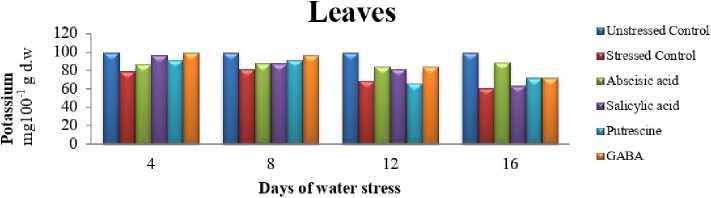
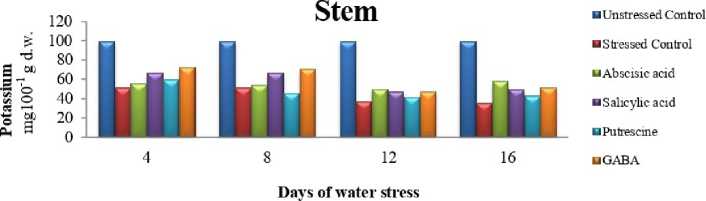
The effect of foliar sprays of ABA, SA, Putrescine, and GABA on potassium content in the root, stem, and leaves of S. glauca subjected to water stress is depicted in Figure 1. It was observed that water stress resulted in a significant decrease in potassium content in the root, stem, and leaves of S. glauca compared to the unstressed control. However, foliar application of ABA, SA, Putrescine, and GABA led to an increase in potassium content in all stressed plants. Notably, SA, Putrescine, and GABA treatments induced a marked accumulation of potassium in the root, stem, and leaves.
Potassium is a crucial macronutrient that plays an essential role in plant growth and development. It is the most abundant inorganic constituent in plants and is involved in several physiological processes. Potassium acts as an activator for more than 50 enzymes involved in vital metabolic processes, including photosynthesis, respiration, protein synthesis, and leaf movements.
The present investigation revealed a decrease of approximately 20 to 40% in potassium content in the roots, stems, and leaves of water-stressed plants compared to the unstressed control. However, foliar application of ABA, SA, Putrescine, and GABA led to a significant elevation in potassium content in all stressed plants. These findings are consistent with previous studies on the effect of water stress on potassium levels. Richard and Wadleigh (1952) reported a reduction in potassium content under water stress conditions. Abdalla and El-Khoshiban (2007) observed a decrease in potassium levels in the leaves of Triticum aestivum subjected to water stress. Furthermore, El-Abagy et al. (2010) found that SA treatment stimulated potassium content in artichoke plants, and Shaddad et al. (2010) reported enhanced potassium absorption in shoots and roots due to putrescine treatment.
These studies indicate that foliar application of plant growth regulators (PGRs) such as ABA, SA, Putrescine, and GABA can mitigate the adverse effects of water stress by promoting the accumulation of potassium. This enhancement of potassium levels could play a critical role in improving the plant's ability to tolerate water stress.
The results from this study suggest that the foliar application of ABA, SA, Putrescine, and GABA effectively enhances potassium accumulation in S. glauca under water stress. This increase in potassium content may contribute to improved plant resilience and tolerance to water stress. The findings highlight the potential of these PGRs as a strategy to enhance mineral uptake and mitigate the detrimental effects of water stress in S. glauca , with broader implications for other crops facing similar stress conditions.
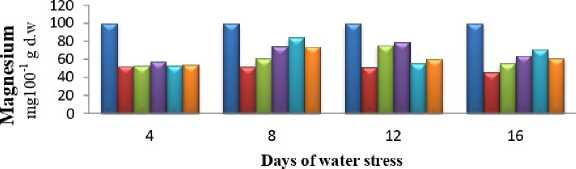
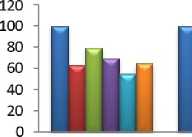
Figure 2 illustrates the impact of foliar sprays of ABA, SA, Putrescine, and GABA on magnesium content in the root, stem, and leaves of S. glauca subjected to water stress. It was observed that water stress led to a significant reduction in magnesium content in the root, stem, and leaves of S. glauca compared to the unstressed control. However, foliar application of ABA, SA, Putrescine, and GABA resulted in an increase in magnesium content in all stressed plants. Specifically, SA, Putrescine, and GABA treatments induced the accumulation of magnesium in the root, stem, and leaves of stressed plants.
Magnesium is an essential, mobile macronutrient, and a strongly electropositive element that plays a pivotal role in plant physiology, particularly as a central component of the chlorophyll molecule. In this study, magnesium content was significantly reduced by 40 to
80% in the root, stem, and leaves of all stressed plants compared to the unstressed control. In contrast, foliar application of ABA, SA, Putrescine, and GABA led to a notable increase in magnesium content when compared to the stressed control plants.
These findings are consistent with previous studies on the effects of water stress on magnesium levels. Kawasaki et al. (1983) reported a decrease in magnesium content in Phaseolus vulgaris under drought conditions. Similarly, Bharambe and Varade (1984) observed a reduction in magnesium content in the leaves of cotton plants subjected to water stress. Shaddad et al . (2010) demonstrated that putrescine application increased magnesium content in both drought-sensitive and drought-resistant maize genotypes ( Nefertiti and Bashaier , respectively).
The increase in magnesium content due to the foliar application of ABA, SA, Putrescine, and GABA in S. glauca under water stress suggests that these PGRs play a crucial role in mitigating the adverse effects of water stress. Enhancing magnesium content may contribute to improved plant resilience by supporting vital metabolic processes, such as photosynthesis and stress tolerance, in this medicinally important, oilyielding plant.
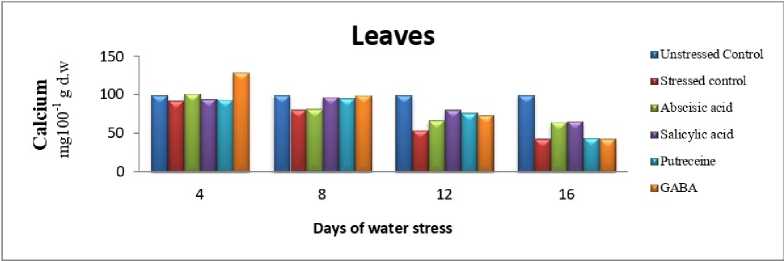
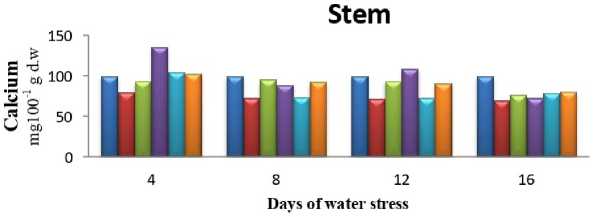
The impact of foliar sprays of ABA, SA, Putrescine, and GABA on calcium content in the roots, stems, and leaves of S. glauca subjected to water stress is shown in Figure 3. It was observed that water stress resulted in a significant reduction in calcium content in the roots, stems, and leaves of S. glauca when compared to the unstressed control. However, foliar application of ABA, SA, Putrescine, and GABA led to an increase in calcium content across all stressed plants. Notably, SA, Putrescine, and GABA treatments promoted the accumulation of calcium in the roots, stems, and leaves.
Calcium is an essential macronutrient that plays a key role in plant cell structure and function. It is a major component of the middle lamella in the cell wall, primarily in the form of calcium pectate, and exists in plant tissues as free Ca² ⁺ ions or as absorbed Ca² ⁺ bound to indiffusible ions such as carboxyl groups, phosphoxylic groups, and phenolic hydroxyl groups.
Calcium is crucial for regulating enzyme activities, including α-amylase, phospholipase, and ATPase
In the current study, it was observed that water stress resulted in a 50% reduction in calcium content in the roots, stems, and leaves of stressed plants compared to the unstressed control. However, foliar application of ABA, SA, Putrescine, and GABA significantly elevated calcium content in the stressed plants.
This finding is consistent with previous research on the impact of water stress on calcium levels.
Root
H Unstres sed C ontrol и Stressed Control н Abscisic acid
О Salicylic acid и Putrescine
И GABA
Days of water stress
№ hill bin kin
4 8 12 16
Potassium- Unstressed control- Leaves- 780mgl00‘ g dry wt., Stem- 960mgl001 g dry wt., Root-600 mglOO'1 g dry wt.
Figure 1: Effect of foliar sprays of ABA, SA, Putrescine and GABA on potassium content of the root, stem and leaves of S.glauca grown under water stress.
Leaves
H Unstressed Control
В Stressed control
H Abscisic acid
H Salicylic acid
В Putreceine
HGABA
Stem
Oft
Я 00
hhki
В Unstressed Control
В Stressed control и Abscisic acid и Salicylic acid в Putreceine
И GABA
4 8 12 16
Days of water stress
Root я Unstressed Control
■ Stressed control
И Abscisic acid
В Salicylic acid
В Putreceine
UGABA
едшш
4 8 12 16
Days of water stress
Magnesium- Unstressed Control- Leaves- 975 mglOO-1 g dry wt., Stem-543 mglOO-1 g dry wt., Root-408 mglOO-1 g dry wt..
Figure 2: Effect of foliar sprays of ABA, SA, Putrescine and GABA on magnesium content of the root, stem and leaves of S.glauca grown under water stress.
D Unstressed Control
H Stressed control a Abscisic acid
H Salicylic acid
H Putreceine a GABA
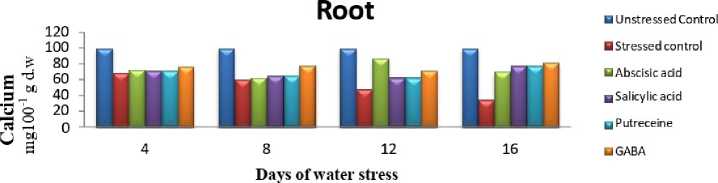
Calcium- - Unstressed Control- Leaves -1497mgl00-1 g dry wt., Stem- 1417mgl00-1 g dry wt., Root-1130mg 100-1 g dry wt.
Figure 3: Effect of foliar sprays of ABA, SA, Putrescine and GABA on calcium content of the root, stem and leaves of S.glauca grown under water stress.
Goicoechea et al . (1997) observed a reduction in calcium content in Medicago sativa under water stress conditions. Furthermore, Al-Hakim et al. (2001) demonstrated that exogenous application of SA enhanced calcium uptake in Triticum aestivum under salinity stress. Gunes et al . (2005) also observed increased calcium content in Zea mays when sprayed with SA under salinity stress.
The increase in calcium content due to the foliar application of plant growth regulators (PGRs) suggests that these compounds may play a crucial role in alleviating the negative effects of water stress by enhancing calcium uptake and distribution within the plant. This could be particularly beneficial in improving cellular integrity and stress tolerance in S. glauca , an important medicinal and oil-yielding plant.
CONCLUSIONS
The study highlights the significant role of plant growth regulators (PGRs) in mitigating the effects of water stress on S. glauca. The foliar application of SA, Putrescine, GABA, and ABA effectively enhanced the accumulation of potassium, magnesium, and calcium in the plant, thereby improving its drought tolerance. These findings suggest that the application of these PGRs could be a potential strategy to improve the resilience of S. glauca and possibly other crops facing water stress, thereby enhancing their growth and productivity under adverse environmental conditions.
CONFLICTS OF INTEREST
All authors declare that they have no conflicts of interest.
