
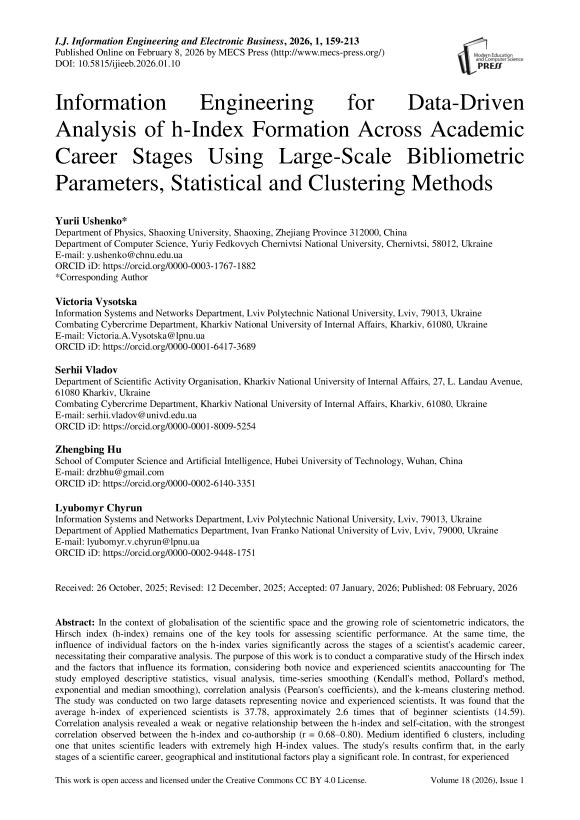
Information Engineering for Data-Driven Analysis of h-Index Formation Across Academic Career Stages Using Large-Scale Bibliometric Parameters, Statistical and Clustering Methods
Journal: International Journal of Information Engineering and Electronic Business @ijieeb
Article in issue: 1 vol.18, 2026.
Free access
In the context of globalisation of the scientific space and the growing role of scientometric indicators, the Hirsch index (h-index) remains one of the key tools for assessing scientific performance. At the same time, the influence of individual factors on the h-index varies significantly across the stages of a scientist's academic career, necessitating their comparative analysis. The purpose of this work is to conduct a comparative study of the Hirsch index and the factors that influence its formation, considering both novice and experienced scientits anaccounting for The study employed descriptive statistics, visual analysis, time-series smoothing (Kendall's method, Pollard's method, exponential and median smoothing), correlation analysis (Pearson's coefficients), and the k-means clustering method. The study was conducted on two large datasets representing novice and experienced scientists. It was found that the average h-index of experienced scientists is 37.78, approximately 2.6 times that of beginner scientists (14.59). Correlation analysis revealed a weak or negative relationship between the h-index and self-citation, with the strongest correlation observed between the h-index and co-authorship (r = 0.68–0.80). Medium identified 6 clusters, including one that unites scientific leaders with extremely high H-index values. The study's results confirm that, in the early stages of a scientific career, geographical and institutional factors play a significant role. In contrast, for experienced scientists, the Hirsch index becomes more predictable and is determined by the quality of scientific publications, the level of citation, and practical cooperation within scientific teams.
Similar articles in the section Science and knowledge in general. Organization of intellectual work
Short address: https://sciup.org/15020169
IDS: 15020169 | DOI: 10.5815/ijieeb.2026.01.10
