
Innovative Measures of Treatment and Prevention of Infectious Diseases in Poultry: Infectious Laryngotracheitis
Journal: Bulletin of Science and Practice @bulletennauki
Section: Сельскохозяйственные науки
Article in issue: 3 т.12, 2026.
Free access
This article examines the poultry disease laryngotracheitis, caused by opportunistic microbes that result in economic losses for poultry farms in Azerbaijan. Factors contributing to the spread of laryngotracheitis are identified. Recommendations for the use of plants with anti-inflammatory phytobiotic activity are offered. Strict veterinary monitoring is recommended to prevent the occurrence of such viral infectious diseases. Periodic general and laboratory examinations, proper care, the use of plants with phytobiotic activity, and limiting contact between objects and living creatures outside the confines of a single room minimize the risk of infection and spread.
Similar articles in the section Veterinary science. Veterinary medicine
Short address: https://sciup.org/14134727
IDS: 14134727 | UDC: 619:616.995.42:636.52 | DOI: 10.33619/2414-2948/124/45
Инновационные методы лечения и профилактики инфекционных заболеваний у домашней птицы: инфекционный ларинготрахеит
Изучается заболевание домашней птицы ларинготрахеитом, вызываемым оппортунистическими микробами, наносящими экономический ущерб птицеводческим хозяйствам Азербайджана. Выявляются факторы, способствующие распространению ларинготрахеита. Предлагаются рекомендации по использованию растений с противовоспалительным фитобиотическим действием. Предлагается строгий ветеринарный контроль во избежание возникновения таких инфекционных заболеваний вирусного происхождения, периодические общие и лабораторные обследования, надлежащий уход и использование растений с фитобиотическим действием, ограничение контактов между предметами и живыми существами, не связанными с внутренним пространством отдельного помещения, минимизируют вероятность заражения и распространения.
Text of the scientific article Innovative Measures of Treatment and Prevention of Infectious Diseases in Poultry: Infectious Laryngotracheitis
Бюллетень науки и практики / Bulletin of Science and Practice
The concept of development “Azerbaijan 2026: A Look into the Future” and the “Strategic Roadmap for the Future of National Ecosystems,” which take into account the main changes and problems that may arise in the economic, social, demographic, natural, and technological spheres after 2026 to ensure food security, lay the foundation for innovative scientific research on infectious diseases of viral origin, conducted by us in accordance with international standards and improving their effectiveness, provision of poultry products to the domestic market, and coordination of the value chain to meet the needs of the population for high-quality food. Poultry farming plays an important role in providing the population with meat, eggs, and bird fluff, being considered the main part of animal husbandry. In recent years, new technologies imported from foreign countries have been installed at large poultry farms, and intensive development of poultry farming has begun. At the same time, the intensive development of poultry farming in small farms and family farms is also gradually increasing.
The aim of the study was to investigate the epizootic situation with laryngotracheitis, a disease caused by conditionally pathogenic microbes that hinder the full development of various forms of poultry farming and cause economic damage to poultry farms, as well as to identify factors contributing to its spread, identify measures to combat them through research, and add fenugreek and licorice root to the diet of birds, and amaranth grains with phytobiological efficacy against the aforementioned pathogens, and to test them for the presence of pathogens. It is well known that improper feeding in poultry farming and the use of low-quality feed can lead to the spread of many pathogens, including laryngotracheitis, pasteurellosis and other diseases.
The results of monitoring conducted on this topic in farms in various regions of the republic show that laryngotracheitis is widespread in poultry farms. These diseases cause even greater damage to farms operating, in particular, in the meat sector. Considering all of the above, in order to develop and implement effective measures for the treatment and prevention of these diseases, we conducted an experiment on birds raised in VSRI (Veterinary Scientific Research Institute), adding phytobiotic effective plants such as licorice root, fenugreek, amaranth grains, as well as hydroponically sprouted corn, barley, amaranth and fenugreek grains with high nutritional value to the feed ration of developing young birds. Four groups of chickens (control and three experimental groups) were selected for the experiment. Chickens in groups were selected using the paired analog method, taking into account their age, body weight and development.
In accordance with the recommendations of the All-Russian Scientific Research Institute of Poultry Farming (ARSRIPF), the rearing and feeding of chickens, as well as the parameters of the microclimate, were the same in all groups. Before the first 60 days of age, the birds were transferred to bird food; after 61 days, they were transferred to a special feed ration compiled by us for each group. In the first experimental group, the main feed ration consisted of 4% hydroponic fenugreek and 10% fenugreek. In the second experimental group, hydroponic fenugreek and fenugreek grain were replaced by hydroponic amaranth and amaranth grain in the same ratio. In the third experimental group, chickens were given 4% hydroponic fenugreek, 10% fenugreek grain, 4% hydroponic amaranth, and 10% amaranth grain, with the addition of 0.4% ground licorice. All grain feeds were ground into cereals and fed to experimental birds in dry formula feed form. The live weight of birds was determined by individual weighing on days 60, 90, 120, 150, and at the end of the experiment (6 months). During the experimental period, from 60 days to 6 months, the survival of birds in all groups was partially ensured; i.e., during this period, one bird died in the control group, and one in experimental group I. On March 16, 2023, an autopsy on the carcass of a deceased 130-day-old young chicken from the control group was performed by us, and laryngotracheitis was detected. One of the infectious diseases of viral origin is also infectious laryngotracheitis (gotracheitis infectious avium; the synonym is bronchial laryngotracheitis), which is a contagious disease of poultry. The places of localization of the disease are complete damage and inflammation of the alveoli, trachea, as well as the mucous membranes of the larynx-pharynx, the cavity of the vascular-ocular canal, and the orbit. The most susceptible to the disease are domestic birds – groups of chickens, turkeys, and peacocks, which, being more susceptible, have a mild, moderate, and in most cases, acute course of the disease.
The disease was first reported in the United States in 1925 by May and Titzler. In 1925–1930, the disease was identified by Beach, Kernogen, Boundeft, and Hudson and named infectious bronchitis. For several years, it was believed that infectious bronchitis and infectious laryngotracheitis were the same disease, but in 1930, Biggs et al. reasonably established that both diseases differed from each other in many characteristics. In 1931, the Committee on Avian Diseases, functioning as part of the American Veterinary Association, registered this disease, which causes damage to the larynx and trachea of birds, as infectious laryngotracheitis. In Russia, this disease was first determined in 1932 by R.T. Batanov, and some of its features were studied by A.P. Kiur-Muratov and Panchenko. The disease causes great economic damage to poultry farms, which is often observed in epizootic conditions in poultry-producing countries on all continents of the world. The economic damage caused by this disease consists of the death of sick birds, forced slaughter, reduced egg production, weight loss, and high costs for the eradication of infectious diseases [2].
The causative agent is a DNA virus belonging to the genus of herpesviruses of the Herpesviridae family and called the Herpes galli-1 virus. The size of virions is 80–100 nm. The virus is cultured in the chorioallantoic membrane of 9–12-day-old chicken embryos, as well as in primary and passage cell cultures. On the 3rd–4th day of cultivation, the virus exerts a cytopathic effect on the host cell. In addition to highly virulent strains of the virus, weakly virulent strains also circulate in nature.
Persistence – in the environment, the virus shows itself to be weakly resistant. It is inactivated in the eggshell at a temperature of 37°C for 2–12 hours. Being unstable to thermal effects at +55°C, it can survive for up to 10 minutes, and at +60°C for up to 2 minutes. Drying and freezing preserve the virus. In the trachea of birds forcibly slaughtered as a result of the disease, the virus persists for up to 370 days at a temperature of 8–10°C, and in the frozen carcass of poultry for up to 19 months at a temperature of –18–28°C. During lyophilization and under vacuum conditions, the virus does not lose its virulence for 13.5 years. The virus is inactivated by 6–9 days in poultry houses, 30–35 days in birds’ carcasses not buried in the ground, and 45–50 days in bird carcasses buried in the ground to a depth of 1 m 20 cm (Figure 1).
6-9 days in poultryhouses
30-35 days in birds` carcasses

45-50 days in the ground to a depth of
1m 20 cm
Figure 1. The development cycle of pathogens
It has been established that most disinfectants quickly destroy the causative agent of the disease at low concentrations. Thus, 1% solutions of sodium hydroxide, 3% of cresol, and 2% of chlorinated lime inactivate the herpes virus in 1-2 minutes [2].
Epizootology. The infectious laryngotracheitis virus naturally affects chickens, turkeys, pheasants and quails. Experimentally, it is possible to become infected with this disease by injecting the virus into the mucous membrane of the upper respiratory tract and conjunctiva. The virus is spread primarily by airborne route, but it is also transmitted through infected equipment, goods, feed, and eggshells. The source of infection is sick birds that have been carrying the virus for more than a year.
The disease is registered in birds belonging to the entire age group, but 60-100-day-old birds manifest greater susceptibility. Infection of chickens aged 25-30 days is also observed for infectious laryngotracheitis in stationary farms. Infection. The source of the causative agent of infection is considered to be sick birds which had the disease. Air, feed, water, and care products for birds infected with the virus play an important role in the spread of the pathogen. Bloodsucking arthropod insects are considered a backup source of the causative agent of infection.
Have shown that the virus carriage in birds vaccinated with a live vaccine persists for up to one year. In non-immunized birds, infectious laryngotracheitis occurs as mild epizootics. On stationary farms, a greater number of young birds are affected. The rapid nature of the disease is explained by the prolonged period of virus carriage and improper poultry farming practices. The accumulation of carbon dioxide, ammonia, and hydrogen sulfide inside the premises due to dense bird housing, high humidity, poor ventilation, and improper feed management create the preconditions for the development of infectious laryngotracheitis. The virulence of epizootic virus strains varies greatly. On some farms, low-virulence virus strains circulate among birds, causing immunizing subinfections. Transmission of the virus through eggs has been established.
Infectious laryngotracheitis sometimes takes its course in combination with smallpox, respiratory mycoplasmosis, colibacteriosis, and infectious bronchitis. Such mixed infections dramatically increase mortality among birds. Under favorable conditions of feeding and maintenance, the spread of infectious laryngotracheitis usually gradually weakens and disappears after 2-4 weeks.
Pathogenesis. After entering the body through the mucous membranes of the conjunctiva, mouth, and nose, the virus multiplies in the epithelial cells of the mucous membranes of the larynx and trachea, causing serous-catarrhal inflammation and the formation of intracellular bodies. In damaged epithelial cells, a sharp increase in the nucleus is observed, despite the absence of cytoplasmic division. Usually, the virus appears in the blood after 24 hours. During this period of the disease, epithelial cells detach from the mucous membranes of the respiratory organs, and mucous exudate mixed with blood accumulates in the trachea. In the later stages of the disease, the increased damage to the mucous membrane of the larynx and trachea is not only due to the effect of the virus but also due to the occurrence of dystrophic changes there. Ultimately, as a result of the narrowing of the airways and the formation of a congestion consisting of a caseous mass, suffocation and death occur in birds.
Course and clinical signs. The disease affects birds aged 1–8 months and is more acute in young birds aged 120–150 days. The disease manifests itself in very acute, acute, subacute, and chronic forms, including laryngitis, tracheitis, and conjunctivitis. The incubation period of the disease is 2– 30 days, depending on the virulence and dose of the virus, as well as the general resistance of birds. Depending on the course of the disease, acute, subacute, and chronic forms are distinguished, and depending on the localization of the pathological process, laryngotracheal and conjunctival forms (Figure 2).
The most severe form of the disease develops suddenly, with 80% of birds becoming ill at the same time. Sick birds make wheezing sounds and have difficulty breathing. When coughing, mucus mixed with clotted blood flows out of the mouth. The disease leads to death within 1–3 days. The laryngotracheal form of the disease in birds, having an acute course, is manifested by general weakness, loss of appetite, and various noises when breathing. As a result of blockage of the larynx and trachea by mucous exudate, the respiratory process is completely disrupted. Birds breathe with difficulty, with their beaks open and their heads stretched forward. Exudate in the respiratory tract often turns into a bloody mass. The mucous membrane of the oral cavity is hyperemic, swollen, and stained with blood. Egg production in chickens decreases sharply. In the laryngotracheal form, mortality ranges from 10 to 60% [2, 3].
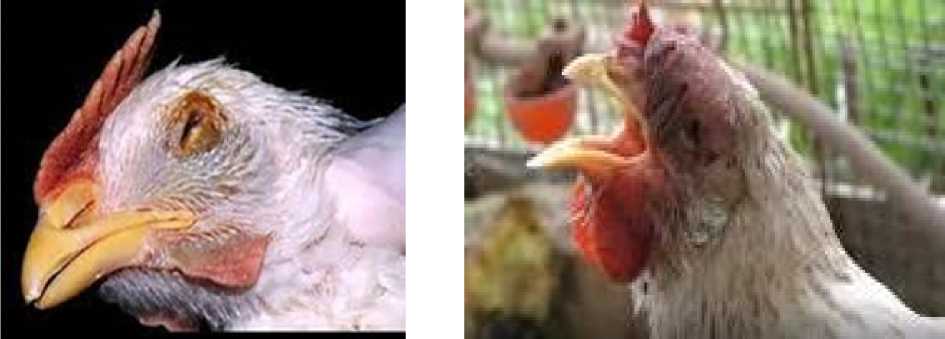
Figure 2. External signs of the disease
In the acute form, most birds get sick, and the illness lasts 3–5 days. Birds shake their heads when breathing, trying to get rid of mucus accumulated in the nasal cavity. Some sick birds stretch their heads forward and make sounds similar to suffocation.
In the subacute form of the disease, birds get sick relatively easily and recover within 2–5 days. The mortality rate is 2–10%. The most noticeable symptoms in this form are rhinitis and difficulty breathing. When conjunctivitis occurs, the disease is prolonged. The appetite of the bird decreases, and productivity goes down.
When the disease becomes chronic, it causes coughing, difficulty breathing, and conjunctivitis, and under favorable conditions leads to the death of 2–5% of diseased birds.
The conjunctival form of the disease is observed mainly in chickens aged 10–15 days. It is characterized by sclerotic inflammation of the conjunctiva, lacrimation, and photophobia. With the chronic course of the conjunctival form, birds develop fibrinous inflammation of the conjunctiva, clouding of the cornea, which leads to visual impairment, and sometimes to blindness. The conjunctival form sometimes occurs in combination with the laryngotracheal form [5-7].
Pathoanatomic changes. In the laryngotracheal form of the disease, significant changes are observed in the larynx and trachea. The mucous membranes of these organs are hyperemic, swollen, erosive and bleeding. Their sinuses are blocked by catarrhal or catarrhal hemorrhagic exudate. In most cases, a blockage consisting of fibrinous-caseous mass is found in the larynx. Such blockages are sometimes also noticeable in large bronchi. Sometimes catarrhal inflammation is detected in the nasal and oral cavities of birds, and fibrinous deposits are found on the root of the tongue. In addition, some chickens have an enlarged spleen, catarrhal inflammation of the small intestine, fabricium sac and cloaca. With the conjunctival form, serous or fibrinous conjunctivitis is detected. On examination, a caseous formation is found in the conjunctival sac, sometimes clouding of the cornea and damage to the eyeball. The palate and the eye canal become inflamed, the eyelids swell, fill with fibrin, and the eye closes completely. Thus, the eye loses its function, and even pus comes out of the eyeball (Figure 3).
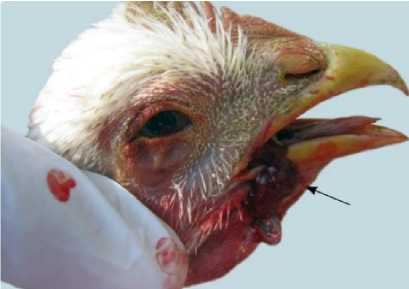
Figure 3. Fibrinous conjunctivitis
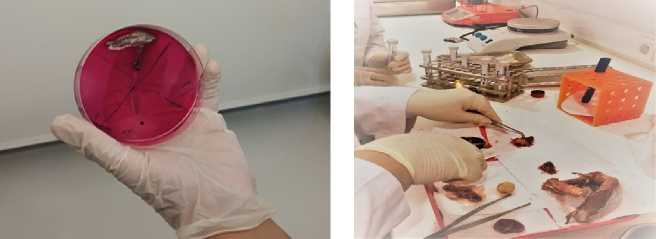
Diagnosis. To diagnose the disease, its epizootological characteristics, clinical signs and pathoanatomic changes are taken into account, as well as a bacteriological study is carried out. To conduct a bacteriological study, 10-11-day-old chicken embryos are infected with a suspension of scrapings from the respiratory tract of birds in the laboratory. If the material contains a virus, numerous gray nodules appear on the chorioallantoid membrane of the embryo on day 4-5. Serological reactions are used to identify the isolated virus; chickens are infected at the age of 2-3 months. When making a diagnosis, epizootological data and the age of the bird are taken into account. Of the clinical signs, attention is drawn to difficulty breathing, rhinitis and conjunctivitis (Figure 4).
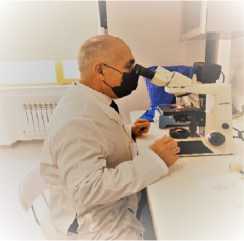
Figure 4. Work in the laboratory
It must be distinguished from Newcastle disease, smallpox, infectious bronchitis, respiratory mycoplasmosis, and vitamin A deficiency.
Treatment. There are practically no effective remedies for the treatment of sick birds. For preventive purposes and to prevent complications associated with secondary bacterial microflora, the combined use of broad-spectrum antibiotics and nitrofuran compounds, as well as trivitamins, is of particular importance. For each kilogram of live weight of an adult bird, 20,000 T. V. streptomycin in trivitamin or 1 ml of fish oil is administered intramuscularly 2-3 times with an interval of 7-8 days. At the same time, the replacement of the main part of the feed ration with amaranth and fenugreek grains, ground licorice root, which are plants with a phytobiotic effect, as well as the addition of 20
mg of furazolidone per kg of live weight of birds for 5 days, is considered an effective treatment measure.
Control and prevention measures. To ensure the well-being of poultry farms from infectious diseases, comprehensive economic, organizational, zoohygienic, and veterinary and sanitary measures should be implemented [1].
Birds that have had this disease develop lifelong immunity. Therefore, in order to combat the disease, in addition to taking veterinary and sanitary measures to prevent the virus from being brought into the farm from outside with incubation eggs, birds, feed, service items, people, etc., active vaccination is used in farms where there is a risk of infection and the disease occurs. Vaccination should be carried out according to the instructions for the vaccine used.
Before introducing a new group of birds to the farm, the premises are dried after reliable disinfection and left empty for 10 days when stored in cages and 14 days when stored in flooring conditions. A 27-day prophylactic is used once a year. Air exchange and microclimate should be monitored daily in poultry-houses.
In general, the concentration of ammonia inside the building should be 0.01 mg/l, hydrogen sulfide — 0.006 mg/l, carbon dioxide — 0.2%, and relative humidity — 60-70%.
If infectious laryngotracheitis is detected among birds, the department or farm is declared unhealthy and restrictive measures are taken to prevent the spread of the disease. It is forbidden to export birds of all ages, feed, things from the territory, and group birds within the farm. If the disease occurred for the first time, and it occurred indoors, it is advisable to immediately destroy all these birds. Their carcasses are processed in accordance with the rules of veterinary and sanitary inspection. Strict mechanical cleaning and disinfection of the building and the surrounding area is carried out. Sick and suspicious birds are slaughtered. Conditionally healthy birds are vaccinated with a dry culture of the viral vaccine. To prevent the disease, it is necessary to vaccinate the chicks with this vaccine at the age of 27-30 days. Poultry-houses and slaughterhouse are disinfected with 2% sodium hydroxide and chlorinated lime solutions containing 2% active chlorine heated to 45ºC. For disinfection in conditions where birds are present, 100 ml of a 3% solution of hydrogen peroxide is used for every 1 m3 of volume.
Vaccination against infectious laryngotracheitis in healthy chickens aged 1-4 months with the foreign-made CEBAK BRON aTa vaccine is carried out using the intraocular method. 1000 doses of the vaccine are dissolved in 30 ml of boiled and cooled water and injected. 1 drop (0.03 ml) is 1 dose.
The restriction is lifted in 2 months after the eradication of infectious laryngotracheitis and after the introduction of all sanitary measures [3, 4].
After the restriction is lifted, the transfer of the parent bird flock to other farms is not allowed earlier than after 6 months [4].
Iodized aluminum vapor is used to treat sick birds. To do this, crushed iodine and ammonium chloride powders are mixed in a metal cup, aluminum powder is poured on top, mixed again and hung on a wire hook. After hanging the required number of cups with mixtures, 3-4 drops of water are pipetted into each cup, starting from the furthest one. The treatment is carried out in the morning, before feeding. The premise is hermetically sealed in advance. The vapor of preparations should be effective within an hour. Then the air in the room is ventilated. The operation is repeated 2-3 times with an interval of 2-4 days [2, 3].
Given the urgency of carrying out general sanitary and preventive measures to combat the disease, the following measures are considered appropriate
-
- Implementation of protective and restrictive measures during the transportation of poultry and poultry products, as well as control over the grouping and movement of birds on the farm.
-
- Keeping poultry and poultry products imported into the republic and farms under preventive quarantine and conducting surveys.
-
- To ensure the resistance of birds to infectious diseases, the production of hereditarily resistant bird breeds through selection.
-
- To organize the provision of high-quality and rational feeding of birds and their keeping in appropriate zoohygienic conditions.
-
- To organize timely separation, isolation and treatment of sick birds during infections.
-
- To carry out systematic disinfection of poultry-houses, adjacent territories and care items.
-
- Collection and disposal of manure, feed residues, bird carcasses, waste from industrial and biological enterprises.
-
- Disinfection, disinsection and deratization on poultry farms in a systematic manner.
-
- Poultry farms should be regularly checked for rodents and ectoparasites, and wild birds should be prevented from entering poultry houses.
-
- It is necessary to organize full-fledged, high-quality and rational feeding of birds and their keeping in accordance with zoohygienic conditions.
Outcomes:
-
- To prevent the spread of laryngotracheitis among birds, it is necessary to regularly monitor the air quality in poultry-houses and the physico-chemical parameters of the air, especially the degree of microbial contamination should be checked periodically.
-
- The fact that amaranth and fenugreek grains, ground sweet licorice root from phytobiotically effective plants, are superior to other plant-based feeds in both chemical composition and nutritional value, as well as the presence of 19.9-21.3% linolenic acid in amaranth and fenugreek seeds, makes it possible to create highly effective immunity against infectious laryngotracheitis and other diseases by strengthening the immune system in birds and providing partial replacement of grain feeds, which are considered the main part of the feed ration in poultry farming.
