
Использование машинного обучения для сегментации ультразвуковых изображений скелетной мышцы
Журнал: Проблемы информатики @problem-info
Рубрика: Прикладные информационные технологии
Статья в выпуске: 3 (64), 2024 года.
Бесплатный доступ
В данной статье рассмотрены вопросы применения методов машинного обучения для сегментации ультразвуковых изображений скелетных мышц человека. Актуальность данного исследования заключается в сложности и длительности расшифровки медицинских материалов, а также субъективности и ошибках. Целью статьи является создание точной и эффективной модели сегментации здоровых скелетных мышц с использованием машинного обучения для метода ультразвукового исследования медицинской визуализации. Дтя построения модели сегментации скелетных мышц использовались архитектура U-net с различным количеством сверточных слоев, а также сеть U-net++, которая представляет собой модификацию классической U-net. Для обучения нейронной сети был использован набор данных ультразвуковых снимков скелетных мышц из открытых источников, для проверки были использованы ультразвуковые изображения скелетных мышц добровольцев с помощью акустической системы Verasonics. Были проведены обучение, анализ и тестирование модели нейросети, сравнение результатов обучения при различных модификациях и гиперпараметрах. Основным результатом исследования является получение эффективной модели нейросети и подтверждение потенциала ее применения для сегментирования ультразвуковых изображений скелетных мышц.
Похожие статьи в разделе Искусственный интеллект
Короткий адрес: https://sciup.org/143183465
IDS: 143183465 | УДК: 004.85 | DOI: 10.24412/2073-0667-2024-3-47-57
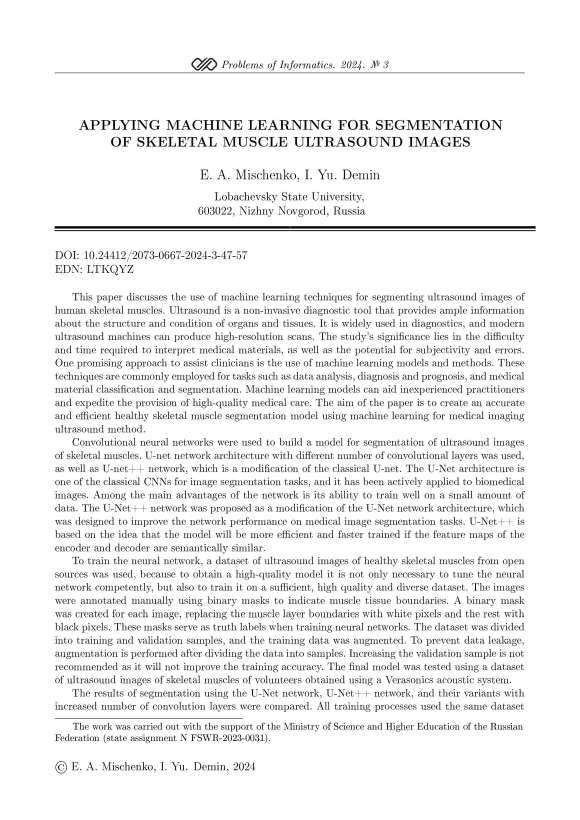
Applying machine learning for segmentation of skeletal muscle ultrasound images
This paper discusses the use of machine learning techniques for segmenting ultrasound images of human skeletal muscles. Ultrasound is a non-invasive diagnostic tool that provides ample information about the structure and condition of organs and tissues. It is widely used in diagnostics, and modern ultrasound machines can produce high-resolution scans. The study’s significance lies in the difficulty and time required to interpret medical materials, as well as the potential for subjectivity and errors. One promising approach to assist clinicians is the use of machine learning models and methods. These techniques are commonly employed for tasks such as data analysis, diagnosis and prognosis, and medical material classification and segmentation. Machine learning models can aid inexperienced practitioners and expedite the provision of high-quality medical care. The aim of the paper is to create an accurate and efficient healthy skeletal muscle segmentation model using machine learning for medical imaging ultrasound method. Convolutional neural networks were used to build a model for segmentation of ultrasound images of skeletal muscles. U-net network architecture with different number of convolutional layers was used, as well as U-net++ network, which is a modification of the classical U-net. The U-Net architecture is one of the classical CNNs for image segmentation tasks, and it has been actively applied to biomedical images. Among the main advantages of the network is its ability to train well on a small amount of data. The U-Net++ network was proposed as a modification of the U-Net network architecture, which was designed to improve the network performance on medical image segmentation tasks. U-Net++ is based on the idea that the model will be more efficient and faster trained if the feature maps of the encoder and decoder are semantically similar. To train the neural network, a dataset of ultrasound images of healthy skeletal muscles from open sources was used, because to obtain a high-quality model it is not only necessary to tune the neural network competently, but also to train it on a sufficient, high quality and diverse dataset. The images were annotated manually using binary masks to indicate muscle tissue boundaries. A binary mask was created for each image, replacing the muscle layer boundaries with white pixels and the rest with black pixels. These masks serve as truth labels when training neural networks. The dataset was divided into training and validation samples, and the training data was augmented. To prevent data leakage, augmentation is performed after dividing the data into samples. Increasing the validation sample is not recommended as it will not improve the training accuracy. The final model was tested using a dataset of ultrasound images of skeletal muscles of volunteers obtained using a Verasonics acoustic system. The results of segmentation using the U-Net network, U-Net++ network, and their variants with increased number of convolution layers were compared. All training processes used the same dataset of skeletal muscle ultrasound images, which was divided into training and validation in the ratio of 8/2. Accuracy and loU were used as metrics for evaluation. Callbacks such as Early Stopping, which stops training when the validation error is unchanged and ReduceLROnPlateau designed to adaptively adjust the learning rate when there is no improvement on the monitored metric were used, both calls track the required parameters for a certain number of epochs. These callbacks were used to prevent overlearning. In the context of this work, where the task was to classify a small number of classes and small size images were used, the three-convolution network did not perform better than the two- convolution network. This is because the more complex features that a three-convolution network can learn were not necessary for the task at hand. Under such conditions, the simpler two convolution network can learn more efficiently because it has fewer parameters and requires less computational resources. In addition, the simpler network is less prone to overlearning, which is an important factor in tasks with small amounts of data. A neural network model was trained, analyzed and tested, and a model that can segment ultrasound images of skeletal muscles was developed. In this study, it was shown that neural networks of U-Net and U-Net++ architectures can be effectively used for segmentation of ultrasound images of skeletal muscles. The main result of the study is to obtain an effective neural network model and to confirm the potential of its application for segmenting ultrasound images of skeletal muscles. The application of neural networks in medicine has a number of advantages, including improved diagnostic accuracy, reduced labour costs for physicians and increased speed of data processing.
Список литературы Использование машинного обучения для сегментации ультразвуковых изображений скелетной мышцы
- Shah et al. Artificial intelligence and machine learning in clinical development: translational perspective / / NP J digital medicine. 2019. 2. N 1. 69.
- Hill Bjember Dzh., Haar G. Ul'trazvuk v Fizicheskie osnovy primenenija: uchebnik. Moscow: Fizmatlit, 2008. 544
- Prakticheskoe rukovodstvo ul'trazvukovoj diagnostike. Obshhaja ul'trazvukovaja diagnostika. In V. V. Mit'kova (es). Moscow: Vidar-M, 2011. 720
- Vasil 'ev Ju. i dr. Artefakty v ul 'trazvukovoj diagnostike. Moscow: FGOU VUNMC Roszdrava. 2006.
- Cronin N. J. , Finni Seynnes Fully automated analysis of muscle architecture from B-mode ultrasound images with deep learning / / arXiv preprint arXiv:2009.04790. 2020.
- Mayeuf-Louchart et al. MuscleJ: analysis method to study skeletal muscle with new Fiji tool // Skeletal muscle. 2018. 8. 1--11.
- Mischenko Demin I. Yu. Ispol 'zovanie mashinnogo obuchenija dlja segmentacii UZI izobrazhenij skeletnoj myshcy // Trudy XXIII Mezhdunarodnoj konferencii (N. Novgorod, 13- 16 nojabrja 2023 g.). Nizhnij Novgorod: Nizhegorodskogo universiteta, 2023. 106- 111.
- Avetisjan S. Segmentirovanie ob'emnyh medicinskih izobrazhenij s ispol'zovaniem svertochnyh nejronnyh set ej. Master's degree, MGU im. Lomonosova Fakul'tet VMK. 2018. 58.
- Ronneberger Fischer Brox U-net: Convolutional networks for image segmentation / / Medical Image Computing and Computer-Assisted Intervention- MICCAI 2015: 18th International Conference, Munich, Germany, October 5- 9, 2015, Proceedings, Part III 18. Springer International 2015. 234- 241.
- Punn N. S., Agarwal S. Modality specific U-Net variants for image segmentation: survey / / Artificial Intelligence Review. 2022. 55. N 7. 5845- 5889.
- Zhou z. et al. Unet++: nested u-net architecture for medical image segmentation / / Deep Learning in Medical Image Analysis and Multimodal Learning for Clinical Decision Support: 4th International Workshop, DLMIA 2018, and 8th International Workshop, ML-CDS 2018, Held in Conjunction with MICCAI 2018, Granada, Spain, September 20, 2018, Proceedings 4. Springer International 2018. 3- 11.
- Hoorali F., Khosravi Moradi Automatic microscopic diagnosis of diseases using an improved UNet++ architecture / / Tissue and Cell. 2022. 76. 101816.
- Kozlova V., Kunica Ju., LukasheviCh U-net dlja reshenija zadachi segmentacii medicinskih izobrazhenij / / Pjataja Mezhdunarodnaja nauchno-prakticheskaja konferencija "BIG DATA and Advanced Analytics. DATA i analiz vysokogo urovnja". Minsk, Belarus'. 2019.
- Kalackaja L. V., Novikov V. Sadov V. S. Organizacija i obuchenie iskusstvennyh nejronnyh setej: Jeksperimental'noe uchebnoe / Minsk: BGU. 2003. 52- 72.
