
Level and quality of employment of households with children: (Non-)sustainability and dynamics in the new conditions of Russia’s development
Journal: Economic and Social Changes: Facts, Trends, Forecast @volnc-esc-en
Section: Social and economic development
Article in issue: 5 т.18, 2025.
Free access
The work is devoted to the study of the labor situation of households with children, as well as its dynamics in the new conditions of Russia's development after 2022. The information base for the research was formed by data from a specially organized survey conducted in 2024 among representatives of households with children using telephone interviews. The paper revealed the actual characteristics of households with children, which make up their socio-demographic and labor potential, determine the employment status of households and their (non-)sustainability, and set objective limits on the rate and quality of employment in households, some of which are beyond economic activity and working age. We carried out the identification of households with children belonging to different groups as the stability of their employment situation decreases, based on a comprehensive assessment. The criteria used for identification were: (I) realization of the household's labor potential, (II) stability and sustainability of employment in the household, and (III) employment potential to ensure the economic sustainability of the household. We determined the scale of these groups among households with children in general and by their types (as of 2024) – with stable, with relatively stable, with partially unstable, and with unstable employment status. The article revealed that the scale of groups among households with children increases with the “transition” from a stable to an unstable employment situation. The research proved that the prevalence of stable employment status reaches the highest values among households with one child (4.6%), unstable employment status among large households (78.8%)
Similar articles in the section Labour market. Employment

Short address: https://sciup.org/147252465
IDS: 147252465 | UDC: 331.5, 330.59 | DOI: 10.15838/esc.2025.5.101.7
Text of the scientific article Level and quality of employment of households with children: (Non-)sustainability and dynamics in the new conditions of Russia’s development
The research was supported by Russian Science Foundation 23-18-00537, 23-18-00537/, at the Institute of Economics, Russian Academy of Sciences.
Increasing the well-being of families with children belonging to vulnerable groups is one of the priorities of Russia’s agenda. The national project “Family” has been implemented since 2025, it includes five federal projects: “Family support”, “Large family”, “Protection of motherhood and childhood”, “Older generation”, “Family values and cultural infrastructure”1. In December 2024, the Presidential Council for the Implementation of State Demographic and Family Policy was established2. In March 2025, the Action Strategy for the implementation of family and demographic policy, support for large families in the Russian Federation until 2036 has been approved. The strategy is aimed, in particular, at supporting and protecting families as the basis of Russian society3.
The situation of households with children is determined by a complex of factors, among which those related with employment are significant. The level and quality of employment in households determine the financial situation of households, the degree of their financial resilience without using social support tools (Rzhanitsyna, 2019; Gulyugina, Odintsova, 2024; etc.). The level of employment in the household is determined by various circumstances, including the presence of objective constraints on employment among household members (for example, health, education), workfamily balance, the distribution of family responsibilities among household members, women’s difficulties returning to work after maternity leave (Pishnyak, Nadezhdina, 2020; Chernykh et al., 2023; Odintsova et al., 2023).
Childbirth affects the level of employment, transforms the employment strategies of parents (Cools et al., 2017; Aguilar-Gomez et al., 2019; etc.), and can lead to a decrease in the quality of employment (lower wages, transition to informal employment, etc.) (Berniell et al., 2023; Eberhard et al., 2023). Women are more vulnerable in terms of their employment (Querejeta, Bucheli, 2021), as well as parents with many children (Shakhmatova, 2013; Smoleva, 2019; Grishina, 2024). Parental employment also has specific features in terms of children’s age (the situation is worse in families with children under 7 years old) and household composition (parents’ relatives, their age) (Chen et al., 2023).
The specifics of household employment cannot help affecting their financial situation, which is the result of the “efforts” of household members, determined by the specifics of their employment and the level of income from it4 (Sinitsa, 2019; Temnitskiy, 2020; Odintsova et al., 2023; etc.). Households with the unemployed have higher risks of monetary poverty or deprivation (de Graaf-Zijl, Nolan, 2011; Korchagina, Prokofieva, 2023). Insecure, temporary and precarious employment also have negative consequences for households (Lewchuk et al., 2015; Auguste et al., 2023; Mussida, Sciulli, 2024; Perez-Corral et al., 2024). Families where the primary breadwinner is a woman, including single-parent families, are more vulnerable (Calegari et al., 2024; McErlean, Glass, 2024).
We consider the features of involvement in employment and its quality within the integrated assessment of the situation of households with children. The research perspective chosen in this paper when assessing the employment situation of households with children is associated with security. In modern research, it is studied mainly in one of the corresponding areas: economic resilience (Rzhanitsyna, 2019; Bobkov, 2019a; Gulyugina, Odintsova, 2024), financial resilience5, housing precarity (Debrunner et al., 2024), employment precarity (Bobkov, 2019b; Toshchenko, 2022) and others. This work allows us to develop a more comprehensive view of the situation of households with children, which is assessed taking into account households’ employment security (precarity) and their economic resilience (vulnerability).
The object of the study is households with a child (children) (hereinafter referred to as households with children, households). The subject of the study is the employment of households with children. The aim is to identify the employment security (precarity) of Russian households with children and its dynamics compared to 2022, which marked the beginning of a new stage in Russia’s development.
The scientific novelty of the work lies in the consideration of employment as an integral characteristic of households within the paradigm of “security” – “precarity”, qualitative and quantitative identification of groups of households with children, differing in employment security.
The significance of the study lies in identifying the criteria determining employment security (precarity) of households with children in general and depending on the number of children. The findings have practical significance in the context of the development of public policy aimed at improving the situation of families with children, in the field of employment and increasing real incomes of the population.
Theoretical and methodological foundations of the research
The employment situation of a household with children was considered in this work as an integral, general characteristic reflecting the employment status and its quality for the household members. The employment situation was assessed in the “security – precarity” paradigm.
The issue of employment security has been most elaborated in terms of identifying precarious employment (Bobkov, 2019b; Toshchenko, 2022; Kreshpaj et al., 2020; Padrosa et al., 2021; etc.), its identification is based on an assessment at the individual level. The topic of security (precarity) is also being explored in terms of financial situation (Gulyugina, Odintsova, 2024), housing conditions (affordability, safety of housing, etc.) (Clair et al., 2019; Debrunner et al., 2024; etc.), while measurement is carried out at the household or population level. In this study, the issue of security (precarity) was considered at the level of households with children as part of an assessment of their employment situation resulting from the “contribution” of all household members to it.
Household’s employment security (precarity) indicates the (in)ability to ensure economic resilience by employment, considering the employment status of economically active members of the household and the dependent-care responsibility of the employed. The assessment of the household’s employment situation regarding its security (precarity) was based on the following criteria.
-
I. Achievement of the household’s labor potential. This criterion allows us to consider the involvement of household members in employment. In other studies, it can be measured, for example, using work intensity – how much all working-age household members actually worked compared to their potential6. In our study, the situation was considered in more detail. The assessment based on this criterion took into account the ratio of the employed to the unemployed in the household among people aged 15 and over, the presence of the employed not achieving their labor potential (for example, having part-time job or overqualified for their job), the presence of the unemployed aged 15 and over not achieving their labor potential
and/or with objective employment restrictions (permanent or temporary)7.
-
II. Stability, security of employment in the household. This criterion reflects the quality of employment in the household, which can also affect the situation of households (Lewchuk et al., 2015; Perez-Corral et al., 2024; etc.). In our assessment, we considered the presence of the employed aged 15 years and over in the household, whose employment has (two or more) manifestations of precarity8 verified in previous studies9.
-
III. The labor potential to ensure the economic resilience of the household. Within the framework of this criterion, the possibilities of ensuring the economic resilience of the household living on income from employment were taken into account. Household well-being is an important indicator of the effectiveness of the employment behavior of its members (Temnitskiy, 2020). In our study, the threshold for the economic resilience of households was the socially acceptable consumer budget (SACB), reflecting a higher quality of life relative to the living wage due to a broader list of socially significant needs. The SACB takes into account the principle of self-sufficiency, which provides for payments for accommodation and utilities without external subsidies. Financial self-insurance is also provided through the targeted savings aimed at maintaining well-being in unexpected or unfavorable circumstances by creating a financial
reserve, purchasing passenger transport (a car) and improving housing. At the household level, the SACB value varies depending on the type and composition of the household10 (Gulyugina, Odintsova, 2024).
The highlighted characteristics, considering the data available for the analysis, allow studying the involvement of household members in employment, including members who have objective reasons for being unemployed. In other words, to identify how much household resources are “exhausted” to provide income through employment, as well as to determine employment opportunities in jobs requiring different skill levels, leading to discrepancies between incomes from employment.
In addition to assessing the current employment situation of households with children through the lens of its security (precarity), this study also revealed changes which caused the current situation. Changes in the number of people working in the household, in the quality of employment, in the general level of income from employment in the household, etc. were considered. The “reference point” for identifying changes was February 2022, which marked the beginning of a new stage in Russia’s development with new constituent entities in its composition, the beginning of a special military operation, and increased external sanctions pressure.
Data and methods
The information base of the study includes data collected during a survey of representatives of households with children, specially organized as part of the scientific project 23-18-00537 of the Russian Science Foundation11. The survey was conducted in the summer of 2024 using telephone interviews based on a random probability sample of landline and mobile phone numbers among the Russian population of 18 years old and over living in households with children aged 15 years old and younger. The sample size is 842 effective interviews.
Due to the absence of a set of data necessary for the study in open sources (statistical observations, non-governmental monitoring), the survey provided a real time assessment of the situation for 2024, as well as the dynamics compared to February 2022.
The information collected in the survey provides a comprehensive picture of the characteristics of the social and labor situation of households with children, including those missing from official statistics and publicly available databases of household monitoring surveys: quality of employment and its security (precarity), (in) security of income and its sources, (in)security of expenditure and consumption, needs and opportunities to improve housing, financial and saving strategies, changes in characteristics of the employment situation and standard of living in the period after February 2022. The work focuses on characteristics affecting the employment status of households with children. The survey results were processed and analyzed using SPSS and Excel.
The results of an earlier expert survey conducted with our participation were also used for the analysis, it discussed current risks for the social and labor situation of households with children, including employment risks (Odintsova, 2024).
Findings
Socio-demographic and labor potential of households with children as a basis for the development of employment security. The ratio of adults to children determines the potential dependent-care responsibility in households, which is important in terms of building their security. As follows from the collected data (Tab. 1), in families with one child, the number of adults corresponds to (25.8%) or exceeds the number of children (74.2%). In households with two children, the number of adults most often corresponds to the number of children (68.4%), in a significant group of households it is less than the number of children (22.1%), in few households it exceeds their number (9.5%). In large families, the number of adults is usually less than the number of children (83.0%), in some households it exceeds or corresponds to the number of children (17.0%). The age of children (in most cases it does not exceed 15 years) is also important as it influences the amount of time spent on caring for them, has impact on work-family balance and can result in a decrease in adult employment, as well as change prospects (considering future employment of grown-up children).
Table 1. Socio-demographic and labor potential of households with children, % of households of the corresponding type
|
Indicator |
Types of households with a child (children) (under the age of 18) |
||
|
With one child |
With two children |
With three or more children |
|
|
Number of people aged 18 years old and over in the household |
|||
|
1 |
25.8 |
22.1 |
16.3 |
|
2 |
61.1 |
68.4 |
66.7 |
|
3 or more |
13.1 |
9.5 |
17.0 |
|
Number of people aged 15–18 years old in the household |
|||
|
1 |
8.8 |
29.4 |
30.2 |
|
2 |
0.0 |
1.2 |
6.9 |
|
3 or more |
0.0 |
0.0 |
0.0 |
|
Number of people with secondary vocational or higher education in the household, including an academic degree |
|||
|
No |
5.0 |
6.2 |
14.6 |
|
1 |
33.0 |
30.7 |
22.2 |
|
2 |
56.0 |
56.7 |
53.7 |
|
3 or more |
6.0 |
6.4 |
9.5 |
|
Presence of people with objective employment restrictions (disability, serious health problems that limit employment) in the household |
22.7 |
17.5 |
23.3 |
|
Presence of … in the household |
|||
|
people working at more than one job |
15.9 |
16.9 |
18.2 |
|
working students |
4.3 |
4.3 |
8.2 |
|
people working with disability, serious health problems that limit employment |
13.4 |
10.7 |
12.6 |
|
working pensioners |
2.6 |
3.7 |
3.8 |
|
Source: estimated based on the survey conducted in the summer of 2024. |
|||
The labor potential of households with children is characterized by the fact that the majority (more than 80%) of them have at least 1 person with secondary vocational or higher education, and more than half of the households have 2 people with this level of education. The level of education is important as it influences job opportunities and, consequently, the potential level of income from employment, which is important for the development of security of the household.
In some households, there are people with objective employment restrictions (disability, serious health problems that limit employment). There are 22.7% such households among families with one child them, 17.5% among families with two children, and 23.3% among large families. However, in some households, people worked despite the presence of objective reasons for being unemployed: students (from 4.3 to 8.2%); disabled people or those with serious health problems that limit employment (from 10.7 to 13.4%); pensioners (from 2.6 to 3.8%). In addition, there is a double employment – the presence of a primary and additional job
(a second permanent or regular job, additional casual earnings). It was detected in 15.9% of families with one child, in 16.9% of families with two children and in 18.2% of large families.
Household employment and its security (precarity): an assessment of the current state . Considering the period when the survey was conducted, the assessment of the actual employment situation of households was carried out for 2024 (summer). It has been revealed that the obtained characteristics of the socio-demographic and labor potential of households with children have influenced an employment situation so that it has the following features in terms of security (precarity).
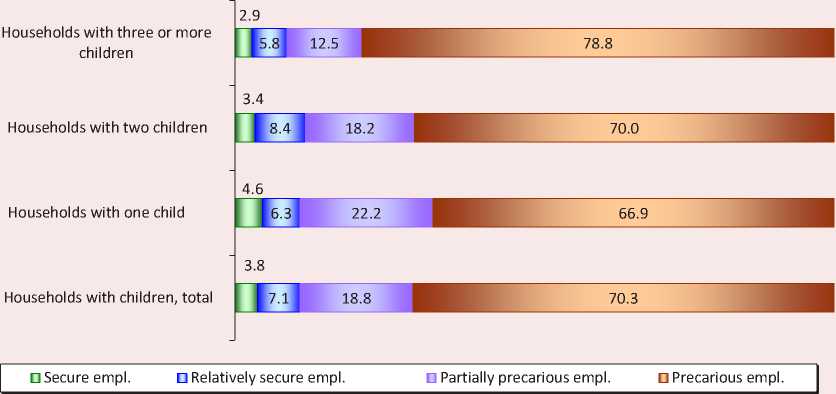
Secure employment distinguishes households with fulfilled labor potential, in which all members aged 15 years old and over are working, while jobs are secure, which ensures economic resilience of households. Their share among households with children in general is only 3.8% ( Fig. 1 ). When considered by household type, the proportion of those characterized by secure employment
Figure 1. Distribution of households with children according to the security (precarity) of their employment situation, % of households of the corresponding type
Source: estimated based on the survey conducted in the summer of 2024.
decreases with an increase in the number of children in the household: 4.6% among households with one child, 3.4% among households with two children, 2.9% among large families.
Relatively secure employment distinguishes households where labor potential may be underachieved, and work may be insecure, but income from it can ensure economic resilience of households. Such an employment situation was found in 7.1% of households with children in general, in 6.3% of families with one child, in 8.4% of families with two children, and in 5.8% of large families.
Partially precarious employment characterizes households with fulfilled labor potential, in which all members aged 15 and over are employed, whose work is secure, but income from it does not allow households to ensure economic resilience even if there are other sources of income (social benefits, etc.). In general, 18.8% of households with children have such an employment situation, 22.2% of families with one child, 18.2% of families with two children, and 12.5% of large families.
Precarious employment distinguishes households where labor potential may be underachieved, and employees may have insecure jobs. Moreover, income from employment does not allow house- holds to ensure economic resilience even if there are other sources of income (social benefits, etc.). Precarious employment is typical for 70.3% of households with children in general, 66.9% of families with one child, 70.0% of families with two children, and it is even more common among large families (78.8%).
Changes in the employment situation of households with children in 2022–2024 . The actual employment situation of households is a consequence of previous processes reflecting changes in the labor market and employment sectors of household members. The analysis of the data obtained during the survey showed that in the period after February 2022, both negative and positive changes took place in the employment situation of households with children. In some households, job loss for various reasons was recorded ( Tab. 2 ). In particular, in 6.9% of households, one of the family members has lost his or her job or business. There are 6.3% of such households with one child, 7.4% with two children, and 7.6% among large families. In 1.4% of families with one child, someone has stopped working due to disability.
In 10.2% of households, one of its members has quit the job to take care of household members. Household members of both below working age (for
Table 2. Changes in the employment situation of households with children (February 2022 – summer 2024), % of households of the corresponding type
|
Indicator |
Households with children, total |
Including households |
||
|
with one child |
with two children |
with three or more children |
||
|
Someone of the household members: |
||||
|
has lost the job |
6.9 |
6.3 |
7.4 |
7.6 |
|
has been registered as a disabled person and quit the job |
0.6 |
1.4 |
0.0 |
0.0 |
|
has quit the job to take care of household members |
10.2 |
8.5 |
11.3 |
11.4 |
|
has retired and stopped working |
4.2 |
5.7 |
3.1 |
3.1 |
|
has got a new job, has started business |
9.8 |
10.2 |
7.4 |
13.9 |
|
has been promoted |
10.0 |
8.8 |
11.7 |
9.5 |
|
has been demoted |
4.3 |
4.8 |
4.6 |
2.5 |
|
has got an increase in pay |
32.4 |
32.4 |
32.5 |
32.1 |
|
has got a decrease in pay |
17.6 |
15.1 |
20.6 |
17.0 |
Source: estimated based on the survey conducted in the summer of 2024.
example, a newborn child) and working age (for example, a disabled person) could require care. These changes in the employment situation have occurred in 8.5% of households with one child, in 11.3% of families with two children, and in 11.4% of large families. In some households (9.8%), the opposite situation was observed – one of the household members has got a job or started business. The largest number of such households are among large families (13.9%), among families with one child their share is 10.2%, and among families with two children – 7.4%.
The changes have also affected people who were already employed in 2022–2024 or started working during this period. For them, there was downward/ upward occupational mobility. In 10.0% of households, someone has been promoted, in 4.3% of households, on the opposite, someone has been demoted. These changes were recorded, respectively, in 8.8 and 4.8% of families with one child, in 11.7 and 4.6% of families with two children, in 9.5
and 2.5% of large families. In addition, the level of labor income has changed in households. In general, in 32.4% of households with children, some people among the employed have managed to increase earnings, while incomes decreased in 17.6% of families. Among families with one child, the corresponding changes were recorded in 32.4 and 15.1% of households, among families with two children – in 32.5 and 20.6% of households, among large families – in 32.1 and 17.0% of households.
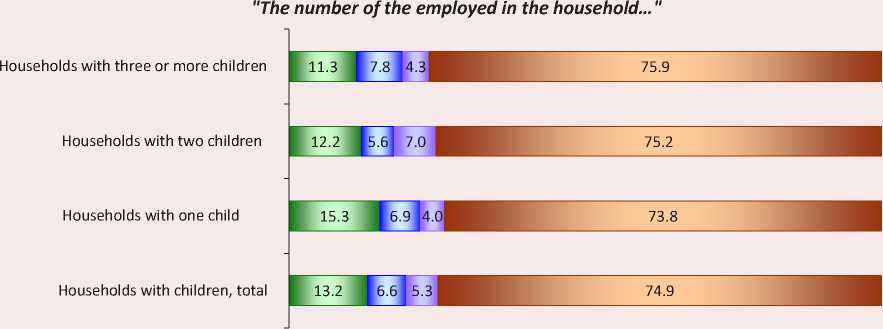
In general, the changes that occurred in 2022– 2024 led to the decrease in the number of the employed in 13.2% of households, to its increase in 6.6% of households, while in the rest (80.2%) nothing has changed or the number of the employed, despite the changes, remained the same ( Fig. 2 ). The number of workers has decreased/increased, respectively, in 15.3/6.9% of households with one child, in 12.2/5.6% of households with two children, in 11.3/7.8% of large families.
Figure 2. Change in the number of the employed in households with children (February 2022 – summer 2024), % of households of the corresponding type*
□ has decreased
□ has increased
□ has remained the same despite the changes
□ has not changed
*The figure does not show the percentage of those who answered “I don’t know”. Source: estimated based on the survey conducted in the summer of 2024.
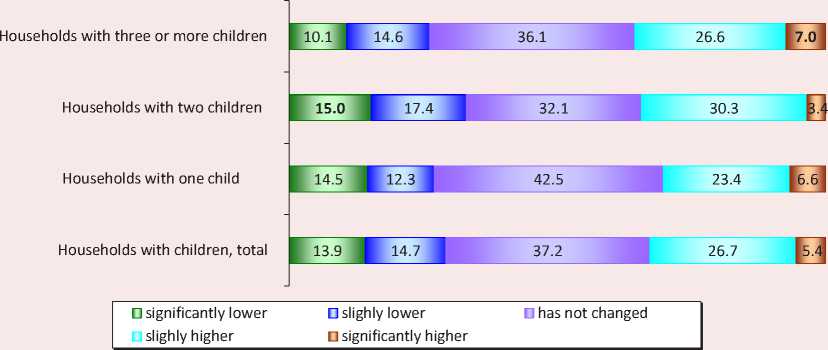
Figure 3. Change in the total level of income from employment in households with children (February 2022 – summer 2024), % of households of the corresponding type*
"The total level of labor income in the household has become…"
*The figure does not show the percentage of those who refused to answer or answered “I don’t know”. Source: estimated based on the survey conducted in the summer of 2024.
As a result, the total labor incomes of households have become significantly lower for 13.9% of households, slightly lower for 14.7%, slightly higher for 26.7%, significantly higher for 5.4%, and unchanged for the rest (37.2%) ( Fig. 3 ). Among families with one child, the ratio of those with the decreased/increased labor income was, respectively, 26.8/30.0%, among families with two children – 32.4/33.7%, among large families – 24.7/33.6%.
Discussion
The findings indicate that households with children have overcome the initial stage (2022– 2024) of a new phase in Russia’s development with varying degrees of success. The experience of households was both negative, associated with a decrease in employment security, and positive, expressed in the improvement of the employment situation and increased stability.
The findings of the survey regarding representatives of households with children allow us to make an assumption about the materialization of employment risks during the period under review and their impact on the employment situation of households. The collected data can be interpreted in the context of the results of an earlier study conducted on the basis of an expert survey aimed at identifying significant and relevant employment risks for households with children in the new conditions of Russia’s development after 2022 (Odintsova, 2024). Among them, the risks of involvement in non-standard, insecure forms of employment, a decrease in labor income, as well as the risks of “entering” the job market (issues of getting employed) and “exiting” from it (job loss) were identified. As the survey data showed, for some households with children in the period under review, the risks of job loss and/or retirement were relevant and significant. In households, some of the employed lost their jobs (about 7% of households faced these employment risks), retired due to disability (0.6% of households), or stopped working “voluntarily” to care for household members (10.2% of households).
More than a quarter of households with children faced risks of a decrease in their total labor income: 13.9% of households – with a significant decrease, 14.7% – with a slight decrease. This could be the result of a reduction in the number of the employed in the household (13.2% of households), downward labor mobility (4.3%), and/or income decrease experienced by someone among the employed in the household (17.6%).
Some of the households with children were not affected by employment risks during the period under review. On the contrary, the changes were positive: someone from the household has got a job, started his or her own business (about 10.0% of households), has been promoted (10.0% of households), someone’s labor income has increased (about a third of households). As a result, the number of the employed in 6.6% of households has increased, and a third of households have increased their total income from employment (slightly – 26.7%, significantly – 5.4%).
In general, an additional analysis showed that 20.6% of households with children went through negative changes in their employment situation during the period under review (they experienced at least one negative change in their employment situation from those listed in Table 2). In contrast, 31.2% of households had positive changes (at least one positive indicator from those listed in Table 2). Also, 8.2% of households had both negative and positive changes.
40.0% of households with children were not affected by any changes related to their employment situation during the period under review. Thus, we can assume that the existing secure (precarious) employment of these households, unlike other social groups, did not develop in 2022–2024, but is prior to this period.
The findings indicate that for some households (about 11%), the level of income from employment allows it to reach the threshold of economic resilience
(3.5 living wages per capita or more), even in the case of underachieved household labor potential, experienced insecurity/instability of employment among workers in the household (7.1%). In the majority of households with children (more than 80%), incomes are not sufficient to ensure economic resilience, including with the fulfilled labor potential and secure employment (18.8%).
An additional analysis showed that employment security of households with children is primarily undermined by the level of labor incomes. Given the current level of employment in the household and its quality, income from it does not allow the household to ensure economic resilience. This confirms the need to move to new guidelines in the field of income policy (Rzhanitsyna, 2019; Bobkov, Odintsova, 2024). The level of labor income is a consequence of the involvement of household members in it and the characteristics of its quality other than those connected with income (type, conditions of employment) (Korchagina, Prokofieva, 2023; Auguste et al., 2023). As the findings of the study showed, the second most common criterion leading to a decrease in the security of the household’s employment situation is their underachieved labor potential. Problems with the fulfillment of labor potential can be caused by the underachieved labor potential of workers (overqualification, etc.), the presence of people with objective employment restrictions in the household, and insufficient involvement of people without such restrictions in employment. Precarious and unstable employment is more rarely experienced by households with children than the other two reasons for decreased employment security.
The findings complement the accumulated results of other studies focused on the specifics of strategies for family workers’ participation in employment (Pishnyak, Nadezhdina, 2020; Chernykh et al., 2023; Cools et al., 2017; Chen et al., 2023), the issues of identifying the quality of employment and its precarity (Lewchuk et al., 2015; Padrosa et al., 2021), financial situation (Grishina, 2024). Combining several analysis vectors – the level and quality of employment in households and their “outcome” in the form of households’ (in)ability to achieve certain standards of living – allowed us to obtain new data arguing the importance of studying the relationship between employment and standards of living. In this study, the labor outcomes of household members are not considered in the context of monetary and non-monetary poverty (Calegari et al., 2024; Perez-Corral et al., 2024), but at a qualitatively different level: through the lens of security – precarity, delimited by the threshold of economic resilience of households, which is based on a socially acceptable consumer budget (SACB). Consideration of employment security (precarity), integrating different aspects of security, allowed for an appropriate classification of households with children, complementing a multidimensional approach to studying household security (Lain et al., 2020).
The findings of the study lead to the conclusion that it is important to continue research on the employment situation and its quality in households. The directions of further study on employment may include elaboration of strategies for the participation of household members with children in employment, which lead to the security (precarity) of their employment situation. During the study, the implementation of this task was limited by the capabilities of the tools: given the limited length of interviews, it was necessary to collect data not only on the household’s employment situation, but also on the household’s standard of living and their dynamics.
Conclusion
The study allowed classifying households with children in terms of their employment security measured using the household level of labor potential fulfillment, job security of workers, as well as the labor potential of workers to ensure the economic resilience of households. It was revealed that 3.8% of households with children have secure employment situation, 7.1% – relatively secure situation, 18.8% – partially precarious situation, and 70.3% – precarious situation. In about 30% of households, the security (precarity) of the employment situation was developed as a result of the “accumulation” of risks in the field of employment in the period 2022–2024, while in about 40% of households the current situation developed earlier.
Our findings expand the research field of the quality and standard of living of households with children, the factors in the development of these indicators; contribute to scientific knowledge about the relationship between the level and quality of employment in households and their economic resilience, supplementing it with new data on the features of secure (precarious) employment of different types of households with children; confirm that in order to improve the situation of households with children and increase its security, public policy should not only develop measures of social support for families with children, but also work on promoting employment, improving its quality and real labor income. The findings of the study may be in demand in the implementation of the national project “Family”, the Action Strategy for the implementation of family and demographic policy, support for large families in the Russian Federation.
