
LIVESTOCK PRESSURE AND ECOHYDROLOGICAL STABILITY OF THE ORKHON RIVER BASIN, MONGOLIA
Опубликовал: BAT-ERDENE MYATAV
Бесплатный доступ
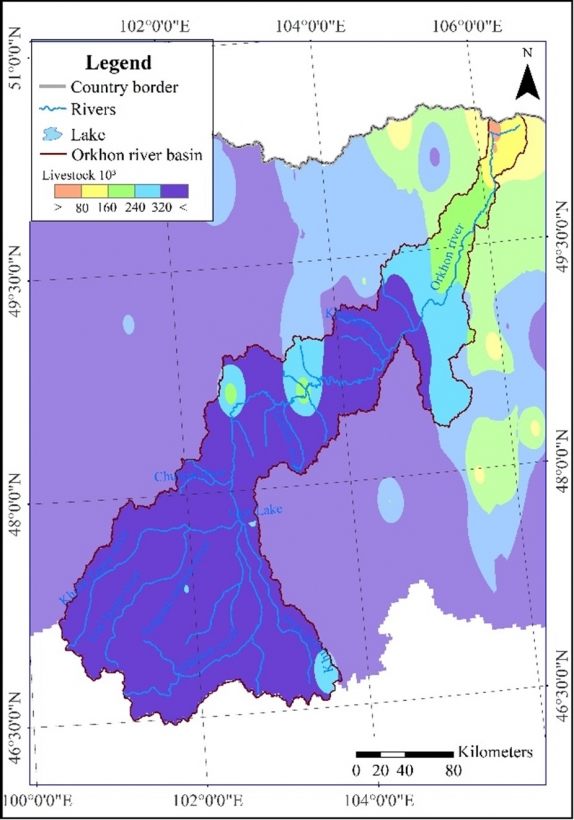
The Orkhon River basin is a major socio-ecological region of Mongolia where rangeland use, climate variability, and watershed processes are tightly coupled. This article investigates how growing livestock pressure reshaped ecohydrological stability in the basin during 1990-2025. The analysis is based on a focused synthesis of the author’s doctoral dataset, including official livestock statistics, Landsat-derived land-cover and vegetation information, hydrometeorological observations, and GIS-based spatial comparison of pasture use and environmentally sensitive sectors. The evidence indicates that total livestock numbers increased by about 2.2 times after 1990 and that herd composition shifted toward a larger share of goats. Grassland remained the dominant land-cover type, yet it became more variable through time, especially during dry periods and in areas exposed to concentrated grazing. Bare land expanded during major degradation intervals, while wetland and water-related surfaces contracted overall. The middle and southern parts of the basin show the strongest coincidence of intensified grazing, vegetation drought, and reduced ecohydrological buffering capacity. In practical terms, these changes lower infiltration potential, weaken soil-moisture retention, and make runoff generation more seasonally unstable. The article demonstrates that ecohydrological vulnerability in the Orkhon River basin cannot be attributed to climate forcing alone; it is reinforced by herd growth, herd-structure change, and uneven spatial concentration of grazing pressure. The results support climate-adaptive pasture management, carrying-capacity regulation, and basin-scale restoration planning.
Похожие статьи в разделе Природа. Охрана природных ресурсов. Угрозы окружающей среде и защита от них
Короткий адрес: https://sciup.org/11012404
IDS: 11012404
Фрагмент статьи LIVESTOCK PRESSURE AND ECOHYDROLOGICAL STABILITY OF THE ORKHON RIVER BASIN, MONGOLIA
Abstract
The Orkhon River basin is a major socio-ecological region of Mongolia where rangeland use, climate variability, and watershed processes are tightly coupled. This article investigates how growing livestock pressure reshaped ecohydrological stability in the basin during 1990-2025. The analysis is based on a focused synthesis of the author’s doctoral dataset, including official livestock statistics, Landsat-derived land-cover and vegetation information, hydrometeorological observations, and GIS-based spatial comparison of pasture use and environmentally sensitive sectors. The evidence indicates that total livestock numbers increased by about 2.2 times after 1990 and that herd composition shifted toward a larger share of goats. Grassland remained the dominant land-cover type, yet it became more variable through time, especially during dry periods and in areas exposed to concentrated grazing. Bare land expanded during major degradation intervals, while wetland and water-related surfaces contracted overall. The middle and southern parts of the basin show the strongest coincidence of intensified grazing, vegetation drought, and reduced ecohydrological buffering capacity. In practical terms, these changes lower infiltration potential, weaken soil-moisture retention, and make runoff generation more seasonally unstable. The article demonstrates that ecohydrological vulnerability in the Orkhon River basin cannot be attributed to climate forcing alone; it is reinforced by herd growth, herd-structure change, and uneven spatial concentration of grazing pressure. The results support climate-adaptive pasture management, carrying-capacity regulation, and basin-scale restoration planning.
Keywords: Orkhon River basin; livestock pressure; grazing; ecohydrology; grassland degradation; Mongolia; water resources.
Acknowledgements: This manuscript was prepared on the basis of the author’s doctoral research on climate change, land-cover dynamics, and water resources in the Orkhon River basin.
Список литературы LIVESTOCK PRESSURE AND ECOHYDROLOGICAL STABILITY OF THE ORKHON RIVER BASIN, MONGOLIA
- References
- Amgalan, M., et al. 2020. Changes and causes of environmental characteristics of Ogii Lake and Orkhon Valley, Mongolia. Journal of Asian Earth Sciences, 18(4), 199–211.
- Cao, Z., et al. 2022. Watershed ecohydrological processes in a changing environment: Opportunities and challenges. Water, 14(9), 1502.
- Caylor, K. K., Manfreda, S., Rodriguez-Iturbe, I. 2005. On the coupled geomorphological and ecohydrological organization of river basins. Advances in Water Resources, 28(1), 69–86.
- Dashdorj, B. 2023. Peak flow frequency analysis of the Orkhon River, Mongolia. In Proceedings of the Second International Conference on Resources and Technology (RESAT 2023).
- Dorjsuren, B., et al. 2021. Study on relationship of land cover changes and ecohydrological processes of the Tuul River Basin. Sustainability, 13(3).
- Ganguli, R. 2020. Water in Mongolia: sources, uses and issues, with special emphasis on mining. In Hindu Kush-Himalaya Watersheds Downhill: Landscape Ecology and Conservation Perspectives.
- Karthe, D., et al. 2014. Integrating multi-scale data for the assessment of water availability and quality in the Kharaa–Orkhon–Selenga river system. Environmental Earth Sciences.
- Karthe, D., et al. 2015. IWRM in a country under rapid transition: lessons learnt from the Kharaa River Basin, Mongolia. Environmental Science and Policy.
- Ma, J., Xue, X., Wang, P. 2024. Progress in ecohydrology research: theory, applications, and prospects. Advances in River Research, 4(3), 430–454.
- McGrane, S. J. 2016. Impacts of urbanisation on hydrological and water quality dynamics, and urban water management: a review. Hydrological Sciences Journal, 61(13), 2295–2311.
- Odongo, V. O., et al. 2014. Coupling socio-economic factors and eco-hydrological processes using a cascade-modeling approach. Journal of Hydrology, 518, 49–59.
- Tugjamba, N. 2021. Hydrography of Mongolia. In The Physical Geography of Mongolia.
- Yembuu, B. 2021. Climate and climate change of Mongolia. In The Physical Geography of Mongolia.
