
Лошадь у населения Сургутского Приобья в раннем железном веке
Журнал: Вестник Новосибирского государственного университета. Серия: История, филология @historyphilology
Рубрика: Археология Евразии
Статья в выпуске: 5 т.25, 2026 года.
Бесплатный доступ
Изучены останки лошадей из памятников раннего железного века Сургутского Приобья. Они найдены на памятниках калинкинской, белоярской и кулайской культур. Среди останков доминируют кости черепа. Найдены останки разновозрастных особей. Впервые получены данные о содержании изотопов 13С и 15N в коллагене костей лошадей из таежной зоны Западной Сибири. Анализ возрастного состава и изотопов показывает, что лошадь разводилась населением калинкинской и кулайской культур. Небольшое количество животных приводили из лесостепных районов. Лошадь использовали как верховое животное. Она играла важную роль в обрядах, что нашло отражение в материалах святилищ и культовых изделиях. В питании лошадь имела небольшое значение.
Похожие статьи в разделе Млекопитающие
Короткий адрес: https://sciup.org/147253844
IDS: 147253844 | УДК: 599.723.2(212.3:571.1)''6383'' | DOI: 10.25205/1818-7919-2026-25-5-73-86
The Horse in the Population of the Surgut Ob Region in the Early Iron Age
Purpose. During the Early Iron Age, three cultures existed in the Surgut-Ob River region: the Beloyarsk and Kalinkinskaya cultures (7th – 4th centuries BC) and the Kulai culture (4th – 3rd centuries BC – 3rd – 4th centuries AD). Horse bones have been found in some settlements belonging to these cultures. The aim of this study is to describe these finds and the methods of horse use. Materials and Methods. Horse remains from 11 settlements are described. Radiocarbon dating of five horse teeth from four settlements was conducted, and the δ13C and δ15N values in collagen were determined. Results. In the Surgut-Ob River region, horses were first recorded at sites of the Kalinkinskaya culture. They were also found in settlements of the later Kulaiskaya culture. No reliable finds have been found from the Beloyarsk culture sites. The horse remains are dominated by skull bones, which is due to taphonomic features. The most stable bones (teeth) from the accumulations (probably sacrificial sites) were preserved. Remains of young, immature, adult, and elderly individuals were found. Conclusion. Horses were initially imported from more southern regions. The age distribution and 13C and 15N isotope analysis indicate that horses were bred by the Kalinka and Kulai cultures. However, animals continued to be imported from southern regions. The main purpose of keeping horses was transportation and use as riding animals. Horses played an important role in rituals, as reflected in materials found in sanctuaries and religious artifacts. They played a minor role in the food industry.
Текст научной статьи Лошадь у населения Сургутского Приобья в раннем железном веке
Исследование выполнено за счет гранта РНФ «Стратиграфия, хронология и изотопные исследования памятников эпохи бронзы – раннего железного века Сургутского Приобья», № 24-28-00650,
The study was funded by the Russian Science Foundation grant “Stratigraphy, Chronology, and Isotopic Studies of Bronze Age and Early Iron Age Monuments in the Surgut Ob Region”, no. 24-28-00650,
Лошадь в западносибирской тайге впервые фиксируется на памятниках бронзового века Васюганья. Ю. Ф. Кирюшин отмечает, что при раскопках поселения Тух-Эмтор IV в слое эпохи развитой бронзы (тухэмторского этапа, середина – третья четверть II тыс. до н. э.) были найдены единичные кости и зубы нестарых особей низкорослой лошади (определение Э. В. Алексеевой). В слое поздней бронзы (тухсигатского этапа, последняя четверть II тыс. до н. э.) их было несколько больше [Кирюшин, Малолетко, 1979, с. 130, 160]. Он полагает, что население этого времени было знакомо с коневодством и что лошадь, которую разводили жители Васюганья, была близка к современной якутской лошади. В монографии не приводится статистика, а «единичные кости» и «несколько больше» не позволяют судить о реальном удельном весе коневодства.
В материалах раннего железного века количество находок костей лошадей на памятниках таежной зоны увеличилось. На васюганском (белоярско-васюганском) этапе они обнаружены на поселениях Степановское I и IV в Томском Приобье, но их количество незначительно [Чиндина, 1984, табл. 14, с. 130, 133–134]. На Степановском IV поселении в очаге жилища 8 были найдены кальцинированные кости минимум одной особи. Л. А. Чиндина пишет, что «лошадь составляла основу животноводческого стада у кулайцев повсеместно, не случайно ее образ нашел отражение в культовом литье» [Там же, с. 133]. Однако археозоологический материал этого периода остается ограниченным.
В конце раннего железного века, на саровском этапе, по мнению Л. А. Чиндиной, коневодство имело транспортную и продуктивную направленность [Там же, с. 134]. В южнотаежной зоне кости лошади найдены на Саровском городище. По Н. М. Ермоловой, останки минимум трех особей из жилища 7 – свидетельство употребления лошадей в пищу и того, что лошадиное мясо было одним из основных видов мясной пищи кулайцев [Ермолова, 1980, с. 11–12]. Скопление челюстей молодых лошадей над могилой в объекте 6 Саровского городища, остатки ног и челюстей вокруг ряда других объектов могут быть свидетельством жертвоприношений на городище [Чиндина, 1978, с. 53, 67].
Заметную роль лошади в хозяйстве и культуре населения таежной зоны отражают изображения всадников на металлопластике и гравировках, глиняной пластике, относящихся к раннему железному веку и свидетельствующих об использовании таежным населением лошади как верхового животного.
В Сургутском Приобье самые ранние находки костей лошади известны из памятников раннего железного века. В это время здесь существовали три археологические культуры (АК): белоярская, калинкинская и кулайская. Белоярская АК начала эпохи железа сформировалась на основе местной барсовской АК позднего бронзового века при участии пришлого населения атлымской АК. Чуть позже в Сургутское Приобье мигрировало население калин-кинской АК, истоки которой до конца не выяснены. Косвенные данные позволяют предполагать, что это могут быть районы южной тайги (Васюганье?) [Чемякин, 2008, с. 74–78; 2022, с. 246–247].
Белоярская и калинкинская АК существовали в первой половине раннего железного века, на белоярско-васюганском этапе (предположительно, VII–IV вв. до н. э.). В результате взаимодействия населения двух культур в Сургутском Приобье формируется свой вариант ку-лайской АК (IV–III вв. до н. э. – III–IV вв. н. э.) [Чемякин, 2008].
Костные останки лошади найдены на поселениях всех трех культур, но их точная культурно-хронологическая привязка не всегда была определена, а характеристика не опубликована. Остается открытым вопрос: разводило лошадей население этого района или получало их от южных соседей? Задачей данной работы является поиск ответа на этот вопрос на основе результатов изотопных анализов костей лошади.
Материал и методика
Материалом для исследований послужили находки костных останков лошадей на памятниках раннего железного века Сургутского Приобья. Они собирались более 50 лет. За это время часть коллекций, после их первичного описания, была утрачена. Произошли изменения в методике описания археозоологических коллекций, поэтому приводимые ниже описания не равноценны по информативности.
Культурные слои рассматриваемых археологических памятников формировались на песчанистых подзолистых почвах [Махонина, 2002, с. 157], для которых характерны высокая кислотность, промывной режим и хорошая аэрируемость. Все это создает крайне неблагоприятные условия для консервации и сохранения костной ткани. До нас доходят преимущественно кости, подвергшиеся действию огня, – карбонатизированные и кальцинированные. На памятниках Барсовой горы древнее эпохи раннего железа выявлены только такие останки
[Косинцев, 2002]. Из «сырых» костей лучше всего сохраняются зубы, другие кости доходят лишь в особых условиях – в ямах, очагах. Все это существенно ограничивает археозоологи-ческий анализ и значительно снижает его информативность. Тафономические особенности костных комплексов приводят к существенным смещениям получаемых археозоологических характеристик. Сохранение в культурном слое преимущественно зубов ведет к искажению соотношения отделов скелета и не позволяет дать оценку особенностей использования и утилизации животных. Дошедшие до нас скопления костей могут быть связаны со специфической деятельностью людей (жертвоприношения) и не отражают половой и возрастной состав используемых животных в хозяйстве и культуре населения. Почти полное отсутствие посткраниального скелета не позволяет описать экстерьер животных.
Индивидуальный возраст животных определяли по смене [Silver, 1969, p. 291] и высоте коронки [Levine, 1982, p. 233–242] щечных зубов.
Для анализа соотношения отделов скелета кости лошади были сгруппированы следующим образом (табл. 1): отдел «голова» – кости черепа, нижняя челюсть; «туловище» – позвонки и ребра; «проксимальные части ног» – лопатка, плечевая, лучевая, локтевая, бедренная, берцовая кости; «дистальные части ног» – карпальные и тарзальные кости, метаподии и фаланги 1–3.
Кости лошади найдены на шести поселениях калинкинской АК. На селище Барсова гора III/7 [Чемякин, Зыков, 2004, с. 105] они обнаружены в двух объектах. В жилище в центре поселения (объект 371) под слоем погребенной почвы была зафиксирована яма диаметром
Таблица 1
Количество костей и соотношение отделов скелета лошади из памятников Сургутского Приобья (экз. / %)
Number of bones and ratio of horse skeleton parts from the monuments of the Surgut Ob region (ex. / %)
Table 1
|
* Памятник |
Отдел скелета |
|||
|
голова |
туловище |
верхние части ног |
нижние части ног |
|
|
Калинкинская культура |
||||
|
Б. г. III/7, жилище 371 |
6/29 |
4/19 |
7/33 |
4/19 |
|
Б. г. III/7, яма |
1/100 |
0 |
0 |
0 |
|
Б. г. III/11 |
?/100 |
0 |
0 |
0 |
|
Б. г. III/12 |
1/25 |
0 |
1/25 |
2/50 |
|
Б. г. III/20 |
0 |
0 |
1/100 |
0 |
|
Кучиминское XIX |
2/100 |
0 |
0 |
0 |
|
Б. г-к I/9, «яма» 2 |
1/100 |
0 |
0 |
0 |
|
Б. г-к I/9, яма 3 |
1/100 |
0 |
0 |
0 |
|
Б. г-к I/9, яма 4 |
1/100 |
0 |
0 |
0 |
|
Белоярская культура |
||||
|
Б. г-к III/1, объект 320 |
1/100 |
0 |
0 |
0 |
|
Б. г. III/38 |
1/100 |
0 |
0 |
0 |
|
Кулайская культура |
||||
|
Б. г-к I/9, вал |
3/100 |
0 |
0 |
0 |
|
Б. г-к I/20 |
1/100 |
0 |
0 |
0 |
|
Б. г-к III/6 |
+/100 |
0 |
0 |
0 |
|
Сырой Аган 6 |
1/50 |
0 |
0 |
1/50 |
* В табл. 1 и 2 приняты следующие сокращения: Б. г. – Барсова гора; Б. г-к – Барсов городок.
45 см, глубиной 27 см, заполненная темно-коричневой супесью с хорошо сохранившимися костями лошади (Елькина М. В. Отчет…, 1974). Яма находилась под обваловкой и была выкопана до сооружения жилища, возможно, в ходе какого-то ритуала. В ней найдены часть скелета взрослого (10–12 лет) жеребца, включавшего все отделы скелета (см. табл. 1); нижняя челюсть и часть скелета молодой (до 6 месяцев) и нижние челюсти взрослой (5–6 лет) и старой (около 20 лет) особей лошади. Вместе с костями лошади найдена полная кисть самки бурого медведя. Вероятно, части туш и голов лошадей и кисть медведя являлись строительной (?) жертвой. Еще одна нижняя челюсть полувзрослой особи (3–4 года) была найдена под обваловкой или недалеко от стены с противоположной (относительно этой ямы) стороны постройки.
На селище Барсова гора III/11 раскопано одно жилище [Чемякин, Зыков, 2004, с. 106]. На его периферии и во внешних ямах, в том числе в яме II, найдены фрагменты челюстей и отдельные зубы лошадей.
На селище Барсова гора III/12 [Там же, с. 107] под стеной жилища 1665, очевидно, внутри постройки, рядом со скоплением керамики и камней, найдены нижняя челюсть взрослой лошади (6–7 лет), нижний конец лучевой кости, пяточная и таранная кости. Кости, возможно, от одной особи.
Селища Барсова гора III/19 и III/20 представляли собой скопление из 35–40 площадок и неглубоких впадин, в основном с обваловкой, относящихся минимум к двум культурам: белоярской (III/19) и калинкинской (III/20) [Там же, с. 110]. В очаге жилища 1 калинкинской АК найдена кальцинированная кость лошади (Чемякин Ю. П. Отчет…, 1990).
На Кучиминском XIX городище зубы молодой особи (18–30 месяцев) найдены в жилище 1, взрослой лошади (старше 6 лет) – в хозяйственной яме 5 (раскопки Л. М. Тереховой, 1986 г.).
Кости лошади обнаружены также на двух памятниках белоярской АК: городище Барсов городок III/1 и селище Барсова гора III/38. На городище Барсов городок III/1 (раскопки М. В. Елькиной, 1974 г.) нижняя челюсть взрослой особи лошади (8–10 лет) найдена в объекте 320. Было выполнено УМС-датирование зуба из нее. Возраст зуба 2093 ± 35 лет BP (табл. 2), или, в календарном исчислении, 339 г. до н. э. – 5 г. н. э. Эта дата соответствует финалу белоярской и калинкинской АК и началу кулайской АК. На основании археологического контекста эта находка отнесена к белоярской АК. Лошадь (или мясо лошади) в белоярском жилище могла оказаться в результате контактов с калинкинским населением, которое, по нашему мнению, также проживало в это время на Барсовой горе. Отметим, что рядом с этим жилищем находился объект 317 – жилище калинкинской АК (селище Барсова гора III/24), перекрывавшее вал городища. Поэтому не исключена вероятность, что челюсть лошади могла быть связана с ним.
Селище Барсова гора III/38 объединяет примерно 43 разновременные приподнятые площадки. Раскопаны два жилища и две хозпостройки (?) белоярской АК, жилище калинкин-ской АК и ряд объектов эпохи бронзы (Косинская Л. Л. Отчет…, 1993). Рядом с белоярским жилищем 1 найдены три зуба молодой (до 1,5 лет) лошади и нижняя челюсть молодой же лошади (возраст 18–24 месяца). Недалеко от последней обнаружена белоярская керамика.
С кулайской АК связаны находки на четырех поселениях. На городище Барсов городок I/9 выявлены три объекта с зубами лошадей. В центре линзы пестроцвета с включениями углей, размером 1,3 × 0,5 м, зафиксированной в толще вала в 15 см выше погребенной почвы («яма» 2), найдена нижняя челюсть взрослой (5–6 лет) лошади (см. рисунок, А ) (Чемя-кин Ю. П. Отчет…, 1974). На внутренней площадке городища зафиксирован ряд ям, в том числе две с зубами лошади. В центре ямы 3 размером 2,25 × 1,15 м и глубиной 25–30 см от погребенной почвы найдены развал сосуда и зуб, а рядом с ямой – бронзовое зооморфное изображение с привязанным к нему клочком меха [Чемякин, 2008, рис. 87, 1 ]. Яма 4 подпрямоугольной формы размером 1,8 × 1,2 м, глубиной 50–55 см от уровня погребенной почвы,
Таблица 2
Результаты анализа изотопов из памятников раннего железного века Сургутского Приобья
Results of isotope analysis from Early Iron Age sites in the Surgut Ob region
Table 2
|
№ * |
Памятник |
Вид |
Материал |
14С дата |
№ GV |
Дата 14С cal |
δ13C (‰ VPDB) |
δ15N (‰ AIR) |
C : N |
C (%) / N (%) |
|
1 |
Б. г. III/7, о. 371 |
лошадь |
зуб |
2218 ± 36 |
5878 |
385–177 гг. до н. э. |
–22,6 |
7,2 |
3,2 |
40,2/14,7 |
|
2 |
Б. г. III/7, о. 371 |
лошадь |
зуб |
2206 ± 35 |
5879 |
378–174 гг. до н. э. |
–22,5 |
6,8 |
3,2 |
41,5/15,2 |
|
3 |
Б. г-к III/1, о. 320 |
лошадь |
зуб |
2093 ± 35 |
5881 |
339 г. до н. э. – 5 г. н. э. |
–19,7 |
5,6 |
3,2 |
41,9/15,1 |
|
4 |
Б. г-к I/9, «яма» 2 |
лошадь |
зуб |
2434 ± 37 |
5882 |
752–405 гг. до н. э. |
–22,8 |
5,5 |
3,3 |
41,0/14,6 |
|
5 |
Сырой Аган 6 |
лошадь |
зуб |
2114 ± 36 |
5883 |
346–4 гг. до н. э. |
–22,8 |
3,5 |
3,2 |
40,0/14,7 |
|
6 |
Б. г. III/7, о. 371 |
медведь |
кость |
2230 ± 36 |
5880 |
390–197 гг. до н. э. |
–23,0 |
5,1 |
3,2 |
41,6/15,1 |
Номер соответствует номеру на графике (см. рисунок, Б ).
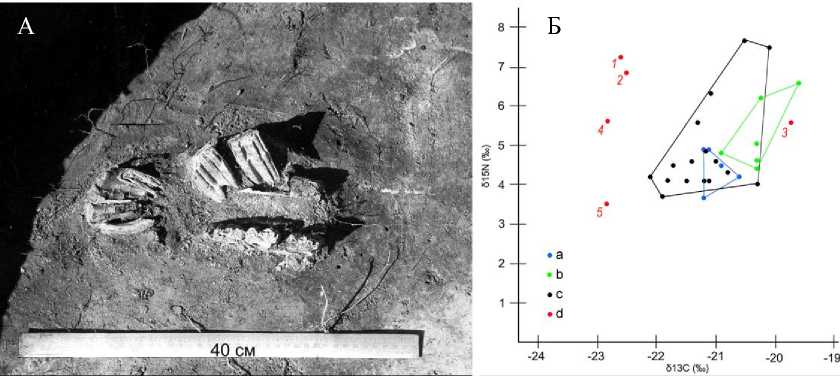
А – городище Барсов городок I/9, челюсть лошади в пятне («яме») 2 (фото 1973 г.);
Б – график распределения значений δ13C и δ15N (‰) в коллагене костей лошади из памятников Западной Сибири, лесостепная зона: а – поздний бронзовый век [Vasyuchkov et al., 2024]; b – финал бронзового века [Privat, 2004; Privat et al., 2005]; c – ранний железный век [Мыльникова и др., 2024; Privat, 2004]; d – ранний железный век Сургутского Приобья (номера на графике соответствуют номерам в табл. 2)
A – Barsov Gorodok I/9 fortified settlement, a horse’s jaw in the “pit” 2 (photo from 1973);
Б – graph of the distribution of δ13C and δ15N values in the collagen of horse bones from the sites of Western Siberia, forest–steppe zone: a – late Bronze Age [Vasyuchkov et al., 2024]; b – the end of the Bronze Age [Privat, 2004; Privat et al., 2005]; c – early Iron Age [Mylnikova et al., 2024; Privat, 2004]; d – early Iron Age of the Surgut Ob region (the numbers on the graph correspond to the numbers in table 2)
в ее северной половине лежали два зуба из нижней челюсти лошади. Еще три зуба лошадей найдены в толще вала, окружавшего городище, среди многочисленных прикладов в виде блях и культового литья кулайской культуры [Чемякин, 2012, с. 119] 1.
Предполагалось, что все зубы и челюсть лошади из городища Барсов городок I/9 связаны с кулайским святилищем на заброшенном городище калинкинской АК. Однако зуб из «ямы» 2, выявленной в 25–30 см ниже многих бронзовых изделий, дал дату 2434 ± 37 лет BP (см. табл. 2), или 752–405 гг. до н. э. Видимо, линза пестроцвета 2, как и ямы 3 и 4, перекрытые погребенной почвой, связаны с калинкинской культурой, материалы которой представлены на внутренней площадке городища. В то же время зубы лошади, найденные среди бронзовых изделий в толще насыпи вала, относятся к кулайскому святилищу рубежа эр. Со святилищным слоем связан и обломок глиняной скульптурки, изображающей, скорее всего, лошадь [Чемякин, 2008, рис. 87, 8 ]. Подобные фигурки были найдены на Потчевашском городище [Мошинская, 1953, табл. XII, XIII].
На городище кулайской АК Барсов городок I/20 [Чемякин, Зыков, 2004, с. 26–27], судя по ряду находок (бронзовые наконечники стрел, украшения, культовая металлопластика), кладу и погребению шамана (?), проживала элита кулайского общества. Спустя некоторое время после завершения его функционирования здесь возникло селище или мастерская ку-лайской же культуры. Судя по малочисленности находок и отсутствию стационарных объектов, селище (или мастерская?) было кратковременным [Борзунов, Стефанов, 2016, с. 39]. Находки из этих слоев представлены обломками кулайской керамики и тиглей, а также отдельными костями животных. Среди последних определены зуб и нижняя челюсть от двух взрослых (старше 6 лет) особей лошадей.
Несколько зубов лошади найдено в яме внутри жилища 1 на городище Барсов городок III/6 [Чемякин, Зыков, 2004, с. 50–51] 2. На нем, предположительно, также проживала кулай-ская элита. Рядом с ямой обнаружено культовое литье и бронзовый наконечник стрелы.
На селище Сырой Аган 6 рядом со скоплением тиглей найдена парная нижняя челюсть взрослой особи (5–6 лет), а на дне ямы – целая фаланга I лошади [Арефьев, Карачаров, 2003, с. 31]. Радиоуглеродная дата соответствует периоду кулайской АК (см. табл. 2).
Для изотопного анализа были отобраны два зуба от двух взрослых (5–6 и 8–10 лет) лошадей из объекта 371 селища Барсова гора III/7 (калинкинская АК), зуб взрослой (5–6 лет) лошади из «ямы» 2 на городище Барсов городок I/9 (калинкинская АК), зуб взрослой (5–6 лет) лошади из объекта 320 городища Барсов городок III/1 (белоярская АК – ?), а также зуб взрослой (5–6 лет) лошади из кулайского поселения Сырой Аган 6.
Анализ стабильных изотопов (δ13C и δ15N) и УМС-датирование выполнены в ЦКП «Ускорительная масс-спектрометрия НГУ-ННЦ» (Новосибирск). Методики пробоподготовки и определения значений изотопов описаны в [Мыльникова и др., 2024]. В полученных образцах коллагена атомное соотношение C / N – в диапазоне 3,2–3,3; содержание углерода (С) – ок. 40–42 мас. %; содержание азота (N) – ок. 14–15 мас. % (см. табл. 2). Эти характеристики свидетельствуют о том, что выделенный для анализа коллаген не претерпел значимых диагенетических изменений и имеет хорошее качество [DeNiro, 1985]. Калибровка радиоуглеродного возраста в календарный проведена на основе калибровочной кривой IntСal20 в программе OxCal 4.4.
Результаты и обсуждение
Останки лошади найдены минимум на шести памятниках калинкинской АК (2-я треть I тыс. до н. э.): селищах Барсова гора III/7, III/11, III/12, III/20, городищах Барсов городок I/9 и Кучиминское XIX. На памятниках белоярской АК достоверных находок пока нет, так как стратиграфическое положение останков лошади на поселениях Барсов городок III/1 и Барсова гора III/38 неоднозначно. Однако контакты белоярского населения с калинкинским вполне допускают такую возможность (на ранних белоярских селищах костей лошади нет). Найдена лошадь и на памятниках кулайской АК Сургутского Приобья: Барсов городок I/9, I/20, III/6, Сырой Аган 6.
Анализ соотношения отделов скелета (см. табл. 1) показывает, что 11 из 15 костных комплексов включали только останки голов. В трех комплексах найдены останки голов и других отделов скелета, и в одном комплексе – только останки верхних отделов ног. Такая необычная структура костных комплексов лошади связана с физико-химическими особенностями культурного слоя памятников (см. выше). Вероятно, сохранились в основном жертвенные комплексы. С одной стороны, они обычно включали головы и, реже, другие части тела, а с другой – их часто помещали в особые условия (ямы и др.), где они представляли скопления костей. Все это более способствовало сохранению в культурном слое костей из жертвенных комплексов. Таким образом, описанный материал не может быть использован для оценки реальной роли лошади в хозяйстве населения Сургутского Приобья в раннем железном веке.
Значение лошади в хозяйстве населения раннего железного века Сургутского Приобья, по нашему мнению, было заметным. Лошадь относительно хорошо приспособлена к жизни в лесу, так как способна преодолевать достаточно высокий снежный покров и добывать корм из-под снега. Большая физическая сила позволяет ей перевозить значительные грузы. Но, вероятно, содержали лошадей в основном не как транспортных животных, а как верховых. Об этом говорят находки изображений всадников как местного производства, так и привозные. Но оценить степень распространения всадничества имеющиеся материалы не позволяют. Элементы конской упряжи на памятниках раннего железного века Сургутского Приобья не найдены. Можно полагать, что под верх лошадей использовал ограниченный круг людей – «верхушка» общества.
Состав находок характеризуется наличием животных всех возрастных категорий: молодых, полувзрослых, взрослых и старых. Наличие молодых и полувзрослых особей указывает на возможное пищевое использование лошадей, хотя значение их как источника пищи, по сравнению с лосем, северным оленем и рыбой, было незначительным. Отметим находку челюсти лошади в возрасте до 6 месяцев на селище Барсова гора III/7. Маловероятно, что такое молодое животное привели из южных районов, из лесостепи. С большой долей вероятности жеребенок родился в этом регионе.
Описанные находки, скорее всего, отражают специфику комплексов, в которых они обнаружены (жертвенники). Лошадь имела особое культовое значение, и это способствовало ее распространению в таежной зоне. Она, несомненно, играла очень большую роль в ряде важных обрядов у населения раннего железного века. Жертвенными были комплексы на селище калинкинской АК Барсова гора III/7, святилище кулайской АК на городище Барсов городок I/9 (вал). В жертвоприношениях использовали особей разного возраста. Особую роль лошади в обрядах, а также как верхового животного подтверждают ее многочисленные изображения в металлической и глиняной пластике этого времени. Эту роль в культах и обрядах лошадь сохранила и позднее, преимущественно у обских угров [Мошинская, 1979, с. 33–43].
Анализ изотопных подписей δ13C и δ15N в зубах лошадей раннего железного века Сургутского Приобья показывает, что они образуют две группы, различающиеся по содержанию δ13C (см. рисунок, Б). Одна включает четыре особи с низким содержанием δ13C – от 23,0 до 22,5 ‰, а вторая – одну особь из поселения поздней белоярской культуры (?) Барсов городок III/1 с величиной δ13C = 19,7 ‰ (см. табл. 2). Различия между группами составляют 2,8 ‰. Такие существенные различия соответствуют различию между разными трофическими уровнями, но в нашем случае это животные одного вида, т. е. одного трофического уровня. Для животных одного трофического уровня различия в значениях δ13C могут быть связа- ны в основном с двумя факторами: во-первых, с историческими колебаниями содержания изотопа 13С в атмосфере [Bocherens, Drucker, 2003], если они жили в разное время; во-вторых, с различиями природно-климатических условий их жизни, если они жили в разных природных условиях. В частности, у травоядных животных, обитающих в лесной зоне, значение δ13C будет ниже, чем у животных открытых (степь) и полуоткрытых (лесостепь) ландшафтов вследствие эффекта «лесного полога» [Brooks et al., 1997]. Все наши образцы относятся к одному климатическому периоду (субатлантик 1) и часть (образцы из Барсова городка III/1 и Сырого Агана 6) синхронны (см. табл. 2). Иначе говоря, различия в значениях δ13C между ними не связаны с вековыми различиями в содержании 13С в атмосфере. Можно полагать, что особь из городища Барсов городок III/1 жила в условиях более открытых ландшафтов по сравнению с остальными лошадьми и попала в лесную зону незадолго до смерти.
Данные о содержании изотопов δ13C и δ15N в коллагене голоценовых лошадей из таежной зоны Западной Сибири отсутствуют. Но они имеются для лошадей позднего бронзового и раннего железного веков из лесостепной зоны Западной Сибири. Это могильник алакуль-ской АК Алакульский [Vasyuchkov et al., 2024], поселение финала бронзового века – начала раннего железного века Чича [Privat, 2004; Privat et al., 2005], городища раннего железного века Баитовское и Павлиново и могильник этого же времени Скаты [Privat, 2004].
Сравнение значений δ13C у лошадей раннего железного века Сургутского Приобья и у лошадей позднего бронзового и раннего железного веков лесостепи Западной Сибири показывает их существенное различие в значениях δ13C (см. рисунок, Б ). У животных лесостепи значения δ13C заметно выше, чем у лошадей из таежной зоны. Исключение составляет упоминавшаяся особь из городища Барсов городок III/1, у которой значения δ13C соответствуют значениям у лошадей из лесостепи (см. рисунок, Б ). Значения δ13C и δ15N в коллагене костей отражают питание животного в последние несколько лет жизни [Hedges et al., 2007]. Значение δ13C у особи из Барсова городка III/1 показывает, что последние несколько лет она, вероятно, жила в лесостепи, а в таежную зону попала незадолго до смерти.
Значения δ13C определены для трех особей в возрасте 5–6 лет – из двух селищ калинкин-ской АК (Барсова гора III/7, Барсов городок I/9), и одного – кулайской АК (Сырой Аган 6) (см. табл. 2). Они соответствуют значениям, характерным для таежной зоны. Это относительно молодые животные, и, если бы они какое-то время после рождения жили в лесостепной зоне, значения δ13C в коллагене их костей имели бы промежуточное положение между показателями, характерными для лесостепной и таежной зон (см. выше). Это указывает на то, что животные родились в таежной зоне, т. е. население калинкинской и кулайской культур Сургутского Приобья самостоятельно разводило лошадей.
Заключение
Изучение находок останков лошадей из памятников раннего железного века Сургутского Приобья показало, что лошадь здесь впервые фиксируется на памятниках калинкинской АК (вторая треть I тыс. до н. э.). Встречается она и на поселениях более поздней кулайской культуры. Достоверных находок на памятниках белоярской АК не известно. Эта аборигенная культура сосуществовала с калинкинской, и ее население, несомненно, было знакомо с лошадью, но мало использовало ее в хозяйстве. Среди дошедших до нас останков доминируют кости черепа, что связано с тафономическими особенностями. В основном сохранились наиболее устойчивые кости (зубы) из скоплений (вероятно, жертвенников). Найдены останки особей всех возрастов.
Очевидно, что первоначально лошадь была приведена из более южных, лесостепных или южно-таежных, районов. Результаты анализа возрастного состава и изотопов 13С и 15N показывают, что лошадь разводилась населением калинкинской и кулайской АК. Вместе с тем животных продолжали приводить из южных районов. Основной целью содержания лошадей было транспортное использование и как верховое животное зарождающейся военной прослойки. Лошадь играла важную роль в обрядах, что нашло отражение в материалах святилищ и культовых изделиях. В питании населения она имела небольшое значение. Со временем роль лошади в хозяйстве возрастала, при этом сохранялось ее значение как культового животного.
