
Methodology for Assessing the Export Potential of Arctic Mineral Resources in the New Conditions of Monopolistic Competition
Журнал: Arctic and North @arctic-and-north
Рубрика: Social and economic development
Статья в выпуске: 64, 2026 года.
Бесплатный доступ
The article analyzes theoretical and methodological approaches to the spatial organization of neo-geoconvergent development of the Russian Arctic economy in the context of the challenges of 21st-century postmodernity, characterized by high geopolitical instability and the destruction of traditional forms and models of the global economy. Estimation methods based on logarithmic linearization of the gravity equation suffer from serious specification inaccuracy due to omitted variables, which complicates the interpretation of results and leads to unreliable estimates. By contrast, models estimated using an extended specification that accounts for Arctic trade barriers significantly reduce the deviations caused by the influence of multilateral resistance factors, thereby enhancing the reliability of empirical estimates and conclusions. Applying our method to the example of coal reserve development, we demonstrate how the distance elasticity of trade changes when Arctic trade barriers are taken into account and find that the indicators of the Arctic coal industry’s development presented in government documents suffer from statistically significant inaccuracies. Trade elasticity coefficients in the traditional gravity equation are systematically lower than those obtained using logarithmically linearized regressions that account for Arctic trade barriers. This study is a continuation of a series of the author’s works devoted to the Newest General (and Special) Theory of Neo-Geo-Convergent Development of the Economy of the Russian Arctic.
Короткий адрес: https://sciup.org/148334381
IDS: 148334381 | УДК: [338.56:553:339.5](98)(045) | DOI: 10.37482/issn2221-2698.2026.64.42
Текст научной статьи Methodology for Assessing the Export Potential of Arctic Mineral Resources in the New Conditions of Monopolistic Competition
DOI:
The Russian Federation currently faces complex challenges: in the context of escalating geopolitical entropy, leading to the destruction of established forms and models of world order, it is becoming increasingly difficult to ensure sustainable and competitive growth of the national economy, integrated into global value-creation processes, without falling into isolation.
In order to advance national interests within the global system of new world economic relations taking shape right before our eyes, it is no longer sufficient to simply possess large natural resource reserves. It is necessary to propose globally attractive strategies that, based on the principles of mutually beneficial and competitive cooperation (Brandenburger, Nalebuff, 1996), ensure long-term economic growth and development. According to research by D. Moore (Moore, 1996), devoted to the principles of competition in the era of business ecosystems, the most effective long-term strategies are those aimed not at unilateral superiority (the so-called “zero-sum” game, where the winner takes all), but at cultivating business ecosystems that combine environmental influences, competition, and the evolution of multiple stakeholders. D. Moore termed this phenomenon “co-evolution”.
As L. Zobova rightly notes, “in today’s globalized world, the advantage belongs not to those who produce goods, but to those who manage their flows, attract financial resources and highly qualified personnel, and create and disseminate advanced technologies” (Zobova, 2012). Territories capable of influencing global exchanges develop a unique regional rent, which allows for more efficient and diversified resource management, ensuring their greater capitalization and liquidity.
The future global economic order currently remains uncertain. Therefore, Russia’s place in the new system of geo-economic coordinates will largely be determined by strategic choices and the development model of the national economy within the international division of labor. The latter means that at turning points such as today, when a new economic order is taking shape, the variability and significance of historical choices are particularly evident. In our opinion, such choices should be based on a solid scientific foundation, equipped with methodological tools with high predictive power for global economic dynamics. This will not only enable the formulation of a model for the country’s successful socio-economic development, consistent with Russia’s desired future role in the world, but also ensure the achievement of strategic objectives for the globally competitive development of the national economy within the international division of labor.
In this context, the effective use of the Arctic zone’s spatial and resource potential, which is a key factor in ensuring long-term sustainable economic growth for the national economy, is becoming an important element of state strategy, requiring appropriate methodological support that takes into account the new realities of the modern world.
Viewing the Russian Arctic economy as a global world-system project, we consider it necessary to discuss the neo-geoconvergent development of the Arctic economic space, which presupposes a harmonious combination of high-tech, internationalized production cycles of mineral resource extraction with transport and logistics activities facilitating international transit, with the Northern Sea Route serving as the hub for intermodal transport logistics linking the “West - East” and “North - South” international transport corridors (Agarkov, 2025).
Thus, the neo-geoconvergent development of the Arctic economy can be interpreted as the ability to create added value, spatially integrated into the global system of international and national division of labor, based on co-competitive principles of multi-level transregional interaction (Agarkov, 2025).
In relation to the topic of the study, the aim is to develop the methodological foundations for a neo-geoconvergent spatial organization of the Arctic economy, which reproduces a qualitatively new multiregional structure of co-competitive transregional (transnational) market interactions that generate spatially interconnected added value in the international and national division of labor.
The aim of the study is to assess the export potential of Arctic mineral resources under the new conditions of monopolistic competition.
An expanded specification of the gravity equation for trade in Arctic mineral and raw material resources has been developed, taking into account the specific economic and geographical characteristics of economic activity in the Arctic.
An assessment of the export potential of the economic development of Arctic coal deposits has been conducted.
The scientific novelty of the study lies in the development of methodological approaches for assessing the elasticity of trade by distance, taking into account factors of multilateral resistance that characterize the barrier coefficients of Arctic geography and transport logistics. The proposed approach allows for a more accurate assessment of the prospects for economic development of the Arctic zone’s resource potential and the scale effects of growth in Arctic extractive production.
Materials and methods
The basic hypothesis of the study is the empirically confirmed assertion that there is a strong correlation between the indicators of the scale effect of economic growth and market and supplier access, which forms the basis of the developed geoconvergent approach of the complementary spatial organization of the Arctic economy, integrated into the global and national space of value creation (Agarkov, 2025).
The empirical analysis of the Arctic energy resource export potential was based on the methodology of the new analytical trade model (NATM), developed to substantiate the neo-geoconvergent spatial organization of the Russian Arctic market economy. This model characterizes the freedom of trade in Arctic mineral resources in the N-regional economic (market) space Ω R ij in terms of organized proximity of market and supplier access (Agarkov, 2025):
Valras
V j ( S zz j Di,) = P ( Q A , C j : ^ ( SC □ D Q )
НАТМ : Я N =•
Q A = V ( K A, ): ^ ( V ;K Nash a V R ) ’ \ S j
ST( П ) = f Q - / e = 0
ex x = M ( AtT At m )’ □ £, I f (T )
The analytical NATM model (1), based on the theoretical framework of the NEG and the New International Trade, formalizes the conditions for competitive trade equilibrium for Arctic raw materials in a multiregional economic (market) space with a monopolistic competitive structure using the principles of multidimensional balance. The theoretical justification for the NATM is presented in detail in (Agarkov, 2025).
Empirical assessment of the NATM model
In this section of the study, we demonstrate how incorporating Arctic factors of economic geography and transport logistics allows us to create a trade gravity model with a much more plausible interpretation of the estimated export potential and expected scale effects of Arctic extractive industry growth.
Our basic hypothesis is that the current level of development of the Arctic zone’s transport and logistics infrastructure is a constraint on the development of Arctic extractive industry and the Arctic economy as a whole. We further argue that forecast estimates of the economic effects of Arctic extractive industry growth (including those within the framework of the NSR Development Plan1) should take into account the economic and geographical factors of multilateral resistance characteristic of the Arctic zone. Ignoring these factors in the models (specifications) used to forecast the development potential of the Arctic economy leads to a statistically significant bias in the expected growth effects due to omitted variables.
In order to test our hypothesis, we apply an extended version of the gravity equation developed within the NATM methodology (1), which takes into account multilateral resistance factors associated with Arctic economic geography and transport logistics, market and supplier access. Traditional estimation methods suffer from significant inaccuracy due to omitted variables in the specifications, leading to inconsistent estimates. Our approach, in contrast, avoids these problems, thereby enhancing the reliability of empirical estimates and making the interpretation of findings more robust.
In our study, we rely on the methodology proposed by Anderson and van Wincoop (Anderson, van Wincoop, 2003), interpreting the well-known gravity trade equation (2), taking into account Arctic-specific multilateral resistance factors (Arctic trade barriers).
xij
yi yj d n ij

(2),
where xy - value of exports from region (country) i to region (country) j; y.,y. — GDP of region (country) i and j; t.. — costs of trade between regions (countries) i and j; a — elasticity of substi-ij tution between goods of different countries (a > 1); d — distance between trading regions i and ij
j ; n — elasticity of trade by distance; p - coefficient (index) characterizing the multilateral resistance factors to trade between regions (countries) i and j.
The gravity equation (2) shows that bilateral trade between pairs of countries (regions) i and j depends on the scale of their economies y ,yy, the distance between them dtJ, and the factors of multilateral resistance (trade barriers) P , which influence the level of specific costs t ij ij of international (interregional) trade and economic relations (Anderson, van Wincoop, 2003). Following this logic, the basic specification of the empirical gravity model describing the export potential of Arctic mineral resources can be represented in the following log-linear form:
In EX jt = In Aim - nj ln T + £, (3), where lnEX... — logarithm of the expected (planned) export volume of Arctic raw materials; ij, t
In A sm — logarithm of bilateral market and supplier access, which characterizes the distance-weighted total volume of production capacity QA and consumer demand C A for Arctic raw materials, ln A sm = ln( Q A + C A ) d -1 ; dy — distance between the trading regions i and j ; n A — distance elasticity of trade, taking into account multilateral resistance factors characterizing the barrier coefficients of Arctic geography b A and transport logistics byiJ f, n = 1 + ( bA + bA ) = 1 + ^Al , £ — calculation error.
The gravity model (3) implies that the greater the negative impact of Arctic trade barriers bA L, the higher the distance elasticity of trade nA , which determines the magnitude of trade costs T associated with market and supplier access and, consequently, the lower the export potential ij of Arctic mineral resources (especially low-margin ones, such as coal, where transport costs account for a high proportion of the price).
In our approach, in the absence of trade barriers bAL = 0 , the elasticity of interregional (international) trade is equal to one ( nA = 1 ), meaning that specific market and supplier access trade costs increase proportionally with distance without additional cost-increasing factors affecting export potential (export volume). Accordingly, trade barriers associated with Arctic geography b A and transport logistics bA of market and supplier access increase the distance elasticity of trade
ПА > 1, and the less developed the transport and communications infrastructure (both domestic and transit) is within the economic space of the trading countries and regions, the greater this increase. In other words, the influence of trade barrier factors leads to an increase in the elasticity coefficient, which amplifies the impact of the distance effect on export volume. However, the functional dependence characterizing the trade costs T of interregional trade and economic rela-ij tions is not obvious and depends on the specific research question (see, for example, (Redding, Venables, 2004); Bosker, Garretsen, 2010)). It follows that there is a critical value of specific costs of transregional trade Tn = max:^ (nA ^^), when the export of Arctic raw materials becomes economically unprofitable, taking into account the marginal costs of extraction and transportation, which jointly characterize the survival threshold of companies (ST) in conditions of monopolistic competition, ST (Па, Tn) = 0 (see system of equations 1).
Thus, using Arctic barrier coefficients, we examine the remoteness and heterogeneity of the market and supplier access distance effects to test the hypothesis regarding how economic and geographic factors of multilateral resistance influence the export potential and economies of scale for Arctic extractive production growth.
It is assumed that with the development of multimodal transport logistics, the distance factor ceases to be decisive, and the role of remoteness in transregional trade and economic relations will diminish. In a model-based econometric interpretation, this will lead to a decrease in the distance elasticity of trade b^L ® 0, П ^ 1 .
Our specification (3) highlights some well-known constraints associated with high-latitude geography and transport logistics, which determine the specific nature of economic activity in the Arctic. This primarily concerns the Northern Sea Route (NSR), which is the main trunk route that forms the backbone of all transport logistics in the Arctic zone and facilitates domestic and international trade flows.
The main challenges associated with Arctic transport logistics include:
-
• insufficient development of port and navigation infrastructure;
-
• a lack of modern icebreakers and ice-class transport vessels capable of year-round operation in the extreme natural and climatic conditions of the Arctic;
-
• limited navigation season (a maximum of three months in open water, from July to October) and the need for icebreaker escort in certain areas, which significantly increases the cost of cargo transportation;
-
• relatively shallow waters of the Arctic seas, particularly the eastern sector of the Russian Arctic (more than half of the Laptev Sea and East Siberian Sea have depths of no more than 20 meters), which prevents large-tonnage vessels with deep draughts from navigating traditional shallow-water routes (Fig. 1) and requires the development of high-latitude routes, including reliable navigation support.
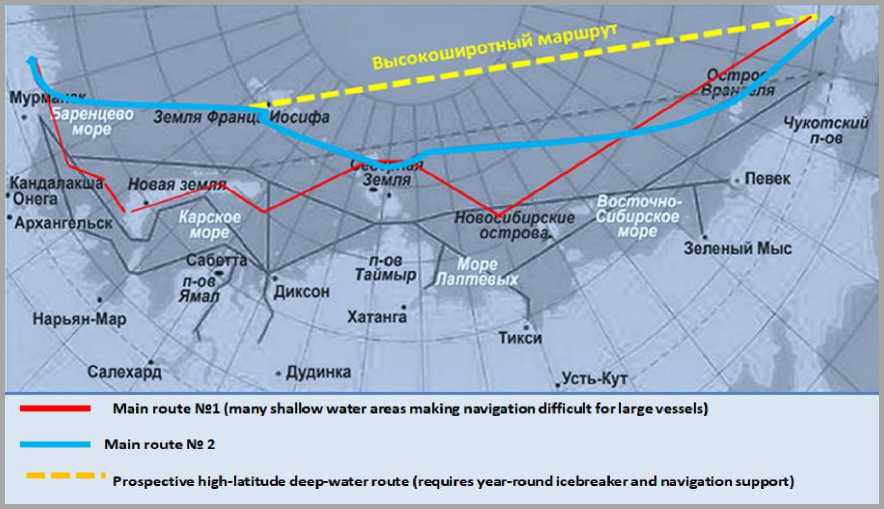
Fig. 1. Existing and prospective high-latitude (deep-water) routes of the Northern Sea Route2.
Research results
Empirical testing of the NATM trade model using the economic development of the Sy-radasay coal deposit as an example.
The Taimyr coal basin, one of the largest coal basins in Russia, is located in Krasnoyarsk Krai, on the Taimyr Peninsula, its development began in 2024. According to forecasts stated in the Northern Sea Route Development Plan until 2035, approved by Government Decree No. 2115-r of August 1, 20223 (hereinafter referred to as the NSR Development Plan), by 2035, the planned volume of coal production and export will be 113.8 million tons. However, in our view, these stated figures do not reflect the actual situation, as they do not take into account the economic and geographical factors of multilateral resistance characteristic of the Arctic zone.
Table 1 provides an overview of the key statistical data characterizing the assumptions and key indicators of the counterfactual scenario analysis of the potential economic development prospects of the Syradasay coal deposit until 2035.
Table 2 Scenario assumptions for the counterfactual analysis of the prospective economic development of the Sy-radasay coal deposit until 2035 4
|
2024 |
2025 |
2026 |
2027 |
2028 |
2029 |
2030 |
2035 |
total |
|
|
Physical volume of exports according to the NSR Development Plan (PhF), mln tons |
3.5 |
5.3 |
7.0 |
7.0 |
7.0 |
7.0 |
12.0 |
60 |
108.8 |
|
Forecast world price per ton of coal, US dollars |
average |
||||||||
|
1. "FIXING" — (fixed world coal price) |
150 |
150 |
150 |
150 |
150 |
150 |
150 |
150 |
150 |
|
2. "GROWTH" — |
150 |
160 |
170 |
180 |
190 |
200 |
210 |
240 |
205 |
2 Source: compiled by the author based on (Afonin, Telikov, 2017).
3 Order of the Government of the Russian Federation of August 1, 2022 No. 2115-r "On Approval of the Northern Sea Route Development Plan until 2035". URL: (accessed 12 August 2025).
4 Source: compiled by the authors.
(rising world coal price)
3. "FALL" —
(falling world coal price)
We are considering three scenarios:
-
1. The inertial scenario ( Inertial scenario, IS ) characterizes the current state of development of the transport and communications system, where navigation along the NSR lasts no more than four months and there is a complete absence of specialized ice-class bulk carriers to ensure the transportation of Arctic coal to sales markets. The calculated trade elasticity coefficient, taking into account multilateral resistance factors characterizing the barrier coefficients of Arctic geography b A and transport logistics b A^ (Formula 3), n A ~ 3,2 ^ ( navigat < 4 months );
-
2. The basic modernization scenario ( Basic modernization scenario , BmS ) is characterized by the pace of development of the Arctic transport and communications infrastructure and iceclass transport vessels, which ensures navigation for at least eight months a year, n A « 2,2 ^ ( navigation < 8 month );
-
3. The neo-modernization scenario ( Neo-modernization scenario , NmS ) is oriented towards the advanced and comprehensive development of the Arctic transport infrastructure, integrated into global transport corridors, which is based on the neo-industrial type of development of the Arctic economy, focused on the formation of a high-latitude transport and energy complex in the Arctic zone, integrated through a system of transport corridors into global processes (chains) of value creation. This requires an appropriate level of state involvement in strategically important areas of the long-term development of intermodal transport logistics and the advanced development of Arctic shipbuilding (see Fig. 5 for details (Agarkov, Ivanova, 2024; Agarkov, 2023)), n A ^ 1 ^ ( all - year navigation ) .
Thus, we evaluate the impact of Arctic trade barriers of economic geography bA and transport logistics bA on the expected economies of scale and export potential of the Syradasay deposit in three scenarios (inertial, IS ; basic, BmS ; neo-modernization, NmS ):
InS: n A ~ 3,2 ^ ( navigat < 4 months )
Et ( X , x; P , QAc , b AL ) = ‘ BmS: n A ~ 2,2 ^ ( navigation < 8 month )
NmS: n A ~ 1 ^ ( all - year navigation ~ 12 month )
where E ( X , t ) — planned physical volume of coal exports mined at the Syradasay deposit in period t = (2024 - 2035) ; e ( x P , t ) - planned monetary equivalent of the planned volume of financial revenues from coal exports mined at the Syradasay deposit in period t ; n A — elasticity of transregional trade, taking into account the barrier coefficients of Arctic geography b A and transport logistics bLA , ij for a pair of countries (regions) i and j .
The model showed that the maximum level of Taymyr coal exports in the “inertial” scenario ( IS ), which characterizes the current state of development of the transport and logistics complex, will amount (estimated) to no more than 44.2 million tons for the period up to 2035, or approximately 41% of the volume of 108.8 million tons declared in the NSR Development Plan. The current situation is characterized by a complete lack of ice-class bulk carriers (at least Arc4), which limits the possibility of transporting coal via the Northern Sea Route exclusively to the summer navigation period, lasting no more than four months a year (August–November). Therefore, approximately 64.6 million tons (which is 60% of the declared volume) will remain unexported.
In the basic “modernization” scenario ( BmS ), assuming the availability of specialized iceclass bulk carriers capable of navigating for up to eight months, export volumes could reach approximately 85-90 million tons by 2035, which corresponds to more than 78% of the volume stated in the NSR Development Plan.
Modeling revealed that only the neo-modernization scenario makes it possible to achieve the Arctic coal export targets set out in the SMP Development Plan, amounting to 108.8 million tons by 2035. This scenario envisages a strategy for neo-geoconvergent spatial development of the Arctic economic complex, complemented by the spatial organization of production and sales, ensuring diversified access for Arctic producers to domestic and global markets that generate demand for energy resources and other strategic raw materials (see (Agarkov, 2025) for more details).
Table 2 presents data on the export potential of Arctic energy resources based on a coun-terfactual scenario assessment of the expected cash flow (CF) for the economic development of the Syradasay coal deposit, taking into account the economic and geographical factors characteristic of the Arctic zone that create multilateral resistance to transregional trade.
-
Table 3
Projected cash flow (CF) from the development of the Syradasay coal deposit, million US dollars5
|
Scenarios for the development of Arctic transport and logistics infrastructure 1) |
Scenarios for the dynamics of global coal pric- es2) |
2025 |
2030 |
2035 |
total for the period |
in % |
|
mln USD |
mln USD |
mln USD |
mln USD |
|||
|
NSR Development Plan, СF (η=1.0), mln USD |
1320 |
6000 |
9000 |
16 320 |
100 3) |
|
|
1. Inertial scenario, СF (η ≈ 2.7), mln USD |
1. "FIXING" |
485.9 |
2208.6 |
3312.9 |
6 007 |
36.8 |
|
2. Basic modernization scenario, СF (η ≈ 1.4), mln USD |
935.2 |
4250.9 |
6376.4 |
11 562 |
70.8 |
|
|
3. Neo-modernization scenario, СF (η→1), mln USD |
1238.1 |
5627.7 |
8441.6 |
15 307 |
93.8 |
|
|
1. Inertial scenario, СF (η ≈ 2.7), mln t |
2. "GROWTH" |
505.4 |
2834.4 |
5300.6 |
8 640 |
52.9 |
|
2. Basic modernization scenario, СF (η ≈ 1.4), mln USD |
972.7 |
5455.3 |
10202.2 |
16 630 |
101.9 |
|
|
3. Neo-modernization scenario, СF (η→1), mln USD |
1287.8 |
7222.3 |
13506.6 |
22 017 |
134.9 |
|
|
1. Inertial scenario, СF (η ≈ 2.7) |
3. "FALL" |
466.4 |
1844.2 |
2473.6 |
4 784 |
29.3 |
5 Source: compiled by the authors.
|
mln USD |
||||||
|
2. Basic modernization scenario, СF (η ≈ 1.4), mln USD |
897.7 |
3549.5 |
4761.0 |
9 208 |
56.4 |
|
|
3. Neo-modernization scenario, СF (η→1), mln USD |
1188.4 |
4699.2 |
6303.1 |
12 191 |
74.7 |
-
1) reflects scenarios that take into account Arctic economic and geographic factors of multilateral resistance to transregional trade, depending on the level of development of transport and logistics infrastructure
-
2) reflects the data of the assumptions (Table 1)
-
3) the target indicator of the NSR Development Plan is taken as the baseline (100%)
As follows from Table 2, the targets specified in the NSR Development Plan (estimated at 16.3 million US dollars – 100%) can only be achieved if global coal prices rise. Calculations show that within the framework of the “basic modernization” and “neo-modernization” scenarios of spatially complementary development of the Arctic economy, these indicators will amount to 102% and 135% of the planned values, which in monetary terms amounts to 16.6 and 22.0 million US dollars, respectively.
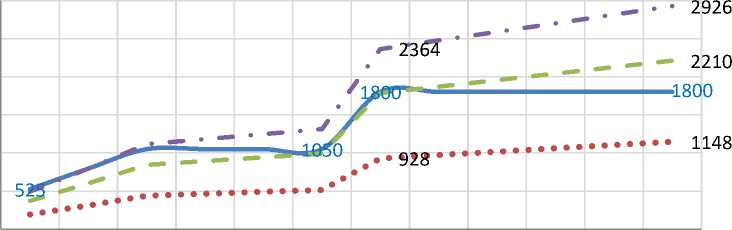
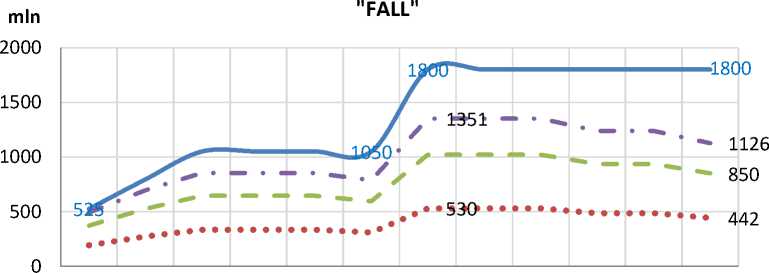
The graphs below (Figs. 2, 3, 4) illustrate the results of a counterfactual scenario analysis of the expected effects of the economic development of the coal reserves at the Syradasay deposit, conducted on the basis of the NATM (1) using an extended specification of the gravity equation (3), which includes barrier coefficients for Arctic economic geography and transport logistics.
The graphs (Figs. 1, 2, 3) illustrate the scale effect of growth in physical PhF and cash CF export flows in three scenarios, depending on the trade elasticity η A of Arctic energy resources, which characterizes the level of development of intermodal transport logistics, providing Arctic mining companies with access to sales markets. A high trade elasticity coefficient η A indicates underdeveloped transport and communications infrastructure, which, given the specific conditions of high-latitude Arctic geography, is a critically important factor negatively affecting international trade and the development of Arctic extractive industries as a whole.
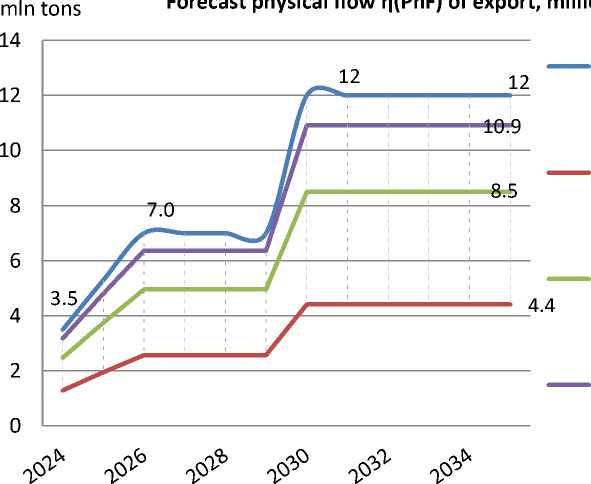
Physical volume of exports according to the NSR Development Plan (PhF), million tons
Basic modernist scenario, PhF (η ≈ 1.4), million tons
Inertial scenario, PhF (η ≈ 2.7), million tons
Neo-modern scenario, PhF (η → 1.0), million tons
tons
Fig. 2. Projected physical flow (PhF) of Taimyr coal exports, taking into account Arctic economic and geographical barriers, for the period up to 20356.
Financial flow (CF) of exports, million US dollars "GROWTH"
mln
^ ^ г^ гОг1 ^ ^ ^ ^ г^г ^ ^ ^
Northern Sea Route (NSR) development plan: CF (η = 1.0)
2. "GROWTH" - Inertial scenario, PhF (η ≈ 2.7), million tons
2. "GROWTH" - Basic modernist scenario, PhF (η ≈ 1.4), million tons
2. "GROWTH" - Neo-modern scenario, PhF (η → 1.0), million tons
Fig. 3. Projected cash flow (CF) of Taimyr coal exports, taking into account Arctic economic and geographical barriers, for the period up to 2035 (assuming rising global coal prices — the “Growth” scenario)7.
Financial flow (CF) of exports, million US dollars
^ гог5 ^ г^ ^ ^ ^ ^ ^г г^> ^ г^ ^^^^^^^м Northern Sea Route (NSR) development plan: CF (η = 1.0)
3. "FALL" - Inertial scenario, PhF (η ≈ 2.7), million tons
3. "FALL" - Basic modernist scenario, PhF (η ≈ 1.4), million tons
3. "FALL" - Neo-modern scenario, PhF (η → 1.0), million tons
Fig. 4. Projected cash flow (CF) of Taimyr coal exports, taking into account Arctic economic and geographical barriers, for the period up to 2035 (assuming falling global coal prices — the “Fall” scenario)8.
Overall, we find strong evidence that estimation methods based on logarithmic linearization of the gravity equation suffer from significant specification error due to omitted variables, which complicates the interpretation of the results and leads to unreliable estimates.
In contrast, models estimated using an extended specification that accounts for Arctic trade barriers significantly reduce the biases caused by multilateral resistance factors, increasing the reliability of the empirical findings.
Trade elasticity coefficients in the traditional gravity equation are systematically lower than those obtained using log-linearized regressions that account for Arctic trade barriers.
Thus, we have empirically confirmed the hypothesis that as multimodal transport logistics develop, including specialized ice-class vessels, the factors of high-latitude Arctic geography and remoteness cease to be decisive for international (interregional) trade and economic relations. In economic and mathematical terms, this would imply a decrease in the distance elasticity of trade.
Conclusion
This study analyzed the theoretical basis for substantiating the neo-geoconvergent spatial organization of the Russian Arctic market economy, which is reflected in the NATM analytical trade model. An empirically substantiated gravity model of Arctic energy resource trade was developed, taking into account the specific economic and geographical factors of multilateral resistance characteristic of the Arctic zone.
The presented methodological approaches were tested using the example of the economic development of the Syradasay coal deposit. The developed methodology was used to calculate the distance trade elasticity coefficients, taking into account the economic and geographical factors of multilateral resistance characteristic of the Arctic zone. The hypothesis was confirmed that the influence of the distance factor on trade diminishes over time as transport and communications infrastructure develops in a spatially complementary manner, ensuring unimpeded year-round access for Arctic mining companies to domestic and global markets that generate demand for raw materials.
The introduction of Arctic trade barrier indices into the gravity equation is important. This is a significant innovation that expands the applicability of gravity theory to Arctic economic conditions, including increasing the relevance of forecast estimates of export potential and the expected growth effects of Arctic extractive industries and the economy as a whole.
The proposed method enables a consistent and highly accurate evaluation of the theoretical gravity equation, taking into account the unique characteristics and specific features of Arctic economic geography and transport logistics.
This approach can be successfully applied to analyze the impact of various multilateral resistance factors on bilateral trade flows and to assess the effects of scale on Arctic economic growth. The results of this approach should be further developed and generalized in subsequent studies .
