
Моделирование и анализ нагрева окисляющихся слябов в методических печах
Журнал: Вестник Южно-Уральского государственного университета. Серия: Металлургия @vestnik-susu-metallurgy
Рубрика: Металлургическая теплотехника и теплоэнергетика
Статья в выпуске: 1 т.26, 2026 года.
Бесплатный доступ
Введение. В условиях повышения требований к качеству и экономичности процесса нагрева металла в методических печах задача создания и совершенствования алгоритмического обеспечения их систем управления, в частности, расчетно-инструментального контура обратной связи по температурному состоянию нагреваемых заготовок, является вполне актуальной. Цель исследования: рассмотреть особенности моделирования нагрева слябов в методических печах без явного учета и с явным учетом практически наблюдаемого на их поверхности окалинообразования. Материалы и методы. Выполнен анализ литературных источников и проведено обобщение известных результатов по проблеме моделирования нагрева слябов с явным учетом окалинообразования. Результаты. Приведена математическая модель несимметричного нагрева слябов с явным учетом поверхностного слоя окалины. Описаны особенности ее конечно-разностной аппроксимации методом сеток с подвижными узлами. На основании вычислительного исследования оценено влияние процесса окисления на нагрев заготовок в методических печах. Показана практическая допустимость математического описания нагрева слябов без явного учета поверхностного слоя окалины. Определена структура формулы для эквивалентного коэффициента теплоотдачи, что достаточно важно для анализа влияния окалинообразования на интенсивность нагрева и структурного синтеза его модели. Заключение. Результаты работы могут быть использованы при разработке и совершенствовании алгоритмического обеспечения АСУ ТП методических печей.
Похожие статьи в разделе Металлургия
Короткий адрес: https://sciup.org/147253309
IDS: 147253309 | УДК: 669.046.001.57 | DOI: 10.14529/met260107
Modeling and analysis of heating of oxidizing slabs in continuous furnaces
Introduction. In the context of increasing requirements for the quality and efficiency of metal heating in continuous furnaces, the task of creating and improving the algorithmic support of their control systems, in particular, the calculation and instrumental feedback loop for the temperature state of heated billets, is quite relevant. The purpose of the study. To consider the features of modeling slab heating in continuous furnaces with and without explicit consideration of scale formation, which is practically observed on their surface. Materials and methods. An analysis of literary sources was performed and a generalization of the known results on the problem of modeling slab heating with explicit consideration of scale formation was carried out. Results. A mathematical model of asymmetric slab heating with explicit consideration of the surface scale layer is presented. The features of its finite-difference approximation using the method of meshes with movable nodes are described. Based on the computational study, the effect of the oxidation process on the heating of billets in continuous furnaces was assessed. The practical feasibility of a mathematical description of slab heating without explicitly accounting for the surface scale layer is demonstrated. The structure of the formula for the equivalent heat transfer coefficient is determined, which is crucial for analyzing the effect of the oxidation on heating intensity and for the structural synthesis of its model. Conclusion. The results of this study can be used in the development and improvement of algorithmic support for automated process control systems for continuous furnaces.observed on their surface. Materials and methods. An analysis of literary sources was performed and a generalization of the known results on the problem of modeling slab heating with explicit consideration of scale formation was carried out. Results. A mathematical model of asymmetric slab heating with explicit consideration of the surface scale layer is presented. The features of its finite-difference approximation using the method of meshes with movable nodes are described. Based on the computational study, the effect of the oxidation process on the heating of billets in continuous furnaces was assessed. The practical feasibility of a mathematical description of slab heating without explicitly accounting for the surface scale layer is demonstrated. The structure of the formula for the equivalent heat transfer coefficient is determined, which is crucial for analyzing the effect of the oxidation on heating intensity and for the structural synthesis of its model. Conclusion. The results of this study can be used in the development and improvement of algorithmic support for automated process control systems for continuous furnaces.
Текст научной статьи Моделирование и анализ нагрева окисляющихся слябов в методических печах
Постановка задачи
Следует отметить, что в практике моделирования методических печей принято рассматривать процесс нагрева металла, как правило, без явного учета поверхностного слоя окалины. При этом предполагается, что влияние окалины на нагрев можно учесть соответствующей настройкой модели, выбором численного значения коэффициентов внешнего теплообмена. Этот вопрос имеет весьма важное значение для задачи выбора структуры модели, так как возможность получения достаточно малого «расхождения» динамических траекторий при различных структурах математической модели будет служить теоретической основой допустимости упрощенного описания процесса, неявного учета поверхностного слоя окалины.
Успешное решение данного вопроса позволит «снять» многие проблемы, связанные с получением экспериментальной информации для идентификации модели с явным учетом поверхностного слоя окалины. Эти проблемы практически неразрешимы для практики нормальной эксплуатации автоматизированных систем управления технологическими процессами (АСУ ТП) и порождаются, в частности, необходимостью измерения по ходу нагрева толщины образующегося слоя окалины, температуры границы «окалина – неокисленный металл» и т. п., без этих измерений не возможна настройка закона окисления металла в печи. Кроме того, нельзя считать до конца выясненным вопрос о влиянии самого процесса окалинообразования на нагрев, здесь можно встретить весьма противоречивые утверждения. Поэтому представляется достаточно интересным вопрос о том, насколько практически допустимо математическое описание нагрева слябов без явного учета поверхностного окалинообразования, какой при таком подходе должна быть структура формулы для эквивалентного коэффициента внешнего теплообмена, отражающая с той или иной степенью точности физику процессов теплообмена в приповерхностной зоне.
Модель процесса с явным учетом окалинообразования
Известно [1–10], что процесс нагрева окисляющегося сляба можно описать следующей сис- темой уравнений:
CiPid-^ = T^d-^
_L _л мл ti(X’0) = t?(x)’li < x < lt+1,i = 1,3;(2)
_^d^^ = ^Y^fl^Ml^^^ + aiQ^T> 0;(3)
Ш+1(т),т) = ti+i(k+i(.f),T),i = й,т> 0;(4)
Ai w^^w = Ai+i h^^Ln ’i = 12’T>0;(5)
Лз _^(11(^ = En=iуз • ft(t3(T)’ t3(l4(T)T)) + a3Q^,T>0;(6)
_ лU
11(т) = 11-^1(12(т)-12),т>0;(7)
^ = ШМЛМ^М,^ > 0;(8)
^ = F3Оз(т), Uto, t2(I3(т),т)), т > 0;(9)
ЦЮ = 11+^-13(^(10)
lt(0) = l?,i = M, где Ct, Pt, Л - соответственно теплоемкость единицы массы, плотность и коэффициент теплопроводности, зависящие в общем случае от температуры tt(x, т), все эти величины при i = 2 относятся к неокисленному металлу, а при i = 1,3 - к окалине, расположенной на верхней и нижней поверхностях сляба, х - пространственная координата, т - время, lt (т) - координаты границ раздела фаз: 11(т) и 14(т) - координаты двух границ «окалина - окружающая газовая фаза», а 12(т) и 13(т) - координаты двух границ «неокисленный металл - окалина»; t°(x) - заданные функции, f^f^3 - некоторые функции, описывающие внешний теплообмен металла, у/,У3 - параметры моделей внешнего теплообмена, Су(т), с3(т) - температуры теплообменивающихся с заготовкой элементов печного пространства, причем верхний индекс «1» означает, что данные величины относятся к нижней обогреваемой поверхности сляба, а «3» - к верхней, Q - максимальное значение объемной плотности теплоты от окисления, размерность [Q] = Дж/м3, а1 и а3 - коэффициенты, оценивающие реально получаемую слябом долю этого эффекта, ^ь ^4, l°, i = 1,4 - заданные величины, F2,F3 - функции, описывающие законы движения границ (окисления металла). Здесь m и н - число участников теплообмена для нижней и верхней поверхностей сляба соответственно, кроме того, считалось, что объем окалины линейно зависит от объема окисленного металла [4]. В [4, с. 177–178], в частности, указано, что «…объем окалины, образующейся на стали, примерно в два раза больше объема окисленного металла». Как это следует из уравнений (3) и (6), в рассматриваемой модели считается, что теплота от окисления стали выделяется на внешних поверхностях окалины, а далее теплопроводностью переносится через окалину внутрь заготовки. Основанием для этого является следующее утверждение: «…в слое окалины имеет место диффузия металла к наружной поверхности, где в основном протекает его окисление» [6, с. 142]. К месту также заметим, что если проанализировать структуру уравнения (1) в работе [11] и уравнения (2.6) в работе [1], то нетрудно заключить, что авторы этих публикаций относят выделение теплоты от окисления также к внешней поверхности окалины. Расчетная схема сляба приведена на рис. 1.
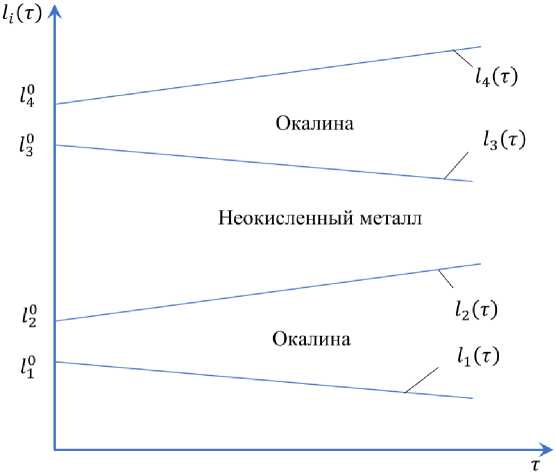
Рис. 1. Расчетная схема сляба
Fig. 1. Calculation scheme of the slab
Вычислительное исследование
Для численного интегрирования уравнений (1)–(11) применяли неявную конечно-разностную схему с подвижными узлами [2, 12–14], что обусловлено следующими обстоятельствами. Как правило, для расчета в областях с переменными во времени границами применяют метод ловли этих границ в узлы сетки с постоянным шагом по пространству, из-за этого в процессе расчета шаг по времени должен быть переменным, переменным также будет и число пространственных узлов. Все это приводит к определенным затруднениям при разработке и программировании алгоритма расчета. Поэтому более привлекательным может быть метод сеток с подвижными узлами. Это позволяет, в частности, избежать как изменения количества узлов расчетной сетки и в связи с этим и размерности используемых информационных массивов, так и шага по времени. Как отмечено в работе [14], при изменении «…размеров фаз изменяется пространственный шаг сетки таким образом, что количество узлов в каждой фазе остается неизменным и межфазная граница совпадает с тем же самым узлом сетки».
При этом при построении конечно-разностной схемы вычислений необходимо иметь в виду следующее. Температура в подвижном узле Сузл = (узл(хузл(т),т) является функцией времени т и координаты %узл(т), которая также зависит от времени. Поэтому ее полная производная по времени будет равна ^^ узл = ^£ узл + ^^ узл • ^^ узл . Или же, учитывая уравнения (1), будем иметь ат от охузл ат
—у-зл = — • —°— (Л; т^узл) + т^узл • аХзл. Здесь ^узл вычисляем с помощью уравнений движения ат ctPi °ХузЛк l °Хуз/ ОхузЛ ат ат границ (7)–(10).
Конечно-разностную схему с подвижными узлами решали методом прогонки. Изменение численных значений с^р^Л; в зависимости от температуры рассчитывали по аппроксимирующим уравнениям работы [15]. Причем с целью упрощения вычислений (исключения итерационных процедур, осложняющих применение метода, как это отмечено в работе [14]) при расчете температурного поля на данном временном интервале значения c ; , р;, Л ; определяли по температурам на предыдущем временном слое. Также поступали и при расчете новых положений границ фаз. Кроме того, при теплообмене излучением граничные условия записывали в конвективной форме с коэффициентами теплоотдачи, зависящими от температуры теплообменивающихся элементов печи и температуры поверхностей окалины, численное значение таких коэффициентов теплоотдачи определяли также по температурам на предыдущем временном слое. Применительно к сеткам с подвижными узлами разработали достаточно точный способ численной аппроксимации конвективного граничного условия, основанный на тепловом балансе для элементарной ячейки у поверхности тела [16, 17]. Полученное соотношение аналогично известной в литературе формуле Бека для сеток с неподвижными узлами [16, 17].
На рис. 2 приведен рассчитанный по модели (1)–(11) график нагрева углеродистого сляба толщиной 0,1 м в методической печи с монолитной подиной в томильной зоне. Кривые 1 и 4 по- казывают изменение по ходу продвижения заготовки через печь соответственно температуры рабочего пространства и среднемассовой температуры неокисленного металла (считалось, что температура рабочего пространства в верхних и нижних зонах печи одинакова), кривые 2 и 3 характеризуют изменение температуры поверхности окалины, а 5 и 6 – ее толщины для верхней и нижней поверхностей сляба соответственно. Отставание температурного поля окалины и ее толщины для нижней поверхности сляба объясняется охлаждающим действием глиссажных труб, которое учитывалось меньшими значениями коэффициентов излучения для нижних зон печи. Кроме того, как видно из рис. 2, при попадании сляба на монолитный под температура его нижней поверхности сначала резко падает вследствие прекращения внешнего теплового потока от греющей среды, а потом начинает медленно расти, последнее происходит из-за выделения тепла при окислении металла.
При этом при расчетах считалось, что усвоенная теплота от окисления составляет 75 % от принятой максимальной массовой плотности теплового эффекта в размере 5652,18 кДж на 1 кг окислившегося железа [15], толщина окалины растет по известным [8–10] экспоненциальным зависимостям, параметры которых подбирались по данным отбора проб окалины, получаемой в методических печах стана «2500» ПАО «Магнитогорский металлургический комбинат» (ММК) [18].
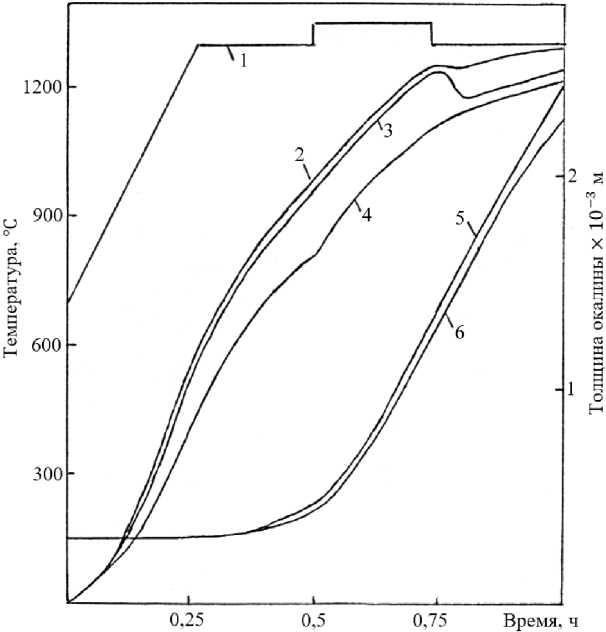
Рис. 2. Нагрев окисляющегося сляба Fig. 2. Heating of the oxidizing slab
Для изучения влияния процесса окалинообразования сравнивали нагрев двух одинаковых слябов в одних и тех же зонах печи. При этом считалось, что первый сляб не окисляется и на его поверхностях нет никакой окалины, наоборот, на поверхностях второго сляба наблюдается ока-линообразование, его нагрев описывается уравнениями (1)–(11).
На рис. 3 приведено семейство кривых, характеризующих изменение во времени следующей величины:
At = t-t oK , (12) где t, t0K - среднемассовые температуры неокисляющегося сляба и только неокисленного металла второго окисляющегося сляба соответственно.
Эти кривые приведены для случая симметричного нагрева углеродистых слябов толщиной 0,1 м с температурой рабочего пространства в зонах в 1350 °C. Коэффициенты излучения к поверхностям обоих слябов здесь принимали равными 2,7 Вт/(м-К), величину Q также выбирали из условия, что максимальная массовая плотность теплоты от окисления составляет 5652,18 кДж на 1 кг окислившегося железа. Приведенные кривые соответствуют, считая сверху вниз , следующим значениям коэффициентов «1 = «з, указывающим идущую на нагрев заготовки долю от максимального теплового эффекта окисления: 0; 0,25; 0,5; 0,75; 1,0.
Разность температуры поверхности первого сляба и температуры границы «окалина – неокис-ленный металл» второго сляба изменяется практически в тех же пределах и по аналогичным кривым, только максимальные значения этой разности достигаются в более ранние моменты времени.
Как видно из рис. 3, с ростом величины усвоенного теплового потока от окисления отставание среднемассовой температуры окисляющегося сляба сокращается и при 0,85 < «1 = «з < 1,0 становится практически несущественным, если считать точность выполнения температурного графика нагрева в 20^25 град. вполне удовлетворительной [19]. Другими словами, при 0,85 < «1 = «з < 1,0 можно считать, что окисляющийся и неокисляющийся слябы имеют практически несущественное различие температурных полей. Более того, как видно из рис. 3, при достаточно большом тепловом потоке от окисления к концу периода нагрева возможна такая ситуация, когда At < 0, т. е. температура окисляющегося сляба будет выше, чем неокисляющегося.
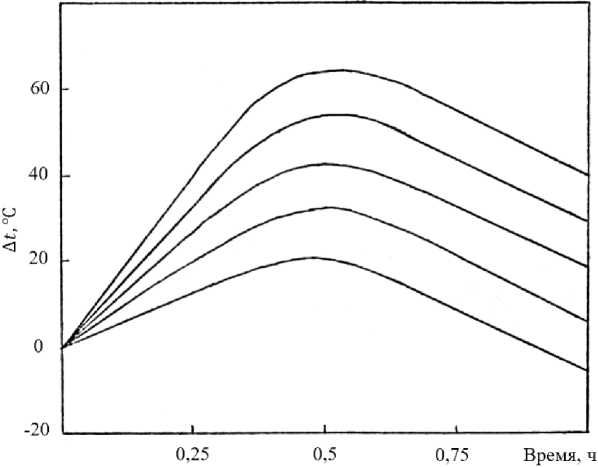
Рис. 3. Разность среднемассовых температур неокисляющегося сляба и только неокисленного металла второго окисляющегося сляба
Fig. 3. The difference between the average mass temperatures of the non-oxidizing slab and only the non-oxidized metal of the second oxidizing slab
Объясняется это тем, что к концу нагрева разность между температурой рабочего пространства и температурой поверхности слябов становится небольшой, поэтому формирующийся вследствие этого тепловой поток будет достаточно малым. По этой причине теплосодержание неокисляющегося сляба изменяется в конце нагрева незначительно, вместе с тем у окисляющегося сляба за счет теплового эффекта окисления температура продолжает расти.
Таким образом, выполненные вычисления подтверждают вывод работы [11] о том, что при малом тепловом эффекте окисления процесс окалинообразования тормозит нагрев, при большой величине теплового эффекта – наоборот, возможно его ускорение, однако это ускорение все-таки нельзя считать существенным, так как возможная ошибка в определении величины Q в сторону ее занижения по проведенному литературному анализу не может быть значительной.
Структура формулы для эквивалентного коэффициента теплообменаи анализ влияния окисления на скорость нагрева
Как упоминалось выше, влияние окалины на нагрев можно учесть выбором численного значения коэффициентов внешнего теплообмена. Поэтому, исходя из рассмотрения физики процесса окисления стали и переноса теплоты через его окислившийся слой, выясним, какой должна быть структура формулы для эквивалентного коэффициента теплообмена. Причем для простоты будем считать, что процесс переноса теплоты стационарный, а внешний теплообмен заготовки с рабочим пространством печи достаточно точно описывается конвективной формой взаимодействия. При этом введем следующие дополнительные обозначения: а - коэффициент теплоотдачи от рабочего пространства печи с температурой tn к окалине, находящейся на поверхности заготовки с температурой ее поверхности Сп . ок, 5ок - толщина окалины, а Лок - ее коэффициент теплопроводности, tr . 0K _ Me - тепература границы «окалина - неокисленный металл», q - плотность теплового потока от окисления стали, а^ - суммарный коэффициент теплоотдачи от рабочего пространства печи к границе «окалина – неокисленный металл» (учитывающий влияние окалинообразования на нагрев). Тогда можно записать следующее уравнение для переноса теплоты:
a(tn - С п,к ) + q = / -к/ к J к м • (13)
° ок
Как это нетрудно видеть, здесь также считается, что теплота от окисления стали выделяется на внешней поверхности окалины, а затем теплопроводностью переносится через окалину внутрь заготовки.
Из данного соотношения получим, что
. 1 .г.ок-ме , „ а ^ п + Л ок о +Q ^ок п.ок а+Л окМок .
Далее представим, что реальная плотность теплового потока a(tп — tп . ок) + q формально представляется конвективным теплообменом между рабочим пространством печи и границей «окалина – неокисленный металл», т. е.
a (tn
—
tп.ок) + q аs(tп
—
t г.ок—ме ).
Подставляя в (15) вместо tп . ок выражение (14), получим
Mt:
—
t г.ок-ме ) a ^п
—
j. 1 ^г.ок-ме #Сп+ Лок я ___________°ок а+ток Оок
+q\
— ) + q-
Отсюда найдем, что
О ( ^ п ^ г.ок-ме ) Q a s ( t п t г 10K _ме ) a ло« + q .
«ок
Поэтому для суммарного (эквивалентного) коэффициента теплоотдачи получим следующую формулу:
(“" (.п-г'о.-^
aj- 0+S
О ок
^о« а«
Из формулы (18) следует, что если q = 0, то ^ = —ок" — а—< а — формула с точно-а+/к
«ок ^ок стью до обозначений совпадает с тем, что содержится для эквивалентного коэффициента теплоотдачи в формуле (14) работы [4, с. 38], понятно, что в этом случае окисление тормозит нагрев заготовки.
Выясним, когда a j > а, т. е. при каких условиях окисление ускоряет нагрев заготовки. Нетрудно видеть, что для этого должно быть
2ок q > a (1-п ‘-г.ок-ме) л , т. е. плотность теплового потока от окисления должна удовлетворять этому неравенству, например, при a — 300 Вт/(м2 • К), 5ок — 1 • 10-3м, Лок — 2 Вт/(м • К), (tп — tг.ок-ме) — 100 К - такая разность температур имеет место на последних стадиях нагрева - должно быть q > 4500 Вт/(м2). Полагая при этом, что перепад температуры в окалине составляет, например, 20 К получим, что плотность теплового потока от рабочего пространства печи к поверхности заготовки будет a(tп — tп.ок) — 300 • 80 — 24 000 Вт/(м2). Таким образом, в данном случае окисление будет ускорять нагрев, если тепловой поток от этого явления будет больше 18,75%-ной доли основного теплового потока от рабочего пространства печи.
Если считать, что при нагреве из-за окисления выделяется 5652,18 кДж на 1 кг окислившегося железа и вся эта теплота идет на нагрев, т. е. внутрь заготовки, то в пересчете на 1 м3 будет Q — 5652,18 • р2 — |р2 * 7500 ^| — 5652,18 • 7500 — 42 391 350кмДж. Поэтому порождаемая окислением плотность теплового потока при скорости окисления, например, в 2 мм за 0,5 ч будет q — q <Шт) — |. — 1,2| — 42 391 350 • ю3 • Ai^— — 47 101,5Вт, что свидетельствует о вполне dT 0,5^3600 м2, реальном выполнении условия (19).
Понятно, что при меньшей скорости окисления, например, в 1 мм за 0,5 ч, плотность теплового потока от окисления будет в два раза меньше, но, тем не менее, вполне значимой для интенсификации нагрева.
Отметим также, что при увеличении разности (tп — tп . ок) плотность теплового потока от рабочего пространства печи к поверхности заготовки тоже будет увеличиваться, поэтому относительное влияние теплоты окисления будет снижаться.
Как видно из формулы (18), суммарный коэффициент теплоотдачи от рабочего пространства печи к границе «окалина – неокисленный металл», включающий в свою структуру учет влияния окалинообразования на нагрев, зависит от разности температур печи и границы «окалина – не-окисленный металл» - (tn — tr . 0K _ Me), следовательно, не является постоянной величиной. Поэтому рекомендуется при моделировании процесса нагрева применять кусочно-постоянную аппроксимацию этой зависимости от температур, что позволит существенно упростить алгоритм расчета.
Таким образом, подтверждается, что при относительно малом тепловом эффекте от окисления нагрев слябов тормозится из-за этого явления, если же тепловой эффект от окисления удовлетворяет неравенству (19), то окисление будет ускорять нагрев. Отметим также, что числовое значение правой части неравенства (19) изменяется в процессе нагрева, так как изменяется разность температур (tn — tr . 0K _ Me).
Выводы
Приведена математическая модель несимметричного нагрева слябов с явным учетом поверхностного слоя окалины. Описаны особенности ее конечно-разностной аппроксимации методом сеток с подвижными узлами, в частности, способ численной аппроксимации конвективного граничного условия, основанный на тепловом балансе для элементарной ячейки у поверхности тела. На основании вычислительного исследования оценено влияние процесса окисления на нагрев заготовок в методических печах. Показано, что при малом тепловом эффекте окисления процесс окалинообразования тормозит нагрев, при большой величине теплового эффекта – наоборот, возможно его ускорение. Определена структура формулы для эквивалентного коэффициента теплоотдачи, что достаточно важно для моделирования процесса нагрева, кроме того, формула позволяет анализировать влияние окисления на скорость нагрева металла.
