
Multi-objective Clustering Framework for Energy-efficient Precision Agriculture in WSNs using Optimized Convolutional Autoencoder with Dual-key Transformer Network
Journal: International Journal of Computer Network and Information Security @ijcnis
Article in issue: 1 vol.18, 2026.
Free access
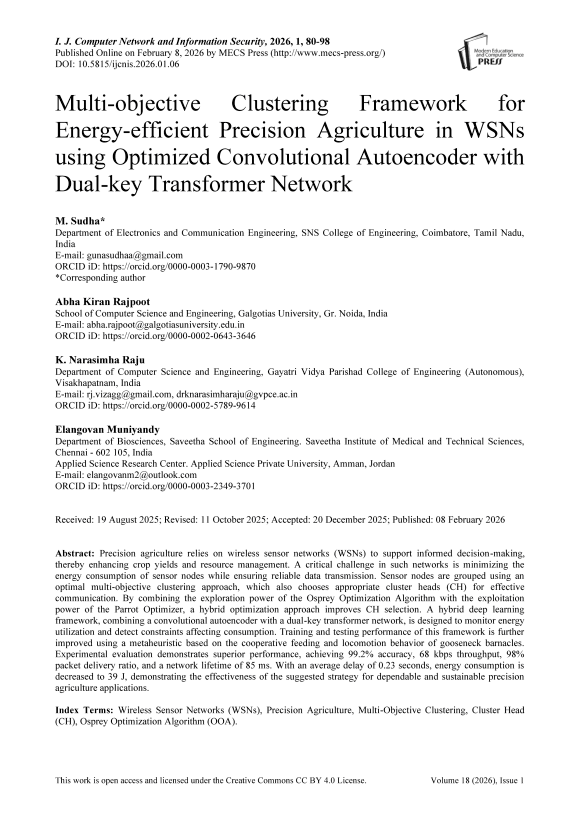
Precision agriculture relies on wireless sensor networks (WSNs) to support informed decision-making, thereby enhancing crop yields and resource management. A critical challenge in such networks is minimizing the energy consumption of sensor nodes while ensuring reliable data transmission. Sensor nodes are grouped using an optimal multi-objective clustering approach, which also chooses appropriate cluster heads (CH) for effective communication. By combining the exploration power of the Osprey Optimization Algorithm with the exploitation power of the Parrot Optimizer, a hybrid optimization approach improves CH selection. A hybrid deep learning framework, combining a convolutional autoencoder with a dual-key transformer network, is designed to monitor energy utilization and detect constraints affecting consumption. Training and testing performance of this framework is further improved using a metaheuristic based on the cooperative feeding and locomotion behavior of gooseneck barnacles. Experimental evaluation demonstrates superior performance, achieving 99.2% accuracy, 68 kbps throughput, 98% packet delivery ratio, and a network lifetime of 85 ms. With an average delay of 0.23 seconds, energy consumption is decreased to 39 J, demonstrating the effectiveness of the suggested strategy for dependable and sustainable precision agriculture applications.
Similar articles in the section Computer communication. Computer networks
Short address: https://sciup.org/15020177
IDS: 15020177 | DOI: 10.5815/ijcnis.2026.01.06
