
Мультиагентная система ведения научных исследований для прогнозирования лекарственных соединений на основе модифицированных алгоритмов искусственных иммунных систем
Журнал: Проблемы информатики @problem-info
Рубрика: Прикладные информационные технологии
Статья в выпуске: 3 (44), 2019 года.
Бесплатный доступ
В статье рассматриваются вопросы создания мультиагентной Smart-системы ведения научных исследований для компьютерного молекулярного дизайна новых лекарственных препаратов с заданными свойствами и прогнозирования зависимости „структура-свойство/активность“ (QSAR, Quantitative Structure-Activity Relationship) на основе модифицированных алгоритмов искусственных иммунных систем и других биоинснерированных подходов искусственного интеллекта. Приведены основные достоинства и недостатки применения различных интеллектуальных алгоритмов при построении Smart системы. Разработана структура мультиагентной Smart-системы ведения научных исследований и описано функционирование агентов.
Похожие статьи в разделе Искусственный интеллект
Короткий адрес: https://sciup.org/143172473
IDS: 143172473 | УДК: 004.89
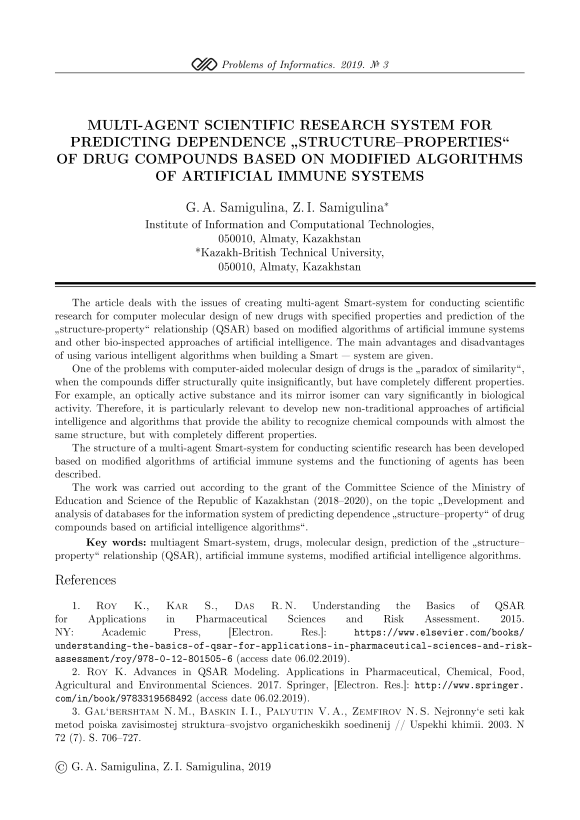
Multi-agent scientific research system for predicting dependence "structure-propertie" of artificial immune systems
The article deals with the issues of creating multi-agent Smart-system for conducting scientific research for computer molecular design of new drugs with specified properties and prediction of the „structure-property11 relationship (QSAR) based on modified algorithms of artificial immune systems and other bio-inspcctcd approaches of artificial intelligence. The main advantages and disadvantages of using various intelligent algorithms when building a Smart system arc given. One of the problems with computer-aided molecular design of drugs is the „paradox of similarity11, when the compounds differ structurally quite insignificantly, but have completely different properties. For example, an optically active substance and its mirror isomer can vary significantly in biological activity. Therefore, it is particularly relevant to develop new non-traditional approaches of artificial intelligence and algorithms that provide the ability to recognize chemical compounds with almost the same structure, but with completely different properties. The structure of a multi-agent Smart-system for conducting scientific research has been developed based on modified algorithms of artificial immune systems and the functioning of agents has been described. The work was carried out according to the grant of the Committee Science of the Ministry of Education and Science of the Republic of Kazakhstan (2018-2020), on the topic „Development and analysis of databases for the information system of predicting dependence „structure-property11 of drug compounds based on artificial intelligence algorithms
Список литературы Мультиагентная система ведения научных исследований для прогнозирования лекарственных соединений на основе модифицированных алгоритмов искусственных иммунных систем
- Roy К., Kar S., Das R.N. Understanding the Basics of QSAR for Applications in Pharmaceutical Sciences and Risk Assessment. 2015. NY: Academic Press, [Electron. Res.]: https://www.elsevier.com/books/ understanding-the-basics-of-qsar-for-applications-in-pharmaceutical-sciences-and-risk- assessment/roy/978-0-12-801505-6 (дата доступа 06.02.2019).
- Roy К. Advances in QSAR Modeling. Applications in Pharmaceutical, Chemical, Food, Agricultural and Environmental Sciences. 2017. Springer, [Electron. Res.]: http://www.springer. com/in/book/9783319568492 (дата доступа 06.02.2019).
- Гальверштам H. М. Баскин И. И., Палютин В. А., Земфиров Н. С. Нейронные сети как метод поиска зависимостей структура-свойство органических соединений // Успехи химии. 2003. № 72 (7). С. 706-727.
- Ivanciuc О. Structure-activity relationships in aquatic toxicology with artificial immune systems: Mechanism of toxic action classification of polar and nonpolar narcotic pollutants with CLONALG (clonal selection algorithm) // J. Molecular Design. 2007. N 6. P. 106-114.
- Cm xI.ix Liang, Lingxi Peng. An Automated Diagnosis System of Liver Disease using Artificial Immune and Genetic Algorithms // Journal of Medical Systems, 2013. D01:10.1007/sl0916- 013-9932-9. DOI: 10.1007/sl0916-013-9932-9
- Umit Yilmaz, Helmi Md Rais, Said Jadid Abdulkadir. Hybrid Swarm Intelligence Algorithms with Ensemble Machine Learning for Medical Diagnosis // Proceedings of 4th International Conference on Computer and Information Sciences (ICCOINS), 2018.
- Zhu H., Wu J., Gu J. Studies on Immune Clonal Selection Algorithm and Application of Bioinformatics // International Journal of Intelligent Engineering and Systems. 2015. V. 8. N 1. P. 10-16.
- Соснин С.Б., Радченко E.B., Палюлин В. А., Зефиров Н.С. Обобщенный фрагментный подход в исследованиях QSAR/QSPR // Доклады Академии наук. Химия. 2015, Т. 463. № з. С. 297-300.
- Ghasemi, Perez-Sanchez; Менш, Perez-Garrido. Neural network and deep-learning algorithms used in QSAR studies: merits and drawbacks // Drug Discovery Today. 2018. N 23 (10). P. 1784-1790. D01:. PMID29936244.
- DOI: 10.1016/j.drudis.2018.06.016
- Yavuz B.3., Sertkaya C., Yurtay N. Prediction of secondary structures of hemoglobin using clonal selection algorithm // Proceedings of the 7 th Int. Work. Comput. Sci. Eng. 2017. P. 1387-1391.
- Samigulina G. A., Samigulina Z.I. Immune network technology on the basis of Random Forest algorithm for computer aided drag design // J. Lecture Notes in Computer Science. Proceedings of the Conference on Bioinformatics and Biomedical Engineering (IWBBIO 2017). Granada (Spain): Springer, 26-28 April 2017. Part 1. P. 50-61.
- L. A. BltKZOCXlK, Iztok F. JR., V. Podgoreleg. Swarm Intelligence Algorithms for Feature Selection: A Review // J. Applied Sciences. 2018. N 8 (9). P. 1521. [Electron. Res.]:
- DOI: 10.3390/app8091521
- Ramirez M.R., Ramirez Moreno H.B., Rojas E.M., Hurtado C., Vazquez Nunez S. O. Multi-Agent System Model for Diagnosis of Personality Types /7 Proceedings of the 12th International Conference Agents and Multi-agent Systems: Technologies and Applications. Smart Innovation, Systems and Technologies book scries (SIST). Springer, 2018. Vol. 96. P. 209 214. 10.1007 / 978-3-319-92031-3_ 19.
- DOI: 10.1007/978-3-319-92031-3_19
- Ivacovix M., Nixkovic S. Personalized HealthCare and Agent Technologies // Proceedings of the 11th International Conference Agents and Multi-agent Systems: Technologies and Applications. Smart Innovation, Systems and Technologies book scries (SIST). Springer: KES-AMSTA, 2017. V. 74. P. 3-11.
- German S., Shin S., Tsourdos A. // Proceeding of the IEEE 24th Mediterranean Conference on Control and Automation (MED). 2016. P. 1020-1025.
- Samigulixa G. A., Massimkaxova Zn. A. Multiagent system of recognize on the basis of modified algorithms of swarm intelligence and immune network modeling /7 Proceedings of the 12th International Conference Agents and Multi-agent Systems: Technologies and Applications (AMSTA- 18). Australia: Springer, 20 22.June 2018. P. 199 208.
- Samigulixa G.A., Samigulixa Z.I. Modified immune network algorithm based on the Random Forest approach for the complex objects control /7 Artificial Intelligence Review. 2018. P. 1 17.
- Samigulixa G. A., Samigulixa Z. I. Development of multi-agent technology for prediction of the „structure-property11 dependence of drugs on the basis of modified algorithms of artificial immune systems /7 Proceedings of International work conference on bioinformaties and biomedical engineering (IWBBIO2018). Spain, Granada, 25 27 April 2018. P. 1 2.
- САМИГУЛИНА Г. А., Самигулина З.И. Разработка технологии иммунносетевого моделирования для компьютерного молекулярного дизайна лекарственных препаратов (программа для ЭВМ). Свидетельство о государственной регистрации нрав на объект авторского нрава в Комитете но нравам интеллектуальной собственности МЮ РК. Астана, 28 марта 2011. № 473. 23 с.
