
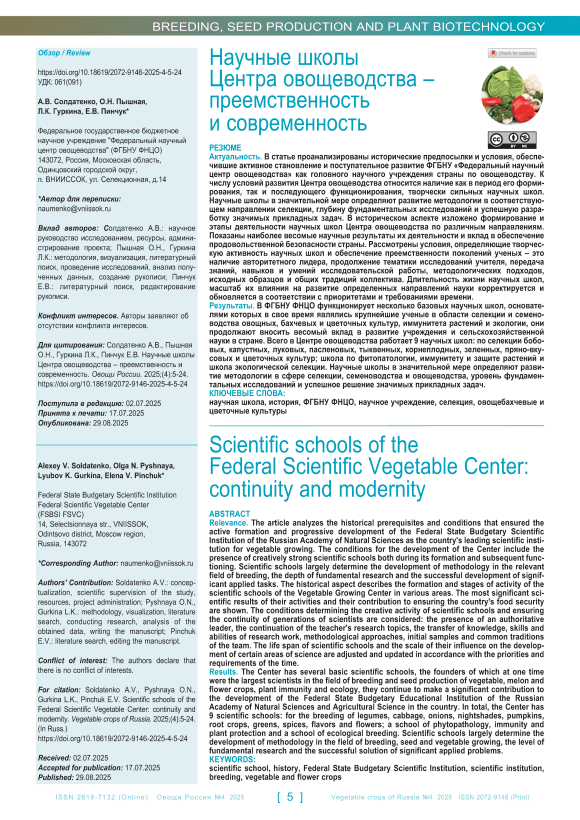
Научные школы Центра овощеводства – преемственность и современность
Журнал: Овощи России @vegetables
Рубрика: Селекция, семеноводство и биотехнология растений
Статья в выпуске: 4 (84), 2025 года.
Бесплатный доступ
Актуальность. В статье проанализированы исторические предпосылки и условия, обеспечившие активное становление и поступательное развитие ФГБНУ «Федеральный научный центр овощеводства» как головного научного учреждения страны по овощеводству. К числу условий развития Центра овощеводства относится наличие как в период его формирования, так и последующего функционирования, творчески сильных научных школ. Научные школы в значительной мере определяют развитие методологии в соответствующем направлении селекции, глубину фундаментальных исследований и успешную разработку значимых прикладных задач. В историческом аспекте изложено формирование и этапы деятельности научных школ Центра овощеводства по различным направлениям. Показаны наиболее весомые научные результаты их деятельности и вклад в обеспечение продовольственной безопасности страны. Рассмотрены условия, определяющие творческую активность научных школ и обеспечение преемственности поколений ученых – это наличие авторитетного лидера, продолжение тематики исследований учителя, передача знаний, навыков и умений исследовательской работы, методологических подходов, исходных образцов и общих традиций коллектива. Длительность жизни научных школ, масштаб их влияния на развитие определенных направлений науки корректируется и обновляется в соответствии с приоритетами и требованиями времени. Результаты. В ФГБНУ ФНЦО функционирует несколько базовых научных школ, основателями которых в свое время являлись крупнейшие ученые в области селекции и семеноводства овощных, бахчевых и цветочных культур, иммунитета растений и экологии, они продолжают вносить весомый вклад в развитие учреждения и сельскохозяйственной науки в стране. Всего в Центре овощеводства работает 9 научных школ: по селекции бобовых, капустных, луковых, пасленовых, тыквенных, корнеплодных, зеленных, пряно-вкусовых и цветочных культур; школа по фитопатологии, иммунитету и защите растений и школа экологической селекции. Научные школы в значительной мере определяют развитие методологии в сфере селекции, семеноводства и овощеводства, уровень фундаментальных исследований и успешное решение значимых прикладных задач.
Похожие статьи в разделе Организации вообще. Ассоциации. Музеи
Короткий адрес: https://sciup.org/140312148
IDS: 140312148 | УДК: 061(091) | DOI: 10.18619/2072-9146-2025-4-5-24
Scientific schools of the Federal Scientific Vegetable Center: continuity and modernity
Relevance. The article analyzes the historical prerequisites and conditions that ensured the active formation and progressive development of the Federal State Budgetary Scientific Institution of the Russian Academy of Natural Sciences as the country's leading scientific institution for vegetable growing. The conditions for the development of the Center include the presence of creatively strong scientific schools both during its formation and subsequent functioning. Scientific schools largely determine the development of methodology in the relevant field of breeding, the depth of fundamental research and the successful development of significant applied tasks. The historical aspect describes the formation and stages of activity of the scientific schools of the Vegetable Growing Center in various areas. The most significant scientific results of their activities and their contribution to ensuring the country's food security are shown. The conditions determining the creative activity of scientific schools and ensuring the continuity of generations of scientists are considered: the presence of an authoritative leader, the continuation of the teacher's research topics, the transfer of knowledge, skills and abilities of research work, methodological approaches, initial samples and common traditions of the team. The life span of scientific schools and the scale of their influence on the development of certain areas of science are adjusted and updated in accordance with the priorities and requirements of the time. Results. The Center has several basic scientific schools, the founders of which at one time were the largest scientists in the field of breeding and seed production of vegetable, melon and flower crops, plant immunity and ecology, they continue to make a significant contribution to the development of the Federal State Budgetary Educational Institution of the Russian Academy of Natural Sciences and Agricultural Science in the country. In total, the Center has 9 scientific schools: for the breeding of legumes, cabbage, onions, nightshades, pumpkins, root crops, greens, spices, flavors and flowers; a school of phytopathology, immunity and plant protection and a school of ecological breeding. Scientific schools largely determine the development of methodology in the field of breeding, seed and vegetable growing, the level of fundamental research and the successful solution of significant applied problems.
