
Основные положения рекомендаций МАГАТЭ по критериям защиты населения и работников в случае радиационной аварии
Рубрика: Научные статьи
Статья в выпуске: 3-4 т.15, 2006 года.
Бесплатный доступ
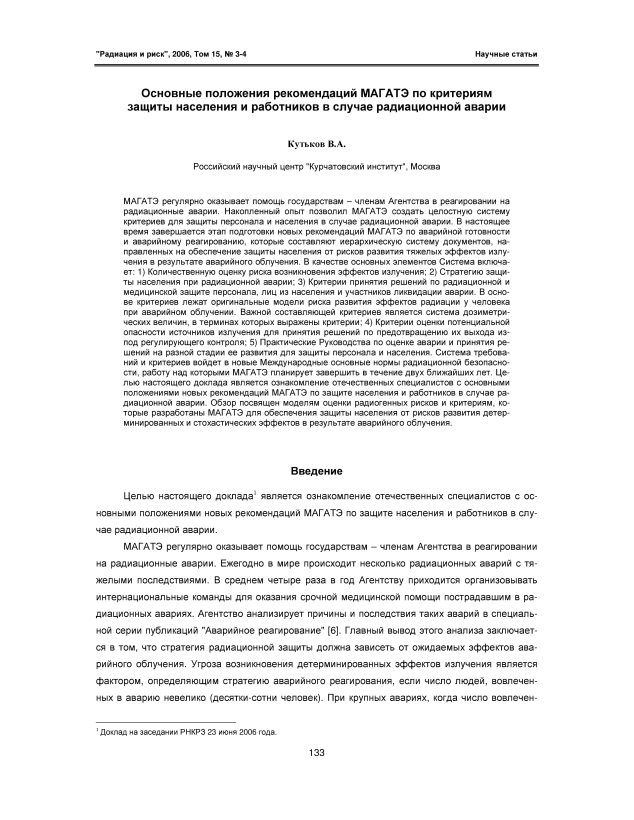
МАГАТЭ регулярно оказывает помощь государствам - членам Агентства в реагировании на радиационные аварии. Накопленный опыт позволил МАГАТЭ создать целостную систему критериев для защиты персонала и населения в случае радиационной аварии. В настоящее время завершается этап подготовки новых рекомендаций МАГАТЭ по аварийной готовности и аварийному реагированию, которые составляют иерархическую систему документов, направленных на обеспечение защиты населения от рисков развития тяжелых эффектов излучения в результате аварийного облучения. В качестве основных элементов Система включает: 1) Количественную оценку риска возникновения эффектов излучения; 2) Стратегию защиты населения при радиационной аварии; 3) Критерии принятия решений по радиационной и медицинской защите персонала, лиц из населения и участников ликвидации аварии. В основе критериев лежат оригинальные модели риска развития эффектов радиации у человека при аварийном облучении. Важной составляющей критериев является система дозиметрических величин, в терминах которых выражены критерии; 4) Критерии оценки потенциальной опасности источников излучения для принятия решений по предотвращению их выхода из под регулирующего контроля; 5) Практические Руководства по оценке аварии и принятия решений на разной стадии ее развития для защиты персонала и населения. Система требований и критериев войдет в новые Международные основные нормы радиационной безопасности, работу над которыми МАГАТЭ планирует завершить в течение двух ближайших лет. Целью настоящего доклада является ознакомление отечественных специалистов с основными положениями новых рекомендаций МАГАТЭ по защите населения и работников в случае радиационной аварии. Обзор посвящен моделям оценки радиогенных рисков и критериям, которые разработаны МАГАТЭ для обеспечения защиты населения от рисков развития детерминированных и стохастических эффектов в результате аварийного облучения.
Похожие статьи в разделе Санитарная техника. Санитарно-технические сооружения. Водоснабжение. Канализация. Освещение
Короткий адрес: https://sciup.org/170169910
IDS: 170169910
Substantive provisions of the IAEA guidelines for criteria for protecting the public and workers in radiation emergency
The IAEA regularly assists the member states in response to radiation emergencies. The accumulated experience has allowed the IAEA to create overall system of criteria for protecting the public and emergency workers in radiation emergency. Now the IAEA finalizes a preparation of the new guidelines for emergency preparedness and response. These guidelines are the part of hierarchical system of the documents directed on supporting protection of the public from risks of development of severe radiation effects. As a basic element, the System includes: 1) Quantitative evaluation of risk of developing severe radiation effects; 2) The strategy of protection of the public in radiation emergency; 3) Decision making criteria for radiation and medical protection of emergency workers and members of the public. Original risk models of developing the radiation effects in exposed humans lay in a base of criteria. The system of dosimetric quantities for expressing the criteria is also an important part of the System; 4) Criteria of ranking a potential danger of radionuclide sources for decision making on preventing their leave from the regulating control; 5) Practical guidelines for evaluating a radiation emergency, and for decision making to protect emergency workers and the public in different stages of its development. The system of requirements and criteria will be included into the new International Basic Safety Standards, which preparation the IAEA plans to complete in two years. The purpose of the present report is to inform the national experts with substantive provisions of the new IAEA guidelines for protecting the public and emergency workers in radiation emergency. The review is devoted to models of radiogenic risks and criteria, which the IAEA developed to support radiation protection of the public from risks of the deterministic and stochastic effects due to emergency exposure.
Список литературы Основные положения рекомендаций МАГАТЭ по критериям защиты населения и работников в случае радиационной аварии
- Кутьков В.А. Современная система дозиметрических величин//АНРИ. -2000. -№ 1 (20). -С. 4-17.
- Кутьков В.А., Кухта Б.А. Радиологические свойства радиоактивных аэрозолей//АНРИ. -2006. -№ 4(47). -С. 2-22.
- Кутьков В.А., Ткаченко В.В., Романцов В.П. Радиационная безопасность персонала атомных станций. Учебное пособие/Под общ. ред. В.А. Кутькова. -Москва-Обнинск: Атомтехэнерго, ИАТЭ, 2003. -344 с.
- Нормы радиационной безопасности (НРБ-99): Гигиенические нормативы СП-2.6.1.758-99. -М.: Минздрав России, 1999.
- Основные санитарные правила обеспечения радиационной безопасности (ОСПОРБ-99): Санитарные правила СП-2.6.1.799-99. -М.: Минздрав России, 2000.
- An electron accelerator accident in Hanoi, Viet Nam Vienna, IAEA (1996);
- Accidental overexposure of radiotherapy patients in San Jose, Costa Rica Vienna, IAEA (1998);
- Report on the Preliminary fact finding mission following the accident at the nuclear fuel processing facility in Tokaimura, Japan Vienna, IAEA (1999);
- The radiological accident in Lilo Vienna, IAEA (2000);
- The radiological accident in Yanango Vienna, IAEA (2000);
- The radiological accident in Istanbul Vienna, IAEA (2000);
- Investigation of an accidental exposure of radiotherapy patients in Panama Vienna, IAEA (2001);
- The criticality accident in Sarov Vienna, IAEA (2001);
- The radiological accident in Gilan Vienna, IAEA (2002);
- The radiological accident in Samut Prakarn Vienna, IAEA (2002); Accidental Overexposure of Radiotherapy Patients in Bialystok. Vienna
- The Radiological Accident in Cochabamba Vienna, IAEA (2004).
- Arrangements for Preparedness for a Nuclear or Radiological Emergency. Safety Guide, Safety Standards Series No GS-R-2.1. -Vienna: IAEA (будет опубликован в 2006).
- Categorization of Radioactive Sources. Safety Standards Series No RS-G-1.9. -Vienna: IAEA, 2005.
- Code of Conduct on the Safety and Security of Radioactive Sources. -Vienna: IAEA, 2004.
- Criteria for use in Preparedness and Response to a Nuclear or Radiological Emergency. Safety Guide Safety Standards Series No GS-R-2.2. -Vienna: IAEA (будет опубликован в 2007).
- Dangerous quantities of radioactive material (D-values). EPR-D-Values. -Vienna: IAEA, 2006.
- Development of extended framework for emergency response criteria. Interim report for comments, IAEA TECDOC-1432. -Vienna: IAEA, 2004.
- Generic Procedures for Monitoring in a Nuclear or Radiological Emergency. IAEATECDOC-1092. -Vienna: IAEA, 1999.
- Generic Procedures for Assessment and Response during a Radiological Emergency. IAEATECDOC-1162. -Vienna: IAEA, 2000.
- Generic procedures for medical response during nuclear and radiological emergency. EPR-MEDICAL. -Vienna: IAEA, 2005.
- Generic procedures for monitoring in a nuclear or radiological emergency. EPR-Monitoring. -Vienna: IAEA, 2006 (in preparation).
- Gonzalez A.J. The radiological health consequences of Chernobyl: the dilemma of causation. Symposium on Nuclear Accidents. In: Nuclear accidents: Liabilities and guarantees: Proceedings of the Helsinki symposium, OECD Nuclear Energy Agency, 1993.
- Health effects models for nuclear power plant accident consequence analysis. Low LET radiation. Report NUREG/CR-4214 Rev. 1 Part II. -Washington, DC: U.S. NRC, 1989.
- Health effects models for nuclear power accident consequence analysis. Part I: Introduction, integration, and summary. Report NUREG/CR-4214 ITRI-141 Rev. 2 Part I. -Washington, DC: U.S. NRC, 1993.
- Health effects models for nuclear power accident consequence analysis. Modification of models resulting from addition of effects of exposure to alpha-emitting radionuclides. Part II: Scientific bases for health effects models. Report NUREG/CR-4214 LMF-136 Rev. 1 Part II Addendum 2. -Washington, DC: U.S. NRC, 1993.
- International Basic Safety Standards for Protection against Ionizing Radiation and for the Safety of Radiation Sources, Safety Series No. 115. -Vienna: IAEA, 1996.
- Intervention Criteria in a Nuclear or Radiation Emergency, Safety Series No. 109. -Vienna: IAEA, 1994.
- Libmann J. Elements of nuclear safety. -Paris: IPSN, 1996.
- Manual for extended response to radiological emergencies. EPR-Extended Response. -Vienna: IAEA, 2006 (in preparation).
- Manual for first responders to a radiological emergency. EPR-First Responders. -Vienna: IAEA, 2006.
- Medical Preparedness and Response. Educational Material. EPR-MEDICAL-T-2002/CD. -Vienna: IAEA, 2002.
- Memorandum. The evolution of the system of radiological protection: the justification for new ICRP recommendations//J. Radiol. Prot.-2003. -V. 23. -P. 129-142.
- Method for the Development of Emergency Response Preparedness for Nuclear or Radiological Accidents IAEATECDOC-953. -Vienna: IAEA, 1997.
- Method for developing arrangements for response to a nuclear or radiological emergency. EPR-METHOD. -Vienna: IAEA, 2003.
- Preparedness and Response for a Nuclear or Radiological Emergency, Safety Requirements, Safety Standards Series No. GS-R-2. -Vienna: IAEA, 2002.
- Preparation, conduct and evaluation of exercises to test preparedness for a nuclear or radiological emergency. EPR-EXERCISE. -Vienna: IAEA, 2005.
- Principles for Intervention for Protection of the Public in a Radiological Emergency. ICRP Publication 63. Ann ICRP Vol. 22, No 4. -Oxford, UK: Pergamon Press, 1991.
- Protecting people against radiation exposure in the event of a radiological attack. ICRP Publication 96. Ann ICRP Vol. 35, No 1. -Oxford, UK: Pergamon Press, 2005.
- Radiation Protection and the Safety of Radiation Sources: Safety Fundamental. Safety Standards Series No 120.-Vienna: IAEA, 1996.
- RBE for Deterministic Effects. ICRP Publication 58. Ann ICRP Vol. 20, No 4. -Oxford, UK: Pergamon Press, 1989.
- Recommendations of the International Commission on Radiological Protection. ICRP Publication 26. Ann ICRP Vol. 1, No 3. -Oxford, UK: Pergamon Press, 1977.
- Relative Biological Effectiveness (RBE), Quality Factor (Q) and Radiation Weighting Factor (wR). ICRP Publication 92. Ann ICRP Vol. 33, No 4. -Oxford, UK: Pergamon Press, 2003.
