
Панельный анализ детерминант EBITDA в омниканальной мебельной рознице: методология и результаты
Журнал: Вестник Российского нового университета. Серия: Человек и общество @vestnik-rosnou-human-and-society
Рубрика: Экономические науки
Статья в выпуске: 3, 2026 года.
Бесплатный доступ
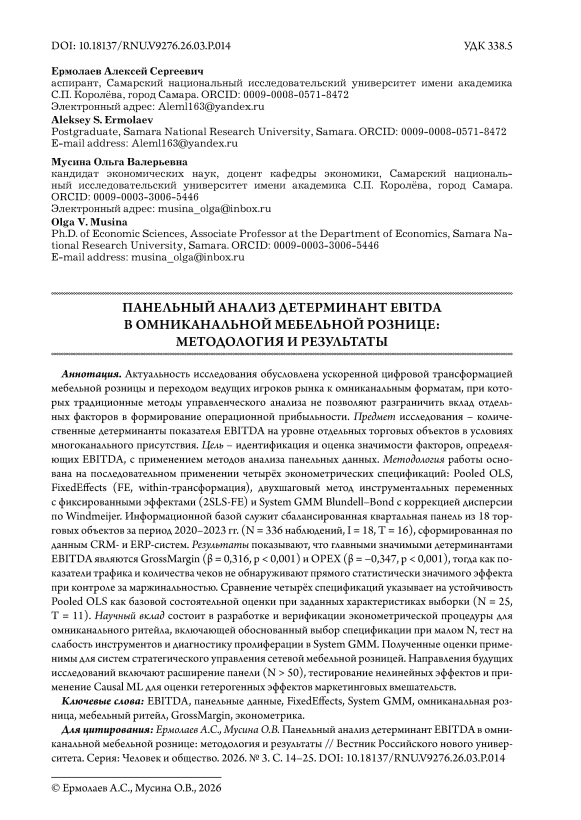
Актуальность исследования обусловлена ускоренной цифровой трансформацией мебельной розницы и переходом ведущих игроков рынка к омниканальным форматам, при которых традиционные методы управленческого анализа не позволяют разграничить вклад отдельных факторов в формирование операционной прибыльности. Предмет исследования – количественные детерминанты показателя EBITDA на уровне отдельных торговых объектов в условиях многоканального присутствия. Цель – идентификация и оценка значимости факторов, определяющих EBITDA, с применением методов анализа панельных данных. Методология работы основана на последовательном применении четырёх эконометрических спецификаций: Pooled OLS, FixedEff ects (FE, within-трансформация), двухшаговый метод инструментальных переменных с фиксированными эффектами (2SLS-FE) и System GMM Blundell–Bond с коррекцией дисперсии по Windmeijer. Информационной базой служит сбалансированная квартальная панель из 18 торговых объектов за период 2020–2023 гг. (N = 336 наблюдений, I = 18, T = 16), сформированная по данным CRMи ERP-систем. Результаты показывают, что главными значимыми детерминантами EBITDA являются GrossMargin (β = 0,316, p < 0,001) и OPEX (β = −0,347, p < 0,001), тогда как показатели трафика и количества чеков не обнаруживают прямого статистически значимого эффекта при контроле за маржинальностью. Сравнение четырёх спецификаций указывает на устойчивость Pooled OLS как базовой состоятельной оценки при заданных характеристиках выборки (N = 25, T = 11). Научный вклад состоит в разработке и верификации эконометрической процедуры для омниканального ритейла, включающей обоснованный выбор спецификации при малом N, тест на слабость инструментов и диагностику пролиферации в System GMM. Полученные оценки применимы для систем стратегического управления сетевой мебельной розницей. Направления будущих исследований включают расширение панели (N - 50), тестирование нелинейных эффектов и применение Causal ML для оценки гетерогенных эффектов маркетинговых вмешательств.
Короткий адрес: https://sciup.org/148334070
IDS: 148334070 | УДК: 338.5 | DOI: 10.18137/RNU.V9276.26.03.P.014
Analysis of EBITDA determinants in omnichannel furniture retail: Methodology and findings
The growing urgency of this research reflects the rapid digital transformation of furniture retailing and the shift of leading market players toward omnichannel formats – a transition that renders conventional management accounting tools inadequate for attributing the contribution of individual operational factors to overall profitability. The subject of this study is the quantitative determinants of EBITDA at the level of individual retail outlets operating within a multi-channel environment. The overarching objective is to identify and assess the statistical significance of EBITDA drivers through the application of panel data econometric methods. The methodological fr amework rests on the sequential estimation of four econometric specifications: Pooled Ordinary Least Squares (Pooled OLS), the Fixed Effects estimator (FE, within-group transformation), a two-stage least squares specification with fixed effects (2SLS-FE), and the Blundell–Bond System Generalised Method of Moments (System GMM) with Windmeijer’s finite-sample variance correction. The empirical foundation is a balanced quarterly panel of 18 retail outlets covering the period 2020–2023 (N = 336 observations, I = 18 units, T = 16 periods), compiled from proprietary CRM and ERP system records. The results indicate that the primary statistically significant determinants of EBITDA are Gross Margin (β = 0.316, p < 0.001) and OPEX (β = −0.347, p < 0.001), while measures of customer traffic and transaction volume yield no direct statistically significant effect once profitability is held constant. A systematic comparison of all four specifi- cations confirms the robustness of Pooled OLS as the preferred consistent estimator under the sample’s structural constraints (N = 25 units, T = 11 periods). The scientific contribution of the paper lies in the development and empirical validation of a tailored econometric selection procedure for omnichannel retail research – one that encompasses justified specification choice under small-N conditions, formal testing forinstrument weakness, and diagnostics forinstrument proliferation in System GMM. The estimated parameters are directly applicable to strategic performance management systems in multi-outlet furniture retail networks. Directions for future researchinclude expanding the panel to N - 50, testing for nonlinear and threshold effects, and applying Causal Machine Learning frameworks to estimate heterogeneous treatment effects of marketing interventions at the outlet level.
Текст научной статьи Панельный анализ детерминант EBITDA в омниканальной мебельной рознице: методология и результаты
Трансформация мебельного ритейла в направлении омниканальных форматов кардинально изменила архитектуру выручки и затрат розничных предприятий. Крупнейшие российские игроки – HOFF, «Первый мебельный», «МебельМаркт» – последовательно развивают e-com-каналы и собственные витрины на маркетплейсах (Wildberries, Ozon), что приводит к ди- версификации структуры себестоимости: появляются специфические переменные затраты – логистика last-mile, комиссионные выплаты маркетплейсам (20–30 % от GMV), стоимость привлечения заказа (CPO) в performance-маркетинге [1].
В этих условиях традиционный управленческий анализ, оперирующий агрегированными показателями выручки, или EBITDA, без разграничения по каналам, утрачивает аналитическую ценность: два
Вестник Российского нового университета Серия: Человек и общество. 2026. № 3
объекта с одинаковой выручкой могут принципиально различаться по маржинальности в зависимости от структуры ChannelMix. Ключевой вопрос практического управления – какие именно операционные параметры и в каком направлении определяют прибыльность – требует количественного ответа.
Метод панельных данных, объединяющий несколько наблюдений по каждому объекту во времени, позволяет контролировать ненаблюдаемую гетерогенность объектов: специфику расположения, бренд-историю, уровень конкуренции, которую кросс-секционный регрессионный анализ не устраняет [2, p. 14]. Вместе с тем применение панельных методов к данным розничных предприятий сопряжено с эконометрическими вызовами: эндогенностью трафика (высокий EBITDA финансирует маркетинг, стимулирующий трафик), неустойчивостью инструментальных переменных при малом N и риском «пролиферации инструментов» в System GMM, [3, p. 86].
Цель статьи – разработка и верификация методологической процедуры панельного анализа детерминант EBITDA для омника-нального мебельного ритейла.
Задачи:
-
1) формирование сбалансированной квартальной панели;
-
2) последовательное тестирование четырёх эконометрических спецификаций;
-
3) сравнительная оценка их устойчивости;
-
4) интерпретация коэффициентов в терминах управленческих решений.
Структура статьи соответствует формату IMRAD: раздел 2 содержит теоретическое обоснование и гипотезы; раздел 3 описывает данные и методологию; раздел 4 представляет результаты; раздел 5 – их обсуждение; раздел 6 формулирует выводы.
Теоретические основ ы и гипотезы
Концепция Contributi on Margin и ValueBased Management
Теоретической базой исследования служит концепция Value-Based Management (далее – VBM), в рамках которой ключевым целевым показателем выступает не выручка, а Contribution Margin (далее – CM) – разность выручки, прямой себестоимости и переменных затрат на канал [4, с. 84]. Для омниканального предприятия CM по каналу c в торговой точке i определяется как
CM{i, c} = R{i, c} – COGS{i, c} – VC{i, c} , где R{i, c} – выручка, COGS{i, c} – прямая себестоимость, VC{i, c} – переменные затраты канала. В e-com-канале переменные затраты включают performance-маркетинг (CPO), логистику доставки, комиссии маркетплей-са и процессинг. EBITDA на уровне торговой точки формируется как агрегат CM за вычетом фиксированных операционных расходов (Fixed OPEX – аренда, фонд оплаты труда, управленческие расходы):
EBITDA i = ΣCM { i , c } – Fixed OPEX i .
Данная декомпозиция указывает на два ключевых управленческих рычага: увеличение GrossMargin (как агрегированного прокси CM через соотношение валовой прибыли к выручке) и сдерживание операционных затрат. Именно эти два вектора формируют основные исследовательские гипотезы.
Детерминанты EBITDA: обзор ли тературы и гипотезы
Академическая литература по ритейл-аналитике выделяет три группы детерминант финансовых результатов розничных предприятий [5, p. 718].
Панельный анализ детерминант EBITDA в омниканальной мебельной рознице: 17методология и результаты 17
Операционные показатели первого уровня – формируют Revenue через мультипликативную связь:
Выручка = Трафик × CR × AvgCheck, где CR – конверсия посетителей в покупателей. В омниканальной среде трафик и CR взаимообусловлены: офлайн-трафик частично генерируется онлайн-контен-том через эффект ROPO (ResearchOnline, PurchaseOffline), что создаёт обратную причинность между трафиком и маркетинговыми инвестициями [6, p. 309].
Маржинальные показатели – GrossMargin как отношение валовой прибыли к выручке – отражают ценовую политику, ассортиментную структуру и переговорную силу с поставщиками. Исследования [7] показывают, что открытие офлайн-точек при одновременном развитии e-com сопровождается ростом среднего чека, но не всегда ростом GM.
Структура затрат – OPEX как доля операционных расходов в выручке – в значительной мере определяется фиксированными затратами (аренда, ФОТ). В омни-канальном ритейле OPEX дополнительно включает переменные цифровые расходы [8, p. 23]. Согласно данным INFOLine1, медианный уровень EBITDA российских мебельных сетей составляет 5–9 %, что соответствует высокой чувствительности EBITDA к незначительным изменениям GM и OPEX.
На основании теоретического анализа сформулированы следующие гипотезы:
-
• H1: Рост GrossMargin значимо и положительно влияет на EBITDA;
-
• H2: Рост OPEX значимо и отрицательно влияет на EBITDA;
-
• H3: Показатели трафика и количества чеков не оказывают прямого значимого воздействия на EBITDA при контроле за маржинальностью.
Эконометрические подходы к анализу панельных данных ритейла
Классификация эконометрических спецификаций для панельных данных [2; 9] предполагает иерархическую процедуру выбора.
Pooled OLS является базовой спецификацией, однако при наличии ненаблюдаемой гетерогенности (α i ) её оценки смещены [10, p. 1417). Выбор между FixedEffects (FE) и RandomEffects (RE) осуществляется тестом Хаусмана: если H0: Cov(α i , x it ) = 0 отвергается, предпочтительна FE-спецификация [2, p. 68].
FE (within-трансформация) устраняет α i вычитанием индивидуальных средних. Несмещённость оценок требует отсутствия обратной причинности и ненаблюдаемых конфаундеров, варьирующихся во времени [9, p. 295].
2SLS-FE применяется при эндогенности: инструментами служат лаги эндогенных регрессоров (t-1, t-2). Необходимое условие состоятельности – F-статистика первой ступени F > 10 [11]; нарушение указывает на слабость инструментов и предпочтительность Pooled OLS.
System GMM Blundell–Bond объединяет уравнение в разностях (инструменты – лаги уровней) и уравнение в уровнях (инструменты – лаги разностей), что устраняет проблему слабых инструментов в уравнении разностей [12, p. 115]. Коррекция малой выборки по [13] обязательна. При N < 30 число инструментов превышает N («пролиферация инструментов»), что обесценивает тест Хансена; рекомендуется коллапс инструментальной матрицы [3, p. 135].
18 Вестник Российского нового университета18 Серия: Человек и общество. 2026. № 3
Матер иалы и методы
Источн ики данных и формирование выбор ки
Информационной основой исследования служат данные корпоративных CRM- и ERP-систем 18 торговых объектов мебельной розничной сети за период 2020 Q1 – 2023 Q4. Объекты расположены в семи регионах Российской Федерации (три федеральных округа) и относятся к трём форматам: офлайн-магазины ( n = 6), собственный интернет-магазин (e-com, n = 6), витрины на маркетплейсах Wildberries/Ozon ( n = 6).
Процедура формирования выборки включала этапы, представленные в Таблице 1.
Итоговая выборка для эконометрического анализа включает N = 164 наблюдения (подвыборка с ненулевыми значениями по всем переменным для 2SLS-оценки) и N = 275 (расширенная выборка 2018– 2023 гг.) для проверки устойчивости.
Регрессионная модель включает следующие переменные:
ebitda_it – зависимая переменная, отношение EBITDA к выручке торговой точки i в квартале t ;
Traffi c_it – количество посетителей/сес-сий, тыс. чел. (ед.);
Checks_it – количество закрытых чеков, тыс. ед.;
AvgCheck_it – средний чек, руб.;
GrossMargin_it – отношение валовой прибыли к выручке (доля);
Opex_it – отношение операционных расходов к выручке (доля);
chMP_it – бинарный индикатор принадлежности к маркетплейс-каналу (1 – мар-кетплейс, 0 – иное);
chRoznitsa_it – бинарный индикатор офлайн-канала (1 – офлайн, 0 – иное).
Роли переменных в центральной спецификации представлены в Таблице 2.
Таблица 2 отражает дифференцированную роль включённых в модель переменных. Ценообразующими факторами, формирующими операционную прибыльность, выступают два показателя с однозначным теоретически обоснованным знаком: GrossMargin (положительный эффект, H1) и OPEX (отрицательный эффект, H2). Переменная среднего чека также ожидаемо положительна, поскольку рост AvgCheck непосредственно увеличивает выручку без пропорционального роста переменных затрат.
Показатели трафика и количества чеков отнесены к эндогенным предикторам с неопределённым знаком: их прямое воздействие на нормированный EBITDA не поддаётся однозначному прогнозированию ввиду обратной причинности и высокой межпеременной корреляции (r = 0,914). Канальные индикаторы (chMP и chRoznitsa) включены в качестве контрольных переменных и отражают структурные различия в профиле OPEX: маркетплейс-канал ожидаемо демонстрирует отрицательный вклад в EBITDA вследствие высоких комиссионных расходов, тогда как офлайн-канал – положительный за счёт более высокой маржинальности.
Таким образом, Таблица 2 операционали-зирует гипотезы H1–H3 и задаёт теоретически обоснованную систему ожиданий для интерпретации эконометрических оценок.
Сформированная система переменных и теоретически обоснованные ожидания относительно знаков коэффициентов позволяют перейти к характеристике эмпирической базы исследования. Описательная статистика панельной выборки, представленная в Таблице 3, даёт возможность оценить распределение ключевых показателей, масштаб межобъектной вариации и наличие структурных особенностей, принципиально важных для выбора эконометрической спецификации.
Панельный анализ детерминант EBITDA в омниканальной мебельной рознице: 19методология и результаты 19
Описательная статистика панельной выборки (N = 336)
Таблица 1
Процедура формирования панельной выборки
|
Этап |
Критерий |
Значение |
|
1. Первичная выгрузка |
CRM/ERP, объектов с выручкой > 500 тыс. руб. за квартал |
612 843 записей |
|
2. Идентификация панели |
Размерность: I × T = 7 регионов × 3 канала × 16 кварталов |
N = 336 |
|
3. Пропущенные значения |
Доля пропусков по ключевым переменным |
≤ 5,0 % |
|
4. Очистка выбросов |
Q1 - 1,5 · IQR / Q3 + 1,5 · IQR по EBITDA |
3 объекта, 2,1 % |
|
5. Зависимая переменная |
Нормировка EBITDA к выручке |
ebitda = EBITDA/Revenue |
|
6. КМО (MSA) |
Адекватность выборки |
0,893 |
|
7. Заключительная панель |
Сбалансированная панель для Pooled OLS / FE |
N = 336 (I = 18, T = 16) |
Источник: здесь и далее таблицы составлены авторами.
Таблица 2
Роль переменных в регрессионной спецификации
|
Переменная |
Тип |
Ожидаемый знак |
Обоснование |
|
Traffic_it |
Предиктор |
Неопределённый (эндогенный) |
Обратная причинность с EBITDA |
|
Checks_it |
Предиктор |
Неопределённый (эндогенный) |
Коллинеарность с Traffic (r = 0,914) |
|
AvgCheck_it |
Предиктор |
(+) |
Рост чека → рост Revenue → рост EBITDA |
|
GrossMargin_it |
Предиктор |
(+) |
H1 |
|
Opex_it |
Предиктор |
(-) |
H2 |
|
chMP_it |
Контроль |
(-) |
Высокий OPEX маркетплейса |
|
chRoznitsa_it |
Контроль |
(+) |
Выше маржинальность офлайн |
Таблица 3
|
Показатель |
Mean |
Std |
Min |
Q25 |
Медиана |
Q75 |
Max |
|
EBITDA, д. ед. |
2,94 |
5,85 |
-21,52 |
0,00 |
3,63 |
7,36 |
12,39 |
|
Выручка, млн руб. |
236,0 |
312,4 |
8,7 |
42,3 |
98,5 |
278,9 |
1 624,3 |
|
GrossMargin, % |
42,15 |
8,73 |
21,80 |
36,40 |
42,70 |
48,15 |
64,20 |
|
OPEX, % |
38,92 |
9,14 |
18,60 |
32,90 |
39,10 |
44,75 |
69,40 |
|
CAPEX, млн руб. |
14,82 |
23,41 |
0,00 |
2,30 |
6,45 |
18,90 |
147,30 |
|
ChannelMix, % |
24,75 |
14,30 |
3,50 |
13,20 |
22,40 |
34,60 |
58,90 |
|
Трафик, тыс. чел. |
189,4 |
204,6 |
12,3 |
56,8 |
112,5 |
245,3 |
1 120,7 |
|
Чеки, тыс. ед. |
72,8 |
84,3 |
4,7 |
21,9 |
43,2 |
92,5 |
461,3 |
|
Средний чек, руб. |
3 248 |
1 287 |
1 460 |
2 310 |
2 975 |
3 840 |
7 695 |
Источник: таблица составлена авторами на основе обезличенной управленческой отчетности.
20 Вестник Российского нового университета20 Серия: Человек и общество. 2026. № 3
Анализ описательной статистики выявляет ряд ключевых закономерностей. Распределение EBITDA характеризуется выраженной левосторонней асимметрией: медиана (3,63) превышает среднее значение (2,94) при минимуме -21,52, что свидетельствует о наличии убыточных объектов в выборке и обусловливает необходимость контроля за ненаблюдаемой гетерогенностью. Высокий коэффициент вариации EBITDA (CV = 1,99) подтверждает значительную межобъектную дисперсию, что является самостоятельным аргументом в пользу применения панельных методов перед кросс-секционным анализом.
Показатели GrossMargin (среднее 42,15 %, std = 8,73 %) и OPEX (среднее 38,92 %, std = 9,14 %) демонстрируют сопоставимый разброс, при этом их медианные значения практически совпадают (42,70 % и 39,10 % соответственно), формируя узкий операционный коридор в 3–4 п.п., в рамках которого и определяется фактическая EBITDA большинства объектов. Существенный диапазон выручки – от 8,7 до 1 624,3 млн руб. – отражает значительную размерную неоднородность объектов панели, что дополнительно обосновывает нормировку зависимой переменной (EBITDA/Revenue) вместо использования абсолютных значений.
Совокупность характеристик выборки – высокая межобъектная дисперсия EBITDA, узкий операционный коридор GM/OPEX и значительная размерная неоднородность объектов – указывает на необходимость более детального изучения структуры взаимосвязей между переменными до построения регрессионных спецификаций. С этой целью в Таблице 4 представлена матрица парных корреляций, позволяющая выявить направление и силу линейных зависимостей между предикторами, а также диагностировать потенциальные проблемы мультиколлинеарности, способные искажать оценки коэффициентов модели.
Высокие корреляции EBITDA с GrossMargin (r = 0,714) и Opex (r = -0,658) предварительно подтверждают H1 и H2.
Эконометрические спецификации
Выбор эконометрической спецификации для панельных данных не является тривиальным и требует последовательной диагностической процедуры, поскольку каждая из доступных оценок состоятельна лишь при выполнении определённого набора предпосылок [2, p. 14; 9, p. 251]. В контексте настоящего исследования проблема выбора спецификации приобретает особую остроту в силу трёх структурных характеристик данных:
Матрица корреляций переменных (N = 164)
|
Х |
EBITDA |
Traffic |
Checks |
AvgCheck |
GrossMargin |
Opex |
|
EBITDA |
1 |
|||||
|
Traffic |
-0,043 |
1 |
||||
|
Checks |
-0,037 |
0,914 |
1 |
|||
|
AvgCheck |
0,118 |
-0,187 |
-0,234 |
1 |
||
|
GrossMargin |
0,714 |
0,041 |
0,038 |
0,052 |
1 |
|
|
Opex |
-0,658 |
0,089 |
0,105 |
-0,118 |
-0,236 |
1 |
