
Parameters of the Digital Twin Model of Peas for Modeling Using the Discrete Element Method
Журнал: Инженерные технологии и системы @vestnik-mrsu
Рубрика: Технологии, машины и оборудование
Статья в выпуске: 3, 2026 года.
Бесплатный доступ
Introduction. In the context of developing energy-saving technologies and machines based on digital twins, the use of the discrete element method for modeling the technological process of sowing is the most in-demand area. The key advantage of DEM modeling is the ability to minimize the cost of creating new technology through virtual testing and optimization. The quality of the sowing machines is known to directly affect the uniformity of sowing and, ultimately, the yield. Therefore, the creation of adequate digital twins taking into account the physical and mechanical properties of real seeds is an important scientific and practical task. To model the process of sowing peas, it is necessary to solve two main tasks: to select an adequate contact model and calibrate its parameters that is the main aim of this work. Aim of the Study. The study is aimed at determining the parameters of the contact model of a digital twin of pea seeds for modeling using the discrete element method. Materials and Methods. The object of the study is the calibration of the parameters of the Linear Spring Dashpot contact model applied to pea seeds. The stages of the study include: identifying the limitations of calibration methods when modeling seed movement; determining the effect of moisture content and fractional composition of pea seeds on friction coefficients; developing a method for calibrating the contact model taking into account force impact in conditions close to the sowing machine operation; verifying models by comparing DEM modeling with data from field experiments in a coil apparatus. Results. There has been determined the fractional composition of pea seeds showing pronounced polydispersity of the material. The dominant fraction (83.4%) has a diameter of 6.0–7.0 mm, which has been taken into account when parameterizing the DEM model in the Rocky DEM software package to create a representative digital twin. The significant influence of seed moisture content on their friction properties has been experimentally proven. With an increase in moisture content from 9% to 23%, the coefficient of dynamic friction increases that leads to a regular increase in the torque on the sowing machine shaft from 0.3 to 1.0 N·m. There has been has been developed and tested a comprehensive calibration method using the torque on the shaft of the sowing machine as a compliance criterion. There has been defined the range of the main parameters of the Linear spring dashpot contact model, ensuring high modeling accuracy: the coefficient of dynamic friction between seeds kd = 0.14...0.16; the coefficient of dynamic friction of seeds with the walls of the device kd.k = 0.07...0.09. Based on the results of the experiments, there has been developed a nomogram for selecting the dynamic friction coefficient depending on the moisture content of pea seeds. Conclusion. The use of the proposed calibration method based on torque allows the creation of high-precision digital twins suitable for optimizing the design and technological parameters of sowing machines that contributes to improving the quality of sowing and saving resources in agricultural production.
Короткий адрес: https://sciup.org/147255044
IDS: 147255044 | УДК: 631.3:633.358:004.9:519.854 | DOI: 10.15507/2658-4123.26363.483-499
Параметры модели цифрового двойника гороха для моделирования методом дискретных элементов
Введение. В контексте разработки энергосберегающих технологий и машин на основе цифровых двойников наиболее востребованным для моделирования технологического процесса посева является метод дискретных элементов. Его преимущество – минимизация затрат на создание новой техники за счет виртуального тестирования и оптимизации. Ключевой задачей является преодоление масштабного разрыва между физико-механическими свойствами семян и макроскопическими показателями качества работы высевающего аппарата. Создание адекватных цифровых двойников, учитывающих свойства реальных семян, позволит повысить качество моделирования и точность прогнозирования, что является необходимым условием для последующего увеличения урожайности. Цель исследования. Определение параметров контактной модели цифрового двойника семян гороха для моделирования методом дискретных элементов. Материалы и методы. Объектом исследования является процесс калибровки параметров контактной модели Linear Spring Dashpot применительно к семенам гороха. Этапы проведения исследования включают: выявление ограничения методов калибровки при моделировании движения семян; определение влияния влажности и фракционного состава семян на коэффициенты трения; разработку методики калибровки контактной модели с учетом силового воздействия в условиях, близких к работе высевающего аппарата; верификацию моделей путем сравнения DEM-моделирования с данными натурных экспериментов в катушечном аппарате. Результаты исследования. Установлен фракционный состав семян гороха, показавший выраженную полидисперсность материала. Доминирующая фракция (83,4 %) имеет диаметр 6,0–7,0 мм, что учтено при параметризации DEM-модели в программном комплексе Rocky DEM для создания репрезентативного цифрового двойника. Экспериментально доказано существенное влияние влажности семян на их фрикционные свойства. С увеличением влажности от 9 до 23 % коэффициент динамического трения возрастает, что приводит к закономерному росту крутящего момента на валу высевающего аппарата с 0,3 до 1,0 Н·м. Разработана и апробирована комплексная методика калибровки, использующая в качестве критерия соответствия крутящий момент на валу высевающей катушки сеялки. Установлен диапазон основных параметров контактной модели Linear Spring Dashpot, обеспечивающий высокую точность моделирования: коэффициент динамического трения между семенами kd = 0,14...0,16; коэффициент динамического трения семян cо стенками аппарата kd.k = 0,07...0,09. Разработана номограмма выбора коэффициента динамического трения в зависимости от влажности семян гороха. Заключение. Использование предложенной методики калибровки на основе крутящего момента позволяет создавать высокоточные цифровые двойники, пригодные для оптимизации конструктивно-технологических параметров высевающих аппаратов, что способствует повышению качества посева и ресурсосбережению в сельскохозяйственном производстве.
Текст научной статьи Parameters of the Digital Twin Model of Peas for Modeling Using the Discrete Element Method
ТЕХНОЛОГИИ, МАШИНЫ И ОБОРУДОВАНИЕ / TECHNOLOGIES, MACHINERY AND EQUIPMENT
EDN: updates УДК / UDK 631.3:633.358:004.9:519.854
Ufa, Russian Federation,
г. Уфа, Российская Федерация,
Discrete element modeling (DEM) is a modern approach to analyzing technological processes, including the sowing of agricultural crops. This area is particularly relevant in the context of developing energy-saving technologies and machines based on digital twins. A key advantage of DEM modeling is the ability to minimize the cost of creating new technology through virtual testing and optimization.
Peas are one of the main legume crops cultivated in the Republic of Bashkortostan, and their share in the structure of sown areas in some agricultural enterprises reaches 10%. However, the yield of this crop depends on the quality of the pea seeds. The quality of sowing equipment, as is well known, directly affects the uniformity of sowing and, ultimately, crop yields. Therefore, the creation of adequate digital twins that take into account the physical and mechanical properties of real seeds is an important scientific and practical task. To simulate the process of sowing peas, two main tasks must be
^® ИНЖЕНЕРНЫЕ ТЕХНОЛОГИИ И СИСТЕМЫ Том 36, № 3. 2026 solved: selecting an adequate contact model and calibrating its parameters that is the main goal of this work.
Currently, considerable attention is being paid to calibrating the parameters of contact models in the DEM and improving the adequacy of digital twins of seeds created on its basis. The analysis of the literature shows that research is being conducted in several key areas.
The study is aimed at developing an improved method for calibrating the parameters of the contact model for pea seeds, which allows for the dynamic processes of particle interaction under the operating conditions of the reel seeder to be taken into account. The objectives of the study are: to identify the limitations of existing calibration methods (based on natural slope and collapse to determine experimentally the effect of moisture content and fractional composition of pea seeds on their friction properties (static and dynamic friction coefficients); to develop a method for calibrating the parameters of the contact model, integrating data on the force exerted on the seeds under conditions similar to those of the seeding machine; to verify the accuracy of the calibrated model by comparing DEM modeling data with the results of field experiments in a reel seeder.
LITERATURE REVIEW
A number of works, such as studies by C. Coetzee, J. Horabik, B. Ghodki are devoted to the direct calibration of parameters for specific agricultural materials [1–3]. In particular, B. M. Ghodki has successfully calibrated the models for legume seeds, showing that the results of modeling using the Hertz – Mindlin and Linear spring-dashpo t models do not exceed the statistical error compared to the full-scale experiment that confirms the applicability of these models for creating digital twins [4].
Another area is related to the use of calibrated models for the design and optimization of working parts of agricultural machinery, as, for example, in the works of K. Bangura on the modeling of fertilizer spreaders [5] and X. Gao on the analysis of sowing machines, which demonstrates the influence of the physical and mechanical properties of seeds on the design parameters of the equipment [6; 7]. At the same time, the studies by S. Lee, N. Sharaby, and J. Fan emphasize the critical importance of considering external factors, in particular the material of the contact surface and the moisture content of seeds, which significantly affect their friction properties [8–10].
In the study by J. Wang the DEM is successfully applied to investigate the operating parameters of sowing machines, demonstrating high predictive power in optimizing fertilizer application processes [11]. Of particular value is the relationship identified by the authors between the microscopic characteristics of particles (force, kinetic energy, free space) and the macroscopic performance indicators of the device (coefficient of variation). This confirms the promise of using DEM to analyze processes similar to pea sowing simulation, when accounting for seed moisture content and fractional composition requires detailed study of particle mechanics.
There is presented a comprehensive experimental approach developed to determine the physical and mechanical parameters of granular mineral fertilizers for calibrating DEM models based on the angles of natural slope and collapse of seeds when poured from a rectangular container [12]. The analysis of the study shows that,
Vol. 36, no. 3. 2026 ENGINEERING TECHNOLOGIES AND SYSTEMS .^Ts despite the achieved accuracy of calibration of the contact model parameters based on the angles of natural slope and collapse, the methods used are simplified and have a fundamental limitation. They simulate the process of particle spillage under the action of gravity in static conditions, which does not allow for adequate consideration of the real dynamic processes occurring in reel sowing machines. In these conditions, seeds are subjected to complex forces, including forced movement by working parts, friction against various surfaces, impact interactions, and compression effects, which differ significantly from free spillage. In order to accurately simulate the movement of seeds in a sowing machine, it is necessary to develop a more sophisticated calibration method that will directly take into account the specific force and kinematic conditions of the sowing process.
A team of scientists from the USA using a comprehensive approach for calibrating dry bulk materials by the discrete element method, employing shock wave propagation, cone penetration, direct shear, triaxial loading, and flow in a bunker, came to the conclusion that calibrating parameters for DEM is a non-trivial task, and its accuracy critically depends on the correct determination of contact stiffnesses and damping [13]. This confirms our hypothesis about the need to develop an improved calibration method that goes beyond static tests and the promise of using a comprehensive approach to simulate real dynamic processes in agricultural machinery.
Thus, despite the progress achieved, the dominant calibration methods based on determining the natural slope angle and arch angle have significant limitations. In particular, they do not fully take into account the change in the dynamic friction coefficient of pea seeds depending on moisture content and its effect on the force loads in the device, and also ignore the polydisperse distribution of seeds by fractions, which also critically affects the nature of their interaction in the working area of the sowing machine. The current task is to develop an improved calibration method that integrates these factors to improve the accuracy of digital twins.
MATERIALS AND METHODS
On the basis of analyzing literary sources and previously conducted own research, there was identified limitations of calibration methods (angles of natural slope and collapse) when modeling seed movement.
There was determined the effect fractional composition of pea seeds on friction coefficients. There was used a sieve analysis to evaluate the polydisperse distribution of pea seeds by fractions. Due to the close spherical shape of the seeds, there were used sieves with round holes. The range of cell sizes was determined by measuring the minimum and maximum seed sizes with a micrometer. After sifting, the seeds were divided into fractions and their mass was measured on an electronic scale.
There was developed a method for calibrating the contact model taking into account force effects in conditions close to the operation of the seeding apparatus. To calibrate the parameters of the DEM model in terms of torque, there was developed a laboratory installation based on the John Deere 1910 seeding machine. The torque was measured using a digital dynamometer. The experiments used pea seeds with variable moisture content in the range from 9 to 23%.
Verification of models by comparing DEM modeling with data from field experiments in a coil apparatus. This was done by comparing the results of experiments to determine the torque in a laboratory installation with different moisture content levels of pea seeds and in the Rocky Dem software package with a different coefficient of dynamic friction between particles kd when changing the coefficient of dynamic friction of particles with the walls of the apparatus.
There was used the sieve analysis was used to evaluate the polydisperse distribution of pea seeds by fraction. Since pea seeds are nearly spherical in shape, a set of sieves with round holes was used for classification (Fig. 1 a). The range of cell sizes was determined based on preliminary measurements with a micrometer of the minimum (< 4.5 mm) and maximum (> 7 mm) linear dimensions of the seeds.
Seeds sifted through sieves with hole sizes of 4.5, 5.0, 5.5, 6.0, and 7.0 mm were divided into fractions and their weight (Fig. 1 b) was measured on HL-100 electronic scales. Peas with a density of 1,200 kg/m3 and a bulk density of 720 kg/m3 were used for the study, with a sample weight of 0.5 kg.
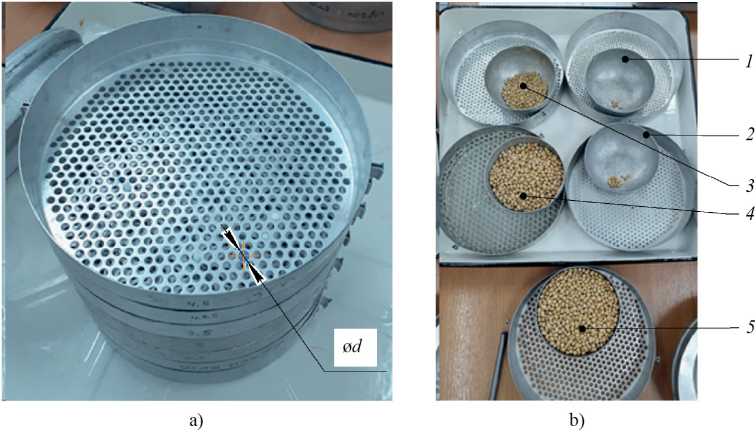
F i g. 1. Study of the fractional composition of pea seeds:
a) sieve classifier; b) pea seed fractions: 1 – seed size with a diameter of less than 4.5 mm;
2 – fraction seed size with a diameter of 4.5 to 5.0 mm; 3 – fraction seed size with a diameter of 5.0 to 6.0 mm; 4 – fraction seed size with a diameter of 6.0 to 7.0 mm;
5 – fraction seed size with a diameter of more than 7.0 mm
Note: d – diameter of the sieve classifier mesh, fraction, mm.
Source: The photographs for figure 1 a was taken by A. M. Mukhametdinov during experimental research in the laboratory of biochemical analysis and biotechnology at Bashkir State Agrarian University in 2024.
One of the main physical and mechanical parameters of pea seeds is their friction properties. The main type of friction that occurs between seeds and the surfaces of the working parts of sowing machines is sliding friction. The dynamic friction coefficient characterizes the resistance to the movement of seeds relative to the surfaces of the sowing
Vol. 36, no. 3. 2026 ENGINEERING TECHNOLOGIES AND SYSTEMS $p machine parts, as well as between the seeds themselves. The seeds are captured by the reel and held by adhesion and friction forces. Under the action of rotation, the working part of the reel transports the seeds. A change in the dynamic friction coefficient affects the force required to move the pea seeds. This creates resistance to the rotating coil, which requires effort to overcome the friction forces and requires a certain torque to turn the coil. We used the change in torque in the coil drive depending on the physical and mechanical properties of the seeds as a comprehensive criterion for calibrating the parameters of the DEM model.
To calibrate the DEM model parameters based on torque, we developed a laboratory setup based on the John Deere 1910 seeding complex (Fig. 2 a). Torque was measured using a digital dynamometer (Fig. 2 b). The experiments used pea seeds with varying moisture content ranging from 9 to 23%. It should be noted that the optimal moisture content for sowing peas according to GOST R 52325-20051 is 11–19%, which meets the agronomic requirements for active swelling and germination without the risk of fungal diseases. This factor, along with the increase in moisture content during etching, determined the upper limit of the range under study.
The design of the installation (Fig. 2 a) includes a hopper 2 for pea seeds 1 , a reel sowing machine 3 with a housing 4 , and a digital dynamometer 5 with a key 6 for measuring torque. The field experiment method consisted of filling the hopper with 1 kg of seeds and then rotating the reel 3 using the key 6 . The rotating reel captures and transports the seeds inside the housing 4 , and the resulting torque is recorded by the dynamometer 5 .
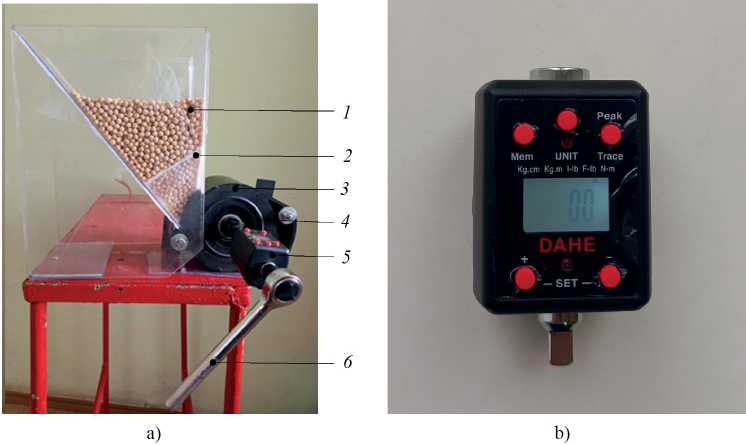
F i g. 2. Conducting field experiments:
a) laboratory setup of the sowing machine; b) digital electronic dynamometer
Sourc e: The photographs for figure 2 a was taken by A. M. Mukhametdinov during experimental research at the Department of Mechatronic Systems and Agricultural Machinery of Bashkir State Agrarian University in 2025.
To conduct model experiments in the KOMPAS-3D environment, there was developed a three-dimensional model of a full-scale laboratory setup (Fig. 3 a), which was then imported into the Rocky DEM software package (Fig. 3 b). The created digital twin allows visualizing the movement of pea seeds in the working area of the sowing machine.
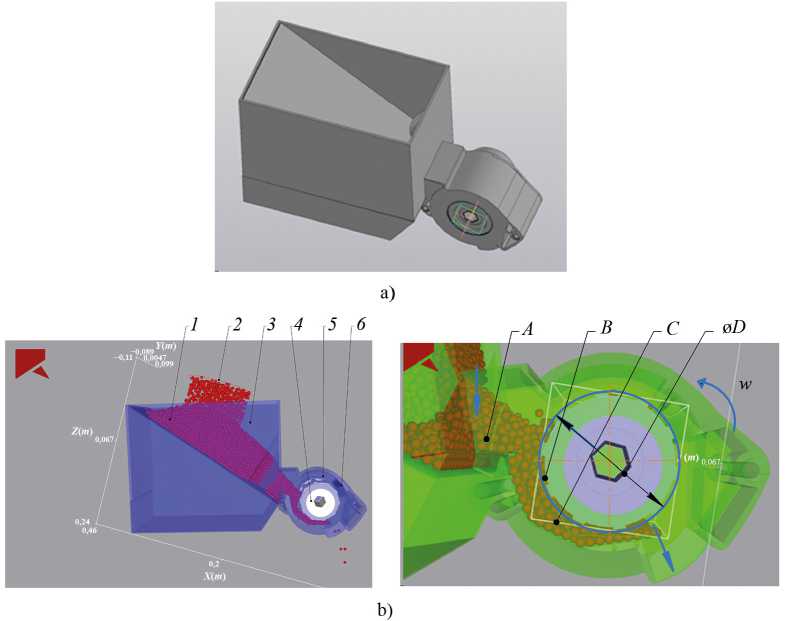
F i g. 3. Model of the laboratory setup: a) 3D model in KOMPAS; b) model in Rocky DEM: 1 – pea seed particles; 2 – particle generator Inlet; 3 – hopper; 4 – coil; 5 – housing; 6 – cleaner
Note: Y ( m ) – the coordinate axis; Z ( m ) – the coordinate axis; X ( m ) – the coordinate axis; A – particles in the hopper moving under the action under the influence of gravity; B – particles captured by the coil grooves and transported by its rotation; C – particles in the gap between the coil and the body, whose movement is caused by the shear of the active layer; D – diameter; w – angular velocity.
Source: Figures 3–6 compiled by the authors of the article.
The simulation of the process begins with the generation of seed particles through Inlet 2 and filling of the hopper cavity 3 . The specified rotation of coil 4 ensures the capture and transport of particles inside housing 5 , while cleaner 6 prevents their reverse movement.
To rotate a coil with a diameter D at an angular velocity w , it is necessary to overcome the torque, the value of which is determined by the physical and mechanical properties of the seed particles and the material of the sowing machine (Fig. 3 b). During operation, three characteristic zones of particle movement can be distinguished:
– Zone A : particles in the hopper moving under the action under the influence of gravity;
– Zone B : particles captured by the coil grooves and transported by its rotation;
– Zone C : particles in the gap between the coil and the body, whose movement is caused by the shear of the active layer.
The intensity of the active layer movement in zone C is determined by the dynamic friction coefficient between both the seed particles and between the particles and the inner surface of the sowing machine shell.
Based on an analysis of research in the field of seed modeling using the discrete element method, it has been established that the Linear spring dashpot model is used as the contact model. This model takes into account both elastic and dissipative (friction) parameters of particles. The normal contact force Fn in this model consists of a linear elastic repulsive force and a restoring force between pea seed particles, determined by the formula [13–15]:
Fn = knlsn + Cnsn 1, where Fn – normal contact force, N; knl – normal contact stiffness of a linear hysteresis spring, N/m; sn – contact with normal overlap, m; Cn – is the recovery coefficient; sn1 – is the time derivative of the contact normal overlap, m/s.
The degree of seed elasticity is determined by the recovery coefficient Cn upon impact, which is the ratio of the normal component of the pea seed velocity before impact to its value after collision with the working surface of the sowing machine working parts.
The main parameters of the Linear spring dashpot contact model, based on our own research and scientific works [1; 15], are presented in Table 1.
Parameters of the contact model
T a b l e 1
|
Parameter |
Indicators |
|
Young modulus E, Pa [14; 15] |
1.9–2·108 |
|
Poisson ratio ν [14; 15] |
0.22 |
|
Coefficient of static friction between seeds fst |
0.4–0.6 |
|
Dynamic friction coefficient between seeds fd |
0.14–0.16 |
|
Recovery coefficient k vost |
0.24–0.34 |
|
Coefficient of static friction between seeds and the walls of the apparatus fst.k |
0.3 |
|
Coefficient of dynamic friction between seeds and the walls |
0.08 (based on experimental |
|
of the apparatus kd.k |
studies) |
|
Particle diameter d , mm |
based on studies of the polydisperse distribution of pea seeds |
Source: the tables 1–3 were compiled by the authors of the article.
The calibration of the parameters of the contact DEM model of pea seeds was performed according to the algorithm presented in the block diagram (Fig. 4).

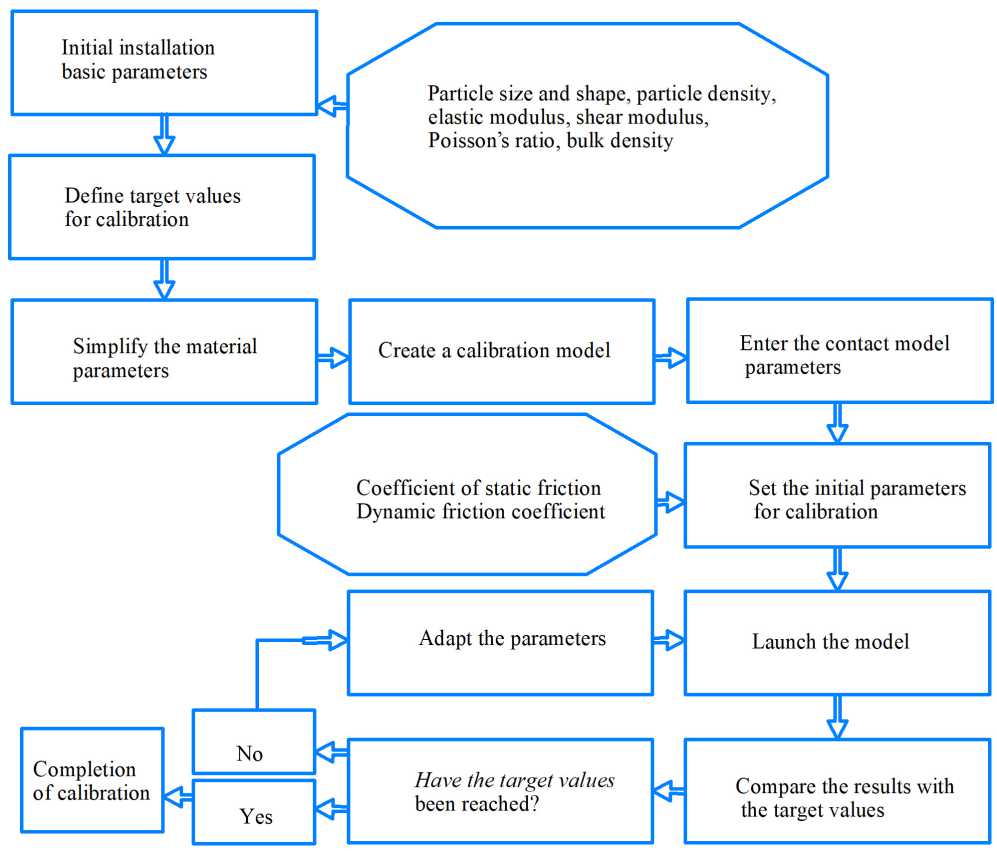
F i g. 4. Parameter calibration using the discrete element method
The model of the sowing machine operation was implemented using Rocky Dem software on a computer with an Intel Core i9-14900HX processor with a frequency of 2.39 GHz and a GeForce RTX4060 (8 GB) video card.
RESULTS
Table 2 shows the polydisperse distribution of pea seeds by size based on the results of sieving.
T a b l e 2
Results of determining the polydisperse distribution of pea seeds by size
|
Seed name |
No |
Fraction (size) seeds with a diameter of mm |
Cell |
Seed weight, g |
Fraction yield, % |
|
Peas |
1 |
less than 4.5 |
– |
1.4 |
0.3 |
|
2 |
4.5–5.0 |
4.5 |
2.0 |
0.4 |
|
|
3 |
5.0–6.0 |
5.0 |
11.6 |
2.3 |
|
|
4 |
6.0–7.0 |
6.0 |
416.8 |
83.4 |
|
|
5 |
7.0–10 |
7.0 |
68.2 |
13.6 |
The sieving results show pronounced polydispersity of the seed material. It was found that the bulk of the seeds (83.4%) are concentrated in the diameter range of 6–7 mm. A significant proportion (13.6%) falls into the large fraction with a diameter of more than 7 mm, while small fractions (less than 5 mm) account for less than 3%. The obtained distribution was used to parameterize the DEM model in the Rocky DEM software package by specifying the corresponding percentage ratio of particles of different diameters.
Table 3 shows the results of experiments to determine the torque on a laboratory setup at different moisture contents of pea seeds and in the Rocky Dem software package at different coefficients of dynamic friction between particles kd when changing the coefficient of dynamic friction of particles with the walls of the apparatus.
T a b l e 3
Results of experiments on a laboratory setup and modeling in Rocky Dem
|
Full-scale experiments |
||||||||
|
Seed moisture content W % |
9.0 |
11.2 |
13.8 |
15.1 |
17.0 |
19.3 |
21.4 |
23.0 |
|
Average torque value M , N·m |
0.3 |
0.3 |
0.5 |
0.6 |
0.7 |
0.8 |
1.0 |
1 |
|
Dispersion |
0.007 |
0.013 |
0.022 |
0.017 |
0.013 |
0.003 |
0.027 |
0.028 |
|
Mean square deviation |
0.08 |
0.11 |
0.15 |
0.13 |
0.11 |
0.05 |
0.16 |
0.17 |
|
Modeling |
in Rocky Dem |
|||||||
|
Dynamic friction coefficient between 0.135 |
0.14 |
0.145 |
0.15 |
0.155 |
0.16 |
0.165 |
0.17 |
|
|
particles kd Average torque value M , N·m |
k d.k = 0.07 0.2 |
0.3 |
0.4 |
0.5 |
0.6 |
0.7 |
0.8 |
0.8 |
|
at a coefficient of dynamic |
kdk = 0.08 0.3 |
0.4 |
0.5 |
0.6 |
0.7 |
0.8 |
1.0 |
1 |
|
friction between particles and |
1.1 |
|||||||
|
walls kd.k at |
k d.k = 0.09 0.4 |
0.5 |
0.6 |
0.7 |
0.7 |
1.0 |
1.1 |
|
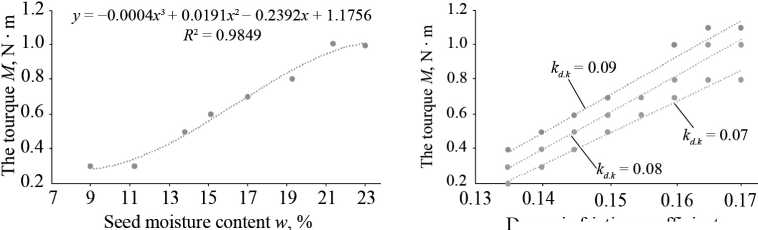
Based on the data in Table 3, there were constructed the graphs showing the dependence of torque on the moisture content of pea seeds (Fig. 5 a) and on the dynamic friction coefficient of the simulated particles (Fig. 5 b).
Dynamic inction coefficient between particles kd
F i g. 5. Torque dependence: a) on the moisture content of pea seeds in a field experiment; b) on the coefficient of dynamic friction in Rocky Dem
For modeling, the coefficient of dynamic friction of pea seeds with the walls of the apparatus kd.k was used in the range from 0.07 to 0.09. The most accurate values Technologies, machinery and equipment 493
^ ИНЖЕНЕРНЫЕ ТЕХНОЛОГИИ И СИСТЕМЫ Том 36, № 3. 2026 of torque and the nature of the change (slope of the trend line) lie within the range of the particle-particle dynamic friction coefficient kd = 0.14...0.16, which corresponds to a moisture content of 11.2 to 19.3%. At the same time, the torque varies in the range from 0.3 to 1.0 N·m.
As a result of parametric research, it was established that the most adequate correspondence to full-scale experiments is achieved with the following friction coefficient values in the Linear spring dashpot model:
– coefficient of dynamic friction between particles kd = 0.14...0.16;
– coefficient of dynamic friction between particles and the walls of the apparatus kd.k = 0.07...0.09.
> = 26i-3.34 R2 = 0.9826
Dynamic friction coefficient between particles kd
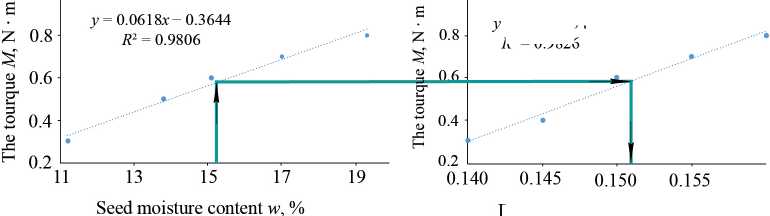
F i g. 6. Nomogram for selecting the dynamic friction coefficient depending on the moisture content of pea seeds
The nomogram obtained will be used in further research for the digital twin of the pea seed sowing process and the operation of the sowing machine when selecting the parameters of the contact model in the Rocky Dem software.
DISCUSSION
Field experiments demonstrated a clear correlation between seed moisture content and torque on the sowing machine shaft. As moisture content increased from 9 to 23%, the average torque value increased from 0.3 to 1.0 N·m, indicating a significant effect of moisture content on the friction characteristics of seeds. The dispersion of measurements was in the range of 0.003–0.028, confirming the reproducibility of the results.
This range of parameters corresponds to seed moisture content of 11.2–19.3% and provides a calculated torque of 0.3–1.0 N·m, which statistically significantly coincides with the experimental data.
A comparison of the results of physical and numerical experiments showed satisfactory agreement: the experimental torque values (0.3–1.0 N·m) are completely within the range obtained in the simulation (0.2–1.1 N·m).
The studies conducted made it possible to establish the main patterns determining the interaction of pea seeds with the working parts of the sowing machine. Analysis of the particle size distribution (Table 2) showed a pronounced polydispersity of the seed material: the predominant fraction (83.4%) has a diameter of 6–7 mm, while large seeds (> 7.0 mm) account for 13.6% and small seeds (< 5 mm) account for less than 3%.
494 Технологии, машины и оборудование
Vol. 36, no. 3. 2026 ENGINEERING TECHNOLOGIES AND SYSTEMS .^Ts The data obtained are consistent with the results of studies by B. M. Ghodki [4], V. I. Khizhnyak [16], and A. N. Marthekha [17], confirming the representativeness of the sample. The established fractional structure was taken into account when parameterizing the DEM model in the Rocky DEM software package, where the corresponding percentage ratio of particles is specified. The observed relationship between seed size and friction-larger and heavier seeds exhibit a lower coefficient of dynamic friction due to easier sliding-was also reflected in the model.
The significant influence of seed moisture on their friction properties has been experimentally confirmed. With an increase in moisture from 9 to 23%, the coefficient of dynamic friction increases, which leads to an increase in the torque from 0.3 to 1.0 N·m required for the seeding machine to operate. A comparative analysis of the dependencies (Fig. 5 a, b) showed that with a coefficient of friction between the seeds and the walls of the device kd.k = 0.8, the Rocky DEM model most accurately reproduces the nature of the torque change observed in the full-scale experiment. These results correlate with data from previous studies on the calibration of pea seed parameters [15].
Three characteristic modes of operation of the apparatus were identified depending on seed moisture content:
– range 9–11%: the torque is minimal and stable, which is explained by the easy movement of dry seeds with low friction.
– range 11.2–19.3%: a progressive increase in torque is observed, due to increased adhesion and friction.
– range above 19.3%: torque stabilizes, probably due to a decrease in adhesion between overmoistened seeds.
Calibration of the contact model parameters of the digital twin showed that of all the parameters studied (Poissonʼs ratio 0.22; Youngʼs modulus 1.9–2×10⁸ Pa; recovery coefficient 0.24–0.34), the coefficient of dynamic friction between seeds has the greatest influence on the nature of the torque change. It has been established that the values of kd = 0.14...0.16 in the model correspond to the experimental data at a moisture content of 11.2–19.3% and provide a calculated torque of 0.3–1.0 N·m, which confirms the adequacy of the calibrated DEM model.
CONCLUSION
Based on the established dependencies, a nomogram was constructed for the rapid determination of the dynamic friction coefficient depending on seed moisture content, which will be used in further studies of the digital twin of the sowing process.
The results obtained confirm the adequacy of the developed DEM model and demonstrate the promise of using the method of calibrating the parameters of the contact model by torque to predict the performance characteristics of sowing machines.
The study allowed us to develop and verify a method for calibrating the parameters of the contact model for the digital twin of pea seeds, which adequately describes their behavior in the working area of the coil seeder. The following main conclusions were obtained as a result of the work.
The fractional composition of pea seeds was established, showing a pronounced polydispersity of the material. The dominant fraction (83.4%) has a diameter of 6–7 mm,
^® ИНЖЕНЕРНЫЕ ТЕХНОЛОГИИ И СИСТЕМЫ Том 36, № 3. 2026 which was taken into account when parameterizing the DEM model in the Rocky DEM software package to create a representative digital twin.
There was experimentally proven a significant influence of seed moisture content on their friction properties. With an increase in moisture content from 9% to 23%, the dynamic friction coefficient increases, which leads to a natural increase in the torque on the shaft of the sowing machine from 0.3 to 1.0 N·m.
A comprehensive calibration method has been developed and tested, using torque as a criterion for conformity. The range of key parameters of the Linear spring dashpot contact model has been established, ensuring high simulation accuracy:
– seed-seed dynamic friction coefficient kd : 0.14–0.16;
– dynamic friction coefficient seed-apparatus wall kd.k : 0.07–0.09.
A nomogram was constructed for the rapid determination of the dynamic friction coefficient depending on seed moisture content, which allows for the effective configuration of a digital twin for modeling the sowing process under various conditions.
Verification of the model confirmed its adequacy: the discrepancies between the results of field experiments and DEM modeling data do not exceed 10%, and the nature of the torque change is reproduced correctly.
The use of the proposed calibration method based on torque allows the creation of high-precision digital twins suitable for optimizing the design and technological parameters of sowing machines, which contributes to improving the quality of sowing and saving resources in agricultural production.
