
Performance comparison of an organic Rankine cycle system operating at various temperatures using different working fluids
Журнал: Вестник Южно-Уральского государственного университета. Серия: Энергетика @vestnik-susu-power
Рубрика: Теплотехника
Статья в выпуске: 3 т.26, 2026 года.
Бесплатный доступ
Organic Rankine Cycle (ORC) systems are commercially employed for small- and large-scale thermal conversion to produce electricity. Waste heat energy sources are abundant. Some renewable energy sources cannot be used to power conventional steam Rankine and open-gas cycle turbine cycles. Few can provide viable, sustainable, techno-economic solutions for power generation. ORCs operate using a conventional steam Rankine cycle at subcritical and supercritical regimes, employing heavy molecular weight organic fluids instead of water steam. This enables ORCs to operate for medium- and low-grade heat conversion into electricity. No ideal fluid exists for all applications. Six hundred pure and zeotropic mixtures have been investigated as suitable working fluids for ORCs. These investigations considered performance characteristics such as efficiency, cost, and environmental impacts. The current study presents a review of working fluid selection for different applications. This can help designers identify the most suitable organic fluids for various ORC applications considering the proposed operating conditions.
Короткий адрес: https://sciup.org/147255391
IDS: 147255391 | УДК: 621.43 | DOI: 10.14529/power260312
Сравнение характеристик органической системы цикла Ренкина, работающей при различных температурах с использованием различных рабочих жидкостей
Системы органического цикла Ренкина (ORC) коммерчески используются для мало- и крупномасштабного преобразования тепла в электричество. Существует множество источников отработанного тепла. Некоторые возобновляемые источники энергии не подходят для питания стандартных паровых циклов Ренкина и открытых газовых турбинных циклов для обеспечения их эффективности. Лишь немногие из них обеспечивают внедрение практически осуществимых, устойчивых и технико-экономически эффективных решений для выработки энергии. ORC функционируют на основе стандартного парового цикла Ренкина в докритическом и транскритическом режимах, применяя органические жидкости с высокой молекулярной массой вместо водяного пара. Это делает ORC подходящими для преобразования тепла средней и низкой степени в электричество. Идеальной жидкости для всех применений не существует. Шестьсот чистых и зеотропных смесей были исследованы в качестве подходящих рабочих жидкостей для ORC. В этих исследованиях рассматривались такие эксплуатационные характеристики, как эффективность, стоимость и воздействие на окружающую среду. Текущее исследование представляет собой обзор выбора рабочей жидкости для различных применений. Это может помочь проектировщикам определить наиболее подходящие органические жидкости для различных применений ORC с учетом предлагаемых условий эксплуатации.
Текст научной статьи Performance comparison of an organic Rankine cycle system operating at various temperatures using different working fluids
The world population continues to grow, requiring more energy, partially due to higher electricity use. Environmental impacts are paramount. New energy generation methods and renewable energy technologies are needed [1–6].
Most industrial sectors require energy. Heat is lost during industrial processes [7–11] most often at high temperatures, 100 °С or more. Waste heat from refrigeration is rejected at much lower temperatures, e.g., 30 °С. This latter type of energy is called secondary waste heat [12]. Organic Rankine cycle (ORC) technology is a promising way to recover low-grade waste heat using organic working fluids [13–16].
ORC systems can improve electricity production. To enhance the thermal efficiency and capacity of ORC, several strategies have been proposed by using different working fluids [17, 18].
A.F. Babatunde et al. [1] did a comprehensive review of working fluid selection for ORC applications. Pure and azeotropic fluids were discussed. They assessed thermophysical properties, stability, environmental effects, safety, compatibility, availability, and cost as essential factors when choosing the most appropriate organic working fluids. The trade-offs were discussed.
H.M.D.P. Herath et al. [2] examined the performance of ORCs using seven working fluids: R-134a, R-245fa, benzene, methanol, ethanol, acetone, and propane (R-290). Their results show that benzene- and methanol-based ORC systems are more efficient than other working fluids. They require lower fluid mass flow rates per unit of power generation.
M. Bahrami et al. [3] modeled a combined cycle. They considered performance optimization of several working fluids within relevant temperature ranges. The total power efficiencies of their cycle were 34 to 42%. FC72, FC87, HFE7100, HFE7000, Novec649, n-pentane, n-decane, R245fa, and toluene were investigated from thermal, operational, and environmental perspectives.
-
L.J. Brasz et al. [4] compared the cycle efficiency of CFC113, CFC114, CFC11, and HCFC123 with some of the newer refrigerants (HFC245fa, HFC236fa, and HFC134a). They were evaluated as working fluids in organic Rankine cycle applications.
Mohamad Salman [5] Designed and simulated several Organic Rankine Cycle (ORC) systems and conducted sensitivity analyses. He then analyzed their performance and pinpointed the factors that most influence cycle efficiency. The impacts of specific working fluids upon cycle feasibility were examined. The evaluated fluids were R236ea, R600, n-butane, R245fa, and n-hexane.
P.J. Mago et al. [6] investigated R134a, R113, R245ca, R245fa, R123, isobutane, and propane as working fluids. Their boiling temperatures were 243– 488 °C. A combined first- and second-law analysis was performed while changing system parameters at various temperatures.
M.A. Sadek et al. [8] simulated ORC systems using hydrocarbons, as well as standard and alternative refrigerants, as working fluids at 15, 35, and 50 °C. The HYSYS optimizer was used to achieve optimal system conditions for each working fluid. Evaluated fluids were R-12, R-123, R-134a, RC318, 1234yf, R1234ze (Z), R1234ze (E), R1224yd (Z), R245ca, and R141b.
A. Pintoro et al. [9] used R134a and R245fa as working fluids. They simulated an ORC system for a low-temperature geothermal heat source.
A.S. Chowdhury and M.M. Ehsan [10] selected R245fa, R134a, R123, R404a, R600a, and R407c for their study. R123, R600a, and R245fa are dry working fluids, whereas R134a, R404a, R143a, and R407c are wet.
The current study compared four working fluids, R236ea, R227ea, R407c, and R717, at 70 and 110 °C. This was done to identify high-efficiency fluids under various operating conditions based on performance characteristics such as cost and environmental impacts. The system was evaluated using the EES simulator to reach the optimal conditions for each working fluid. Each working fluid has a different specific heat, conductivity, and latent heat of vaporization that impact Organic Rankine cycle (ORC) systems and ultimately determine cycle performance. We used a sub-critical Rankine cycle without superheating, employing heat sources at 70–110 °C, with evaporator pressure as an independent parameter. The selection of a working fluid depends on the heat source, temperature, and design objective.
Theoretical Equations
The fundamental knowledge is presented in the following equations, and the theoretical thermodynamic process occurring at each stage of the cycle is
The quality factor of the gas is
X = [kJ/kg, k].
sa sf
explained [5].
The Optimal Rankine Cycle
The heat in the boiler is
Qin = ̇ (ℎ з- ℎ2) [kJ].(1)
Turbine work, which is also the output or outcome, is
Wt = ̇ (ℎ з -ℎ 4) [kJ].(2)
Heat rejected from the system, which is sent to the cooling water, is expressed as:
Qout = ̇ (ℎ 4- ℎ1) [kJ].(3)
Pump work is wp = ̇ (ℎ2- ℎ1) [kJ].(4)
The thermal efficiency ŋ is the difference between the turbine and pump work divided by the heat transferred to the boiler.
ŋ =“ [%].(5)
The turbine work divided by pump work is the back-work ratio (bwr) of the system.
bwr [%].(6)
Specific enthalpy is
ℎ2= ℎf+ x (ℎ g - ℎf) [kJ].
Irreversibility
Isentropic turbine efficiency, ŋ f , is
( wt / rr ̇) s ŋ£ = ( wt / rr ̇)
^1~^2
/i
~^2S
[%].
Isentropic pump efficiency, ŋ V , is expressed as
( Wp / rr ̇) ŋ p = ( Wp / TT ̇)s
^4S~^3 ^4-^3
[%].
Layout of the Basic ORC
Fig. 1 shows Layout 1, a model for the basic ORC cycle described previously. It has four basic components: a pump, a phase shift boiler, low-pressure turbine, and a heat exchanger that serves as a condenser [5].
Fig. 2 illustrates the thermodynamic process for an ORC system. The ideal Rankine cycle is made up of the following processes: 1–2: Compactness (working fluid feed pump); 2–3: Heat supply (various heat sources); 3–4: Expansion through a turbine; 4–1: Heat rejection at a condenser.
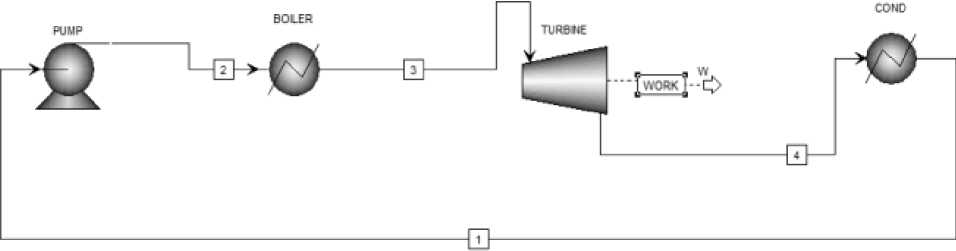
Fig. 1. A basic ORC
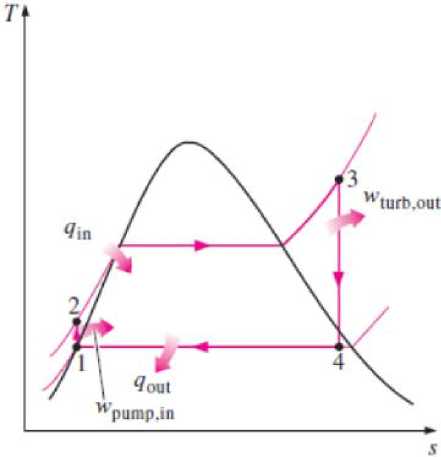
Fig. 2. Fundamental Rankine Cycle on a TS-Diagram
System Description
An ORC cycle operates under the identical thermodynamic conditions of a Rankine cycle using an organic working fluid. The cycle has the same components: a boiler, turbine, condenser, and pump. Heat sources at less than 300 °C are normally employed. Working fluid characteristics make the ORC suitable for these low-temperature heat sources. High molecular weight working fluids enable phase transition from a saturated liquid to saturated vapor at lower temperatures. The working fluid is vaporized in a boiler and passes through a turbine connected to a generator. Gas is condensed after the turbine and returned to a pump to repeat the cycle.
Results
The results of our simulation and calculations are presented in the following tables comparing different efficiencies and temperature variations within the system. This analysis deals with performance efficiency at lower operating temperatures, the effect of the temperature difference on net power output, and overall system performance. Also given are the key performance parameters. The four working fluids for this study were chosen based on the criterion that the critical points of the fluids are higher than the temperatures of the heat source for proper operation in the desired temperature range. These tables present the simulation results for a basic ORC system where the turbine outlet temperature ( T 3) is equal to 110 and 70 °C.
An ORC system of the same design was used to simulate the performance of the basic cycle operating under constant pressure and flow conditions. Pmax = 15.74 bars is the pressure at point 2, the pump outlet. Pmin = 2.438 bars is the pressure at point 4, the turbine outlet, as shown in Fig. 2.
The simulation results are presented in Table 1 and Fig. 3 and were obtained at a constant mass flow rate of the working fluid, specified pressure parameters for each thermodynamic cycle, and a constant turbine inlet temperature of 110 °C. The controlled environment allows for a direct evaluation of the effectiveness of the selected working fluids. Comparison of the thermal efficiencies obtained shows that, in general, the different fluids examined behave similarly. However, a large anomaly is observed for R717, which shows the highest thermal efficiency in the group with a value of 0.1903. The improved efficiency indicates R717 could be a particularly suitable working fluid for the given operating conditions. This remarkable success will be examined later.
Table 2 and Fig. 4 present the simulation results under a constant working fluid mass flow rate and at specific pressures, with a 70°°C turbine inlet temperature. This analysis mirrors the conditions explored in Table 1 (110°°C turbine inlet temperature) and allows for a direct comparison of working fluid performance across different temperature regimes. At the higher temperature, the thermal efficiencies of the different working fluids are generally comparable at 70°°C. However, in this lower temperature regime, R407c exhibits the highest thermal efficiency, reaching a value of 0.1836. Comparing these results with those obtained at a turbine inlet temperature of 110°°C (see Table 1) reveals a notable trend: R717 demonstrates
A comparison of several operational fluids modeled at T 3 = 110 °C
Table 1
|
ч |
ṁ , kg/hr |
р . min |
р max |
Selected ORC fluids |
|
0.1621 |
152.04 |
2.438 |
15.74 |
R236ea |
|
0.1596 |
152.04 |
2.438 |
15.74 |
R227ea |
|
0.1903 |
152.04 |
2.438 |
15.74 |
R717 |
|
0.19 |
152.04 |
2.438 |
15.74 |
R407c |
Table 2
Simulated comparison of different working fluids at 70 °C
|
4 |
ṁ , kg/hr |
p min |
p max |
Selected ORC fluids |
|
0.07341 |
152.04 |
2.438 |
15.74 |
R236ea |
|
0.1179 |
152.04 |
2.438 |
15.74 |
R227ea |
|
0.1808 |
152.04 |
2.438 |
15.74 |
R717 |
|
0.1836 |
152.04 |
2.438 |
15.74 |
R407c |
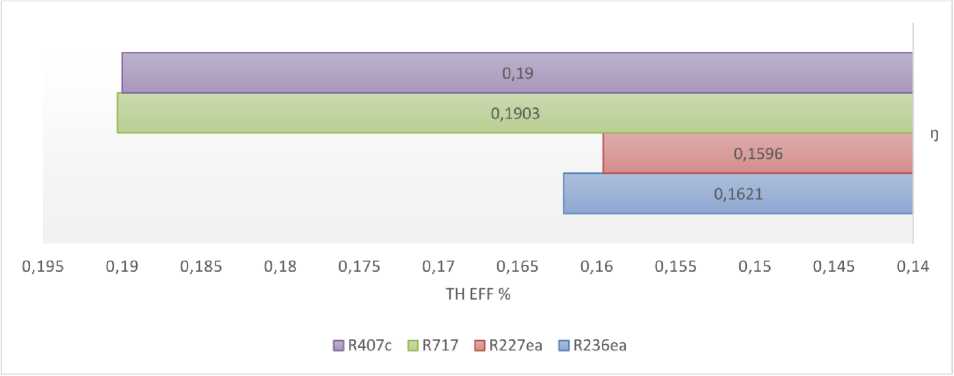
Fig. 3. Basic ORC Effectiveness at a stable temperature, T 3 = 110 °C
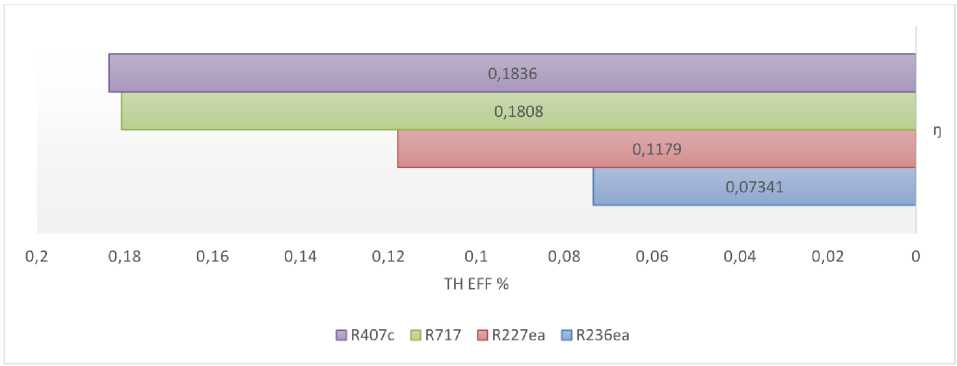
Fig. 4. Basic ORC Efficiency at a constant temperature, T 3 = 70 °C
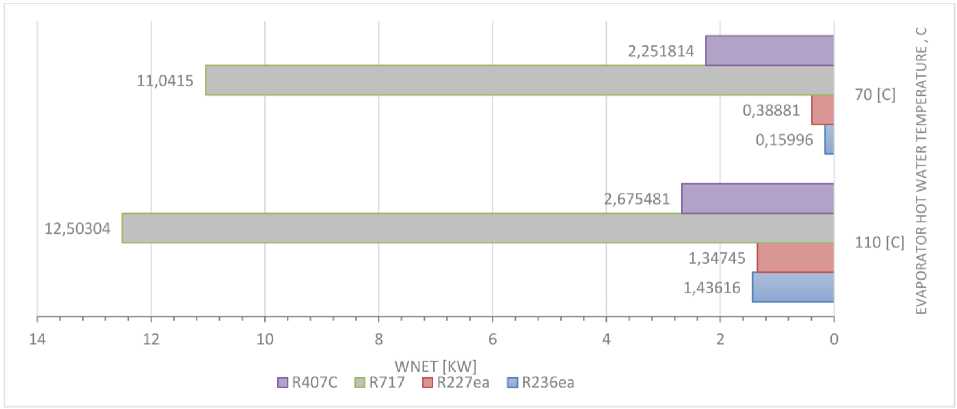
Fig. 5. Influence of temperature variation on net power output
the greatest efficiency at the higher temperature, while R407c achieves the highest efficiency at the lower temperature. This indicates a temperature-dependent performance characteristic for these working fluids. Consistent with the basic thermodynamic laws, the data also suggests a positive correlation between turbine inlet temperature and the overall thermal efficiency.
Fig. 5 shows a comparison of the power output generated by different working fluids at different heating temperatures. The results demonstrate that R717 and R407c provide the highest power outputs among the four fluids considered regardless of the heating temperature. However, detailed analysis shows that R717 has a significantly better performance. This fluid demonstrates a considerably higher power output and superior overall system efficiency compared to R407c. This notable difference in performance characteristics demonstrates the potential of R717 as a particularly well-suited working fluid for basic organic Rankine cycle (ORC) operations, especially within the context of the previously defined operating conditions using low-temperature heat sources. The extra power output and efficiency of R717 indicate the potential of R717 to optimize the energy recovery from low-temperature heat sources.
Conclusions
The current study indicates that an organic Rankine cycle can produce electrical power at low temperatures. Comparing R236ea, R227ea, R407c, and R717 showed that refrigerant R407c has superior performance. Increased heat source temperature improves power output and system efficiency. Further study should evaluate the effect of changing design parameters on net power output and total system efficiency. Future work will include detailed sensitivity analysis of all parameters for an ORC.
Discussion
The cost and availability of the working fluids should be considered. Conventional refrigerants are costly when applied in an ORC system. This cost may be minimized either by increasing the scale of manufacture of such refrigerants or by using low-cost hydrocarbons. Hydrocarbons and other alternative working fluids are being investigated because they have lower global warming potentials, are more extensively available, and are less expensive [9]. Another method of decreasing the carbon emissions of ORCs is the use of green or sustainable working fluids, such as fluids generated from biomass. Lastly, careful analysis of expense, availability, environmental consequences, and efficiency should precede selection of an ORC system’s working fluid. An added benefit is that some organic fluids are environmentally friendly, and their use reduces water consumption.
