
Половой диморфизм и генетическое разнообразие популяции Сarassius carassius в эвтрофном водоеме бассейна реки Тура
Журнал: Вестник Нижневартовского государственного университета @vestnik-nvsu
Рубрика: Экология животных
Статья в выпуске: 4 (72), 2025 года.
Бесплатный доступ
Исследование направлено на выявление половых различий и генетического разнообразия золотого карася Сarassius carassius (Linnaeus, 1758), обитающего в эвтрофном водоеме бассейна реки Тура (Западная Сибирь). Данный вид в последние десятилетия динамично снижает численность в водоемах Евразии [5; 15; 16; 19]. В ходе работы проведён биологический анализ 100 особей золотого карася, включая определение морфометрических характеристик и площади ядер эритроцитов. Исследование показало, что данная популяция характеризуется низкотелой карликовой формой с соотношением полов 1:1, где все особи в выборке имели четвертую стадию зрелости гонад. Выявлены достоверные половые различия по размерно-весовым и меристическим признакам. Самки отличались большей длиной и массой тела, а также имели достоверно большие значения по 55,6% из исследованных меристических признаков. Анализ площади ядер эритроцитов показал, что все особи являются диплоидами, при этом половые различия по этому показателю оказались не значимыми. Генетический анализ мтДНК выявил единственный гаплотип CCA2, что указывает на низкое генетическое разнообразие в данной популяции. Результаты исследования подчеркивают необходимость мониторинга за изменениями в структуре популяций золотого карася и разработки мероприятий по сохранению данного вида.
Похожие статьи в разделе Общая генетика. Общая цитогенетика. Иммуногенетика. Эволюционное учение. Видообразование. Филогенез
Короткий адрес: https://sciup.org/14134403
IDS: 14134403 | УДК: 575.174.5 | DOI: 10.36906/2311-4444/25-4/06
Sexual Dimorphism and Genetic Diversity of the Carassius carassius Population in the Eutrophic Water Body of the Tura Basin
The study aimed to identify sexual differences and genetic diversity of the crucian carp Carassius carassius (Linnaeus, 1758) inhabiting a eutrophic reservoir of the Tura river basin (Western Siberia). This species has been dynamically declining in numbers in Eurasian waters in recent decades [5; 15; 16; 19]. During the study, a biological analysis of 100 individuals of the crucian carp was conducted, including the determination of morphometric characteristics and the area of erythrocyte nuclei. The study showed that this population is characterized by a short dwarf form with a sex ratio of 1: 1, where all individuals in the sample had the fourth stage of gonadal maturity. Reliable sex differences in size-weight and meristic traits were revealed. Females were distinguished by a greater commercial length and body weight, and also had reliably higher values for 55.6% of the studied meristic traits. Analysis of the erythrocyte nuclear area showed that all individuals were diploids, while sex differences in this indicator were not significant. Genetic analysis of mtDNA revealed a single CCA2 haplotype, which indicates low genetic diversity of this population. The results of the study emphasize the need to monitor changes in the population structure of golden crucian carp and develop measures to preserve this species.
Текст научной статьи Половой диморфизм и генетическое разнообразие популяции Сarassius carassius в эвтрофном водоеме бассейна реки Тура
In the waterbodies of Northern Eurasia, the crucian carp ( Carassius carassius L.) has historically been relatively abundant [1; 4; 8; 10; 15; 19].
The crucian carp is one of the most ecologically adaptable native fish species, resistant to various adverse environmental factors such as oxygen deficiency, extreme temperatures, and poor feeding conditions.
Under such circumstances, this species often forms a low-bodied dwarf form – C. carassius morpha humilis Heckel, 1840, which demonstrates a wide range of variability in several of its biological and morphological traits [4; 7; 12].
Since the late 20th century, in most waterbodies of Eurasia, as well as in lakes of the steppe and forest-steppe zones and in floodplain taiga reservoirs of Western Siberia, a disappearance or a rapid decline in the abundance of C. carassius has been observed [3; 6; 8; 9; 16; 17; 19].
Possible reasons for the reduction of its range include displacement due to the introduction of the silver crucian carp from the Amur river [3; 6; 8; 15; 16; 19; 23; 26], which has a higher growth rate [30]; a potential hybridization among cyprinid species [3; 6; 8; 15; 16; 19; 22]; and a low genetic diversity of the crucian carp, suggesting a reduced ability to adapt to changing environmental conditions [16; 23; 26; 27]. These factors determine growing scientific interest in the current state and biological characteristics of the crucian carp populations, both in Russia and abroad [15; 16; 19; 22; 23; 26; 31; 32].
Previously, sexual dimorphism in the crucian carp populations outside the breeding season was characterized as weak. For example, in the waterbodies of Kazakhstan, females and males differed only in the size of the pectoral and anal fins [8]. No sexual dimorphism was found in populations of the crucian carp in some waterbodies of the Udmurt Republic [12]. In the Middle Ob river basin, differences were recorded only in head length and maximum body height [3; 5; 8].
As a result of studies on the crucian carp population in Lake Igumenskoye (Tomsk), sexual dimorphism was revealed only in plastic (morphometric) traits: females had greater head length, anteventral, and antepectoral distances; males had larger ventroanal, ventrocaudal, anocaudal, dorsocaudal distances, head height, eye diameter, dorsal and anal fin heights, and the lengths of pectoral, pelvic, and lower caudal fin lobes [19].
A comparative analysis of how often certain countable morphological traits (meristic traits) appear is used to identify intra-population and sex-related features in bony fishes. This approach

is based on the fact that these traits have high heritability and show up early in ontogenesis [13]. However, studies focused on sexual differences in meristic traits that include the three sections of the vertebral column and the number of seismosensory canals on paired cranial bones are still insufficient for populations of the сrucian carp.
It is known that C. carassius forms bisexual populations with a 1:1 female-to-male ratio, and individuals have a diploid (2n) set of chromosomes [3; 4; 5; 8; 16]. Research on the genetic diversity of the genus Carassius based on mitochondrial DNA (mtDNA) has shown that the сrucian carp has at least two closely related haplotypes (CCA1 and CCA2). One of them was originally identified in the Czech Republic, and the other in Kazakhstan [26; 27]. It is also known that a comparative mtDNA analysis of the crucian carp and the silver crucian carp revealed a difference of about 6% in nucleotide substitutions, which support the relatedness of the two species [3]. Until now, mtDNA of the crucian carp from the study region has not been analysed.
The aim of this work is to examine sexual differences and genetic diversity in a population of the сrucian carp inhibiting a eutrophic waterbody within the Tura river basin.
Materials and Method s
For this study, we selected a winterkill-prone body of water, Lake Srednee (coordinates: 57°38’15.9”N, 64°28’50.9”E), which belongs to the Tura river basin (Western Siberia) and is not connected to the main river channel. Lake Srednee is a small, roughly circular lake. Its shoreline is mostly surrounded by a mixed forest, while the western part is swampy. The lake’s surface area is 1.07 km², and the depth to the silty bottom is between 1.1 m and 1.6 m.
The fish community of the lake includes the following species: C. carassius, Carassius gibelio (Bloch, 1782), Rhynchocypris percnurus (Pallas, 1814), and Perccottus glenii Dybowski, 1877. During the study period, the lake showed an increased level of primary production throughout its area. The following species of higher aquatic plants were common: Typha latifolia L. (1753), Nuphar lutea (L.) Smith., Lemna minor L. (1753), and Potamogeton natans L. (1753). There was also an intensive growth of the cyanobacterium Aphanizomenon flos-aquae .
Sampling was carried out in July 2018. Fish were collected with a fishing seine (20.0 m long, 1.5 m high, 24-mm mesh size) and with telescopic rods equipped with two-hook rigs.
According to its hydrochemical characteristics during sampling, the water of Lake Srednee was classified as belonging to a hydrocarbonate class, a sodium group, and a low-mineralised type (type I) [6]. During the research period, the concentrations of ammonium nitrogen and total iron exceeded the maximum allowable limits. The increased amount of organic matter and high primary production during the summer growing season match the conditions typical of a eutrophic waterbody prone to winterkill.
The research object was the population of the crucian carp, historically long-established in this particular waterbody. The total sample size comprised 100 specimens. For all individuals, a biological analysis was conducted to determine: sex and age; gonadal maturity stages; commercial length measurements (L, cm) – from the tip of the snout to the base of the caudal fin, measured horizontally; maximum body height (qh) – from the highest dorsal point to the ventral side, measured vertically; total body mass (m, g); cytometric analysis of the erythrocyte nuclear area (ENA); and scoring of meristic traits considering bilateral distribution according to established ichthyological guidelines [12; 15; 18]. For 30 individuals (15 females and 15 males) selected from the total sample, a sequence analysis of the mitochondrial DNA control region (460 bp) was performed to investigate the genetic diversity of the population.
For all individuals in the sample, there were analyzed 18 meristic traits, including: the number of spiny rays in the dorsal fin (Dк); the number of branched rays in the dorsal fin (Dв); spiny rays in the anal fin (Aк); branched rays in the anal fin (Aв); the number of gill rakers on the first gill arch (Sp.br.); perforated scales (l.l.); rays in the pectoral fin (Pв); rays in the pelvic fin (Vв); the total number of scales in the lateral line (l.l. total.); the number of scale rows above the lateral line (l.l. above) and below the lateral line (l.l. under); total vertebrae number in the vertebral column (Vo); vertebrae count in the abdominal region (Va), transitional region (Vi), and caudal region including urostyle (Vc + ct); as well as the number of sensory canal pores (ССК) located on three paired cranial bones – praeoperculum (pop), dentale (dn), and frontale (f) [12; 16; 18; 20].
To measure the erythrocyte nuclear area (ENA), arterial blood samples were taken from live specimens, followed by fixation and staining of erythrocyte nuclei using a fixative-stain solution composed of 0.3% dry eosin methylene blue dye according to May-Grünwald in methanol. Cytogenetic analysis was performed microscopically, and cytological measurements of erythrocyte nuclei were conducted using the licensed version of the Levenhuk Lite software. The erythrocyte nuclear area was calculated using the formula for the area of an ellipse, based on measurements of erythrocyte length and width [2; 6]. To ensure statistical reliability of the ENA determination, 20 randomly selected erythrocytes were measured per individual.
Statistical processing included the calculation of the mean value (Хmean), the standard error of the mean (mX), and the coefficient of variation (CV) [14].
The normality of the distribution of traits was tested using the Kolmogorov–Smirnov test. Since the indicators of body length, height, body mass, and meristic traits deviated from a normal distribution, the Mann–Whitney U-test was used to compare the mean values. The GSI in the sample followed a normal distribution; therefore, the Student’s t-test was applied to compare females and males for this parameter [14]. Statistical analysis was performed using Microsoft Excel 2016.
Fin clips of the fish, preserved in 80% ethanol, served as the biological material for the genetic analysis. DNA extraction was performed using the D-cells kit according to the manufacturer's protocol. A fragment of the mtDNA control region (D-loop) was amplified using the “BioMaster HS-Taq PCR-Color” kit (Biolabmix) with primers L15923 (5′-TTAAAGCATCGGTCTTGTAA-3′) and H16150 (5′-GCCCTGAAATAGGAACCAGA-3′), following the methodology of Takada et al., 2010 [29]. PCR products were purified from the reaction mixture using ExoSAP-IT reagent (Applied Biosystems). Sequencing reactions were carried out in a thermal cycler using BigDye™ Terminator v1.1 reagents (Applied Biosystems) with the following thermal profile: initial denaturation (1 cycle) – 96°C (4 min); 40 cycles (denaturation – 98°C (10 s), primer annealing – 57°C (10 s), extension – 60°C (4 min)); deactivation – 96°C (3 min); hold – 4°C (indefinite). Reaction products were purified using the BigDye XTerminator Purification Kit (Thermo Fisher Scientific). The sequencing of the purified DNA mixture was performed using a 3500 Genetic Analyzer (Applied Biosystems) capillary sequencer. The alignment of the nucleotide sequences of the mtDNA control region fragment (460
bp) of the crucian carp was performed using the MAFFT v7.245 algorithm in the Geneious v10.0.9 software. The obtained sequences were compared with the publicly available GenBank database.
The study was conducted in accordance with all applicable international, national and institutional guidelines for the care and use of animals.
Results and Discussion
The studied sample of C. carassius (100 spec.) consisted of 52 females and 48 males (a ratio close to 1:1). All specimens were captured at Stage IV gonadal development. The size of the individuals in the sample ranged in length from 10.1 cm to 15.2 cm and in weight from 22 g to 84 g. The body was elongated, with a mean body length-to-depth ratio of 3.1. The lateral line is perforated. The number of perforated scales in the lateral line varied from 10 to 33 in females and from 17 to 31 in males. The total number of scales along the lateral line ranged from 31 to 40 for females and from 33 to 38 for males. The lower jaw was upturned. The captured individuals had a dark spot at the base of the caudal fin (Fig. 1). These characteristics correspond to the description of the shallow-bodied dwarf form C. carassius morpha humilis Heckel, 1840, inhibiting small oxygen-depleted waterbodies [7; 12].
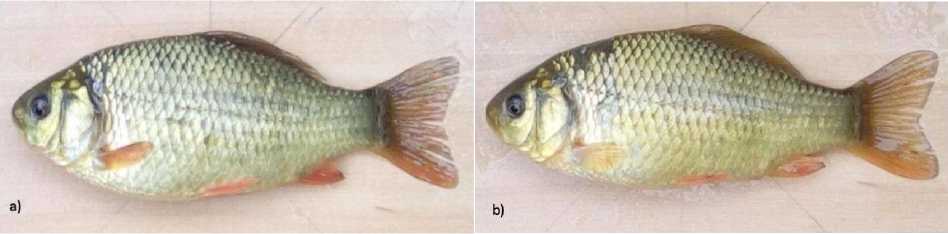
Fig. 1. Carassius carassius specimens from Lake Srednee, a) female (l = 10.5 cm, m = 38 g); b) male (l = 11.9 cm, m = 42 g)
The age of the specimens in the sample was represented by four groups, from 5+ to 8+ years (Table 1). Younger age groups were not captured during the sampling period. The largest number of individuals (49 spec.) were 7+ years.

Table 1
|
Sex, quantity |
Age, year |
|||||||
|
5+ |
6+ |
7+ |
8+ |
|||||
|
L mean , cm |
m mean , g |
L mean , cm |
m mean , g |
L mean , cm |
m mean , g |
L mean , cm |
m mean , g |
|
|
Females, 52 spec. |
10.9 |
28.0 |
12.3 |
43.9 |
13.6 |
63.1 |
14.1 |
68.1 |
|
Males, 48 spec. |
11.0 |
29.3 |
11.3 |
32.1 |
11.6 |
33.6 |
11.6 |
34.2 |
|
All individuals |
11.0 |
28.8 |
11.8 |
37.4 |
12.6 |
49.2 |
13.1 |
54.3 |
Note. L mean – mean length; m mean – mean mass.
Size-age Characteristics of Female and Male Crucian Carp in the Sample from the Studied Waterbody
Females in the entire sample were significantly larger in body length, depth and mass (Table 1 and Table 2). The differences in body depth and mass of the individuals are likely associated with the high (fourth) stage of gonad maturity, the size of which in females is usually 1–2 times larger during egg maturation [1; 4; 7].
Table 2
