
Помощь Северной Кореи Вьетнаму в 1965–1973 годах
Журнал: Вестник Новосибирского государственного университета. Серия: История, филология @historyphilology
Рубрика: История Юго-Восточной и Центральной Азии
Статья в выпуске: 10 т.24, 2025 года.
Бесплатный доступ
Помощь социалистических стран Вьетнаму во время войны является одной из ключевых тем в истории Вьетнамской войны (1954–1975). Северная Корея также была страной, демонстрирующей высокий дух поддержки Вьетнама. В этой статье авторы используют два основных метода исторического исследования: исторический и логический. Для подготовки данной статьи авторы собрали различные источники, включая документы Национального архива Вьетнама, цифрового архива Центра Вильсона (США) и результаты исследований других авторов по изучаемой теме. Авторы сосредотачиваются на следующих вопросах: во-первых, позиция Северной Кореи по отношению к войне сопротивления Вьетнама против США; во-вторых, деятельность Северной Кореи по оказанию помощи Вьетнаму в период с 1965 по 1973 г.; в-третьих, оценка действий Северной Кореи по поддержке Вьетнама в указанный период. Результаты исследования предоставят новый материал, проясняющий международную поддержку сопротивления Вьетнама вторжению США. Кроме того, они помогут преодолеть ограничения существующих документов, связанных с дипломатическими действиями между Северной Кореей и Вьетнамом. Эта статья также является важным источником для всех, кто интересуется историей Вьетнамской войны.
Похожие статьи в разделе Международные отношения. Мировая политика. Внешняя политика
Короткий адрес: https://sciup.org/147252559
IDS: 147252559 | УДК: 327 | DOI: 10.25205/1818-7919-2025-24-10-123-132
North Korea’s Aid to Vietnam from 1965 to 1973
Aid from socialist nations to Vietnam during the war is one of the outstanding issues in the history of the Vietnam War (1954–1975). North Korea is also a country with a very high spirit of aid to Vietnam. In this article, the authors use two main historical research methods (the historical method and the logical method). In order to complete this article, the authors gathered a variety of sources, including records from Vietnam’s national archives, the Wilson Center Digital Archive (USA), and some research findings relating to the study topic conducted by other authors. Thereby, the article will focus on clarifying the following three issues: North Korea’s attitude regarding Vietnam’s resistance war against the US; North Korea’s aid activities to Vietnam between 1965 and 1973, and assessments of North Korea’s aid activities to Vietnam between 1965 and 1973. The research findings of the article will provide new material to help elucidate international support for Vietnam’s resistance war against the United States’ invasion. In addition, it will help to overcome the document limitations that exist in the current investigation of diplomatic actions between North Korea and Vietnam. It will also serve as a significant document for anyone interested in the Vietnam War.
Текст научной статьи Помощь Северной Кореи Вьетнаму в 1965–1973 годах
North Korea was among the first nations to establish diplomatic relations with Vietnam in 1950. Since then, North Korea and Vietnam have developed into significant diplomatic allies in the Asia area. North Korea was one of the socialist nations that supported Vietnam throughout the difficult era of the country’s resistance war against the United States. It is evident, therefore, that there are currently relatively few published studies on North Korea’s aid to Vietnam. This has caused some difficulties while studying this content. As a consequence, the authors have undertaken research using the materials at their disposal and have published their findings in the hope of enriching knowledge on North Korea’s assistance to Vietnam. North Korea has always maintained a supportive attitude and stood with Vietnam in the resistance war against the American invasion in Vietnam, as a communist nation with cordial connections to the Democratic Republic of Vietnam. Among them is support for Vietnam’s economy. In order to support Vietnam in overcoming difficulties, North Korea provided financial and military aid to Vietnam. North Korea’s aid efforts to Vietnam took place continuously from 1965 to 1973 on two primary grounds: economic and military. North Korea’s aid activities were associated with Vietnam’s most difficult period during its resistance to the United States’ invasion. This demonstrates that researching and clarifying North Korea’s aid position is extremely critical for those majoring in the history of international relations in Vietnam between 1954 and 1975. Nevertheless, in recent years, there have been essentially no studies on this topic in Vietnam or internationally. It has even become quite challenging for us to locate information regarding this subject. This information might be seen as a gap in the study of North Korea’s ties with Vietnam in particular as well as the Vietnam War in general. As a result, the authors gathered documents and conducted research to clarify this issue. The authors expect that their research results will serve as a valuable resource, supplementing shortcomings in issues concerning North Korea’s involvement in the Vietnam War. Simultaneously, the assessments conducted by the authors in their research will shed more light on the extent of the international community’s support for Vietnam’s resistance war against the US between 1954 and 1975. The extent of support affirms the righteous nature of the war to protect the independence and territorial integrity of the Vietnamese people.
North Korea was one of the first nations to acknowledge Vietnam’s independence in 1950. Vietnam did not receive international recognition after declaring independence on 2 September 1945, despite President Ho Chi Minh’s intensive diplomatic efforts with nations across the world, including the United Nations. This changed in 1950 when the “Chinese way” was opened (on 1 October 1949, the People’s Republic of China declared its independence), facilitating easier connections between Vietnam and other nations, particularly socialist nations. As a result, more than 50 nations recognized Vietnam’s independence in 1950. With that historical background, the government of Vietnam, headed by President Ho Chi Minh, was acknowledged as legitimate and independent by the Democratic People’s Republic of Korea on 31 January 1950 1. Since then, the two nations have formally established diplomatic relations, which served as a foundation for the parties to conduct formal cooperation in practice. President Ho Chi Minh made an official visit to North Korea in 1957 with the goal of advancing diplomatic ties between the two nations and winning North Korea’s support in the war against the United States. President Ho Chi Minh underlined the need of a Vietnam and North Korea relationship “always standing side by side in the front against imperialist aggression” during this visit 2. In reality, that perspective of Vietnam was well promoted by the two countries in the years that followed, particularly during the period when the United States escalated its aggressiveness in Vietnam (since 1965). As a socialist political ally, North Korea has always stood with the Vietnamese people in their fight for independence. When Vietnam needed assistance, North Korean leaders were always ready to provide it.
North Korean officials have consistently emphasized the significance of Vietnam's war against the United States in the confrontation between socialism and capitalism. According to them, Vietnam's victory in the battle against the United States was directly linked to the continuous antiimperialist front among the world's socialist nations. They believed that the result of the Vietnam War would have a significant impact on the extension of US aggressiveness in Asia as well as the possibilities for the growth of the revolutionary movement in South Korea 4. As a result, North Korean officials were vigorous in their assistance and support efforts for Vietnam, seeming dissatisfied with any country that refused to cooperate on the issue of assisting Vietnam. Therefore, at a secret dialogue with Vietnam, the North Korean representative “criticized China's refusal to cooperate” 5. At the same time, if other socialist nations such as the Soviet Union, Poland, and Romania desired to find a political solution to end the war caused by the United States and its allies in Vietnam, North Korea stated that they disagreed with that view. North Korea did not favour utilizing political solutions to resolve the war but only agreed to settle the problem of Vietnam's victory and defeat by military means. The authors of this study believe that this served as one of the key reasons why North Korea was active in supplying help to Vietnam, including war weapons and people for the Democratic Republic of Vietnam.
Thus, North Korea’s stance on the war caused by the Americans in Vietnam was quite obvious. First and foremost, they believed it was a fight to defend the territory of one of their communist allies. As a result, North Korean leaders consistently emphasized in diplomatic statements that “the
US invasion of Vietnam is like invading (North) Korea” 6. As a result, North Korea showed its compassion and readiness to join other socialist nations to help Vietnam on all fronts – political, military, economic, and diplomatic. Furthermore, North Korea believed that the outcome of who won and who lost in the confrontation between two factions, which was created following the 1945 Ianta conference, was having an impact on the world and that the Vietnam War situation was closely related to the revolutionary effort in South Korea. North Korean officials, on the other hand, supported Vietnam’s use of military force to end the war, opposing the Soviet Union, Poland, and Romania’s pursuit of peaceful solutions to the Vietnam War.
The state of North Korea’s aid to Vietnam is mentioned in the document of the Vietnam National Archives Center III titled “Overview of Economic, Technical, and Scientific Relations between Vietnam and the Democratic People’s Republic of Korea from 1955 to 1973”, Prime Minister Font, file number 9235 7. This document contains information about North Korea’s economic aid to Vietnam from 1965 to 1973 in non-refundable form. According to the report, North Korea started providing Vietnam with economic aid in 1965, with a value of 12 million rubles 8. This information is also current on the Wilson Center Digital Archive. Documents released at this address have given us more particular information concerning the state of North Korea’s aid to Vietnam between 1965 and 1973. By drawing comparisons with the war situation in Vietnam, we can affirm that North Korea’s aid to Vietnam has a close relationship with the development of the war caused by the United States in Vietnam [Do Thanh Thao Mien, 2015]. This indicates that North Korea provided economic assistance to Vietnam at the same time as the United States expanded the war to the North, escalating the war in South Vietnam by sending American soldiers and allies directly into the battlefield in South Vietnam.
North Korea has always been extremely clear on the issue regarding aid to Vietnam. As evidence, we cite a meeting with the Chinese delegation on 20 August 1965, in which Kim Il Sung stated his willingness to assist Vietnam’s resistance war in a high spirit, even if it meant disrupting domestic plans. According to Kim Il Sung, North Korea supported Vietnam with the same spirit as if it were their own war. In case Vietnam requests, North Korea would meet their requests 9. This demonstrates North Korea’s strong spirit of support for Vietnam in the fight against the US invasion of Vietnam. In reality, in order to offer help to Vietnam, the North Korean government established the Foreign Economic Liaison Committee to conduct research and handle projects related to North Korean aid to Vietnam. According to a telegram sent on 25 September 1965, Han Ho-jin 10 met with Liu Xiaotao 11, and the two sides discussed North Korea’s aid plan to Vietnam in late September or early October 1965, which included 2000 tons of construction materials, transport cars, and other equipment. North Korea estimated that this volume was comparable to around 80 freight cars. The means of transportation would be a train that would go through China, separated three or four times. Approximately 25 rail cars would be used for autos, while 2 carriages would be used for other materials. At the same time, the telegram also stated that North Korea had previously used this strategy to successfully convey 52 cars of aid products to Vietnam 12. Regarding the expense of carrying the- se amounts of equipment, China covered the whole cost of the prior 52 train cars, while Vietnam was responsible for the remaining 25 freight carriages 13. In response to China’s proposal, North Korea’s delegate collaborated with Vietnam, and the two parties reached an agreement on North Korea’s transportation plan and China’s suggested shipping costs 14. Based on a telegram dated 12 October 1965, it can be confirmed that the package of 80 train cars made by North Korea was accepted and implemented by all parties.
Following the assistance mentioned in the aforementioned document, a telegram dated 2 November 1965, said that additional materials, tools, and equipment for construction and engineering were being shipped at Vietnam’s request. In 1965, 28 rail carriages would be shipped to Vietnam. On 2 November 1965, thirteen carriages landed in Vietnam. Additionally, this telegram also added that “46 cars that were previously released from the factory arrived in Hanoi” 15. These goods were delivered to Vietnam by train, passing through China before entering Vietnam. China helped process the border regulations that would allow for the fastest transportation 16. At the same time, it was expected that (Northern) Vietnam would continue to receive substantial material aid the following year (1966). The mode of transportation (land or sea) would be arranged based on the Vietnam perspective 17. On 1 September 1966, Le Thanh Nghi led a Vietnamese delegation to visit Pyongyang to discuss economic cooperation between the two nations. As a result, in 1966, the two parties signed agreements to provide free aid totaling 12.3 million rubles to Hanoi 18.
North Korea kept up its assistance status until 1973, when it came to a stop as a result of historical factors at that time. The authors believe that, among other things, North Korea’s view of the Vietnam War in the years that followed was altered by the US withdrawal following the Paris Agreement. The two nations’ relationship was a little worse as a result of this. The following data table specifically illustrates the state of North Korea’s non-refundable economic aid.
According to the table and chart, North Korea’s aid to Vietnam steadily declined from 12 million rubles in 1965 to 1.1 million rubles in 1973, with a total reduction of 10.9 million rubles in 8 years. As a result, on average, this figure fell by more than 1.36 million rubles every year. The data table displays two separate degrees of support for each time period. North Korea’s assistance to Vietnam totaled 30 million rubles in the first four years (1965–1968), however, it only reached 11.8 million rubles in the last five years (1969–1973). The data above reflects a significant decline in North
Table of non-refundable aid from North Korea to Vietnam (1965–1973) 19
Unit: Million rubles
|
Year |
Amount |
Year |
Amount |
|
1965 |
12.0 |
1970 |
1.9 |
|
1966 |
7.0 |
1971 |
2.1 |
|
1967 |
5.3 |
1972 |
2.0 |
|
1968 |
5.7 |
1973 |
1.1 |
|
1969 |
4.7 |
||
|
Total |
41.8 |
||
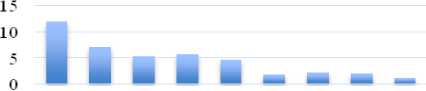

■ Value of North Korea's aid to Vietnam (1965-1973)
Figure: North Korea’s aid status to Vietnam (1965–1973) Unit: Million rubles
Korea’s aid to Vietnam. This can be explained by the fact that, because North Korea’s economy was not as strong as other socialist nations’, North Korea attempted to assist Vietnam in the early stages when the United States expanded the war to encompass both the South and North of Vietnam. The aid status gradually decreased as changes on the battlefield favoured Vietnam. In 1965, the US expeditionary force arrived in Vietnam for the first time, directly engaged in the conflict to strengthen military operations in South Vietnam under the “Local War” plan. At the same time, following the Gulf of Tonkin incident in 1964, the United States deployed its Air Force and Navy to expand the destructive war into the North. The United States intended to use military force to eliminate the liberation army’s rear base in South Vietnam. This caused Vietnam numerous difficulties, not only the confusion in fighting spirit in the early stages, but also difficulty in obtaining weapons for Vietnam’s defense war against the world’s most powerful imperialist. However, the military goals deployed by the United States in the Local War were repeatedly defeated by the fighting power of Vietnam’s main army and local troops. Especially, the Liberation Army’s large-scale attack on the South during Tet in 1968 caused significant losses for the United States and its allies, forcing them to accept a de-escalation of bombing in the South and sit at the negotiating table in Paris to discuss peace for Vietnam and Indochina. Additionally, the Democratic Republic of Vietnam secured significant victory at the Paris negotiating table as well. Furthermore, another factor led the quantity of North Korea’s help to Vietnam to diminish, such as the event that occurred in 1968: “after the event in Seoul (21 January) and the USS Pueblo incident (23 January), we can obviously see a distinct frigid attitude toward Vietnamese diplomats” 20. Additionally, as a result, the two nations’ relation- ship was not as good as it had been before 1968. Those reasons, in the authors’ opinion, caused North Korea to gradually reduce its aid to Vietnam and entirely cease when the Paris Agreement was signed in 1973.
During the years 1965–1973, North Korea’s military support for Vietnam was another significant factor. North Korea’s move did not determine Vietnam’s victory on the battlefield. However, there were obviously some factors that contributed to the Vietnamese side’s increased combat strength. Beginning in 1966, the two parties had discussed, decided upon, and carried out these actions into effect.
According to information in papers published by the Wilson Center Digital Archive, North Korea sent a notification to Vietnam in 1966 (before 21 September 1966), informing them that North Korea would deploy a squad of pilots to fight in Vietnam 21. Prior to that suggestion, on 21 September 1966, the conference headed by Vietnam’s envoy, Vo Nguyen Giap, who spoke on behalf of the Internal Affairs Committee of the Central Military Commission of Vietnam, agreed to accept the idea that North Korea had proposed. Vo Nguyen Giap, however, claims that although North Korean pilots would be referred to as “experts,” they were actually volunteers and required to obey a number of rules established by Vietnam, including the following: they must respect allies, in training and combat, areas of operation must be clearly defined, and Korean regiments would command their own forces based on superiors (Vietnamese leaders) assigning specific tasks 22. On that basis, the two parties signed a legal document for practical implementation according to the agreement.
On 30 September 1966, representatives of Vietnam and North Korea 23 held a meeting. The conversation took place “in an honest and sincere atmosphere, and then an official agreement was signed” on a variety of military cooperation between the two nations in the near future 24. This event occurred as a move by North Korea and Vietnam to respond to the United States’ action to expand the war to North Vietnam. Since the Gulf of Tonkin incident in 1964, the United States employed its Air Force and Navy to bombard and bring war to North Vietnam, sabotaging economic successes and carrying out military operations to destroy North Vietnamese economic strongholds. The primary purpose of the United States was to neutralize military and economic help from North Vietnam to South Vietnam’s liberation forces. If that plan was successful, they (the United States) will certainly weaken the fighting strength of the liberation army of South Vietnam. Based on the weakness of the liberation army in the South, the United States, in collaboration with the Republic of Vietnam army, would proceed to eliminate the liberation army in South Vietnam, aiming for a decisive military triumph while also controlling the diplomatic front.
In the agreement dated 30 September 1966, the parties (including Vietnam and North Korea) agreed on six articles, of which point (1) stipulated that: “At the end of October or in November 1966, North Korea will send to Vietnam enough experts to provide Vietnam with a MiG-17 compa- ny 25. Once Vietnam has prepared enough aircraft, North Korea will dispatch enough specialists to Vietnam by the end of 1966 or the beginning of 1967 in order to help Vietnam establish a second MiG-17 company. In 1967, after North Korea has prepared experts and Vietnam has prepared enough aircraft, North Korea will send enough experts to Vietnam to establish a MiG-21 company for Vietnam” 26. Point (6) has an agreement that stipulates: “North Korea will provide basic technical and tactical training for North Korean experts. After they arrive in Vietnam, they will only get on-site training to adjust to battlefield circumstances, weather, and opponents”. Furthermore, the other four points (2), (3), (4), and (5) of the agreement establish a number of principles governing the operations of North Korean pilots fighting in Vietnam. In addition, the Protocol also includes agreements on the provision of housing, living supplies, transportation, medical support, policy regulations (death, disability, illness, and discipline), as well as matters such as the reward policy for North Korean pilots fighting in North Vietnam 27. According to the terms of the agreement reached by both parties in 1966 and 1967, North Korea would equip Vietnam with three companies of fighter aircraft, comprising two Mig-17 and one Mig-21 (equal to 30 aircraft), as well as adequate specialists for those three companies. According to several documents, North Korea dispatched roughly 100 pilots to Vietnam between 1966 and 1968, and 14 individuals were killed in conflicts with the US air force 28. There is still a memorial space that exists today as evidence of this 29. Furthermore, in 1966, North Korea gave the Vietnamese army non-refundable supplies of small guns, ammunition, clothes, tractors, and trucks to aid them in their conflict with the US military on the Vietnam battlefield 30.
Although the quantity of planes and pilots was not large for the war in Vietnam at that time, it had an extremely important meaning for Vietnam. Because, since 1964, North Vietnam has fought one of the world’s greatest air forces. To fulfill its aims in the plan to expand the war to the north, the United States sent many advanced aircraft into Vietnam to participate in the conflict. Aside from sophisticated aircrafts at the time, the United States sent in B52 bombers. The modernity of the US air force had caused many difficulties for Vietnam. Therefore, in that confrontation, Vietnam depended substantially on aid from socialist nations such as North Korea, the Soviet Union, and China for military equipment.
Furthermore, North Korea also dispatched people to participate in South Korea’s military tactical research activities, with the intention of confronting South Korean soldiers participating in the war as an ally of the United States in South Vietnam. “They operate in areas where the South Korean army is operating to study combat tactics and combat readiness techniques with the South Korean Army as well as use propaganda measures against South Koreans” 31. These activities were, of course, coordinated with the North Korean authorities in Hanoi. Document No. 76247, dated June 1967, states that in order to achieve the above goals (against the South Koreans in South Vietnam), North Korea also planned to “send more people into South Vietnam. But they have language diffi- culties because they cannot speak Vietnamese.” 32 This demonstrates the wide range of ways in which North Korea supports Vietnam militarily, including by providing equipment and human resources.
North Korea’s aid activities to Vietnam took place continuously from 1965 to 1973. The attitude of North Korea’s leaders demonstrated a strong and unwavering mentality. In the mindset of being prepared to support Vietnam, since the North Korean leader saw the US invasion of Vietnam as an invasion of North Korea as well. It also began with the belief that the result of the Vietnam War would directly affect both the South Korean anti-imperialist movement and the global revolutionary movement. For this reason, between 1965 and 1973, North Korea gladly offered all help to Vietnam, including the economy, equipment, and experts, to assist Vietnam in its fighting against the United States and its allies.
The aid situation was intimately related to the evolution of the military conflict between Vietnam and the United States. With documents found concerning North Korea’s aid to Vietnam the authors believe that North Korea’s diplomatic efforts were directly related to the events in Vietnam’s conflict against the United States. In 1965, the United States began to increase the scale of the war in South Vietnam by sending expeditionary troops to directly participate in the war in Vietnam under President Johnson’s “local war” plan. The goal of this action was to crush the South Vietnamese liberation force, according to the United States and its allies. Simultaneously, to limit the combat strength of the liberation forces of South Vietnam, the US employed the Air Force and Navy to extend the conflict to the North in order to undermine the South Vietnamese liberation army’s military and economic basis there. As a result, in 1965, the year North Korea provided the most aid to Vietnam with 12 million rubles, the situation gradually decreased and decreased sharply in 1968, the year the “local war” was declared to have failed. Following the Tet Offensive of the South Vietnamese Liberation Army, the United States was forced to agree to meet with Vietnam in Paris to negotiate an end to the war. From 1969 to 1973, North Korea’s aid situation continued, but at low levels, and ended completely in 1973, which was also the year the two sides reached an agreement on the provisions and signed the Paris Agreement.
In terms of international relations assessment, the authors believe that the Vietnam War issue was an event that drew international attention. More broadly, it can be seen as a battlefield demonstrating the race of the bipolar world that existed after the Ianta conference in 1945. In addition to communist states like the Soviet Union, China attempted to aid in the war in order to demonstrate its role towards allies and simultaneously provide a chance for other nations to establish their influence. Small and medium-sized nations, like North Korea, were no exception, participating in the Vietnam War as socialist allies. Not only did North Korea wish to support the “international proletarian movement” in its spirit, but it also wanted to play a certain part in the community of socialist nations. Especially during this period, North Korean diplomacy was largely dominated by China. Thus, the Vietnam War provided an excellent chance for North Korea to demonstrate an independent diplomatic posture on an issue of international concern. As a result, in addition to sending aid to Vietnam, North Korea also desired to participate in coordinating aid to Vietnam from communist countries. And asserting that socialist nations were responsible for helping Vietnam since the results of Vietnam’s confrontation would have an impact on the world ’s revolutionary movement on the united anti-imperialist front of the existing socialist pole.
The battle against the US invasion of Vietnam from 1954 to 1975 was consistently received with overwhelmingly supportive support from the global community, particularly socialist nations. Vietnam’s victory against America came from a variety of reasons. The fundamental cause of victory was the Vietnamese army’s and people’s great combat ability, which was led correctly by the Vietnam Labor Party. Furthermore, Vietnam also received enthusiastic material and spiritual support from other countries, which encouraged Vietnam’s fighting spirit and strengthened Vietnam’s fight.
Between 1965 and 1973, Vietnam received 41.8 million rubles, 30 fighter aircraft, over 100 pilots, and a variety of additional assistance packages from North Korea. This not only strengthened Vietnam’s combat capacity but also bolstered the country’s battle spirit, assisting Vietnam in reducing budgetary difficulties and military equipment in order to be able to defeat the United States, whose army had the most powerful fighting force in the world. Thus, North Korea, along with other socialist nations, has enthusiastically offered aid to help the Vietnamese army enhance its fighting capacity in order to achieve a final victory, laying the groundwork for Vietnam’s reunification in 1975.
The spirit of wholeheartedly supporting Vietnam came not only materially and spiritually but also by sending experts to directly participate in fighting in the skies of Northern Vietnam. In 1965, when the United States escalated the conflict in the South and expanded it to North Vietnam, North Korea began giving non-refundable aid to Vietnam to help enhance combat power in the battle against the US military and its allies. From 1965 to 1973, North Korea gave Vietnam 41.8 million rubles, 30 fighter aircraft, and over 100 pilots who personally participated in the conflict in North Vietnam to fight with the Vietnamese Air Force against the US Air Force. In order to carry out this action, North Korea first supported the socialist camp and its allies in the spirit of communist internationalism. In addition, North Korea hoped to use this action to demonstrate to Vietnam that it was a part of the socialist bloc and the anti-imperialist struggle that the socialist camp had been fighting since World War II. These diplomatic activities of North Korea not only contributed to encouraging the fighting spirit of the Vietnamese army and people during the Resistance War against the United States that took place from 1954 to 1975, but at the same time, those actions also served as a significant milestone for the two countries to maintain and strengthen traditional diplomatic relations in the complex context of current Asian geopolitics.
