
Принципы, технологии и устройства "капельной" микрофлюидики. Ч. 2 (обзор)
Журнал: Научное приборостроение @nauchnoe-priborostroenie
Рубрика: Приборостроение физико-химической биологии
Статья в выпуске: 3 т.25, 2015 года.
Бесплатный доступ
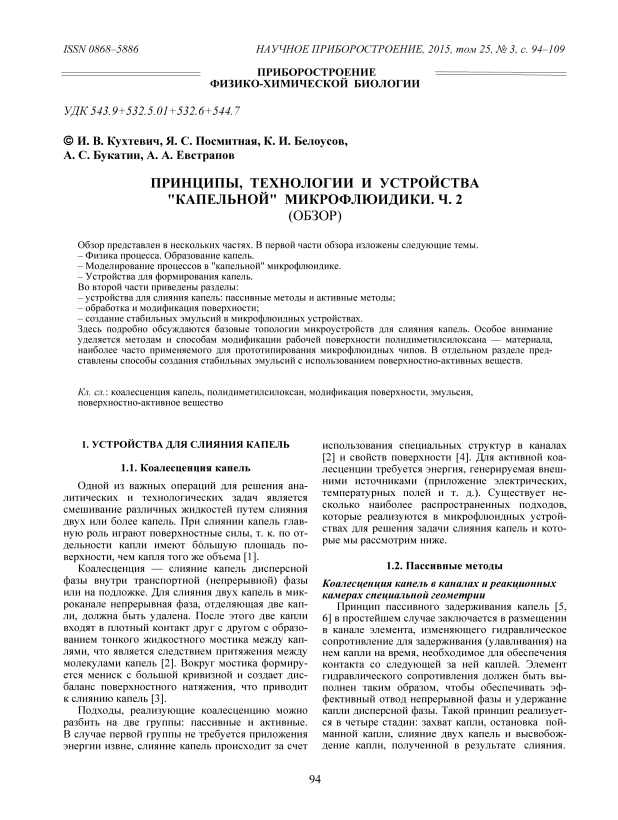
Обзор представлен в нескольких частях. В первой части обзора изложены следующие темы. - Физика процесса. Образование капель. - Моделирование процессов в "капельной" микрофлюидике. - Устройства для формирования капель. Во второй части приведены разделы: - устройства для слияния капель: пассивные методы и активные методы; - обработка и модификация поверхности; - создание стабильных эмульсий в микрофлюидных устройствах. Здесь подробно обсуждаются базовые топологии микроустройств для слияния капель. Особое внимание уделяется методам и способам модификации рабочей поверхности полидиметилсилоксана - материала, наиболее часто применяемого для прототипирования микрофлюидных чипов. В отдельном разделе представлены способы создания стабильных эмульсий с использованием поверхностно-активных веществ.
Похожие статьи в разделе Аналитическая химия
Короткий адрес: https://sciup.org/14264992
IDS: 14264992 | УДК: 543.9+532.5.01+532.6+544.7
Principles, technologies and droplet-based microfluidic devices. Part 2 (review)
The active and passive methods and the devices for coalescence of the droplets are considered in the second part of the review. Particular attention is paid to the methods of processing and surface modification of polydimethylsiloxane (the most frequently used material in microfluidics) in order to create the conditions for the stable droplet generation. Depending on the type of the emulsion (water drops in oil transport flow or vice versa) the surface should be hydrophilic or hydrophobic. The surface with the different wetting properties on the various local sections is required at generation of double emulsions. A single part describes the methods of stabilizing the emulsions. Usually the surfactants used for the droplets stabilizing. The surfactant reduces the surface tension between the two fluids through the formation of the oriented film at their interface. However, the choice of an appropriate surfactant should be carefully carried out, since these substances can affect on the components of sample and biomolecules.
Список литературы Принципы, технологии и устройства "капельной" микрофлюидики. Ч. 2 (обзор)
- Riegler H., Lazar P. Delayed coalescence behavior of droplets with completely miscible liquids//Langmuir. 2008. Vol. 24, no. 13. P. 6395-6398 DOI: 10.1021/la800630w
- Tan Y.C. et al. Design of microfluidic channel geometries for the control of droplet volume, chemical concentration, and sorting//Lab on a Chip. 2004. Vol. 4, no. 4. P. 292-298 DOI: 10.1039/b403280m
- Eggers J., Lister J.R., Stone H.A. Coalescence of liquid drops//Journal of Fluid Mechanics. 1999. Vol. 401. P. 293-310 DOI: 10.1017/S002211209900662X
- Wilhelm T.S. et al. Surface-induced droplet fusion in microfluidic devices//Lab on a Chip. 2007. Vol. 7, no. 8. P. 984-986 DOI: 10.1039/b708091c
- Köhler J.M. et al. Digital reaction technology by micro segmented flow -components, concepts and applications//Chemical Engineering Journal. 2004. Vol. 101, no. 1. P. 201-216 DOI: 10.1016/j.cej.2003.11.025
- Chokkalingam V. et al. Optimized droplet-based microfluidics scheme for sol-gel reactions//Lab on a Chip. 2010. Vol. 10, no. 13. P. 1700-1705 DOI: 10.1039/b926976b
- Bremond N., Thiam A.R., Bibette J. Decompressing emulsion droplets favors coalescence//Physical review letters. 2008. Vol. 100, no. 2. P. 024501 DOI: 10.1103/PhysRevLett.100.024501
- Hung L.H. et al. Alternating droplet generation and controlled dynamic droplet fusion in microfluidic device for CdS nanoparticle synthesis//Lab on a Chip. 2006. Vol. 6, no. 2. P. 174-178 DOI: 10.1039/b513908b
- Niu X. et al. Pillar-induced droplet merging in microfluidic circuits//Lab on a Chip. 2008. Vol. 8, no. 11. P. 1837-1841 DOI: 10.1039/b813325e
- Chabert M., Dorfman K.D., Viovy J.L. Droplet fusion by alternating current (AC) field electrocoalescence in microchannels//Electrophoresis. 2005. Vol. 26, no. 19. P. 3706-3715 DOI: 10.1002/elps.200500109
- Link D.R. et al. Electric control of droplets in microfluidic devices//Angewandte Chemie International Edition. 2006. Vol. 45, no. 16. P. 2556-2560 DOI: 10.1002/anie.200503540
- Niu X. et al. Electro-coalescence of digitally controlled droplets//Analytical chemistry. 2009. Vol. 81, no. 17. P. 7321-7325 DOI: 10.1021/ac901188n
- Zagnoni M., Baroud C.N., Cooper J.M. Electrically initiated upstream coalescence cascade of droplets in a microfluidic flow//Physical Review E. 2009. Vol. 80, no. 4. P. 046303 DOI: 10.1103/PhysRevE.80.046303
- Schwartz J.A., Vykoukal J.V., Gascoyne P.R.C. Droplet-based chemistry on a programmable micro-chip//Lab on a Chip. 2004. Vol. 4, no. 1. P. 11-17 DOI: 10.1039/b310285h
- Singh P., Aubry N. Transport and deformation of droplets in a microdevice using diElectrophoresis//Electrophoresis. 2007. Vol. 28, no. 4. P. 644-657 DOI: 10.1002/elps.200600549
- Wang W., Yang C., Li C.M. On-demand microfluidic droplet trapping and fusion for on-chip static droplet assays//Lab on a Chip. 2009. Vol. 9, no. 11. P. 1504-1506 DOI: 10.1039/b903468d
- Baroud C.N., de Saint Vincent M.R., Delville J.P. An optical toolbox for total control of droplet microfluidics//Lab on a Chip. 2007. Vol. 7, no. 8. P. 1029-1033 DOI: 10.1039/b702472j
- Lorenz R.M. et al. Vortex-trap-induced fusion of femtoliter-volume aqueous droplets//Analytical chemistry. 2007. Vol. 79, no. 1. P. 224-228 DOI: 10.1021/ac061586w
- Lin B.C., Su Y.C. On-demand liquid-in-liquid droplet metering and fusion utilizing pneumatically actuated membrane valves//Journal of Micromechanics and Microengineering. 2008. Vol. 18, no. 11. P. 115005 DOI: 10.1088/0960-1317/18/11/115005
- Fischer A.E. et al. A high-throughput drop microfluidic system for virus culture and analysis//Journal of virological methods. 2015. Vol. 213. P. 111-117 DOI: 10.1016/j.jviromet.2014.12.003
- Jing Yan et al. Monodisperse water-in-oil-in-water (W/O/W) double emulsion droplets as uniform compartments for high-throughput analysis via flow cytometry//Micromachines. 2013. Vol. 4. P. 402-413, DOI: 10.3390/mi4040402
- Bauer W.A.C. et al. Hydrophilic PDMS microchannels for high-throughput formation of oil-in-water microdroplets and water-in-oil-in-water double emulsions//Lab on a Chip. 2010. Vol. 10, no. 14. P. 1814-1819 DOI: 10.1039/c004046k
- Mazutis L. et al. Single-cell analysis and sorting using droplet-based microfluidics//Nature protocols. 2013. Vol. 8, no. 5. P. 870-891 DOI: 10.1038/nprot.2013.046
- Barbier V. et al. Stable modification of PDMS surface properties by plasma polymerization: application to the formation of double emulsions in microfluidic systems//Langmuir. 2006. Vol. 22, no. 12. P. 5230-5232 DOI: 10.1021/la053289c
- Liao C.Y., Su Y.C. Formation of biodegradable microcapsules utilizing 3D, selectively surface-modified PDMS microfluidic devices//Biomedical microdevices. 2010. Vol. 12, no. 1. P. 125-133 DOI: 10.1007/s10544-009-9367-8
- Shah R.K. et al. Designer emulsions using microfluidics//Materials Today. 2008. Vol. 11, no. 4. P. 18-27 DOI: 10.1016/S1369-7021(08)70053-1
- Seo M. et al. Microfluidic consecutive flow-focusing droplet generators//Soft Matter. 2007. Vol. 3, no. 8. P. 986-992 DOI: 10.1039/b700687j
- Romanowsky M.B. et al. Functional patterning of PDMS microfluidic devices using integrated chemo-masks//Lab on a Chip. 2010. Vol. 10, no. 12. P. 1521-1524 DOI: 10.1039/c004050a
- Demming S. et al. Characterization of long-term stability of hydrophilized PEG-grafted PDMS within different media for biotechnological and pharmaceutical applications//Physica status solidi (a). 2011. Vol. 208, no. 6. P. 1301-1307 DOI: 10.1002/pssa.201000967
- Zdyrko B., Klep V., Luzinov I. Universal platform for modification employing grafted polymer layers//Material Matters. 2008. Vol. 3, no. 2. P. 44-46.
- Hwang S., Choi C.H., Lee C.S. Regioselective surface modification of PDMS microfluidic device for the generation of monodisperse double emulsions//Macromolecular Research. 2012. Vol. 20, no. 4. P. 422-428 DOI: 10.1007/s13233-012-0048-8
- Abate A.R., Weitz D.A. High-order multiple emulsions formed in poly (dimethylsiloxane) microfluidics//Small. 2009. Vol. 5, no. 18. P. 2030-2032 DOI: 10.1002/smll.200900569
- Kim B.Y. et al. Solvent-resistant PDMS microfluidic devices with hybrid inorganic/organic polymer coatings//Advanced Functional Materials. 2009. Vol. 19, no. 23. P. 3796-3803 DOI: 10.1002/adfm.200901024
- Abate A.R. et al. Patterning microfluidic device wettability using flow confinement//Lab on a Chip. 2010. Vol. 10, no. 14. P. 1774-1776 DOI: 10.1039/c004124f
- Abate A.R. et al. Photoreactive coating for high-contrast spatial patterning of microfluidic device wettability//Lab on a Chip. 2008. Vol. 8, no. 12. P. 2157-2160 DOI: 10.1039/b813405g
- Bibette J. et al. Stability criteria for emulsions//Physical Review Letters. 1992. Vol. 69, no. 16. P. 2439-2442 DOI: 10.1103/PhysRevLett.69.2439
- Amarouchene Y., Cristobal G., Kellay H. Noncoalescing drops//Physical Review Letters. 2001. Vol. 87, no. 20. P. 206104 DOI: 10.1103/PhysRevLett.87.206104
- Schramm L.L. Emulsions, Foams, and Suspensions: Fundamentals and Applications. Wiley-VCH, Weinheim, Germany, 2005. 463 p DOI: 10.1002/3527606750
- Landfester K. Recent developments in miniemulsions -formation and stability mechanisms//Macromolecular Symposia. 2000. Vol. 150, no. 1. P. 171-178. doi: 10.1002/1521-3900(200002)150:13.0.CO;2-D.
- Goodwin G.W. Colloids and interfaces with surfactants and polymers. An Introduction. John Wiley & Sons Ltd., 2004. 289 p DOI: 10.1002/0470093919
- Griffin W.C. Hydrophilic-lipophilic balance//J. Soc. Cosmet. Chem. 1949. Vol. 1. P. 311-326.
- Baret J.C. Surfactants in droplet-based microfluidics//Lab on a Chip. 2012. Vol. 12, no. 3. P. 422-433 DOI: 10.1039/C1LC20582J
- Zhang R., Somasundaran P. Advances in adsorption of surfactants and their mixtures at solid/solution interfaces//Advances in colloid and interface science. 2006. Vol. 123. P. 213-229 DOI: 10.1016/j.cis.2006.07.004
- Joensson H.N., Andersson Svahn H. Droplet microfluidics -a tool for single-cell analysis//Angewandte Chemie International Edition. 2012. Vol. 51, no. 49. P. 12176-12192 DOI: 10.1002/anie.201200460
- Link D.R. et al. Geometrically mediated breakup of drops in microfluidic devices//Physical Review Letters. 2004. Vol. 92, no. 5. P. 054503 DOI: 10.1103/PhysRevLett.92.054503
- Schaerli Y. et al. Continuous-flow polymerase chain reaction of single-copy DNA in microfluidic microdroplets//Analytical chemistry. 2008. Vol. 81, no. 1. P. 302-306 DOI: 10.1021/ac802038c
- Courtois F. et al. An integrated device for monitoring time-dependent in vitro expression from single genes in picolitre droplets//ChemBioChem. 2008. Vol. 9, no. 3. P. 439-446 DOI: 10.1002/cbic.200700536
- Hatch A.C. et al. 1-Million droplet array with wide-field fluorescence imaging for digital PCR//Lab on a Chip. 2011. Vol. 11, no. 22. P. 3838-3845 DOI: 10.1039/c1lc20561g
- Huebner A.M. et al. Monitoring a reaction at submillisecond resolution in picoliter volumes//Analytical chemistry. 2011. Vol. 83, no. 4. P. 1462-1468 DOI: 10.1021/ac103234a
- Bremond N., Doméjean H., Bibette J. Propagation of drop coalescence in a two-dimensional emulsion: A route towards phase inversion//Physical review letters. 2011. Vol. 106, no. 21. P. 214502 DOI: 10.1103/PhysRevLett.106.214502
- Saint-Jaimes A., Zemb T., Langevin D. Trends in Colloid and Interface Science XV. Springer, Berlin, Heidelberg, 2001. 299 p.
- URL: (http://www.surfachem.com/abil-em180).
- Song H., Tice J.D., Ismagilov R.F. A microfluidic system for controlling reaction networks in time//Angewandte Chemie. 2003. Vol. 115, no. 7. P. 792-796 DOI: 10.1002/ange.200390172
- Niu X., de Mello A.J. Building droplet-based microfluidic systems for biological analysis//Biochemical Society Transactions. 2012. Vol. 40, no. 4. P. 615-623 DOI: 10.1042/BST20120005
- Basova E.Y., Foret F. Droplet microfluidics in (bio) chemical analysis//Analyst. 2014. Vol. 140, no. 1. P. 22-38 DOI: 10.1039/C4AN01209G
- Zheng B., Roach L.S., Ismagilov R.F. Screening of protein crystallization conditions on a microfluidic chip using nanoliter-size droplets//Journal of the American Chemical Society. 2003. Vol. 125, no. 37. P. 11170-11171 DOI: 10.1021/ja037166v
- URL: (http://www.ranbiotechnologies.com/).
- Chen C.H. et al. Enhancing protease activity assay in droplet-based microfluidics using a biomolecule concentrator//Journal of the American Chemical Society. 2011. Vol. 133, no. 27. P. 10368-10371 DOI: 10.1021/ja2036628
- Courtois F. et al. Controlling the retention of small molecules in emulsion microdroplets for use in cell-based assays//Analytical chemistry. 2009. Vol. 81, no. 8. P. 3008-3016 DOI: 10.1021/ac802658n
- Woronoff G. et al. New generation of amino coumarin methyl sulfonate-based fluorogenic substrates for amidase assays in droplet-based microfluidic applications//Analytical chemistry. 2011. Vol. 83, no. 8. P. 2852-2857 DOI: 10.1021/ac200373n
- Roach L.S., Song H., Ismagilov R.F. Controlling nonspecific protein adsorption in a plug-based microfluidic system by controlling interfacial chemistry using fluorous-phase surfactants//Analytical chemistry. 2005. Vol. 77, no. 3. P. 785-796 DOI: 10.1021/ac049061w
- Holtze C. et al. Biocompatible surfactants for water-in-fluorocarbon emulsions//Lab on a Chip. 2008. Vol. 8, no. 10. P. 1632-1639 DOI: 10.1039/b806706f
- Derkach S.R. Rheology of emulsions//Advances in Colloid and Interface Science. 2009. Vol. 151, no. 1. P. 1-23 DOI: 10.1016/j.cis.2009.07.001
- Brouzes E. et al. Droplet microfluidic technology for single-cell high-throughput screening//Proceedings of the National Academy of Sciences. 2009. Vol. 106, no. 34. P. 14195-14200 DOI: 10.1073/pnas.0903542106
