
Proof-of-resource Enabled 6G Resource Management Using Quaternion-attentive Cascaded Capsule Networks
Journal: International Journal of Computer Network and Information Security @ijcnis
Article in issue: 1 vol.18, 2026.
Free access
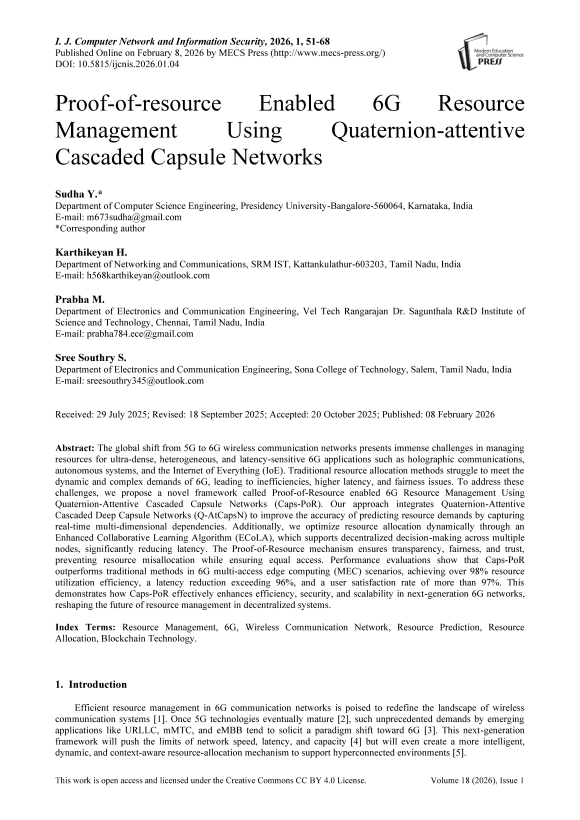
The global shift from 5G to 6G wireless communication networks presents immense challenges in managing resources for ultra-dense, heterogeneous, and latency-sensitive 6G applications such as holographic communications, autonomous systems, and the Internet of Everything (IoE). Traditional resource allocation methods struggle to meet the dynamic and complex demands of 6G, leading to inefficiencies, higher latency, and fairness issues. To address these challenges, we propose a novel framework called Proof-of-Resource enabled 6G Resource Management Using Quaternion-Attentive Cascaded Capsule Networks (Caps-PoR). Our approach integrates Quaternion-Attentive Cascaded Deep Capsule Networks (Q-AtCapsN) to improve the accuracy of predicting resource demands by capturing real-time multi-dimensional dependencies. Additionally, we optimize resource allocation dynamically through an Enhanced Collaborative Learning Algorithm (ECoLA), which supports decentralized decision-making across multiple nodes, significantly reducing latency. The Proof-of-Resource mechanism ensures transparency, fairness, and trust, preventing resource misallocation while ensuring equal access. Performance evaluations show that Caps-PoR outperforms traditional methods in 6G multi-access edge computing (MEC) scenarios, achieving over 98% resource utilization efficiency, a latency reduction exceeding 96%, and a user satisfaction rate of more than 97%. This demonstrates how Caps-PoR effectively enhances efficiency, security, and scalability in next-generation 6G networks, reshaping the future of resource management in decentralized systems.
Similar articles in the section Electrical engineering

Short address: https://sciup.org/15020175
IDS: 15020175 | DOI: 10.5815/ijcnis.2026.01.04
