
Психиатрия, наследственность и душевная болезнь: практики маргинализации "опасных" индивидов в Москве на рубеже XIX и XX веков
Журнал: Вестник Пермского университета. История @histvestnik
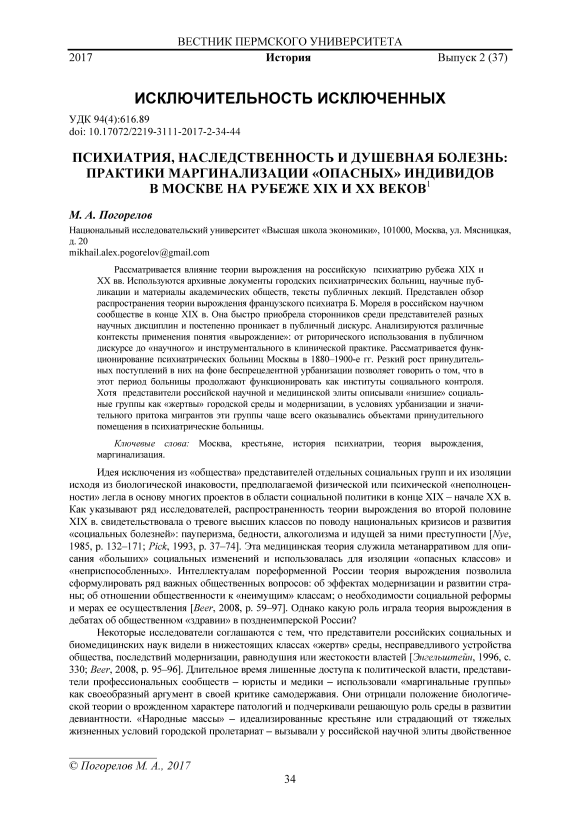
Рубрика: Исключительность исключенных
Статья в выпуске: 2 (37), 2017 года.
Бесплатный доступ
Рассматривается влияние теории вырождения на российскую психиатрию рубежа XIX и XX вв. Используются архивные документы городских психиатрических больниц, научные публикации и материалы академических обществ, тексты публичных лекций. Представлен обзор распространения теории вырождения французского психиатра Б. Мореля в российском научном сообществе в конце XIX в. Она быстро приобрела сторонников среди представителей разных научных дисциплин и постепенно проникает в публичный дискурс. Анализируются различные контексты применения понятия «вырождение»: от риторического использования в публичном дискурсе до «научного» и инструментального в клинической практике. Рассматривается функционирование психиатрических больниц Москвы в 1880-1900-е гг. Резкий рост принудительных поступлений в них на фоне беспрецедентной урбанизации позволяет говорить о том, что в этот период больницы продолжают функционировать как институты социального контроля. Хотя представители российской научной и медицинской элиты описывали «низшие» социальные группы как «жертвы» городской среды и модернизации, в условиях урбанизации и значительного притока мигрантов эти группы чаще всего оказывались объектами принудительного помещения в психиатрические больницы.
Похожие статьи в разделе Всеобщая история
Короткий адрес: https://sciup.org/147203798
IDS: 147203798 | УДК: 94(4):616.89 | DOI: 10.17072/2219-3111-2017-2-34-44
Psychiatry, hereditarianism and mental illness: the politics of "socially dangerous" exclusion in late imperial Moscow
The paper considers how Russian psychiatry, both institutionally and conceptually, marginalized certain social groups with the degeneration concept. The degeneration theory and biomedical discourse in late Imperial Russia were extensively studied by cultural and conceptual historians. Still, there is a lack of studies on human sciences' influence on the social policy in post-reform era. At the turn of the 20th century, Moscow became an urban giant: one of the most populated cities in the Empire, yet the most "peasant" metropolis in Europe. At the same time, Moscow was a center of public and academic life, where the new elite of scientists, professionals and reformers tried to modernize the city and provide it with efficient medical care and infrastructure. In the era of explosive urban growth and influx of migrants in Moscow, degeneration theory supplied clinicians with particular narrative structure, argumentative base and conceptual framework for the description of changes and "damaged" individuals. Psychiatrists emphasized potentially decisive role of the environment. In their view, the urban milieu, its extreme conditions and demands exceeded normal human abilities, leading to mental disorder. While they consider lower urban classes (peasants and factory workers) as victims of deleterious urban environment and consequences of modernizations, those social groups most commonly were subjected of coercive placement and treatment in psychiatric institutions. The research is based on archives of city hospitals and municipal government's files, scientific texts, and periodicals.
Список литературы Психиатрия, наследственность и душевная болезнь: практики маргинализации "опасных" индивидов в Москве на рубеже XIX и XX веков
- Мартин А. Просвещенный метрополии созидание имперской Москвы, 1762-1855. М.: Новое лит. обозрение, 2015. 448 с
- Могильнер М. Homi imperii: Очерки истории физической антропологии в России. М.: Новое лит. обозрение, 2008. 512 с
- Писарькова Л.Ф. Городские реформы в России и Московская дума. М.: Новый хронограф, 2010. 735 с
- Сироткина И. Психопатология и политика: становление идей и практики психогигиены в России//Вопросы истории естествознания и техники. 2000. №1. С. 154-177
- Энгельшейн Л. Ключи счастья: секс и поиски путей обновления России на рубеже веков. М.: Терра, 1996. 572 с
- Юдин Т. Очерки истории отечественной психиатрии. М.: Медгиз, 1951. 481 с
- Яровинский М.Я. Здравоохранение Москвы (1581-2000 гг.). М.: Медицина, 1988. 270 с
- Beer D. Renovating Russia: the Human Sciences and the Fate of liberal modernity. Ithaca: Cornell university press, 2008.229 р
- Brown J. V. Peasant Survival Strategies in Late Imperial Russia: the Social Uses of the Mental Hospitals//Social problems. 1987. №34. P. 311-329
- Brown J. V. The Professionalization of Russian Psychiatry: 1857-1911: Phil. Diss. University of Pennsylvania, 1981.431 р
- Frieden N.M. Russian Physicians in an Era of Reform and Revolution, 1856-1905. Princeton: Princeton university press, 1981. 398 p
- Friedlander J.L. Psychiatrists and crisis in Russia, 1880-1917: Phil. Diss. University of California, 2007. 451 p
- Harris R. Murders and Madness: Medicine, Law, and Society in the Fin de Siecle. Oxford: Clarendon press, 1989. 366 p
- Mazanik A. The City as a transient home: residential patterns of Moscow workers around the turn of the twentieth century//Urban History. 2013. Vol. 40. P. 51-70
- McReynolds L. Murder most Russian: true crime and punishment in late imperial Russia. Ithaca: Cornell university press, 2013. 274 p
- Todes D. Darwin without Malthus: the struggle for existence in Russian evolutionary thought. Oxford: Oxford university press, 1989. 221 p
- Nye R. The bio-medical origins of urban sociology//lournal of Contemporary History. 1985. Vol. 20, No. 4. P. 659-675
- Nye R. Crime, madness and politics in modern France: the medical concept of national decline. Princeton: Princeton university press, 1984. 367 p
- Pick D. Faces of degeneration: A European disorder, c. 1848-1918. Cambridge: Cambridge university press, 1993.288 р
- Wetzell R Inventing the criminal: a history of German criminology. Chapel Hill: University of North Carolina press, 2001. 368 p
