
Racionalnost aktera na finansijskim tržištima
Journal: Ekonomski signali @esignali
Article in issue: 2 vol.7, 2012.
Free access
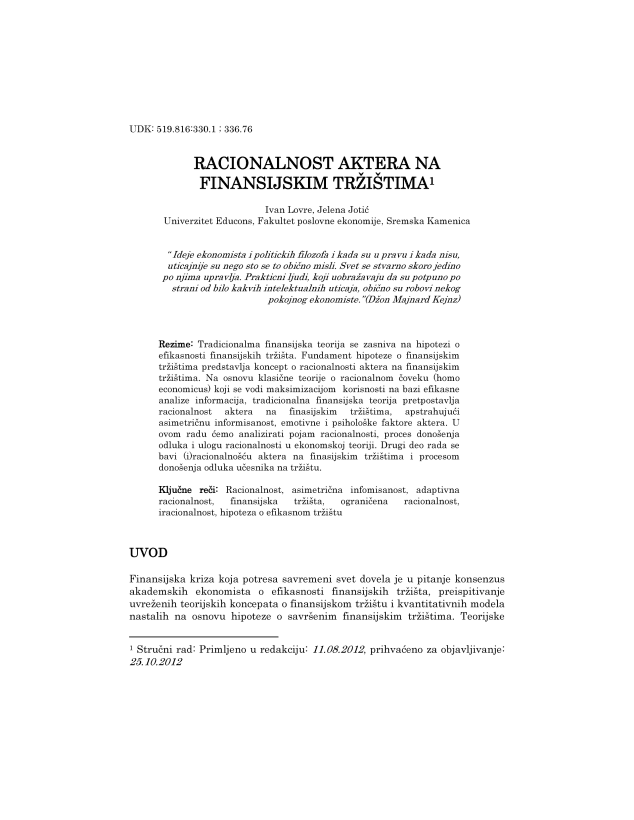
Tradicionalma finansijska teorija se zasniva na hipotezi o efikasnosti finansijskih tržišta. Fundament hipoteze o finansijskim tržištima predstavlja koncept o racionalnosti aktera na finansijskim tržištima. Na osnovu klasične teorije o racionalnom čoveku (homo economicus) koji se vodi maksimizacijom korisnosti na bazi efikasne analize informacija, tradicionalna finansijska teorija pretpostavlja racionalnost aktera na finasijskim tržištima, apstrahujući asimetričnu informisanost, emotivne i psihološke faktore aktera. U ovom radu ćemo analizirati pojam racionalnosti, proces donošenja odluka i ulogu racionalnosti u ekonomskoj teoriji. Drugi deo rada se bavi (i)racionalnošću aktera na finasijskim tržištima i procesom donošenja odluka učesnika na tržištu.
Similar articles in the section Operational research (OR): mathematical theories and methods

Short address: https://sciup.org/170204212
IDS: 170204212 | UDC: 519.816:330.1; 336.76
The rationality of actors in the financial markets
Traditional financial theory is based on the hypothesis of efficiency of financial markets. Fundament hypothesis on financial markets holds the concept of rational actors in the financial markets. Based on classical theory of rational man (homo economicus), which leads to a maximization of the utility based on the effective analysis of information, the traditional financial theory assuming rational actors in financial markets, abstracting asymmetric information, emotional and psychological factors of actors. In this paper we analyze the term rationality and its role in economic theory. The second part deals with (i) rationality of actors in financial markets and decision-making of market participants.
References Racionalnost aktera na finansijskim tržištima
- Auman, R., ; “Rationality and Bounded Rationality”, Games and Economic Behavior 21, The Hebrew university of Jerusalem, Jerusalem, 1997.
- Bebczuk, R., :“Asymmetric Information in financial Markets”, Cambidge University Press, Cambridge, 2003.
- Dželetović, M., : “Finansijska tržišta”, 2006.
- Levine D. P., : “ Economic Studies: Contributions to the Critique of EconomicTheory. ” Routledge&Kegan Paul, London, 1977.
- Lakić, S., Živković A., : “Validnost kvantitativnih modela u finansijskoj industriji u kontekstu finansijske krize”, Montegrin journal of economics, No 12, Vol. 6., Ekonomska laboratorija za istraživanje tranzicije , Podgorica, 2010.
- Miskhin, S., Stanley, E., : “Finansijska tržišta i institucije”, Mate d.o.o., Zagreb, 2005.
- Schinckus, C.,: “The importance of Communicative Rationality on Financial Markets”, Journal of Economic and Social research 12, University of Quebec, Montreal, 2010.
- Stupar, M., “Racionalnost i demokratija”, Treći program radio Beograda, br. 139-140, vol. III-IV/2008, Beograd, 2008.
- Szenverg, M., Ramrattan, L., : “New frontiers in Economics”, Cambridge University Press, Cambridge, 2004.
- Šoškić, D., : “Hartije od vrednosti: upravljanje portfoliom i investicioni fondovi”, Centar za izdavačku delatnost Ekonomskog Fakulteta u Beogradu, Beograd, 2007.
- Todorović, M., : “Psihologija i finansijski menadžment”, Ekonomika preduzeća, Ekonomski fakultet u Beogradu, Beograd, 2011.
- Tseng, K., C., : “Behavioral finance, Bounded rationality, Neuro-finance, and traditional finance”, Investment Management and Financial Innovations, Vol 3., 2006.
- Winston G. C. : “ Three problems with the treatment of time in economics: perspectives, repetitiveness, and time units”, u Winston Gordon C., Teichgraeber Richard F., The boundaries of economics, Cambridge University Press, Cambridge, 1988.
